Capacity vs Utilization for Better Resource Planning
- What is Resource Capacity?
- What is Resource Utilization in Project Management?
- Key Benefits of Resource Capacity in Projects
- 5 Benefits of Resource Utilization in Projects
- Resource Capacity and Utilization in Project Management: Key Differences
- Actionable Strategies to Optimize Resource Capacity and Utilization
- Resource capacity vs utilization: Where Clarity Meets Execution
- FAQs about Resource Capacity vs Utilization

Key Highlights:
- Resource capacity defines how much work your team can handle, while utilization shows how effectively that capacity gets used.
- Balanced capacity and utilization prevent burnout, reduce idle time, while improving overall project efficiency across professional services teams.
- Tracking both metrics helps align staffing, budgets and timelines with industry benchmarks for stronger delivery.
You’re constantly juggling project deadlines but can’t figure out why your team feels overwhelmed while some members seem underused. The numbers don’t add up and you’re making decisions blind without understanding where the real bottlenecks live in your workflow.
Every time you accept a new project you’re gambling on whether your team can actually deliver it on time. You’re either turning down good opportunities because you think you’re maxed out or overcommitting and watching quality suffer as deadlines slip past.
Understanding the distinction between resource capacity vs utilization gives you the clarity to plan confidently and execute efficiently. Let’s break down what each metric means as well as how using both together transforms your project management from guesswork into strategic decision-making.
What is Resource Capacity?
Resource capacity refers to the total amount of work your team can handle within a specific timeframe. It measures the available hours and skills of your people against the demands of your projects. Understanding capacity helps you avoid overloading team members while ensuring projects move forward at a realistic pace.
How Resource Capacity Works?
You calculate capacity by assessing each team member’s available working hours and matching them to project requirements. This involves tracking who’s working on what and when they’ll be free for new assignments. The goal is to balance workload distribution so nobody sits idle while others burn out from too many commitments.
Key objectives:
- Prevent overallocation: Ensure no team member is assigned more work than they can reasonably complete in their available time.
- Maximize utilization: Keep your team productively engaged without leaving valuable skills and time sitting unused on the bench.
- Enable accurate forecasting: Predict when you can realistically complete current projects and take on new work based on available capacity.
- Support strategic planning: Make informed decisions about hiring needs or project priorities by understanding your team’s actual bandwidth.
- Improve project delivery: Match the right people with the right tasks at the right time to keep projects on schedule and within budget.
What is Resource Utilization in Project Management?
Resource utilization measures how effectively your team’s production capabilities are being used. It shows what percentage of available time is spent on active project work versus excess capacity. In simple terms, it helps you see whether team members are fully engaged in productive tasks or if valuable hours are going unused.
How Resource Utilization Works?
You track the hours each person spends on actual project tasks and compare that against their total available working time. The calculation reveals patterns like whether someone is constantly busy or frequently underused. This visibility helps you make adjustments to balance workloads and ensure you’re getting value from your team without pushing anyone into unsustainable overtime.
Key objectives:
- Identify underutilized talent: Spot team members who have capacity to take on more work and aren’t being fully engaged in current projects.
- Optimize project assignments: Distribute work more effectively by seeing who has bandwidth and who’s already at their limit.
- Improve profitability: Ensure billable resources spend their time on revenue-generating work rather than administrative tasks or idle time.
- Support hiring decisions: Determine whether you need additional team members based on consistently high utilization rates across your existing staff.
- Measure operational efficiency: Assess whether your project management processes are keeping people productively engaged or creating bottlenecks and downtime.
Key Benefits of Resource Capacity in Projects
Understanding resource capacity transforms how you manage projects by giving you visibility into what your team can actually accomplish. Let’s explore the concrete advantages this brings to your work.
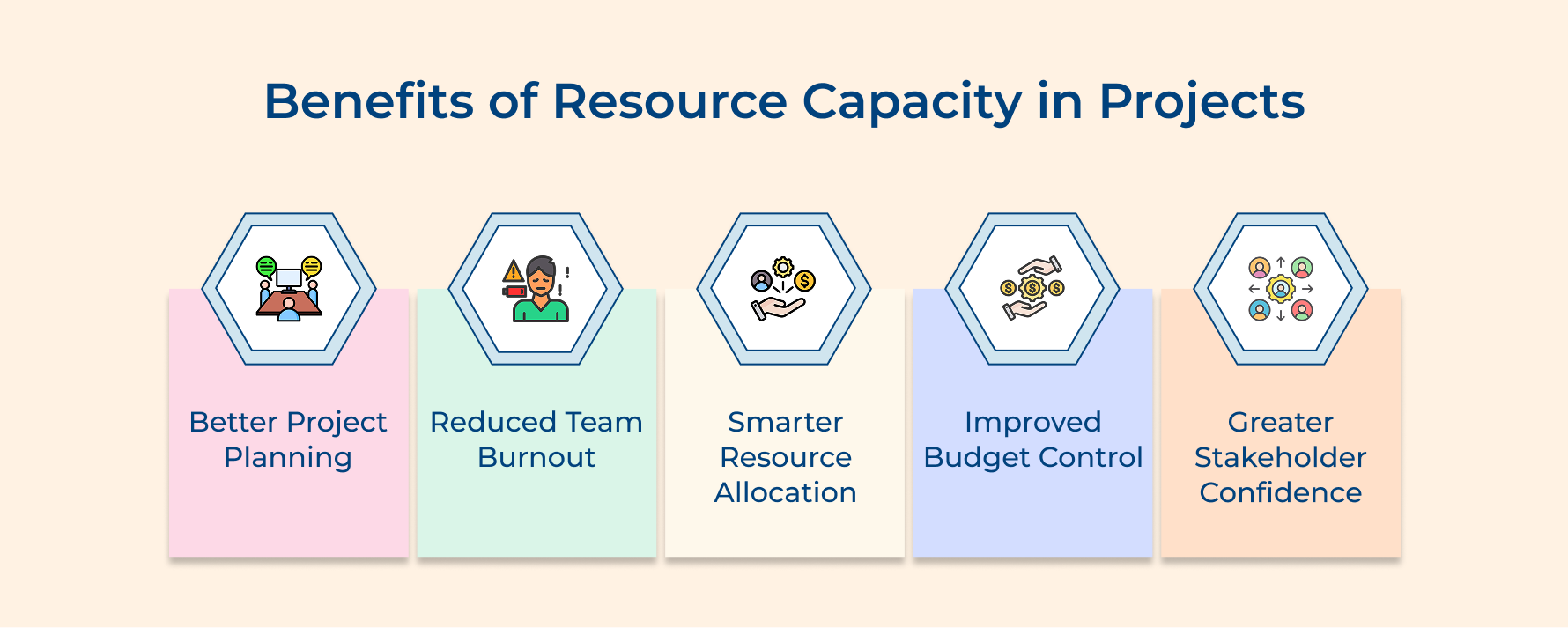
Better Project Planning
When you know your team’s capacity you can set realistic deadlines that people can actually meet. This prevents the common problem of promising delivery dates that looked good on paper but ignored the reality of limited time and people. You build schedules based on facts rather than wishful thinking.
Reduced Team Burnout
Tracking capacity helps you spot when someone is carrying too much work before they reach a breaking point. You can redistribute tasks or adjust timelines to keep workloads manageable. This protects your team’s energy and keeps quality high because people aren’t constantly exhausted or stressed.
Smarter Resource Allocation
Match the right people to the right tasks so your team stays efficient, especially when inflation pressures are tightening budgets. When specialists focus on what they do best instead of jumping between urgent, mismatched tasks, projects move faster and resources are used more effectively—without adding unnecessary costs.
Improved Budget Control
Knowing your delivery capacity helps you make smarter staffing and budget decisions. It keeps you from overspending on contractors when your team already has room to take on more work. At the same time, it prevents understaffing that can delay projects and drive up costs. When you clearly see what your team can deliver, financial planning becomes more accurate and predictable.
Greater Stakeholder Confidence
When you base delivery plans on real capacity data, stakeholders gain confidence in your commitments. You can back up every “no” with solid evidence instead of relying on intuition. This approach builds credibility and ensures your team delivers what it promises without last-minute chaos or excuses.
5 Benefits of Resource Utilization in Projects
Tracking resource utilization gives you a clear picture of how effectively your team’s time translates into project progress. Here’s how measuring utilization creates tangible value for your projects.
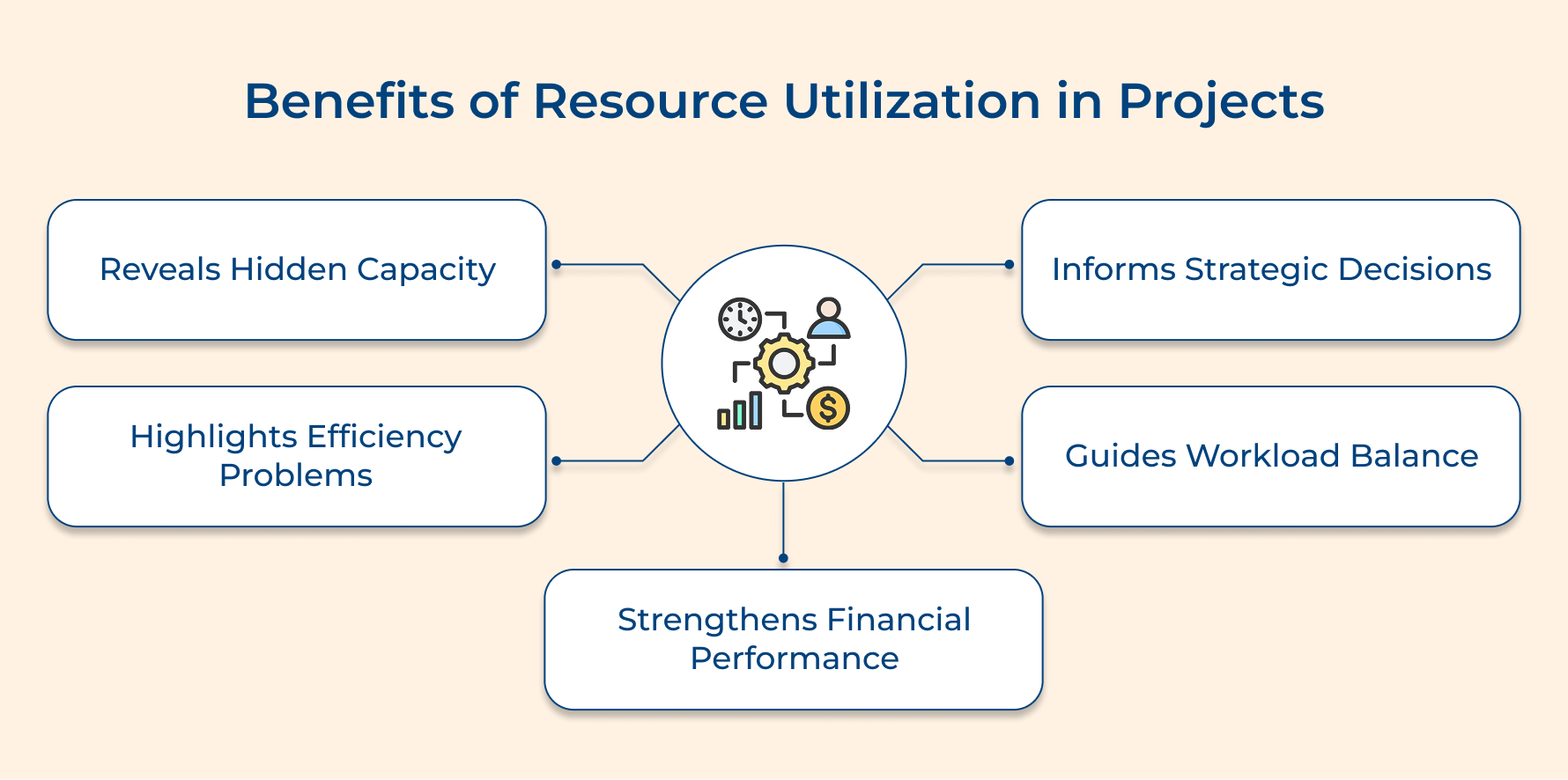
Reveals Hidden Capacity
Tracking your capacity ratio helps you spot people who still have room to take on more work. Instead of assuming everyone’s maxed out, you can reassign tasks to those with available time and move projects forward faster—without hiring extra help or increasing costs.
Highlights Efficiency Problems
In professional services, low productivity often points to process gaps like slow approvals or unclear briefs. When you see this in your utilization data, it’s a signal to fix what’s slowing people down so your team can stay focused on meaningful work.
Strengthens Financial Performance
Compare results against industry benchmarks. It shows where your billable hours deliver strong returns—and where resources aren’t paying off. These insights guide smarter projects as well as staffing decisions that protect margins without compromising quality.
Guides Workload Balance
Track response times to make it easier to see when someone’s overloaded and another has spare capacity. You can rebalance workloads before burnout hits, keeping productivity steady.
Informs Strategic Decisions
Monitor customer satisfaction scores alongside utilization trends. It helps you gauge when your team’s stretched too thin. When workloads stay high but quality dips, it’s clear you need to scale resources to maintain delivery standards.
Resource Capacity and Utilization in Project Management: Key Differences
Let’s explore the key differences between resource capacity and utilization, providing insights into how best to apply them for enhanced project performance as well as efficiency.
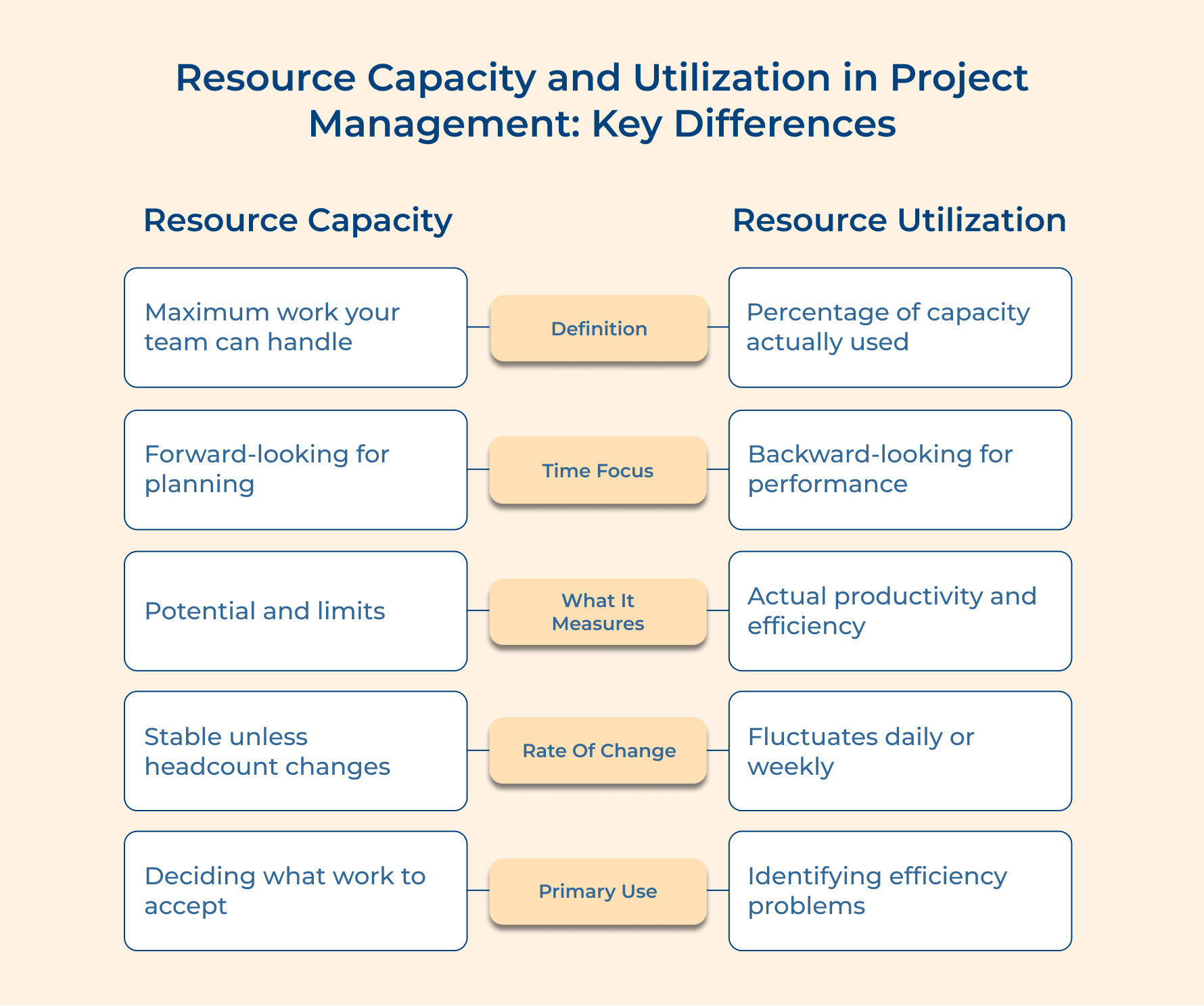
1. What They Measure
Resource capacity tells you the maximum amount of work your team can theoretically handle based on available hours and skills. It’s about potential as well as limits. You’re looking at how much space exists on your team’s plate before adding anything to it.
Resource utilization measures how much of that available capacity is actually being used for productive project work. It’s about performance and efficiency. You’re examining whether the space on your team’s plate is being filled with meaningful work or sitting empty.
Example: Your designer has 40 hours of capacity per week. If she spends 32 hours on actual project work her utilization is 80%. The capacity shows what’s possible while utilization reveals what’s actually happening with that available time.
Key takeaway:
- Capacity answers “how much can we do” while utilization answers “how much are we actually doing.”
- You need capacity data to plan what you can take on and utilization data to see if you’re making good use of what you have.
2. Planning vs Performance Focus
Capacity is forward-looking and helps you make decisions about what projects to accept or when you can deliver them. You use capacity to build realistic schedules and determine if you need more people. It’s your planning tool for understanding constraints before you commit to deadlines.
Here’s how capacity and utilization serve different purposes:
- Capacity drives strategic decisions about taking on new clients or expanding service offerings.
- Utilization reveals operational problems like inefficient processes or poor task allocation.
- Capacity helps you negotiate timelines while utilization shows whether your current projects are running smoothly.
Utilization is backward-looking and shows you how well you used your available resources over a completed period. You analyze utilization to identify efficiency problems or prove you need additional staff. It’s your performance metric for understanding whether you’re getting value from your team.
3. Static vs Dynamic Nature
Resource capacity remains relatively stable unless you hire someone or lose a team member. It changes slowly because it’s tied to headcount and work schedules. When you calculate capacity today it likely looks similar to last month unless your team composition changed.
Resource utilization fluctuates constantly based on project demands and how work gets distributed. It shifts week by week or even day by day as priorities change. One week your developer might be fully utilized and the next week they’re waiting for client feedback with utilization dropping significantly.
Example: A three-person team has a fixed capacity of 120 hours per week. But their utilization swings between 60% during slow periods and 95% when multiple deadlines hit. The capacity stays constant while utilization responds to the rhythm of actual project work flowing through the team.
Key takeaways:
- Capacity gives you a stable baseline for planning while utilization provides dynamic feedback on current performance.
- Changes in capacity require hiring or restructuring decisions but changes in utilization may just need better task distribution or process improvements.
4. Time Horizon Perspective
Resource capacity works best when you’re looking weeks or months ahead at upcoming projects and commitments. You need capacity data to answer questions about whether you can start a new project in three weeks or deliver a complex build by the end of the quarter. It helps you make promises to clients based on realistic availability.
The different time perspectives reveal themselves in specific ways:
- Capacity planning typically covers 30 to 90 days out to align with project timelines and hiring cycles.
- Utilization reporting usually looks at the past week or month to evaluate recent performance.
- Capacity requires forecasting future project needs while utilization simply records what already happened.
Resource utilization focuses on what already occurred in the immediate past. You analyze last week’s or last month’s utilization to understand how productively your team worked during that completed period. This historical view helps you spot patterns and make adjustments but it can’t help you plan what’s coming next.
5. Questions They Answer
Capacity helps you answer planning questions about your team’s ability to take on work and meet future commitments. You’re trying to understand boundaries and possibilities before making promises. The focus sits squarely on what you can realistically accomplish given the people and time you have available.
These are the types of questions capacity and utilization address:
- Capacity: Can we deliver this project by the client’s deadline given our current team size?
- Capacity: Do we need to hire another developer before accepting this new contract?
- Utilization: Why did our team only bill 60% of available hours last month despite having full project schedules?
- Utilization: Is Sarah consistently underutilized because she’s waiting on dependencies from other team members?
Utilization helps you answer performance questions about whether you’re getting good value from your existing resources. You’re trying to diagnose problems and improve efficiency. The focus centers on how well you’re using what you already have rather than whether you have enough.
6. Control and Adjustment
You control capacity primarily through hiring decisions and how you structure your team. Adding or removing people changes your total capacity. Adjusting work schedules or reassigning roles also impacts capacity but these changes happen infrequently while requiring significant decisions.
Here’s how you influence each metric differently:
- Capacity changes require budget approval and recruitment time making adjustments slow as well as deliberate.
- Utilization improves through daily or weekly actions like better task assignment or removing process bottlenecks.
- Capacity involves structural decisions while utilization responds to operational improvements.
You control utilization through daily management actions and process improvements. Better project coordination raises utilization without changing headcount. Removing approval delays or clarifying requirements keeps people working productively. These adjustments happen quickly and don’t require major organizational changes or additional budget.
7. Impact on Business Decisions
Resource capacity directly influences your business development and sales decisions. When a potential client asks if you can handle their project you need capacity data to give an honest answer. Knowing your capacity prevents you from overcommitting and damaging your reputation with late deliveries or rushed work.
Resource utilization drives your operational improvement efforts and helps justify budget requests. Low utilization signals that you’re paying for talent that sits idle due to poor planning or process problems. High utilization proves you’re using your team effectively and might need additional people to maintain quality while preventing burnout.
Example: Your agency has capacity for 200 billable hours per week. A new client wants work that requires 60 hours weekly for three months. Capacity data tells you whether to accept. After accepting you track utilization to ensure those hours actually translate into productive work rather than getting lost to meetings and administrative tasks.
Key takeaways:
- Capacity determines what opportunities you can pursue while utilization reveals whether you’re executing well on the opportunities you accepted.
- Poor capacity planning leads to overcommitment and missed deadlines while poor utilization wastes money on underused resources.
8. Calculation Complexity
Capacity calculation requires forecasting and making assumptions about availability. You account for vacation time as well as holidays. You consider that not all hours are project hours because meetings and administrative work consume some time. The math involves predicting future availability rather than simply adding up what happened.
Consider these calculation challenges each metric presents:
- Capacity: How do you account for uncertain factors like sick days or projects that might extend beyond planned timelines?
- Capacity: Should you include training time or professional development hours when calculating available project capacity?
- Utilization: What counts as productive utilization and what activities should be excluded from the calculation?
- Utilization: How do you handle partial hours or context switching between multiple small tasks throughout the day?
Utilization calculation is more straightforward because you’re working with actual recorded hours. You divide time spent on project work by total available time. The data already exists in timesheets or project tracking tools. The challenge isn’t math but rather defining what activities count as productive utilization versus overhead.
Actionable Strategies to Optimize Resource Capacity and Utilization
Managing both capacity and utilization effectively requires different approaches because they address distinct challenges. Let’s explore practical strategies for improving each aspect of resource management.
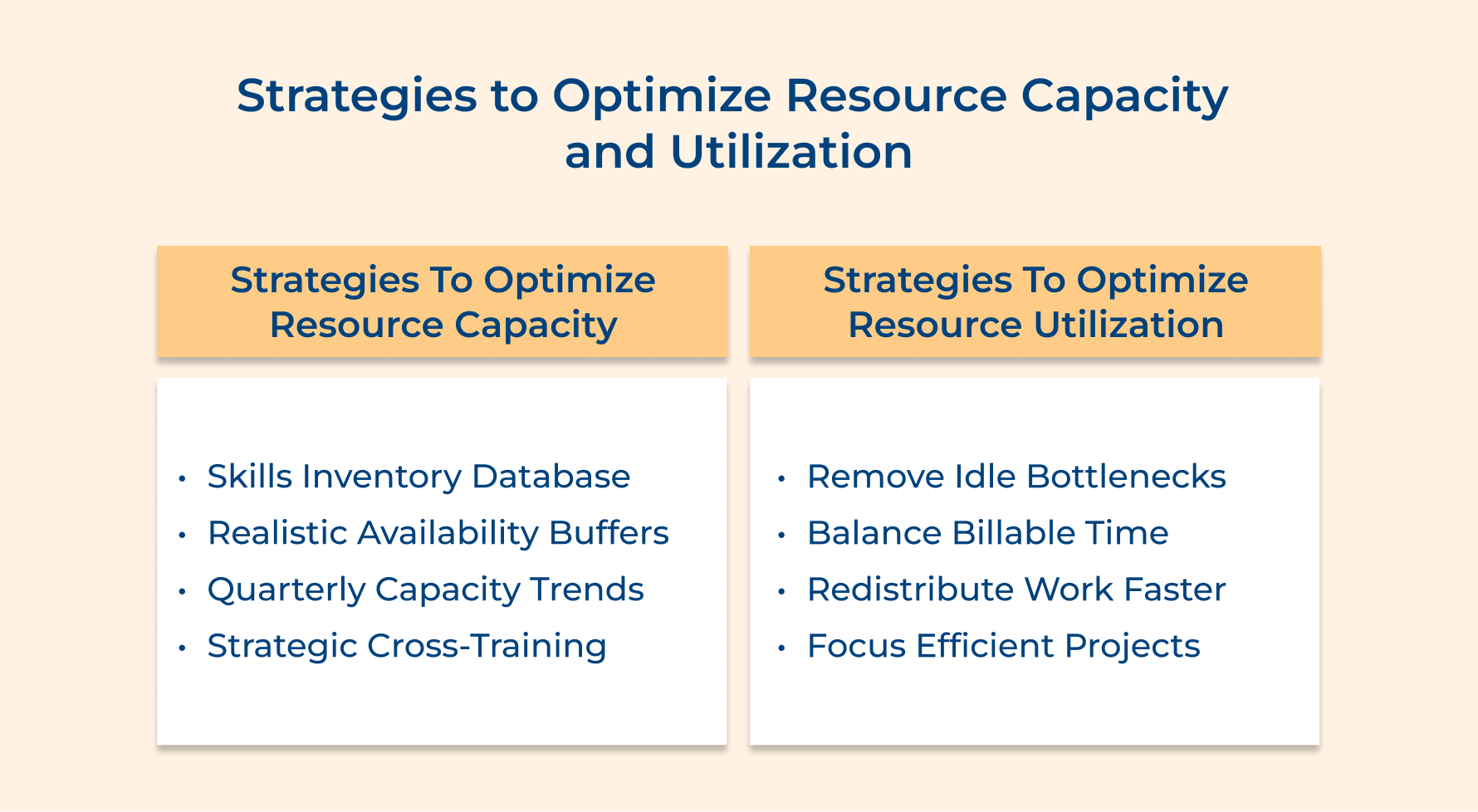
4 Strategies to Optimize Resource Capacity
- Create a skills inventory database: Document every team member’s capabilities and expertise levels so you know exactly what skills you have available when planning projects. It prevents underestimating your capacity because you forgot someone has the right background for a task.
- Build buffer time into capacity calculations: Account for meetings and administrative work by reducing theoretical availability by 10-20% to reflect realistic project time. Thus, creating more accurate capacity estimates that you can actually deliver on without constantly falling short.
- Track capacity trends across quarters: Monitor how your capacity needs fluctuate seasonally or with business cycles to predict when you’ll need temporary help. The forward-looking approach prevents scrambling to find resources during predictable busy periods.
- Cross-train team members strategically: Develop secondary skills in your team so capacity isn’t bottlenecked by single specialists who limit what you can handle. It means one person’s vacation doesn’t paralyze entire project categories.
4 Strategies to Optimize Resource Utilization
Identify and eliminate waiting periods: Track when team members sit idle due to delayed approvals or missing information and fix those bottlenecks. Removing these friction points converts wasted time into productive hours without adding any new resources.
- Balance billable and non-billable targets: Set realistic expectations that include time for necessary overhead like training instead of expecting 100% project time. This prevents gaming the system and creates sustainable utilization that maintains quality.
- Implement daily stand-ups for visibility: Brief check-ins reveal when someone finishes early or gets blocked so you can redistribute work immediately. Quick adjustments keep utilization high by ensuring work flows to whoever has available hours.
- Analyze utilization by project type: Compare utilization rates across different kinds of work to identify which projects use resources efficiently. The insight helps you pursue profitable work types and redesign or avoid projects that chronically waste team time.
Resource capacity vs utilization: Where Clarity Meets Execution
Resource capacity shows you the boundaries of what your team can handle and guides your planning decisions. Utilization reveals how well you’re using those resources in practice. Together they create a complete picture of your team’s effectiveness.
Mastering both (resource capacity vs utilization) metrics transforms how you run projects because you can confidently commit to deadlines while ensuring your team works efficiently. The difference between capacity and utilization is the difference between knowing your potential while achieving it through smart daily execution.
Limit time — not creativity
Everything you need for customer support, marketing & sales.

Shivank Kasera is part of the marketing team at Kooper, where he focuses on building content that helps agencies and service providers grow. With a keen interest in SaaS, operations, and scalability, he translates practical insights into actionable resources for business leaders.