Build a High-Impact Agency Tech Stack for Smarter Growth
- What is an Agency Tech Stack?
- Importance of a Strong Agency Tech Stack
- Things to Consider when Building an Agency Tech Stack
- 8 Essential Components of Technology Stack for Agencies
- Tips and Tricks to Build the Best Agency Tech Stack
- Transform Your Workflow with Agency Tech Stack
- FAQs about Agency Tech Stack

Key Highlights:
- Build your agency tech stack around core business processes, not trendy tools, to solve real operational pain points.
- A connected agency tech stack eliminates data silos, reduces admin tasks and improves collaboration across distributed teams.
- Regular audits of your agency tech stack prevent tool bloat, boost ROI while ensuring your tools grow with your agency.
Agencies often find themselves juggling too many tools as well as conversations, leading to disjointed workflows, scattered information, and a whole lot of chaos.
When systems don’t talk to each other, your team ends up doing the same work twice (or more), manually fixing what tech could’ve automated.
The fix isn’t more tools, it’s the right ones, working together. A smart, integrated tech stack streamlines operations, connects your workflows and automates the grunt work.
Let’s explore the agency tech stack and how it builds smoother collaboration, faster delivery, sharper insights as well as clients who actually stick around.
What is an Agency Tech Stack?
An agency tech stack is the integrated collection of software tools and digital platforms that professional service firms use to manage their operations, deliver client work while driving business growth.
The stack includes everything from project management tools to creative software and analytics platforms. It forms the core technology that helps agencies work smoothly in the digital world.
These tools each handle different tasks but are connected through integrations and APIs. This means they can share data with each other. As a result, teams spend less time on manual work and can collaborate more easily across departments.
Key principles:
- Integration capabilities should connect all tools to eliminate silos and enable seamless data flow between systems.
- Scalability ensures the tech stack can grow alongside your agency without requiring complete overhauls.
- User-friendliness prioritizes tools that your team can adopt quickly with minimal training and resistance.
- Client-centricity focuses on technologies that directly improve the client experience and deliver better results.
- Return on investment balances the cost of tools against their impact on efficiency and revenue generation.
Importance of a Strong Agency Tech Stack
A strong agency technology stack is key to running efficient, scalable operations. Let’s explore why investing in the right technological foundation matters so much.
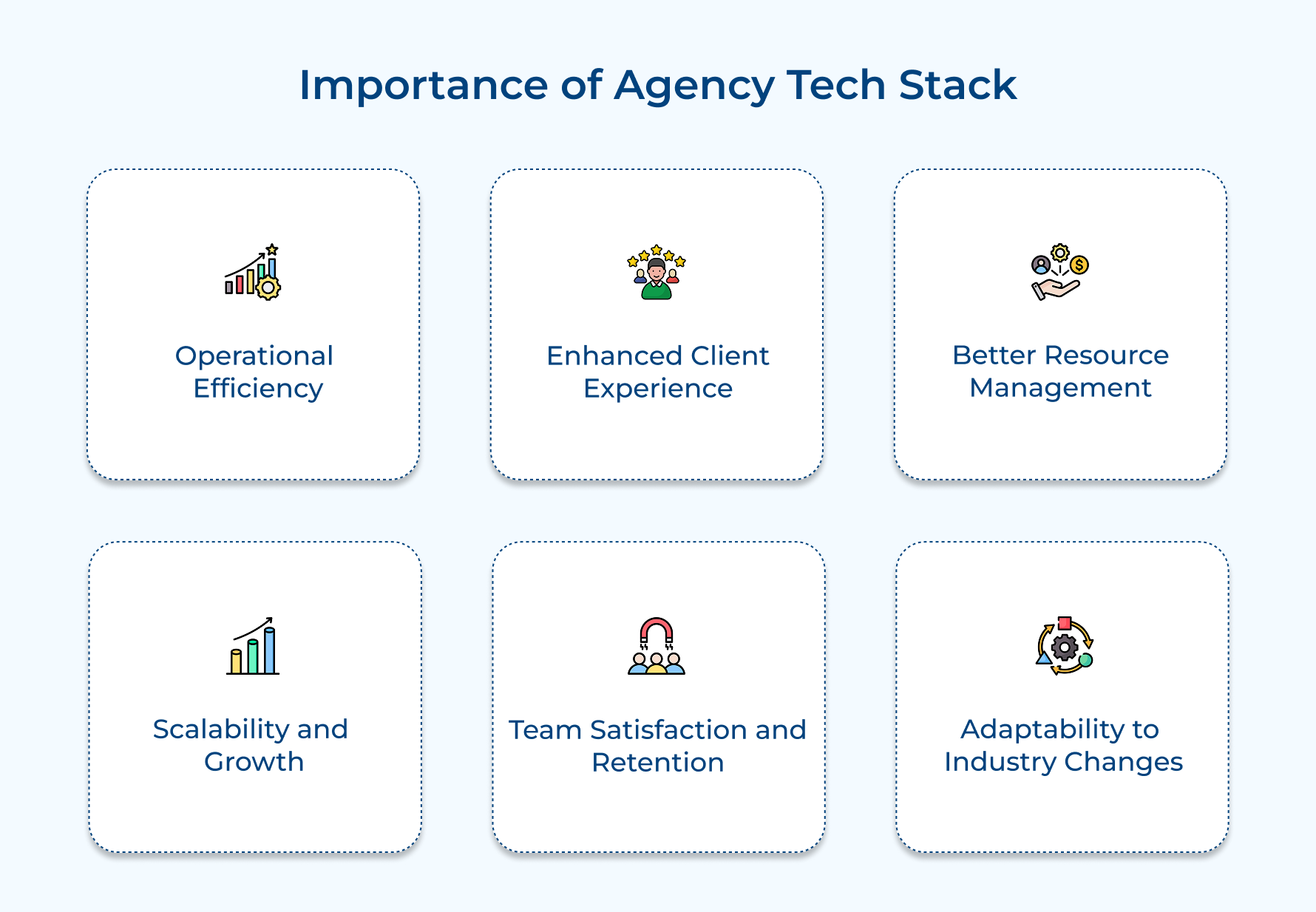
1. Operational Efficiency
Let’s face it, no one wants to waste hours copy-pasting data between tools. A smart agency tech stack takes the grunt work off your team’s plate by automating repetitive tasks and syncing data across platforms. Less time on admin means more time for actual creative work and fewer costly mistakes.
2. Enhanced Client Experience
The current clients expect updates, transparency and fast responses. With the right tools (like client dashboards, real-time messaging, and automated reports) you can keep them in the loop without chasing your team for answers. It shows you’re organized, reliable and in full control of their project.
3. Better Resource Management
Ever double-booked a designer or realized too late that a developer was twiddling their thumbs? A connected tech stack gives you live insights into who’s doing what and when. That means better planning, fewer bottlenecks and smarter use of your talent.
4. Scalability and Growth
Growing your agency shouldn’t mean growing your stress. A solid tech foundation scales with you, letting you take on more clients, more projects and more revenue without needing a massive hiring spree or rebuilding your processes every few months.
5. Team Satisfaction and Retention
Nobody enjoys wrestling with clunky systems or doing the same task three times. When your tech actually supports your team, you’ll see happier faces and better retention. People stick around where they feel empowered.
6. Adaptability to Industry Changes
The agency world moves fast. Whether it’s a new client demand or a shift in digital trends, your tech stack should help you flex and adapt. A future-ready stack lets you plug in new tools, update workflows, and pivot with ease so you’re always one step ahead.
Things to Consider when Building an Agency Tech Stack
Creating the right technological foundation for your agency requires careful planning and strategic thinking. Let’s explore the key considerations that will help you build a tech stack that truly serves your business needs and goals.
Before selecting any tools, take time to clarify your fundamental needs and objectives. Answering these critical questions will guide better tech decisions and prevent costly mistakes down the road.
- What specific business problems are we trying to solve with agency stack?
- What are our current pain points in client delivery and internal operations?
- How do we want to grow in the next 2-3 years, and what technology will support that vision?
- What is our realistic budget for both initial investment and ongoing maintenance?
- What technical capabilities exist within our team, and where might we need support?
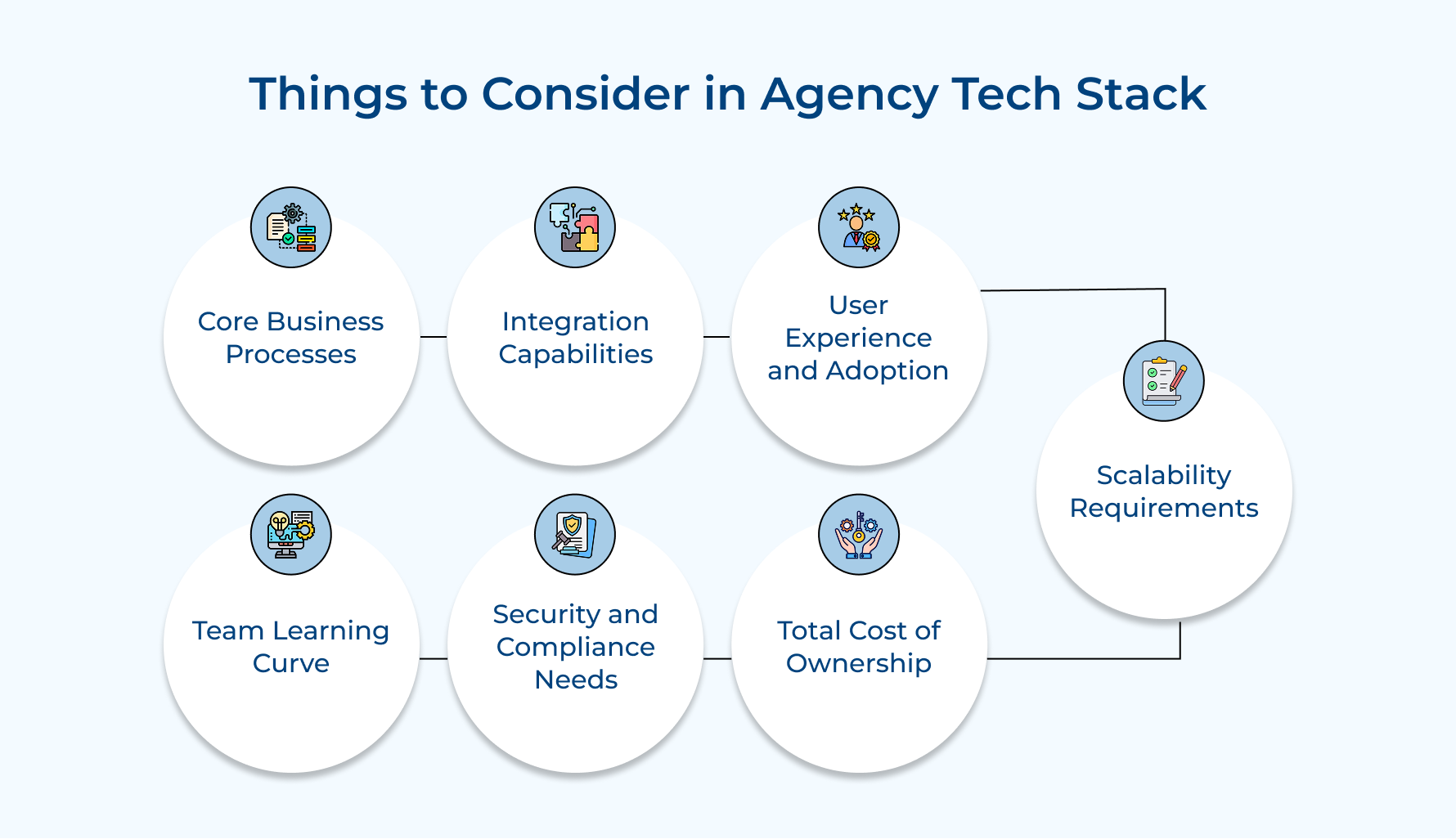
1. Core Business Processes
Map out your most critical workflows from client acquisition to project delivery and identify where technology can create the greatest efficiency gains. Focus first on the processes that directly impact revenue generation and client satisfaction before addressing secondary functions.
2. Integration Capabilities
Prioritize tools that can connect with each other through robust APIs or native integrations. The real power of your tech stack comes from seamless data flow between systems that eliminates redundant data entry and creates a single source of truth.
3. User Experience and Adoption
Select tools that your team will actually use because they’re intuitive and solve real problems. The most powerful technology is worthless if it sits unused because it’s too complicated or doesn’t fit naturally into existing workflows.
4. Scalability Requirements
Choose solutions that can grow alongside your agency without requiring complete replacement as you add clients and team members. Look for tools with tiered pricing models and the ability to add functionality as needed.
5. Total Cost of Ownership
Calculate the full financial impact beyond the sticker price including implementation time, training requirements, and ongoing maintenance. Remember that cheaper options often become more expensive when you factor in productivity losses from limitations or workarounds.
6. Security and Compliance Needs
Assess the data protection requirements for your clients’ industries and ensure your tech stack meets those standards. Robust security measures are increasingly becoming a competitive advantage as clients become more concerned about their data protection.
7. Team Learning Curve
Consider your team’s ability to adapt to new systems and factor in realistic timelines for training and proficiency development. The best tools align with your team’s existing skills while providing accessible paths to learn new capabilities that enhance their work.
8 Essential Components of Technology Stack for Agencies
Modern agencies need a strategic collection of technology tools to deliver exceptional client work while maintaining operational excellence. Let’s explore eight essential tech components for your service business.
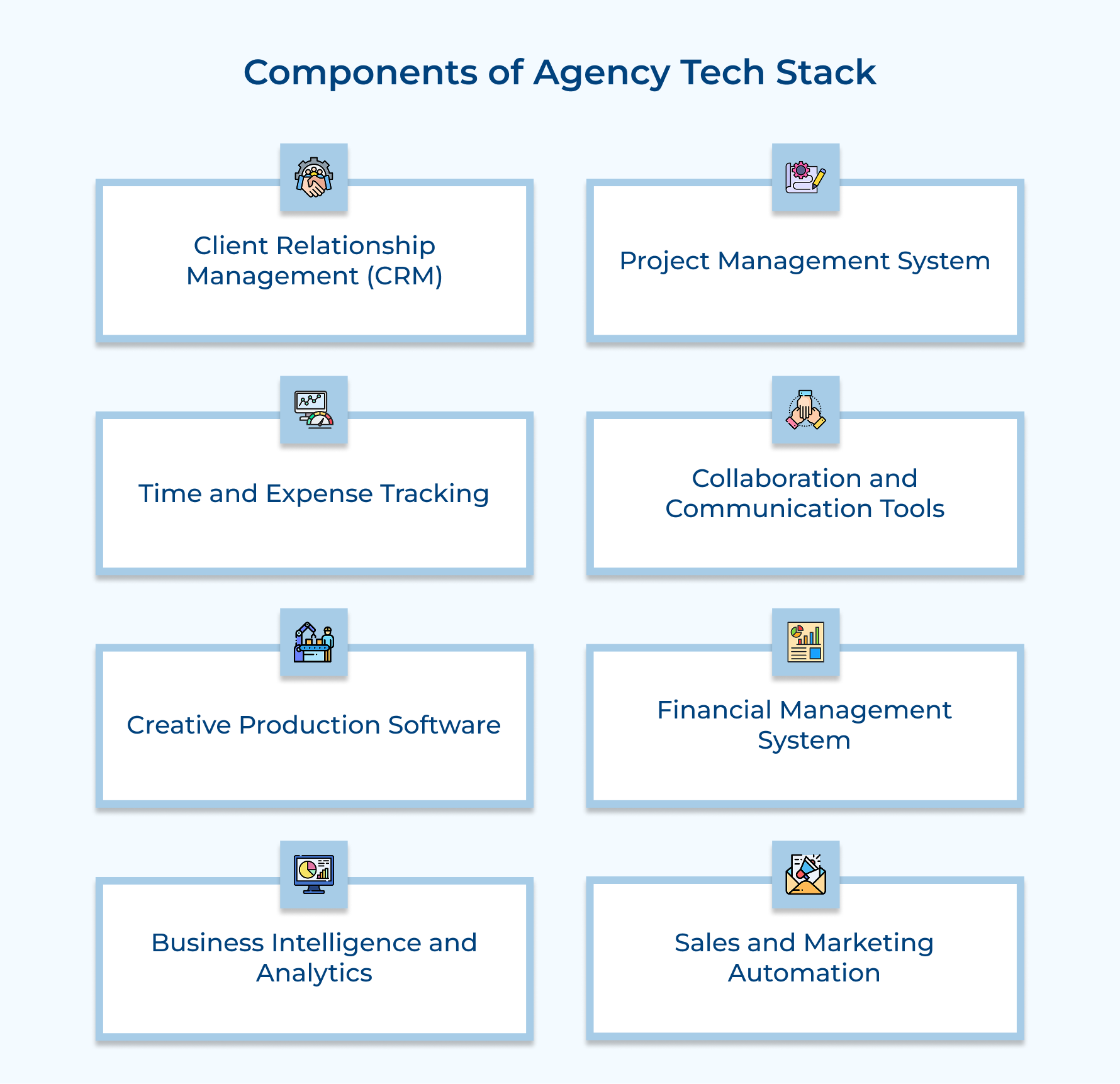
1. Client Relationship Management (CRM)
A CRM system centralizes all client data, interactions, and opportunities in one accessible platform. It helps track prospects through your sales pipeline, maintain communication records, and identify upsell opportunities.
Customer Relationship Management Readiness Checklist:
- Have we defined our client engagement stages from prospect to long-term client?
- Do we have standardized data fields that capture our unique agency-client relationship needs?
- Have we established processes for regular data cleaning and maintenance?
- Is there clear ownership for CRM administration and data governance?
- Have we integrated our CRM with other key systems like email and marketing tools?
Forward-thinking agencies use their CRM as a strategic intelligence hub rather than just a contact database. By analyzing engagement patterns, teams can spot early signs of client dissatisfaction or find perfect moments for proactive outreach. Custom fields specific to agency relationships enable tracking of campaign metrics or approval statuses that matter most.
2. Project Management System
Project management software creates a central workspace where teams plan, execute, and monitor client projects with clarity. These systems help break complex work into manageable tasks, establish timelines, allocate resources and track progress. Hence, giving both managers as well as leadership visibility into project health.
Project System Assessment Questions:
- Does our system provide real-time visibility into resource allocation across all projects?
- Can we easily identify bottlenecks in our workflows before they impact deadlines?
- Have we created templated project structures for our most common service offerings?
- Are we tracking actual vs. estimated time to improve future project planning?
- Do our approval workflows include appropriate stakeholders without creating bottlenecks?
Learning to forecast team capacity prevents both employee burnout and revenue leakage common in service businesses. Advanced users create custom workflows reflecting their delivery methodologies, embedding quality checkpoints directly into project templates.
3. Time and Expense Tracking
Time tracking is a smart way to boost profits and improve planning. With the right tools, it’s easier than ever to keep things on track:
- User-friendly time trackers: Modern tools offer intuitive interfaces, mobile access, and reminders so your team can log hours without disrupting their workflow.
- Predictive time modeling: Use past data to forecast how long similar projects will take, great for spotting scope creep early.
- Passive tracking tools: Automatically capture work activity based on app and document usage.
- Value-based tracking: Shift focus from hours worked to the value delivered (like strategic, creative, or production tasks).
4. Collaboration and Communication Tools
Collaboration tools are the heartbeat of any modern agency, especially with remote and hybrid teams now the norm. A well-chosen tech stack for agencies keeps everyone connected, creative and in sync, no matter where they’re working from.
These platforms create shared digital spaces where teams can exchange ideas, manage files, and stay aligned. To get the most out of them, agencies should ask themselves:
- Have we defined which tools and channels are best for quick chats vs. detailed discussions?
- Do our tools support both live collaboration and async updates?
- Are file names as well as folder structures consistent and easy to navigate?
- Are we saving key conversations and decisions in accessible, organized places?
- Can clients easily access what they need without compromising internal workflows?
5. Creative Production Software
Creative tools are the engine behind every deliverable your agency produces. But simply having the right software isn’t enough. To truly stand out, your tech stack for agencies should support smart, scalable workflows.
Here’s how top agencies do it:
- Modular design systems: Teams reuse approved components to speed up production without sacrificing quality.
- Real-time collaboration: Think of it like Google Docs for creatives. Designers, writers and devs can work together, without stepping on each other’s toes.
- Automated rendering: Tools auto-generate assets in multiple formats, saving hours and ensuring consistency.
The smartest agencies balance structure and flexibility, standardizing tools where needed while staying open to new creative tech that gives them an edge.
6. Financial Management System
Financial software gives agency leaders visibility into business performance and helps maintain healthy cash flow through streamlined invoicing as well as expense management. For service businesses where time equals money, robust systems ensure you capture billable work, maintain margins and identify issues early.
Financial health diagnostic:
- Can we quickly identify our most as well as least profitable clients, projects, and service lines?
- Have we established standardized pricing models with appropriate margins for different services?
- Is our invoicing process automated and tied directly to project milestones?
- Do we have early warning systems for projects at risk of exceeding budget?
Advanced agencies implement comprehensive management systems connecting financial data with operational metrics. Integration between time tracking and financial systems creates a single source of truth providing real-time insights.
7. Business Intelligence and Analytics
Analytics tools are more than just dashboards, they’re the lens through which smart agencies see what’s working, what’s not, and where to grow next. A strong tech stack for agencies connects all your data points and turns them into real insights, not just numbers.
Here’s how top agencies use analytics to stay ahead:
- Contribution analysis reveals which services drive real value, including those often overlooked, like strategy or research.
- Talent planning tools predict future skill needs, so you’re always one step ahead in staffing and development.
- Client diversification scoring helps you reduce risk by balancing your portfolio.
Aligning analytics with key goals (from client success to financial health) will help you build accountability, improve decisions and drive sustainable growth.
8. Sales and Marketing Automation
Sales automation gives your agency’s sales team the tools to focus on what really matters, while the busywork runs in the background. From proposal creation to lead follow-ups, automation helps deliver a smooth, consistent prospect experience.
Here’s how top agencies take it further:
- Behavior-based content adapts to how prospects actually engage, not where you assume they are in the funnel.
- Account targeting frameworks help your team prioritize leads that are the best fit, most profitable, and aligned with your services.
- Modular proposals with performance tracking let you see which case studies or pricing models are driving conversions.
Tracking campaign performance and refining based on results helps agencies turn sales into a smart process.
Tips and Tricks to Build the Best Agency Tech Stack
Here are six practical strategies to help you develop a tech stack that delivers real competitive advantage.
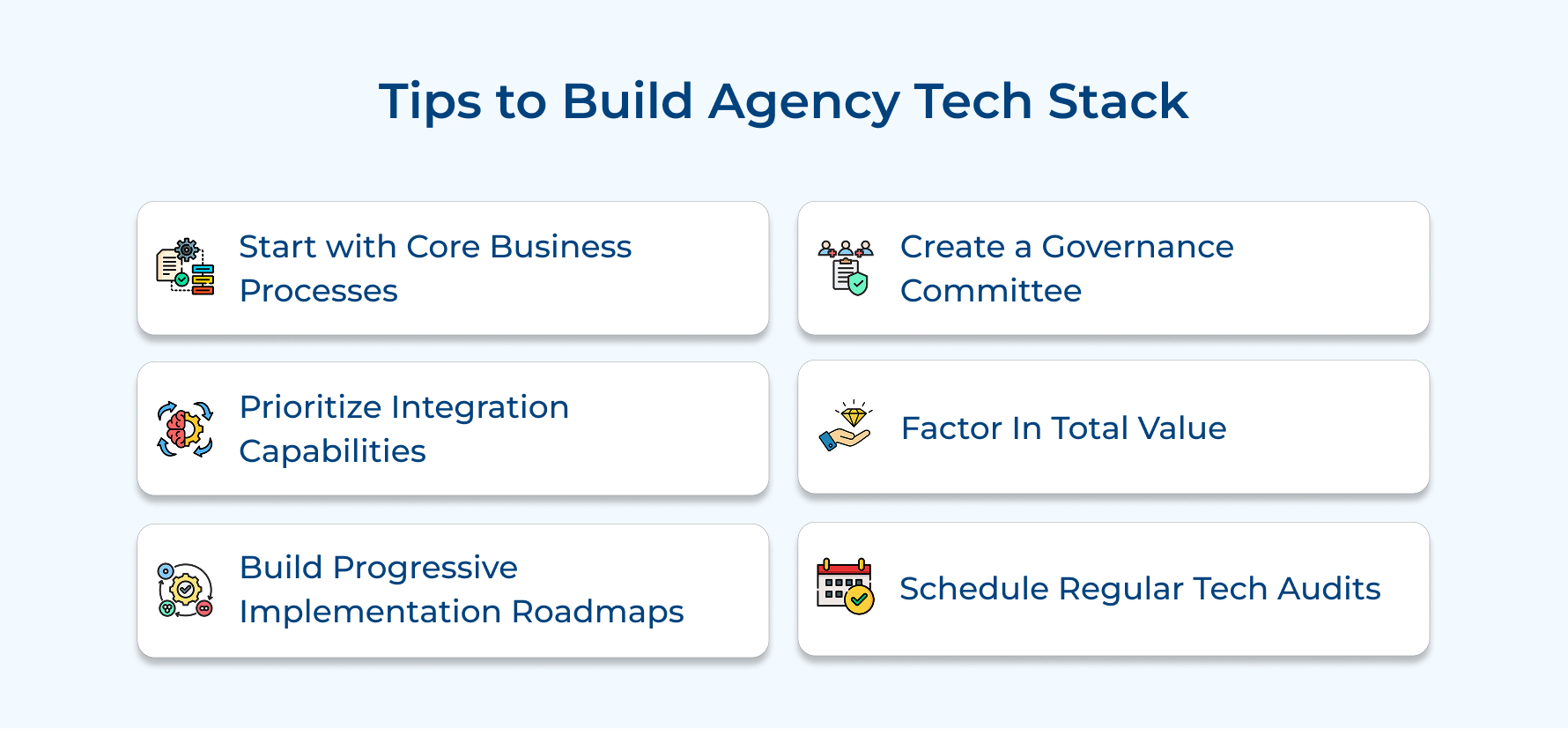
1. Start with Your Core Business Processes, Not Trending Tools
Begin by mapping your essential workflows from client acquisition through project delivery and carefully identify pain points and inefficiencies.
Pick tools that solve your agency’s real problems. Don’t get distracted by trendy software that doesn’t fit your needs or fix issues you don’t face.
2. Prioritize Integration Capabilities Over Isolated Features
Choose tools that work well together using strong APIs. Avoid platforms that look great on their own but don’t connect easily with the rest of your systems.
A less flashy but well-integrated system will consistently outperform a collection of powerful but disconnected tools by eliminating data silos and manual transfers.
3. Build Progressive Implementation Roadmaps
Don’t try to roll out your entire tech stack in one go. Start with the essentials, then layer in more tools as your team gets comfortable.
A phased approach helps avoid overwhelm and keeps things running smoothly as you upgrade your systems.
4. Create a Tech Stack Governance Committee
Bring together people from different teams (creative, accounts, ops, finance) to weigh in on tech decisions.
When everyone has a seat at the table, you avoid tool overload and make sure each new platform actually supports your agency’s goals.
5. Factor In Total Value, Not Just Subscription Costs
It’s not just about what a tool costs, it’s about what it delivers. Look at the full picture – setup time, training, efficiency gains, and potential revenue. The right tools often pay for themselves many times over.
6. Schedule Regular Technology Audits and Optimization
Check in on your tech stack every quarter. What’s working? What’s gathering dust?
Cleaning out the clutter helps you stay efficient, reduce costs, and make room for tools that actually move the needle.
Transform Your Workflow with Agency Tech Stack
A well-integrated agency tech stack is essential in the current digital landscape where manual processes create bottlenecks and competitive disadvantages. By using interconnected platforms, agencies can centralize their operations. This helps eliminate information silos, cut down on time-consuming admin work, and stay ready to meet changing client expectations.
Agencies implementing cohesive tech stacks realize measurable benefits: reduced overhead costs through automation, improved team productivity with streamlined workflows, and enhanced client relationships through data-driven insights as well as transparent reporting. These advantages translate directly to improved profit margins, accelerated project completion, and stronger client retention.
Limit time — not creativity
Everything you need for customer support, marketing & sales.

Shivank Kasera is part of the marketing team at Kooper, where he focuses on building content that helps agencies and service providers grow. With a keen interest in SaaS, operations, and scalability, he translates practical insights into actionable resources for business leaders.