8 Best Agency Client Retention Strategies for Easy Scaling
- What is Agency Client Retention?
- 6 Essential Benefits of Agency Client Retention
- How to Calculate Agency Client Retention Rate?
- 8 Effective Strategies to Improve Agency Client Retention
- Client Acquisition vs. Client Retention: What’s The Difference?
- Reasons Why Client Retention for Agencies Fail
- Transform Client Satisfaction into Long-Term Success with Retention Strategies
- FAQs about Agency Client Retention

Key Highlights:
- Agency client retention helps increase profits over time, reduces marketing expenses, builds stronger relationships and creates a stable agency environment.
- Regular updates and clear reporting show clients your value as well as help prevent misunderstandings that hurt retention efforts.
- Acquiring clients wins short-term business, but long-term retention builds deeper trust and leads to more sustainable agency growth.
In the current crowded agency world, losing a client can hurt more than you think. One big account walking away can throw your whole team off balance—causing cash flow issues, layoffs, and lower service for the rest.
Winning new clients now costs 5–8 times more than keeping the ones you have. And while you’re busy pitching, your competitors are quietly building smart retention systems that give them the edge.
Top agencies are changing course. They’re using eight simple strategies to keep clients happy and profits growing. Let’s explore how agency client retention methods boost service, lead to bigger deals, and bring in referrals—without burning out your team chasing the next new lead.
What is Agency Client Retention?
Agency client retention means keeping your clients happy and working with you over time. It shows how well you build lasting relationships instead of losing clients to competitors. Good retention means clients see value in your work, which helps your agency grow and stay stable.
It starts with clear communication during onboarding. You set expectations, agree on deliverables, and create ways to stay in touch. This builds trust from the start. Keep the clients by delivering consistent results and adjust when their needs change. Check in often, ask for feedback, and show you care about their success (not just the contract).
Key objectives:
- Maximize client lifetime value by extending the average length of client relationships.
- Reduce new business acquisition costs by maintaining a stable client base.
- Generate reliable recurring revenue to support agency stability and growth planning.
- Build a portfolio of case studies and testimonials from long-term, successful partnerships.
- Create opportunities for service expansion and referrals through deepened client relationships.
6 Essential Benefits of Agency Client Retention
Client retention isn’t just about keeping your roster full, but building a sustainable agency with deeper impact. Let’s explore the key advantages of maintaining long-term client relationships.
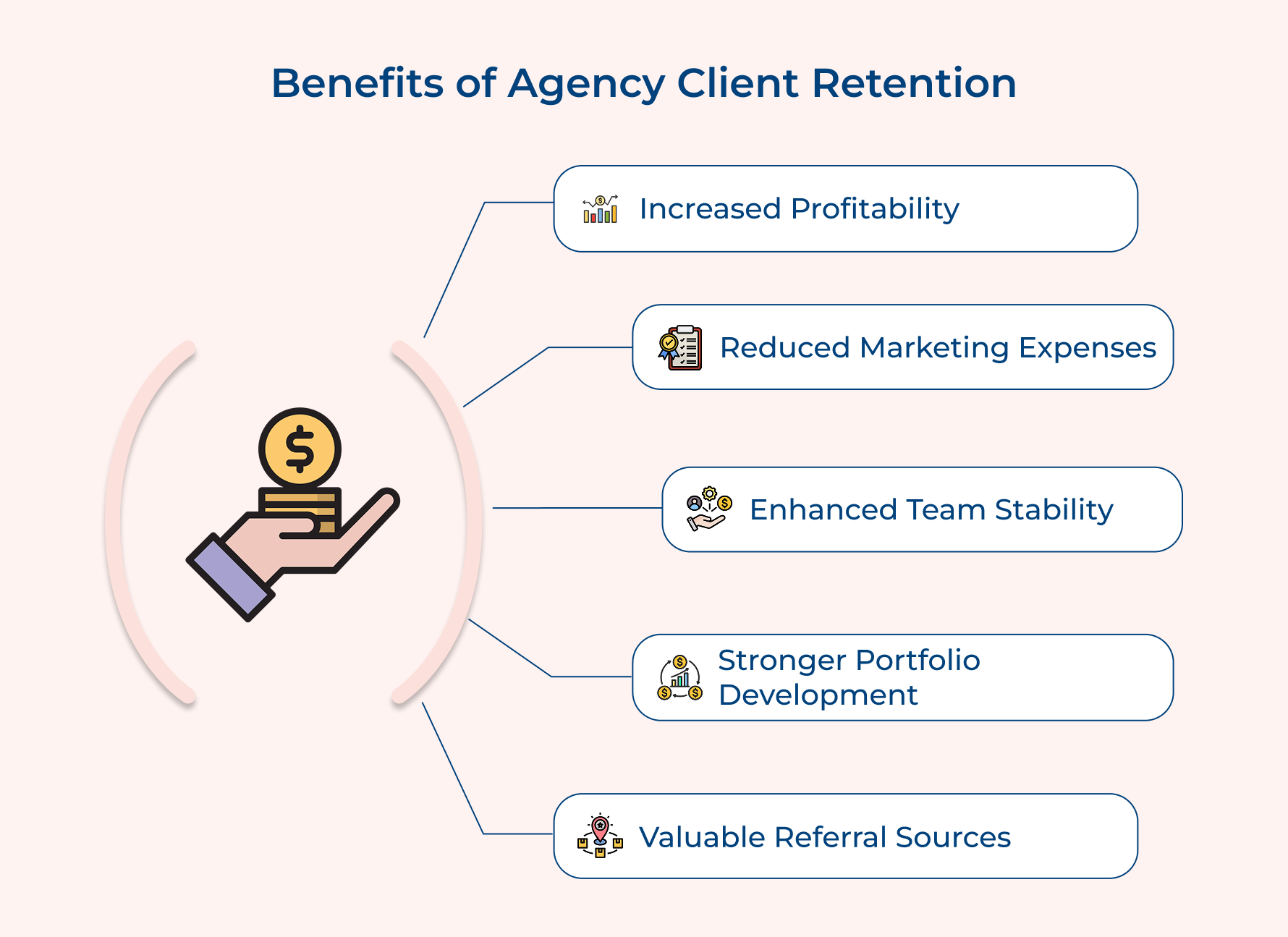
1. Increased Profitability
Existing clients typically become more profitable over time as onboarding costs are eliminated and work processes become streamlined. You can often increase your service scope without the high acquisition costs that come with new clients while maintaining a steady revenue stream from established relationships.
2. Reduced Marketing Expenses
Keeping current clients happy requires significantly less investment than acquiring new ones. Studies suggest acquiring new clients can cost five times more than retaining existing ones due to the expenses of marketing campaigns and sales processes needed to attract fresh business.
3. Enhanced Team Stability
Long-term client relationships create predictable workloads that allow for better resource planning and talent retention. Your team members benefit from deeper understanding of client needs and can develop specialized expertise that makes their work more fulfilling.
4. Stronger Portfolio Development
Extended client relationships provide opportunities to showcase progressive improvements and long-term impact in your case studies. You can demonstrate how your strategic approach evolves and deepens over time rather than just highlighting quick wins from short projects.
5. Valuable Referral Sources
Satisfied long-term clients become powerful advocates for your agency and often refer to new business opportunities. Their enthusiastic recommendations carry more weight than your marketing claims because they’re based on substantial experience with your services over time.
How to Calculate Agency Client Retention Rate?
Your client retention rate reveals how effectively your agency maintains client relationships over a specific time period. It measures client satisfaction, stability and departure patterns needing strategy.

Components
- Ending number of clients: The total number of clients you have at the end of your measurement period. This represents your current client roster after accounting for both gains and losses.
- New clients: The number of new clients acquired during the measurement period. We subtract these from the equation because retention specifically measures keeping existing clients rather than acquisition success.
- Starting number of clients: The total number of clients you had at the beginning of your measurement period. This establishes your baseline for measuring retention performance.
A healthy agency typically maintains a retention rate between 75-85%, though this varies by industry and client type. Digital agencies often see lower rates due to project-based work while retainer-based agencies should aim higher. Tracking your rate over time matters more than comparing to industry averages.
Example
Imagine your agency started January with 20 clients. During the year, you lost 3 clients but gained 5 new ones, ending December with 22 clients.
Starting clients (S) = 20
Ending clients (E) = 22
New clients (N) = 5
Client Retention Rate = (22 – 5) ÷ 20 × 100
Client Retention Rate = 17 ÷ 20 × 100
Client Retention Rate = 85%
This 85% retention rate indicates strong client satisfaction, as you kept 17 of your original 20 clients throughout the year.
8 Effective Strategies to Improve Agency Client Retention
Here’s a comprehensive look at the eight strategies that could be the game-changer your agency needs for improving client retention.
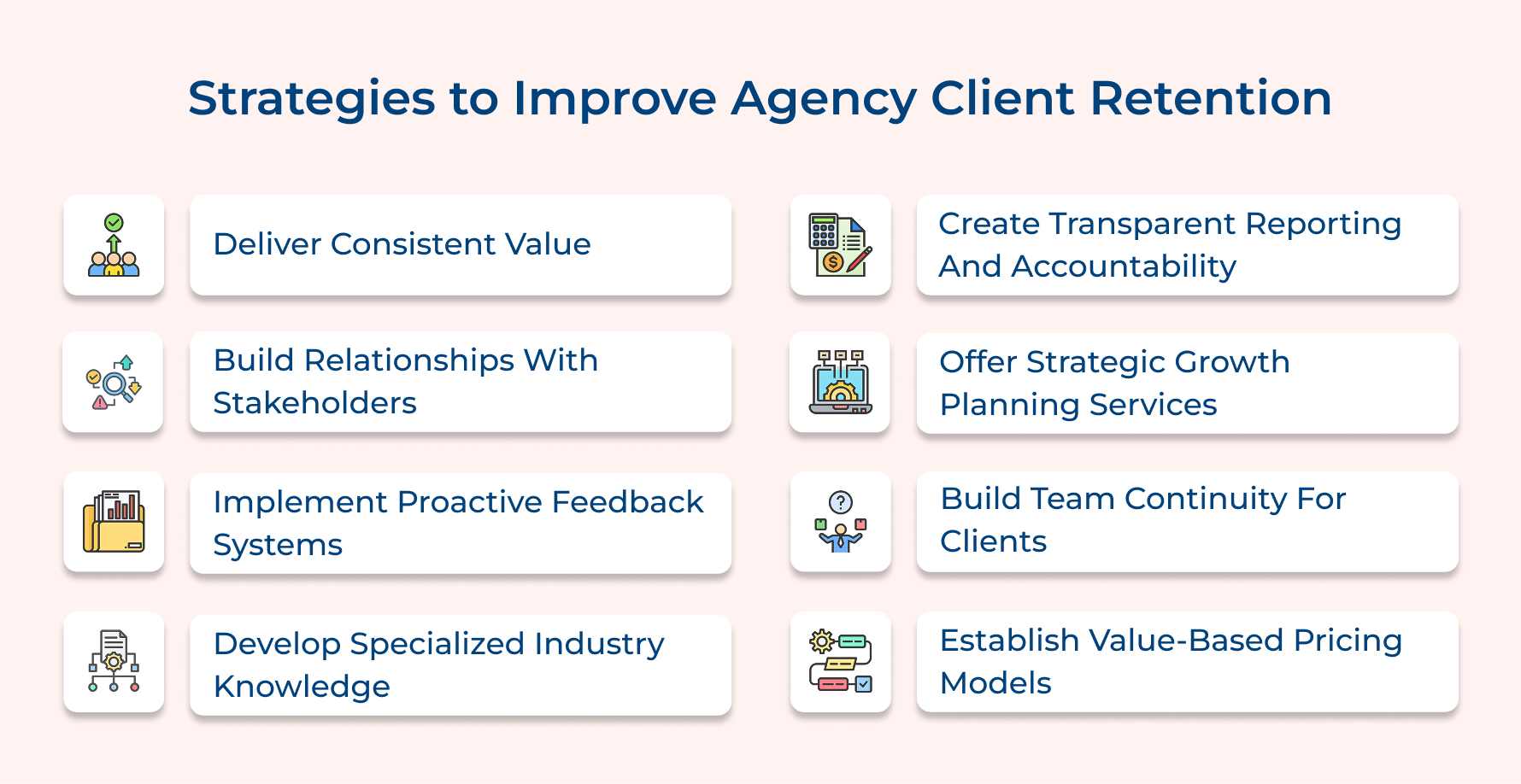
1. Deliver Consistent Value Beyond Expectations
Delivering value beyond expectations means giving clients more than what you originally promised. It helps turn a basic working relationship into a strong, long-term partnership. When clients see your commitment to their success, they view your agency as a key part of their business.
Here are four ways to exceed client expectations:
- Share performance reports that show improvements beyond agreed KPIs and explain the extra business value.
- Send problem-solving updates that highlight issues you spotted early and actions you took before the client even noticed.
- Offer strategic insights based on market trends, with clear steps the client can take to stay ahead.
- Provide custom training and resources to help the client’s team get more from your work.
Learn what truly matters to each client and not just what’s in the contract. Build time into your projects to deliver these extras regularly and consistently.
2. Build Strong Relationships with Stakeholders
Building stakeholder relationships means forming real connections with the key people in your client’s organization—both decision-makers and influencers. These people often have different goals, so strong relationships help you earn trust, gain insights, and build internal support for your work.
Start by mapping the full organization, including those with formal titles and those who quietly influence decisions. Have regular one-on-one chats that go beyond project status. Learn what each person cares about and how they prefer to communicate.
Pro tips:
- Create stakeholder profiles that show what success means to each contact, how they like updates, and what they value most.
- Build a system to track changes in client teams, new initiatives, and internal politics. This helps you stay ahead and adapt quickly when things shift.
3. Implement Proactive Communication Feedback Systems
Proactive communication feedback systems help a marketing agency (or any agency, for that matter) improve customer satisfaction and boost customer retention rates. Instead of waiting for problems, these systems catch issues early and show clients you’re paying attention. This builds stronger relationships and creates a better customer experience.
There are a few simple ways to do this:
- Pulse surveys and satisfaction scores: Ask clients to rate recent work with short surveys. This helps track how they feel over time.
- Client success managers: Assign someone outside the project team to check in regularly and focus on big-picture goals as well as customer satisfaction.
- Milestone retrospectives: After big deliverables, set up a quick review to discuss what went well and what to improve.
These steps are part of an ongoing process. Start small and keep it consistent. Choose methods that fit your client’s style and schedule. Always act on feedback and show clients the changes. This increases customer lifetime as well as trust in your agency.
4. Develop Specialized Knowledge Of Industries
Developing industry specialization means truly understanding the challenges, language, and needs of the industries your clients work in. This helps your agency stand out by offering smart, relevant solutions. Clients trust agencies that “get” their world, which makes this one of the most effective customer retention strategies.
Here’s how to build that expertise:
- Set up research teams to track trends, competitors, and rules in each industry.
- Run client immersion programs where your team works closely with clients to learn how their business works.
- Create industry-specific case studies using past results, so future clients can see clear value.
Industry specialization is an ongoing process. Go too narrow, and you risk customer churn if that market slows down. Try to cover too many sectors, and you lose depth. The key is balance.
5. Create Transparent Reporting and Accountability
Transparent reporting shows clients what’s being done, how it’s going and the results achieved. This builds trust, reduces stress while aligning everyone on success.
Use clear dashboards that turn complex data into simple visuals, focusing on key metrics and updating often with comparisons for context.
Set quarterly goals to stay focused and accountable. In reviews, track progress, celebrate wins, fix issues, and adjust goals as needed. Over time, this turns positive sentiment into measurable results as well as stronger partnerships.
6. Offer Strategic Growth Planning Services
Strategic growth planning moves your agency beyond task delivery, positioning you as a true partner in your clients’ business success. This deeper role shows you understand their big-picture goals and makes you harder to replace, as your support becomes vital to their long-term plans.
Start by uncovering missed opportunities using client data, market trends, and competitor insights. Go beyond your standard services, offering clear reasons to explore new areas. Link your work directly to results like revenue growth, customer gains, or efficiency improvements.
Use clear numbers to show impact in terms of decision-makers’ value. When clients see that your efforts fuel tangible growth, they’ll be far more likely to stay with your agency for the long run.
7. Build Team Continuity For Clients
Building team continuity means keeping the same core people on a client account and making sure important knowledge isn’t lost when someone leaves. Clients spend a lot of time teaching your team about their business, so when key staff change, it can hurt trust and even cause the client to leave.
That’s why it’s important to create strong systems and relationships that go beyond just one person.
Here are some questions to help you build team continuity:
- How can we share knowledge across the team so clients don’t rely on just one person?
- Can we offer career growth within the account to keep great team members from leaving?
- How often should we involve backup team members in client meetings to build deeper connections?
- What steps can we take to save important client info when someone does move on?
Create shared experiences. Try quarterly workshops or sessions like “innovation labs” that bring both teams together for learning and collaboration.
8. Establish Clear Value-Based Pricing Models
Value-based pricing changes how clients see your agency, from paying for hours to investing in real results. Instead of focusing on how much time something takes, you focus on the value your work brings to their business.
This approach helps build stronger, longer-lasting relationships because clients see your fees as smart investments with clear returns.
Here are a few simple value-based pricing models that support client retention:
- Performance milestone pricing: Set fixed fees tied to business goals, with bonuses for exceeding targets or refunds if goals aren’t met.
- Tiered service packages: Offer clear packages based on business outcomes, not just a list of tasks. Clients choose the level of impact they want.
- Retainer plus results: Charge a steady monthly fee for ongoing work, plus extra pay when you help improve key results like leads or revenue.
- Value-banking systems: Clients commit to an annual budget and access different services as needed; no time tracking, just results.
This model shifts your agency’s focus to delivering outcomes, not just hours, and helps build lasting, win-win partnerships.
Client Acquisition vs. Client Retention: What’s The Difference?
Understanding the distinct dynamics between winning new business and maintaining existing relationships is crucial for agency success. Explore how both are distinct from each other.
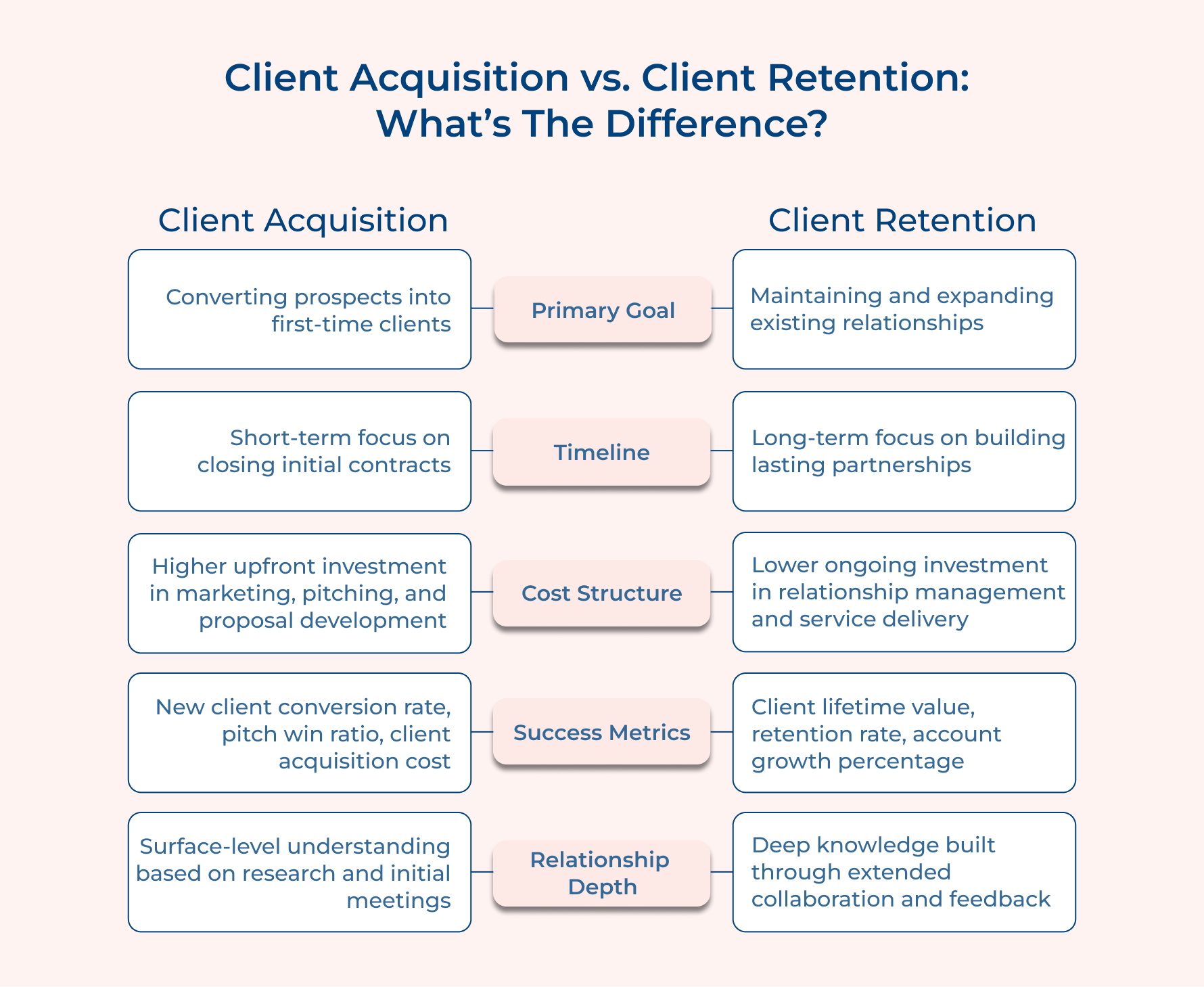
1. Strategy Focus and Planning Horizon
Acquisition strategies typically center on creating awareness, differentiating from competitors, while demonstrating potential value through case studies and capabilities presentations. These approaches operate on shorter timeframes with emphasis on making strong first impressions and overcoming initial objections to secure contracts.
Retention strategies focus instead on providing actual value delivery, building trust through consistent performance, and developing multi-level relationships within the client organization. These approaches require longer planning horizons that anticipate client needs and create structural dependencies that make switching agencies difficult.
2. Resource Allocation and Team Composition
Client acquisition demands significant investment in business development specialists, proposal writers, and presentation designers who excel at crafting compelling narratives about future possibilities. These teams often work intensively but briefly with prospective clients before moving on to the next opportunity, regardless of outcome.
Effective client retention strategies require investment in account managers, client success specialists, and senior strategists who maintain consistent relationships as well as demonstrate evolving expertise. These professionals build cumulative knowledge about client businesses over time and often become embedded as trusted advisors.
3. Communication Style and Frequency
During acquisition, communication tends to be formal, carefully scripted, and concentrated around specific selling opportunities or milestones. Agencies control the narrative through polished presentations that showcase their best thinking and most impressive results from other clients.
In retention situations, communication becomes more frequent, informal and candid as the relationship matures. Regular check-ins, working sessions, and impromptu conversations create space for honest feedback as well as collaborative problem-solving that strengthens the partnership beyond contractual obligations.
4. Value Proposition and Pricing Models
Acquisition value propositions typically emphasize potential transformation and quick wins to generate excitement about future possibilities. Pricing models often feature introductory rates or project-based structures that minimize perceived risk for clients testing an unproven relationship.
Retention value propositions gradually shift toward strategic partnership and cumulative impact built through consistent collaboration. Pricing models evolve toward value-based structures that reflect the agency’s deep understanding of the client’s business and tie compensation to meaningful business outcomes rather than deliverables.
5. Knowledge Requirements and Learning Curves
During acquisition, agencies rely on general industry knowledge, competitive research, and educated assumptions about client needs. Teams must quickly establish credibility through pattern recognition while acknowledging their limited understanding of the specific client context.
In retention situations, agencies develop proprietary insights about the client’s specific business challenges, internal politics, and unwritten rules. This institutional knowledge becomes increasingly valuable over time as it allows the agency to anticipate needs, customize solutions, and navigate complex organizational dynamics more effectively than competitors could.
Reasons Why Client Retention for Agencies Fail
Even the most successful professional agencies face client departures. Let’s examine the primary factors that drive client exits.
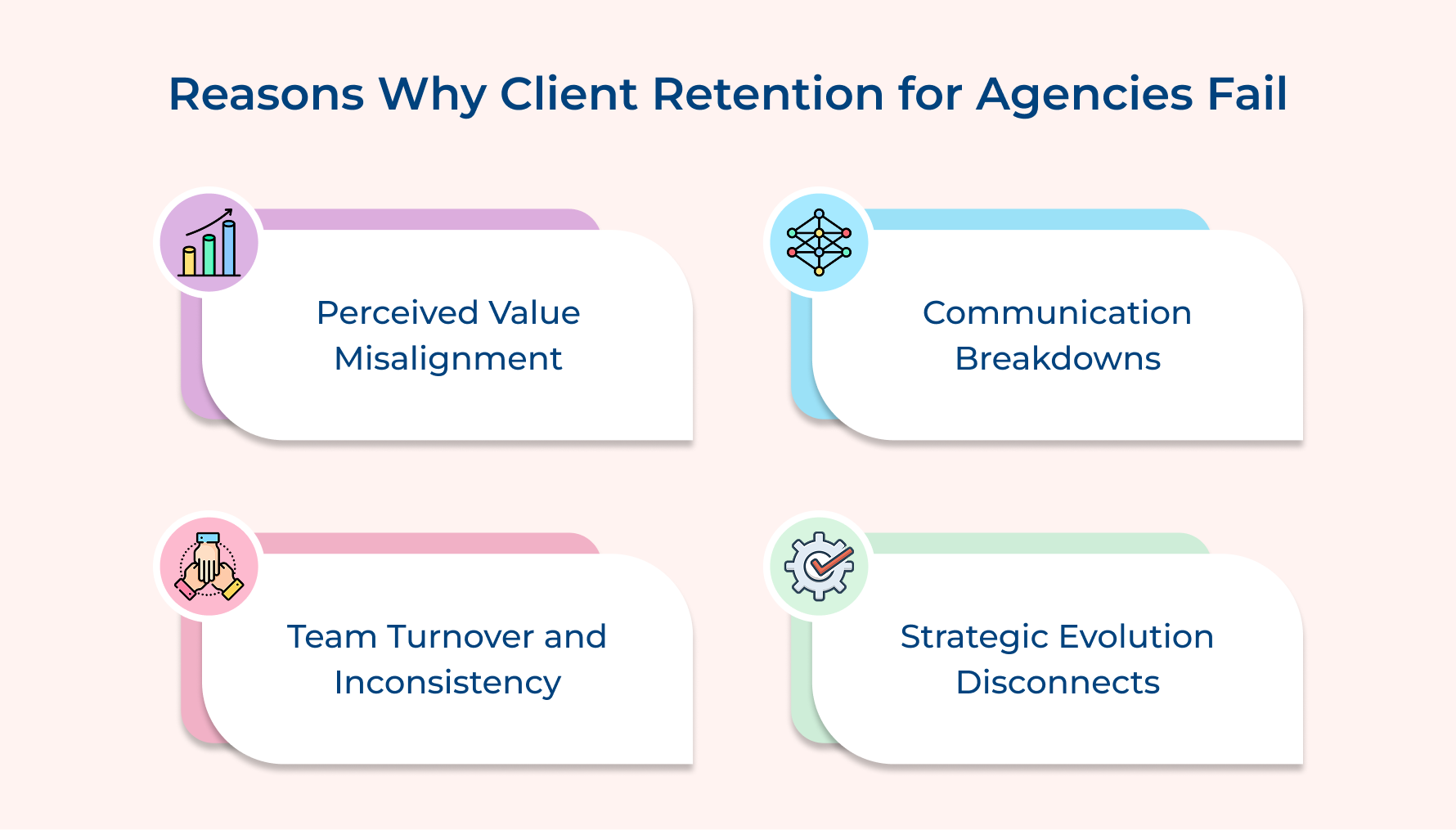
Perceived value misalignment happens when clients feel they aren’t getting enough results for the money they spend. If you don’t regularly show how your work supports their goals, clients may see your services as an easy cost to cut.
Communication breakdowns cause frustration. Slow replies, no updates, confusing language, or ignoring mistakes can all damage trust. Clients may start to think you don’t understand or care about their needs.
Team turnover and inconsistency hurt relationships. When trusted team members leave, clients must teach new people everything again. This disrupts work and opens the door for competitors to step in.
Strategic evolution disconnects happen when your agency or the client shifts direction. If you don’t adjust together, the partnership may no longer fit.
To prevent these issues:
- Hold regular check-ins to review client goals and adjust your services.
- Set clear communication rules—respond quickly, give updates often, and speak in plain business terms.
- Build systems to save client knowledge during staff changes and have more than one person who knows each account.
- Host quarterly business reviews to spot changes early and talk openly about the future.
- Plan 12–24 months ahead with clients to stay aligned and show how your agency supports long-term success.
Transform Client Satisfaction into Long-Term Success with Retention Strategies
Agency client retention isn’t just about keeping customers, it’s the foundation of sustainable growth. When agencies prioritize existing relationship nurturing alongside new business development, they create stability that withstands market fluctuations. Strong retention rates signal service quality to prospects while reducing the constant pressure to replace departing clients.
Agency client retention can dramatically improve profitability by focusing retention efforts on relationship deepening rather than constant acquisition. This approach naturally leads to expanded service opportunities with existing clients who already trust your work. Consistent client partnerships enable better resource planning, predictable revenue forecasting, and the invaluable competitive advantage of accumulated client knowledge.
Limit time — not creativity
Everything you need for customer support, marketing & sales.

Shivank Kasera is part of the marketing team at Kooper, where he focuses on building content that helps agencies and service providers grow. With a keen interest in SaaS, operations, and scalability, he translates practical insights into actionable resources for business leaders.