8 Resource Management Elements Every Project Team Needs

Key Highlights:
- Clear resource management elements prevent wasted capacity and improve project coordination.
- Strategic infrastructure planning ensures the right tools are available at the right time.
- Staffing optimization aligns individual skills with project needs for faster, higher-quality delivery.
Projects usually don’t fail because teams lack people or equipment. They fall apart when no one can clearly see who’s available or what’s needed at each stage of the project lifecycle. As deadlines approach, managers scramble to respond to new project requests, relying on outdated spreadsheets and last-minute coordination.
The real issue isn’t resources—it’s the absence of clearly defined resource management elements. Capacity gets wasted when teams lack shared visibility and effective collaboration tools to align work and availability.
When you build a resource management process around a few core elements, everything changes. These connected practices create clarity, improve coordination and help teams plan smarter across the entire project lifecycle.
What is Resource Management?
Resource management is the strategic process of planning and allocating an organization’s assets effectively. These assets include people, equipment, time, money and materials. The goal is to use these resources efficiently to achieve specific objectives while minimizing waste.
This practice involves continuous monitoring and adjustment of how resources are distributed across different projects or departments. Organizations must balance competing demands while ensuring nothing is overused or left idle. Good resource management helps teams deliver results on schedule and within budget.
Key objectives:
- Optimal allocation: Assign the right resources to the right tasks at the right time to maximize productivity.
- Cost efficiency: Reduce unnecessary expenses by preventing resource shortages and avoiding overstaffing or surplus inventory.
- Risk mitigation: Identify potential resource constraints early and develop backup plans to prevent project delays.
- Workload balance: Distribute tasks evenly among team members to prevent burnout and maintain consistent output quality.
- Strategic alignment: Ensure resource deployment directly supports the organization’s long-term goals and priority initiatives.
8 Essential Elements of Resource Management
Let’s walk you through the eight essential elements of resource management that can transform your chaos into order and spur your projects toward success
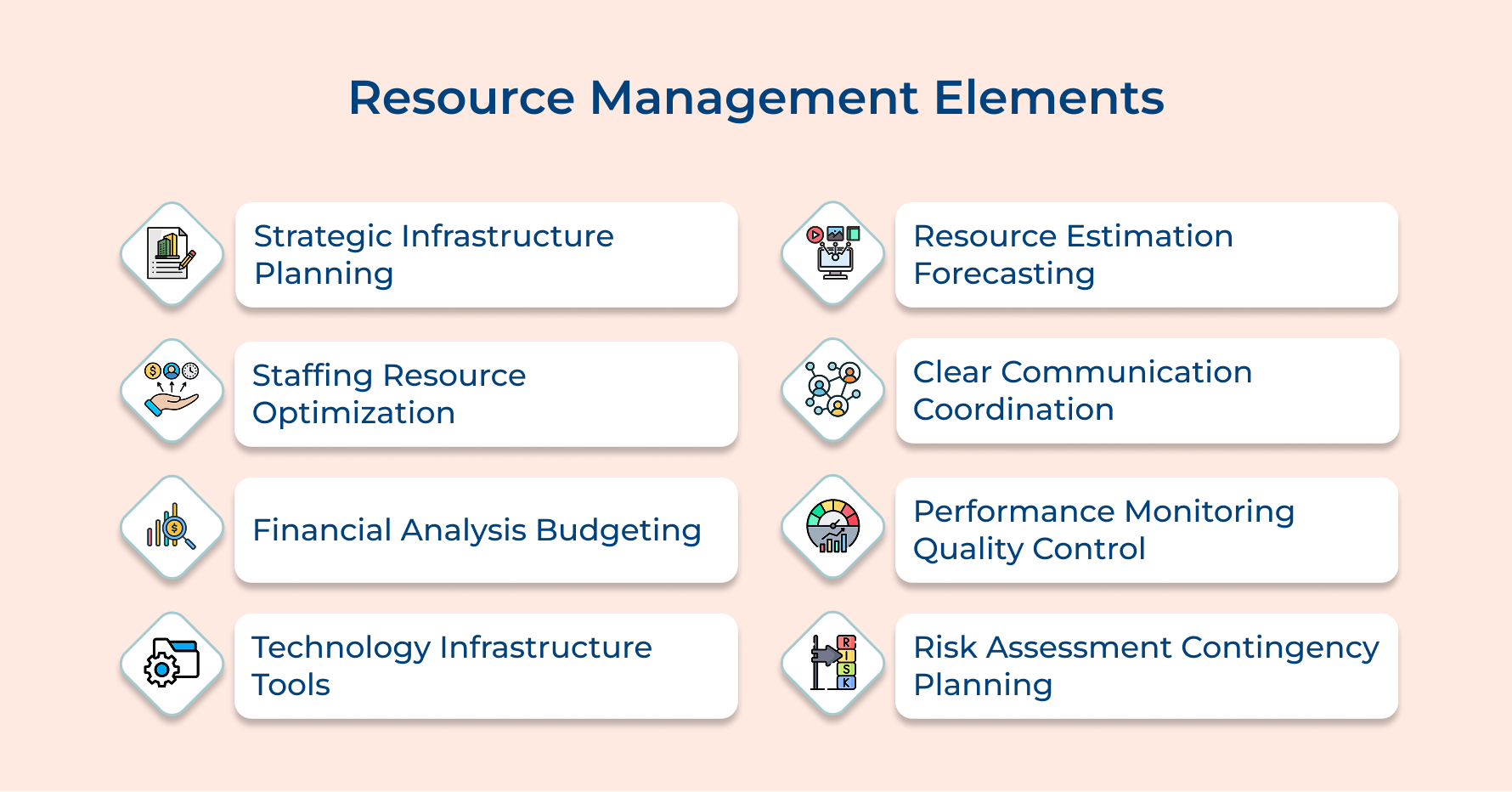
1. Strategic Infrastructure Planning and Development
Strategic infrastructure planning is about making smarter decision making around the equipment and facilities your teams rely on. In a fast-moving multi-project environment, having the right tools available at the right time keeps work flowing smoothly and avoids unnecessary delays.
The process starts with a simple infrastructure check. By reviewing existing assets and aligning them with upcoming project needs, organizations can spot gaps early. This visibility also supports better supply chain management, helping teams decide whether to reuse, upgrade, or invest before projects are at risk.
Common physical assets critical for both organizational operations and client projects include:
- Office space and meeting facilities
- Computer hardware and servers
- Specialized equipment and machinery
- Transportation and delivery vehicles
Effective infrastructure management requires ongoing attention beyond initial setup. Organizations must track asset performance and anticipate replacement cycles before equipment failures disrupt client work. Regular assessment prevents situations where teams discover critical gaps mid-project.
Future planning based on growth projections helps organizations stay ahead of demand. Leaders should analyze pipeline trends and client acquisition rates to forecast infrastructure needs. This forward-thinking approach prevents scrambling for resources when new projects begin.
Here’s how different agencies approach infrastructure planning for client projects:
- Marketing agency: Invests in rendering workstations and collaborative software as client campaigns grow more video-focused as well as data-driven.
- Construction firm: Purchases additional heavy equipment six months before peak season based on historical project volume patterns.
- IT consultancy: Expands server capacity and backup systems after signing three enterprise clients with high security requirements.
2. Staffing and Human Resource Optimization
Staffing optimization is really about putting the right people in the right roles at the right time. Even the strongest project plans fall apart if execution doesn’t match expectations. When staffing decisions miss the mark, deadlines slip, clients get frustrated and teams feel the pressure.
Matching Skills to Project Needs
Instead of relying only on job titles, teams benefit from understanding what each person is truly good at. When project managers align tasks with individual strengths, work moves faster and quality improves. Using software solutions to track skills and availability makes these decisions clearer as well as less reactive.
Building Skills through Focused Training
Training shouldn’t be a last-minute fix. By spotting recurring skill gaps early, organizations can invest in targeted development that prepares teams for future work. This approach supports long-term performance management and builds confidence across projects.
Keeping Workloads Sustainable
Balanced workloads protect both productivity and morale. Monitoring capacity across projects helps managers redistribute work before burnout sets in, keeping teams healthy and delivery consistent.
3. Comprehensive Financial Analysis and Budgeting
Financial analysis involves tracking resource costs and comparing actual spending against projections to maintain project profitability. This element determines if organizations can sustain operations while delivering client value. Projects consume more resources than they generate in revenue when financial oversight is not rigorous.
Key financial metrics that drive effective resource management include:
- Budget variance percentage
- Resource utilization rates
- Cost per deliverable unit
- Return on resource investment
- Overhead allocation ratios
These metrics work together to reveal where resources flow efficiently and where adjustments are needed. Organizations should review these indicators weekly for active projects and monthly for overall resource health. Real-time tracking allows managers to correct courses before small overruns become major financial problems.
Pro tips:
- Build a contingency buffer of 10-15% into resource budgets to handle unexpected scope changes without derailing profitability.
- Review resource costs quarterly against market rates to ensure internal estimates reflect current pricing realities.
4. Modern Technological Infrastructure and Tools
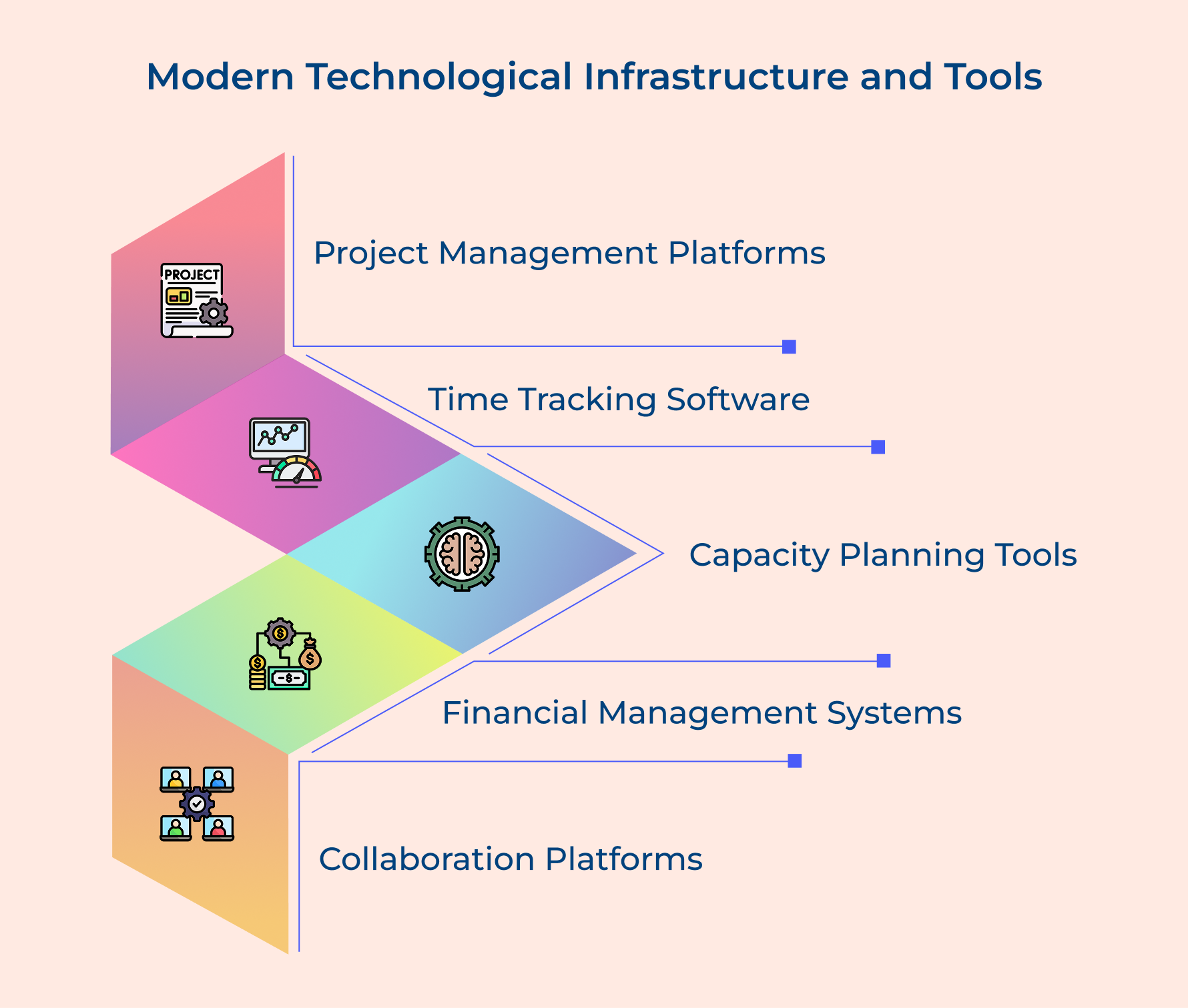
Modern technological infrastructure encompasses the software systems and digital platforms that enable efficient resource tracking as well as allocation across projects. Organizations need robust technology because manual resource management becomes impossible as project complexity grows.
What should organizations consider when evaluating resource management technology? The primary consideration is if the system provides real-time visibility into resource availability across all projects simultaneously. Technology should also reduce administrative burden rather than creating more data entry work for already busy team members.
Essential technology tools that support resource management in client-focused organizations:
- Project management platforms: Coordinate tasks and track resource allocation across multiple simultaneous client engagements with shared visibility.
- Time tracking software: Captures how team members actually spend hours to reveal utilization patterns and billing accuracy.
- Capacity planning tools: Forecast future resource needs by analyzing historical data and upcoming project pipeline requirements.
- Financial management systems: Monitor resource costs in real-time and alert managers when spending approaches budget thresholds.
- Collaboration platforms: Enable distributed teams to communicate efficiently and reduce time wasted on status meetings as well as email chains.
A mid-sized consulting firm implemented integrated resource management software after struggling with spreadsheet-based planning. The system revealed that senior consultants spent 40% of time on administrative tasks that junior staff could handle. Reallocating these activities freed up billable hours and improved project margins by 18%.
5. Accurate Resource Estimation and Forecasting
Accurate resource estimation predicts the time, people and materials needed to complete projects successfully. Poor estimation creates cascading problems that damage both profitability and reputation.
Critical questions to guide your resource estimation process include:
- What similar projects have we completed and what resources did they actually consume?
- Which team members have the specific skills required and what is their current availability?
- What external dependencies could affect our resource requirements?
- How much buffer capacity should we include for unexpected complications?
- What seasonal patterns might impact resource availability during project execution?
These questions force organizations to examine estimation from multiple angles rather than relying on gut feelings. Asking them systematically uncovers hidden assumptions and reveals gaps before they become expensive problems.
Organizations can implement stronger estimation by creating templates based on historical project data. Teams should hold review sessions where multiple perspectives challenge initial assumptions. Building a culture where people honestly discuss past failures leads to continuous improvement.
6. Clear Communication and Stakeholder Coordination
Clear communication establishes shared understanding about resource availability, allocation decisions and changing priorities across all stakeholders. Even perfect resource plans fail when teams lack visibility into decisions. Miscommunication leads to duplicate work and frustration.
Effective communication requires regular touchpoints where resource managers share availability updates with project leads. Organizations should use centralized platforms where anyone can see current commitments and upcoming availability.
Best practices:
- Document resource allocation decisions with brief explanations so future teams understand the reasoning.
- Create weekly resource status emails highlighting upcoming capacity constraints and new availability.
7. Performance Monitoring and Quality Control
Performance monitoring tracks how effectively resources are being utilized and in case they’re producing expected results. Without measurement, organizations repeat inefficient patterns because they lack data to identify what needs improvement.
Three practical approaches to strengthen performance monitoring:
- Establish utilization dashboards: Create visual displays showing billable versus non-billable time for each team member so managers spot underutilization patterns.
- Conduct project retrospectives: Hold structured sessions after project completion where teams analyze what consumed more resources than planned.
- Track quality metrics alongside efficiency: Monitor rework rates and client satisfaction to ensure optimization doesn’t compromise deliverable quality.
A digital marketing agency noticed their most heavily utilized account manager’s projects consistently required more revisions. Performance monitoring revealed that rushing between clients reduced initial quality. Redistributing some accounts to less busy managers improved first-pass approval rates by 35%.
8. Risk Assessment and Contingency Planning
Risk assessment helps teams spot resource gaps and disruptions before they derail delivery timelines. Every resource plan is built on assumptions and when those assumptions don’t hold, projects suffer. That’s why planning for uncertainty is essential—especially when changes in project scope or availability are common.
Spotting Resource Vulnerabilities Early
Regular reviews help teams understand where they’re exposed. Ask simple questions: who holds critical knowledge and what happens if they’re unavailable? Using capacity mapping makes these risks visible across projects and gives you time to plan alternatives instead of reacting under pressure.
Preparing Backup Options for Key Roles
Contingency planning means having a second option ready. Cross-training team members, documenting processes and maintaining backup vendors ensures work continues even when plans shift unexpectedly.
Keeping Schedules Flexible
Avoid planning at full capacity. Adding buffers creates breathing room, allowing teams to absorb small delays without impacting the overall project.
Common Challenges from Misaligned Resource Management
When resource management elements operate independently from project objectives, organizations face systematic breakdowns that compromise delivery quality and profitability.
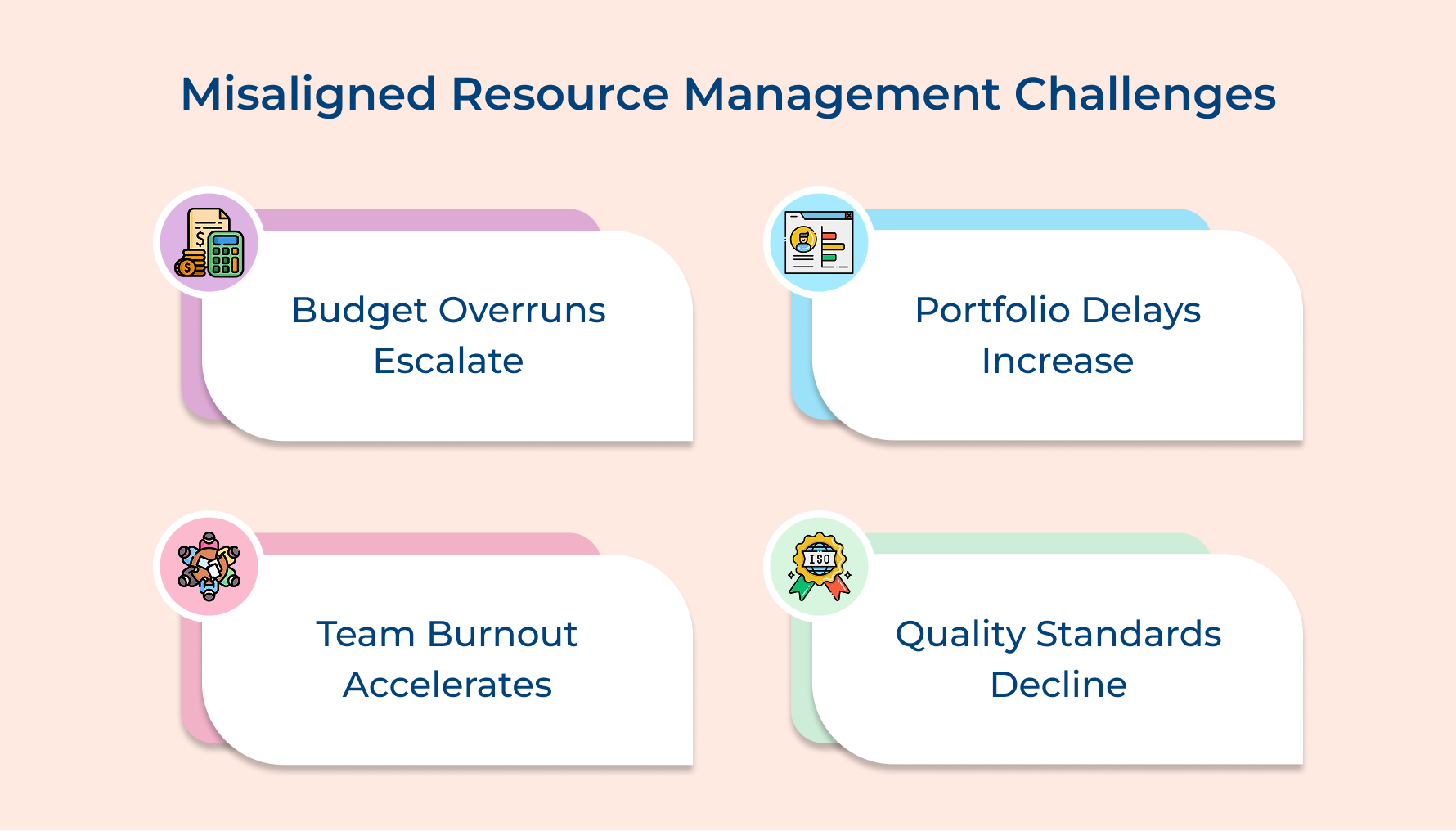
Budget Overruns Become Inevitable
when financial planning doesn’t reflect actual project requirements and teams spend resources on activities that don’t advance core objectives. Money flows toward available resources rather than necessary ones, creating waste that erodes margins.
Project Delays Multiply Across The Portfolio
when staffing decisions ignore project timelines and skill requirements don’t match assigned personnel. Teams spend extra time compensating for capability gaps while critical activities wait for appropriate resources.
Team Burnout Accelerates Rapidly
when workload distribution ignores individual capacity limits and performance monitoring focuses solely on utilization percentages. People become overextended on low-priority work while high-value projects remain understaffed.
Quality Standards Deteriorate Progressively
when infrastructure planning and technology tools don’t support the precision that deliverables require. Teams improvise with inadequate equipment that can’t maintain expected standards. The resulting rework consumes additional resources and damages reputation.
Aligning resource management elements with project goals requires intentional coordination and regular validation:
- Link every resource allocation decision back to specific project deliverables so teams understand how their work contributes to success.
- Establish cross-functional planning sessions where project managers and resource managers jointly review upcoming commitments against available capacity.
- Create feedback loops that capture lessons from completed projects and feed those insights directly into future estimation processes.
- Implement shared dashboards that give all stakeholders visibility into how resource deployment connects to progress toward milestones.
- Schedule quarterly alignment reviews where leadership examines if resource management practices still support evolving organizational priorities.
Harness the Power of Versatility With Resource Management Elements
Effective resource management elements transform how organizations deliver client projects by connecting strategic planning with daily execution decisions. When all eight elements work together, teams gain the clarity and flexibility needed to adapt quickly while maintaining quality standards as well as profitability targets.
Mastering these elements requires ongoing attention rather than one-time implementation because business conditions and client needs constantly evolve. Organizations that treat resource management as a dynamic practice rather than a static framework build resilience that carries them through both predictable challenges and unexpected disruptions with confidence.
Limit time — not creativity
Everything you need for customer support, marketing & sales.

Neeti Singh is a passionate content writer at Kooper, where he transforms complex concepts into clear, engaging and actionable content. With a keen eye for detail and a love for technology, Tushar Joshi crafts blog posts, guides and articles that help readers navigate the fast-evolving world of software solutions.