How Resource Smoothing Creates Balanced Project Workloads
- What is Resource Smoothing?
- Advantages of Resource Smoothing in Project Management
- Common Drawbacks of Resource Smoothing
- Resource Leveling vs Resource Smoothing: Key Differences
- 7 Essential Steps for Resource Smoothing in Project Management
- Real Life Examples of Resource Smoothing
- Master Time and Resources Effortlessly with Resource Smoothing
- FAQs about Resource Smoothing
Key Highlights:
- Resource smoothing in project management balances workloads without extending your project deadline.
- Prevent burnout and overtime by redistributing tasks using available floats effectively.
- Maintain schedule integrity while optimizing resource usage for consistent project delivery.
Your team drowns during project peaks while sitting idle during valleys and your deadline remains non-negotiable. This pattern burns out your best people and wastes capacity you’re already paying for while clients expect consistent delivery quality.
Resource smoothing redistributes work within existing schedule flexibility to create balanced workloads without extending your timeline. You maintain the same deadline and team but eliminate overallocation spikes that derail productivity as well as morale.
This guide walks you through calculating float to monitoring your smoothed schedule so you can transform uneven workflows into sustainable patterns. You’ll learn when to apply this technique and how to avoid common mistakes that undermine effectiveness.
What is Resource Smoothing?
Resource smoothing is a scheduling technique where you adjust activities within their available float to create a more balanced workload without changing the project deadline. You’re moving tasks around within their flexibility windows to avoid resource peaks and valleys while keeping your final delivery date exactly the same.
When To Use Resource Smoothing?
Use resource smoothing when you’re working under a tight time constraint and your team’s workload feels uneven. It’s especially helpful in situations where certain people hit intense work periods and then have stretches of downtime – something that often leads to inefficiencies or even project delays if not managed well.
This technique works best when you have some flexibility in non-critical tasks and want to avoid overtime costs or burning out your team. It’s most effective when the critical path has enough buffer in parallel activities, giving you room to rebalance workloads without disrupting delivery.
Key objectives:
- Maintain project timeline: Keep the original project completion date intact while optimizing resource allocation.
- Balance resource utilization: Distribute workload more evenly across the project duration to prevent overallocation spikes.
- Minimize resource costs: Reduce expenses associated with overtime or bringing in additional temporary resources.
- Improve team morale: Prevent burnout by creating sustainable work patterns instead of intense peaks followed by downtime.
- Preserve critical path: Ensure critical activities remain unchanged while adjusting only tasks with available slack time.
Advantages of Resource Smoothing in Project Management
Resource smoothing offers project managers a practical way to optimize their team’s workload without disrupting deadlines. Let’s explore how this technique creates tangible benefits for your projects.
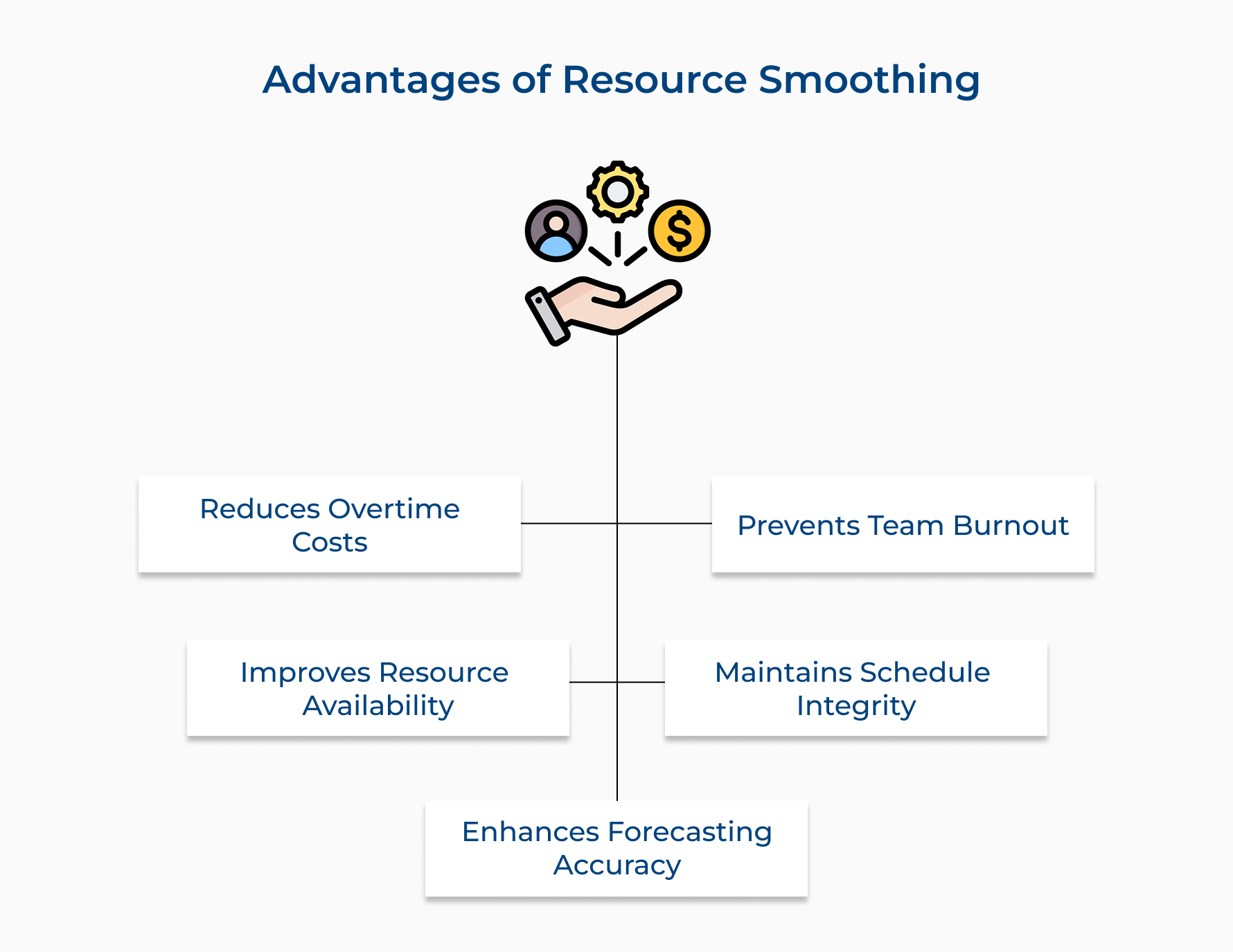
Common 1. Reduces Overtime Costs
You avoid those costly crunch periods where people rack up extra hours by using this resource optimization technique to spread work more evenly across the timeline. This keeps labor expenses predictable and prevents budget overruns that happen when workloads spike without warning.
2. Prevents Team Burnout
Smoothing creates a steadier workload distribution, so your team isn’t bouncing between chaotic pressure and long idle stretches. This balanced pace supports mental well-being and keeps productivity strong throughout the project, not just when things get critical.
3. Improves Resource Availability
You can stay within your existing resource requirements without hiring extra staff or pulling people from other teams. By timing tasks more strategically, the same resources can handle work sequentially instead of being overwhelmed by competing demands.
4. Maintains Schedule Integrity
Unlike leveling, smoothing protects your committed project deadlines while still improving how resources are used. It’s ideal for fixed-date deliveries or contractual commitments where pushing timelines simply isn’t an option.
5. Enhances Forecasting Accuracy
A smoothed plan produces predictable patterns that make future planning more reliable. You can anticipate skill needs earlier and spot conflicts sooner because your resource usage follows a cleaner, more manageable rhythm.
Common Drawbacks of Resource Smoothing
While resource smoothing offers clear benefits, it’s not a perfect solution for every project situation. Understanding its limitations helps you decide when to apply this technique and when to consider alternative approaches.
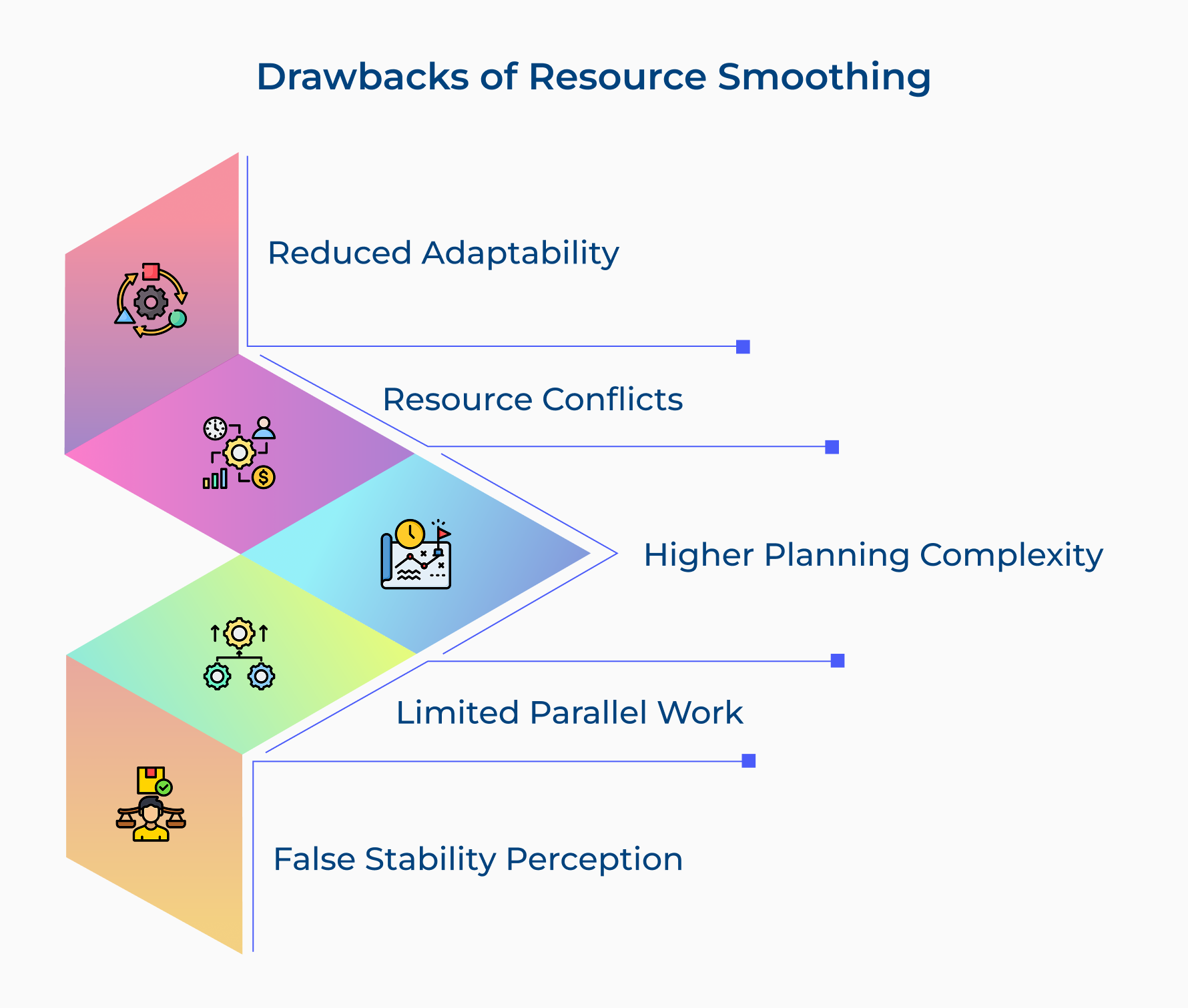
1. Reduces Adaptability of the Project
Resource smoothing consumes the float in your schedule by shifting non-critical tasks to balance workloads. Once you’ve used up this flexibility, you lose your buffer against unexpected delays or changes. This means any disruption that would normally be absorbed by slack time now threatens your deadline.
2. Leads to Resource Scheduling Conflicts
When you move tasks around to smooth resource usage, you create complex dependencies that can trigger cascading problems. A single resource becoming unavailable might force you to rework the entire schedule because everything has been optimized so tightly that alternative arrangements become extremely difficult.
3. Increases Planning Complexity
Creating a smoothed schedule requires sophisticated analysis of float times and resource availability across multiple activities simultaneously. It takes considerable time and expertise to execute properly. Small projects might spend more effort on smoothing than they save from the optimization itself.
4. Limits Parallelism Opportunities
Smoothing often means doing tasks sequentially that could theoretically run in parallel to avoid resource conflicts. While this creates even workloads, you miss chances to accelerate progress when resources temporarily become available. Fast-tracking opportunities disappear because you’ve locked into a leveled approach.
5. Creates False Sense of Stability
A perfectly smoothed schedule looks beautifully balanced on paper but this optimized state rarely survives contact with reality. The plan becomes brittle because it assumes everything will proceed exactly as scheduled. Your smooth plan can quickly become obsolete and requires constant adjustment when inevitable variations occur.
Resource Leveling vs Resource Smoothing: Key Differences
Both techniques optimize how you use resources in project management, but they work in fundamentally different ways. Understanding when to apply each method can make the difference between meeting your deadline and missing it entirely.
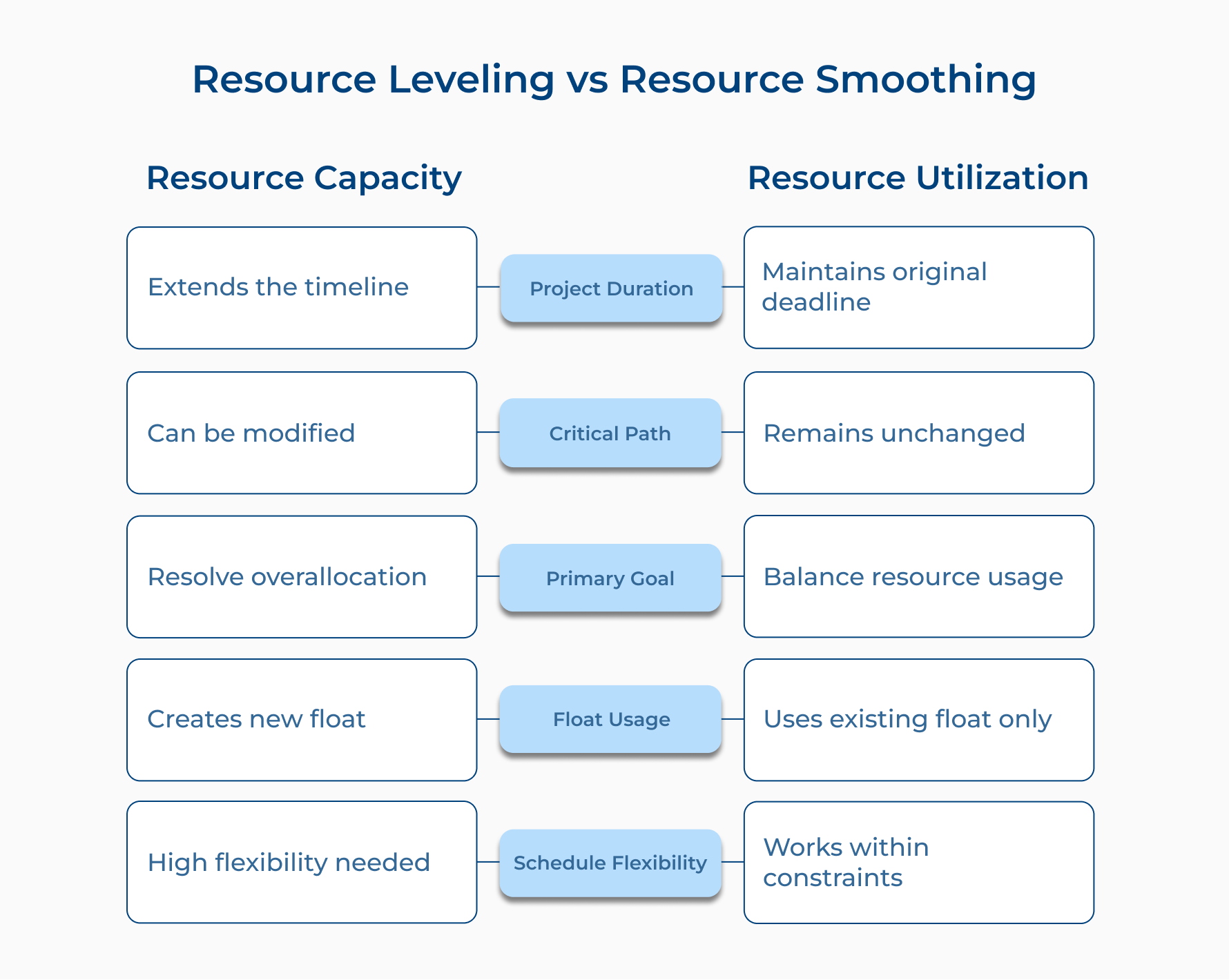
1. Impact on Project Timeline
Resource leveling accepts that your project deadline will likely shift when you need to resolve resource conflicts. The technique prioritizes having adequate resources available over finishing on time.
Resource smoothing treats your deadline as non-negotiable and works backward from that fixed end date. You can only adjust activities that have scheduling flexibility without pushing out the final delivery.
2. Handling the Critical Path
Leveling doesn’t protect your critical path and will extend it when necessary to eliminate resource overallocation problems. Tasks on the critical path might get delayed if that’s what it takes to balance workloads.
Smoothing carefully preserves the critical path because any delay there would automatically extend your project timeline. Only non-critical activities with available floats can be moved around for optimization purposes.
3. Approach to Resource Conflicts
Leveling directly solves resource overallocation by delaying tasks until resources become available even if it means serial execution. The primary concern is ensuring no resource is assigned more work than they can handle.
Resource smoothing accepts some resource constraints and works around them by redistributing work within existing schedule boundaries. It aims for better balance rather than perfect allocation in every time period.
4. Schedule Flexibility Requirements
Leveling requires significant freedom to adjust your schedule because resolving all resource conflicts might demand substantial timeline extensions. This works well for internal projects where deadlines can be negotiated or moved.
Smoothing needs activities with built-in floats to work with since it cannot create additional scheduling rooms. Projects with tight schedules and little slack make smoothing difficult or impossible to implement effectively.
7 Essential Steps for Resource Smoothing in Project Management
Ready to streamline your project execution? Let’s explore the seven essential steps for resource smoothing that will empower you to maximize productivity and achieve your project goals with confidence
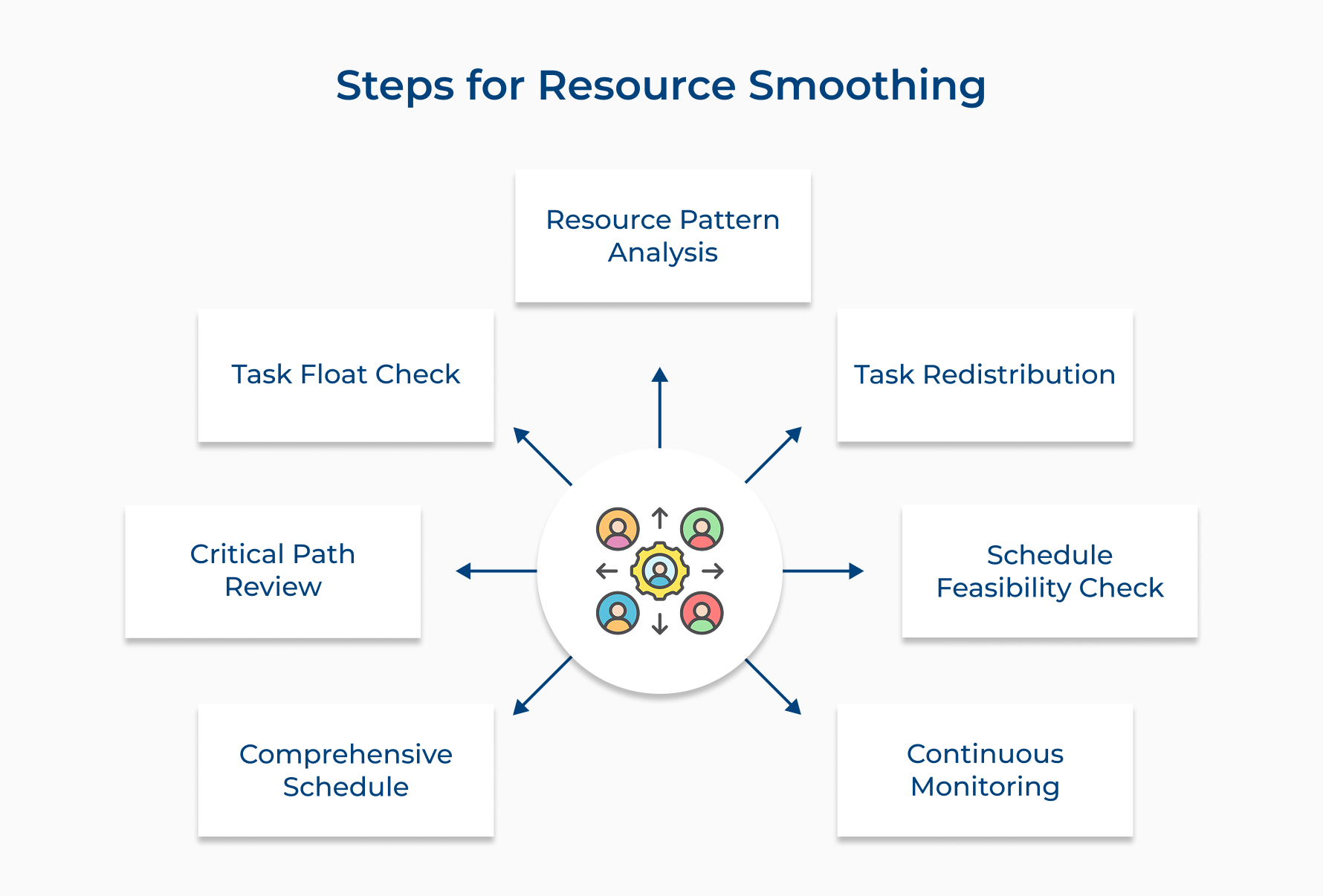
1. Create a Comprehensive Project Schedule
A comprehensive project schedule is your foundation document that lists every activity with start dates and end dates. A clear baseline lets you spot resource conflicts early and see where there’s room to make smoothing adjustments.
Consider your resource availability and task dependencies when building this schedule since these factors directly determine your smoothing options. Also account for activity durations and any external constraints like vendor delivery timelines that might limit your flexibility.
What makes an ideal project schedule for client-based businesses. Here’s what your baseline schedule should include regardless of your industry:
- Activity breakdown: List all deliverables with clear milestones that align with client review points and approval stages.
- Dependency mapping: Show which tasks must finish before others can start to avoid scheduling conflicts with client feedback loops.
- Resource assignment: Specify who does what with their availability percentages so you know capacity constraints upfront.
- Buffer integration: Include reasonable contingency time for client revisions or unexpected scope clarifications that typically emerge during projects.
2. Identify Your Project’s Critical Path
The critical path represents the sequence of dependent tasks that determines your minimum project duration. Identifying it matters because these activities cannot be delayed without pushing your final deadline which defeats the entire purpose of smoothing.
If you’re unsure where to begin with critical path identification, ask yourself these foundational questions:
- Which tasks have zero float and must start exactly on schedule?
- What is the longest chain of dependent activities from project start to finish?
- Which activities would delay the entire project if they slip by even one day?
- Where do multiple task sequences converge creating potential bottlenecks?
These questions help you distinguish between tasks that offer scheduling flexibility and those that absolutely cannot move. Understanding this distinction creates the foundation for effective smoothing because you’ll know exactly which activities are off-limits for adjustment.
Once you’ve answered these questions you need to formally document your critical path using calculation methods. This converts your intuitive understanding into precise data that guides all subsequent smoothing decisions.
How to implement critical path identification:
- Calculate early start and early finish dates for each activity by working forward through your schedule dependencies.
- Determine late start and late finish dates by working backward from your project deadline to find the latest possible times.
- Compare these dates to find activities where early and late dates match perfectly since those tasks have no flexibility.
3. Calculate Float for Each Task
Float or slack is the amount of time a task can be delayed without affecting your project deadline. This step is critically important because float tells you exactly how much scheduling flexibility you have to work with when redistributing tasks.
Understanding float calculation requires knowing these key components:
- Late start (LS): The latest time an activity can begin without delaying the project completion date.
- Early start (ES): The earliest time an activity can begin based on its predecessor dependencies and constraints.
- Total float formula: Total Float = LS – ES, which shows the maximum delay possible for that activity.
What’s the benchmark for acceptable float? There’s no universal standard for how much float is ideal in project management. However most projects need at least some non-critical activities with float to enable smoothing since zero float means zero flexibility.
Follow these steps to determine scheduling flexibility:
1. Determine total slack in non-critical activities: Calculate the difference between late start and early start for each non-critical task to reveal your smoothing opportunities. Focus on activities with substantial slack since they offer the most flexibility for redistribution without threatening your deadline.
Common non-critical tasks that can be adjusted during resource smoothing:
- – Documentation updates
- – Training materials development
- – Post-implementation reviews
- – Lessons learned sessions
2. Identify free float for individual tasks: Free float measures how much delay a task can absorb without pushing any successor’s early start date forward. Calculate it as the difference between the task’s early finish and the earliest early start of its immediate successors to find truly independent scheduling flexibility.
3. Calculate forward pass: Start from day one and work through your network diagram adding durations to find the earliest each activity can start as well as finish. This establishes your baseline timeline and reveals the fastest possible completion path.
Understanding float gives you the data-driven confidence to make scheduling adjustments that optimize resource usage without compromising project success. This quantitative approach transforms smoothing from guesswork into a calculated strategy.
4. Analyze Current Resource Allocation Patterns
The analysis reveals where your resources face overallocation peaks and underutilization valleys across the project timeline. You need this visibility because smoothing specifically targets these imbalances by redistributing work from congested periods into available capacity windows.
Understanding current patterns helps you make informed decisions about which tasks to move and when to reschedule them. Look at both individual resource workloads as well as team-wide capacity to identify the most problematic bottlenecks worth addressing first.
Pro tips:
- Use resource histograms: Visual charts showing resource demand over time make peaks and valleys immediately obvious compared to scanning spreadsheet data.
- Focus on constraint resources: Prioritize smoothing for your most specialized or limited resources since they create the biggest project bottlenecks.
5. Redistribute Tasks Within Slack Time
Redistributing tasks involves moving flexible activities to different time periods within their available float to balance resource workloads. It’s necessary because uneven allocation leads to overtime costs and burnout which ultimately affects your ability to deliver quality work consistently.
Three effective ways to redistribute tasks for smooth allocation:
- Shift to resource valleys: Move tasks with float into periods where team members have lighter workloads instead of stacking them during busy phases.
- Split when possible: Break longer non-critical activities into smaller chunks that can be scheduled across multiple time periods if dependencies allow.
- Delay low-priority tasks: Push activities that can wait toward the end of their available float to free up resources for higher-value work earlier.
For example your designer is overallocated in week three with both client mockups and brand guidelines due simultaneously. Since brand guidelines have five days of float you move them to week four when the designer has light revision work.
6. Verify Schedule Feasibility and Constraints
Feasibility verification ensures your smoothed schedule actually works and hasn’t created new problems while solving old ones. You need this checkpoint because moving tasks can inadvertently violate dependencies or push critical activities off track without careful validation.
Five key considerations when verifying your smoothed schedule:
- Critical path integrity: Confirm no critical activities have been delayed and your project completion date remains unchanged.
- Dependency preservation: Ensure all predecessor-successor relationships still work logically and tasks start only after dependencies finish.
- Resource constraints: Verify smoothing hasn’t overallocated resources in new time periods while fixing old problems.
- External deadlines: Check that client review points and regulatory milestones still align with your adjusted schedule.
- Contractual obligations: Validate that fixed delivery dates or payment milestone triggers remain achievable under the new schedule.
7. Monitor and Adjust the Schedule
Monitoring involves tracking actual resource usage against your smoothed plan while identifying deviations as they occur. This oversight is essential because projects rarely unfold exactly as planned and early detection lets you correct course before small issues become major problems.
Use monitoring data to make informed adjustments when reality diverges from your plan rather than rigidly sticking to an outdated schedule. Regular reviews help you spot patterns that signal the need for re-smoothing.
Best practices:
- Hold brief check-ins to compare planned versus actual allocation and identify emerging bottlenecks before they impact deliverables.
- Revise your smoothed schedule when significant changes occur rather than letting the plan become disconnected from reality.
Real Life Examples of Resource Smoothing
Resource smoothing plays out differently across industries based on the unique challenges. Let’s explore how three organizations apply this technique to balance workloads while protecting deadlines.
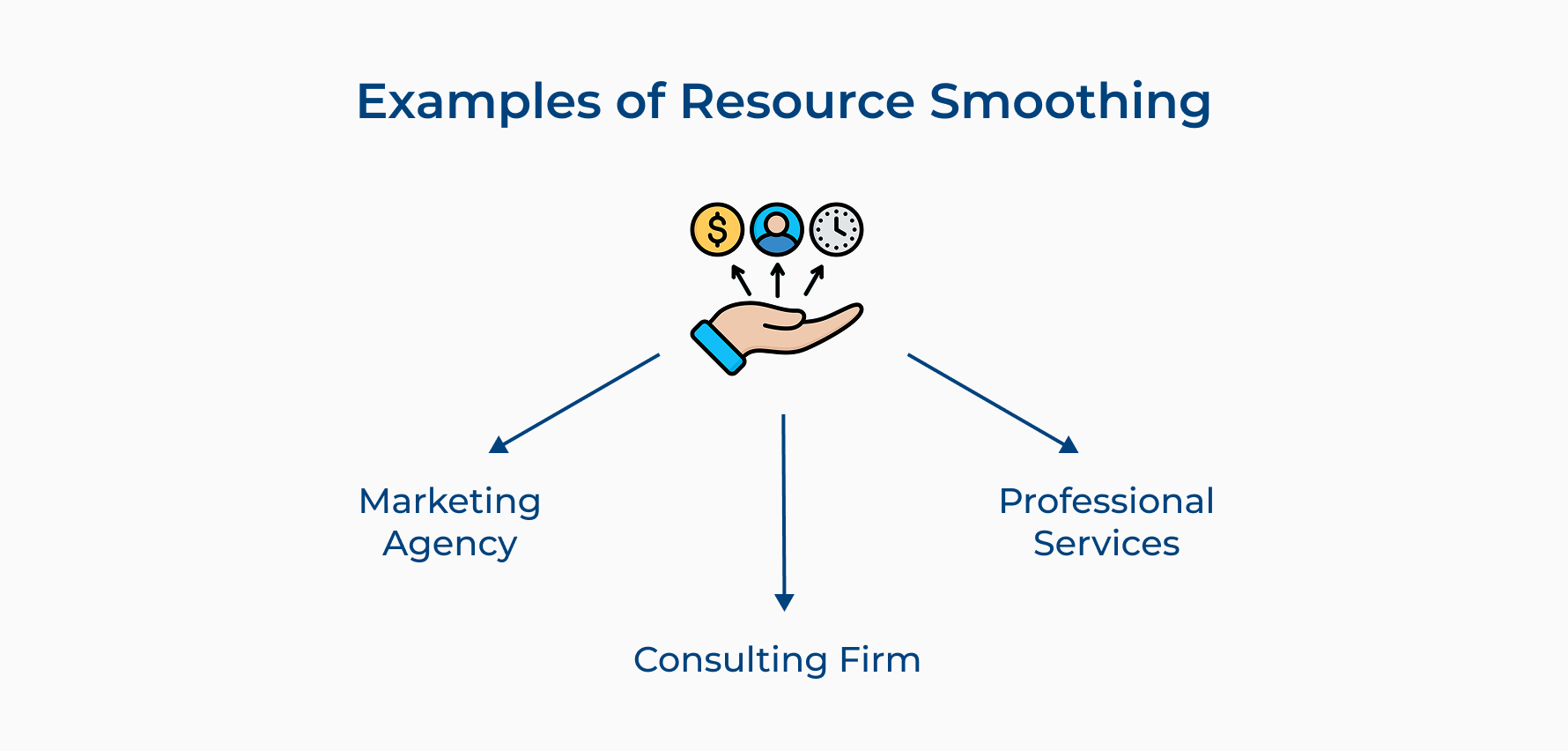
Marketing Agency
In week two, your creative team hits a major crunch with three big client presentations landing at the same time, while weeks three and four look almost empty. Your designer and copywriter are stretched to 150% capacity, putting deadlines at risk.
When you notice that Client B’s presentation has four days of slack, you simply shift that work to week three. Suddenly, week two becomes manageable and the quieter weeks are put to better use, creating a smoother, more sustainable workflow.
Consulting Firm
Your senior consultant is stuck handling a client workshop and a technical assessment in the same week, leaving zero breathing room. At the same time, two junior consultants have almost nothing to do because their research tasks haven’t kicked off yet.
Moving those research tasks into their available float lets the juniors begin their work earlier. They prep the initial findings, reducing the senior consultant’s load later. The result? Work is spread more evenly, expertise is used wisely and the final delivery timeline stays exactly the same.
Professional Services
During tax season, your accounting team is overloaded in March with multiple audits piling up, while February has plenty of unused capacity. One client’s compliance review is scheduled much earlier than the filing requirements actually demand.
You shift that second compliance review into February’s lighter window, using the available three-week float. This keeps all filing deadlines intact, avoids burnout and cuts down the need for temporary staff during peak season.
Master Time and Resources Effortlessly with Resource Smoothing
Resource smoothing transforms chaotic project schedules into balanced workflows that protect both your team and your deadlines. Strategically redistributing tasks within their available float will help you create sustainable work patterns that prevent burnout – all while maintaining commitments to clients.
The technique requires upfront planning and ongoing monitoring but the payoff is significant in reduced costs as well as improved team morale. Start with small projects to build your smoothing skills then scale the approach across your entire portfolio for consistent results.
Limit time — not creativity
Everything you need for customer support, marketing & sales.

Neeti Singh is a passionate content writer at Kooper, where he transforms complex concepts into clear, engaging and actionable content. With a keen eye for detail and a love for technology, Tushar Joshi crafts blog posts, guides and articles that help readers navigate the fast-evolving world of software solutions.