Complete Guide to RACI Matrix for Project Management Success
- What is a RACI Chart?
- Key Benefits of RACI Charts in Project Management
- When to Use a RACI Framework?
- Types of Responsibility Assignment Matrix
- How to Create a RACI Chart in 7 Actionable Steps?
- RACI Chart Best Practices in Project Management
- Limitations of RACI Charts in Project Management
- Real Life Examples and Case Studies of RACI Chart
- Empower your Project Team with Clear Direction Through RACI Matrix
- FAQs about RACI Matrix

Key Highlights:
- Clear task ownership using a structured RACI matrix that removes confusion and strengthens accountability across project teams.
- Streamlined communication through a simple RACI chart that clarifies project roles and reduces decision delays.
- Practical, step-by-step RACI model guidance with examples, templates and best practices for smoother project execution.
Your project has eight people working on it but somehow three critical tasks missed their deadlines last week. Nobody can explain who was supposed to approve the deliverables or why the design team never got consulted on technical constraints that now require expensive rework.
This chaos happens because most teams operate on assumptions about who owns what rather than documented agreements everyone can reference. Tasks fall through cracks when people think someone else is handling them and decisions stall when multiple people believe they have approval authority without clear designation.
A RACI chart solves this problem by creating one simple grid that maps every task to every team member with explicit role assignments. This guide to RACI matrix walks you through everything from basic concepts to advanced implementation strategies so you can bring clarity to your next project.
What is a RACI Chart?
A RACI chart is a project management tool that assigns clear ownership and involvement levels for every task or decision. It prevents confusion by documenting who handles what work. The framework ensures accountability remains visible throughout a project’s lifecycle.
The chart maps tasks down the left side and team members across the top. Each intersection gets marked with one of the four RACI letters. This creates a visual grid where you can instantly see everyone’s role for any given task. Project managers use it during planning phases and update it as responsibilities shift.
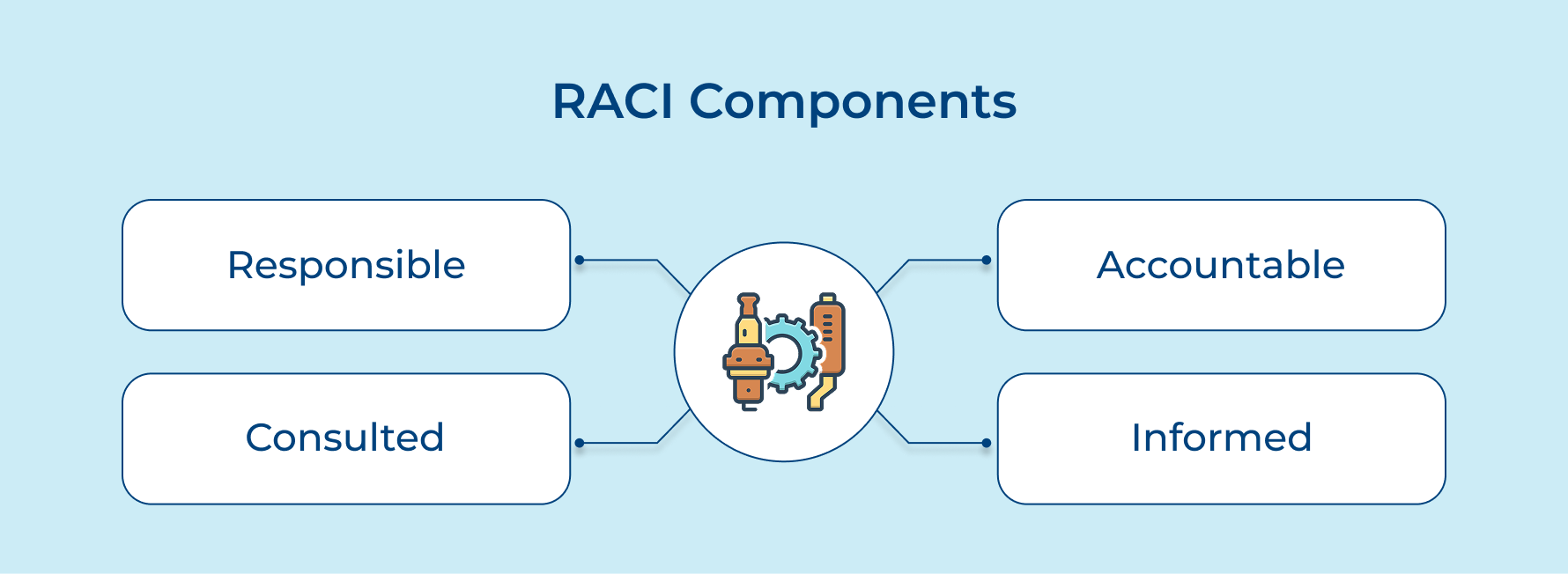
Four RACI Components:
- Responsible: This person does the actual work to complete the task. They’re the ones rolling up their sleeves and producing the deliverables. While multiple people can share this role, having too many responsible parties often dilutes accountability.
- Accountable: This individual ultimately answers for the task’s success or failure. They approve the work that responsible parties complete. Only one person should hold this role per task to maintain clear decision-making authority.
- Consulted: These are the subject matter experts whose input matters before decisions get made. They provide specialized knowledge or feedback through two-way communication. Their expertise shapes how the work gets done but they don’t execute it themselves.
- Informed: These stakeholders need updates about progress or decisions after they happen. Communication flows one way to keep them in the loop. They don’t contribute to the work but need awareness for their own planning or coordination.
Key Benefits of RACI Charts in Project Management
RACI charts bring structure to complex projects by transforming vague responsibilities into concrete assignments. They create clarity that helps teams move faster and work better together.
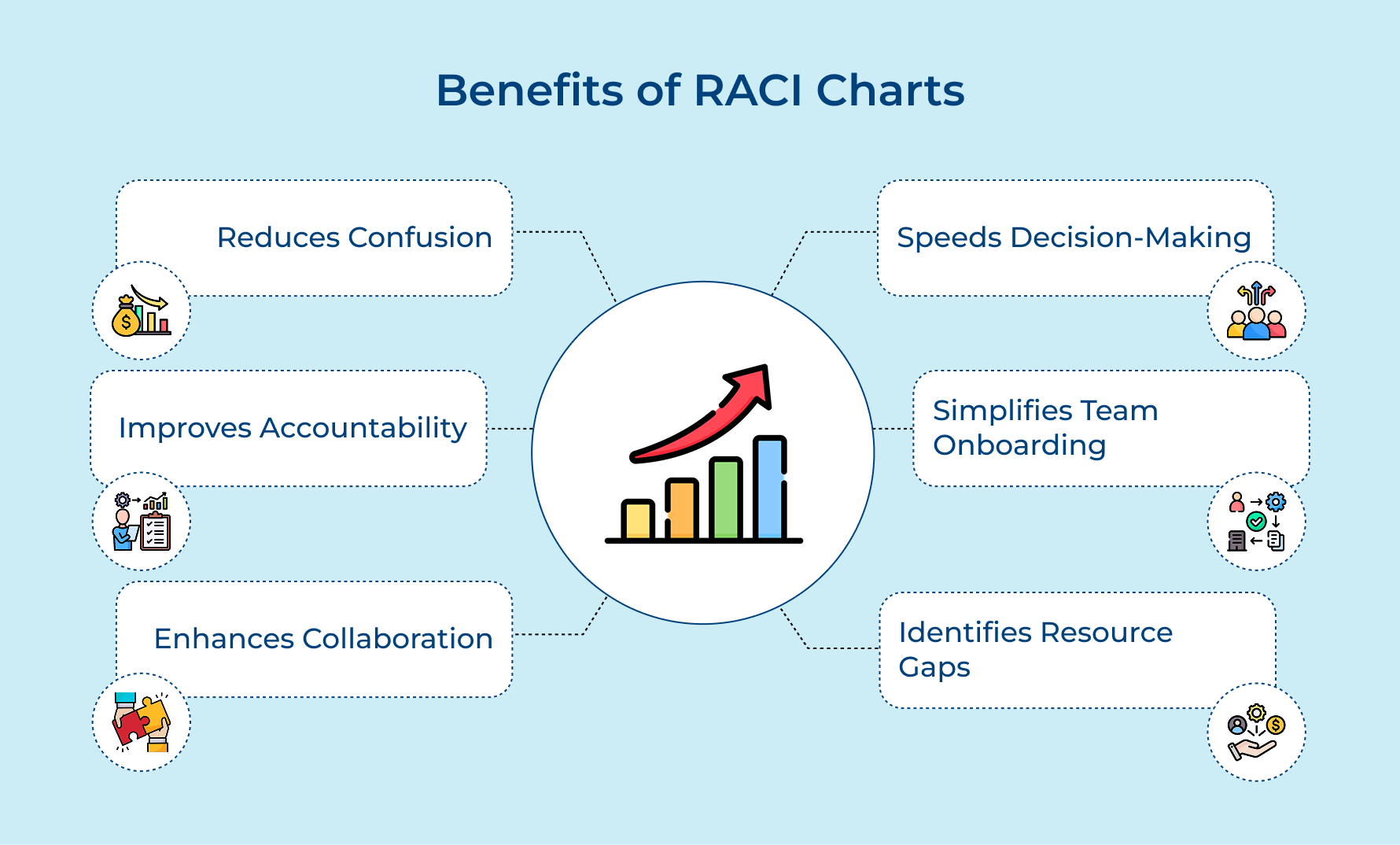
Reduces Confusion and Overlap
When multiple people think they own the same task, work either gets duplicated or completely ignored. A RACI chart eliminates this ambiguity by explicitly stating who handles what. Team members stop second-guessing their roles and can focus energy on execution rather than coordination conversations.
Improves Accountability and Follow-Through
Having one accountable person per task creates a clear point of ownership that prevents work from stalling. When deadlines approach, everyone knows exactly who needs to deliver. This visibility makes it harder for tasks to slip through unnoticed as well as easier to identify bottlenecks before they derail timelines.
Enhances Collaboration and Communication
The chart shows you precisely who needs to be consulted for their expertise and who simply needs updates. It prevents overcommunication that wastes time and undercommunication that creates surprises. Teams can loop in the right voices at the right moments without dragging everyone into every discussion.
Speeds Up Decision-Making
Identifying the accountable party upfront means decisions don’t languish in committee limbo. Conversations move toward resolution faster when everyone knows who has final approval authority. The team avoids endless back-and-forth debates because the decision rights are already established.
Helps onboard new Team Members
New people joining mid-project can look at the RACI chart and immediately understand the team dynamics. They see who to approach for approvals and who possesses specialized knowledge. This accelerates their integration while reducing the burden on existing team members to repeatedly explain the same organizational structure.
Identifies Resource Gaps Early
Creating the chart forces you to think through every task’s staffing needs before work begins. If you can’t assign someone to a responsible role, you’ve discovered a resource problem while there’s still time to solve it. This proactive approach prevents last-minute scrambles when deliverables come due.
When to Use a RACI Framework?
A RACI framework works best in specific scenarios where role clarity becomes critical to success. Knowing when to deploy this tool helps you avoid both chaos and unnecessary bureaucracy.
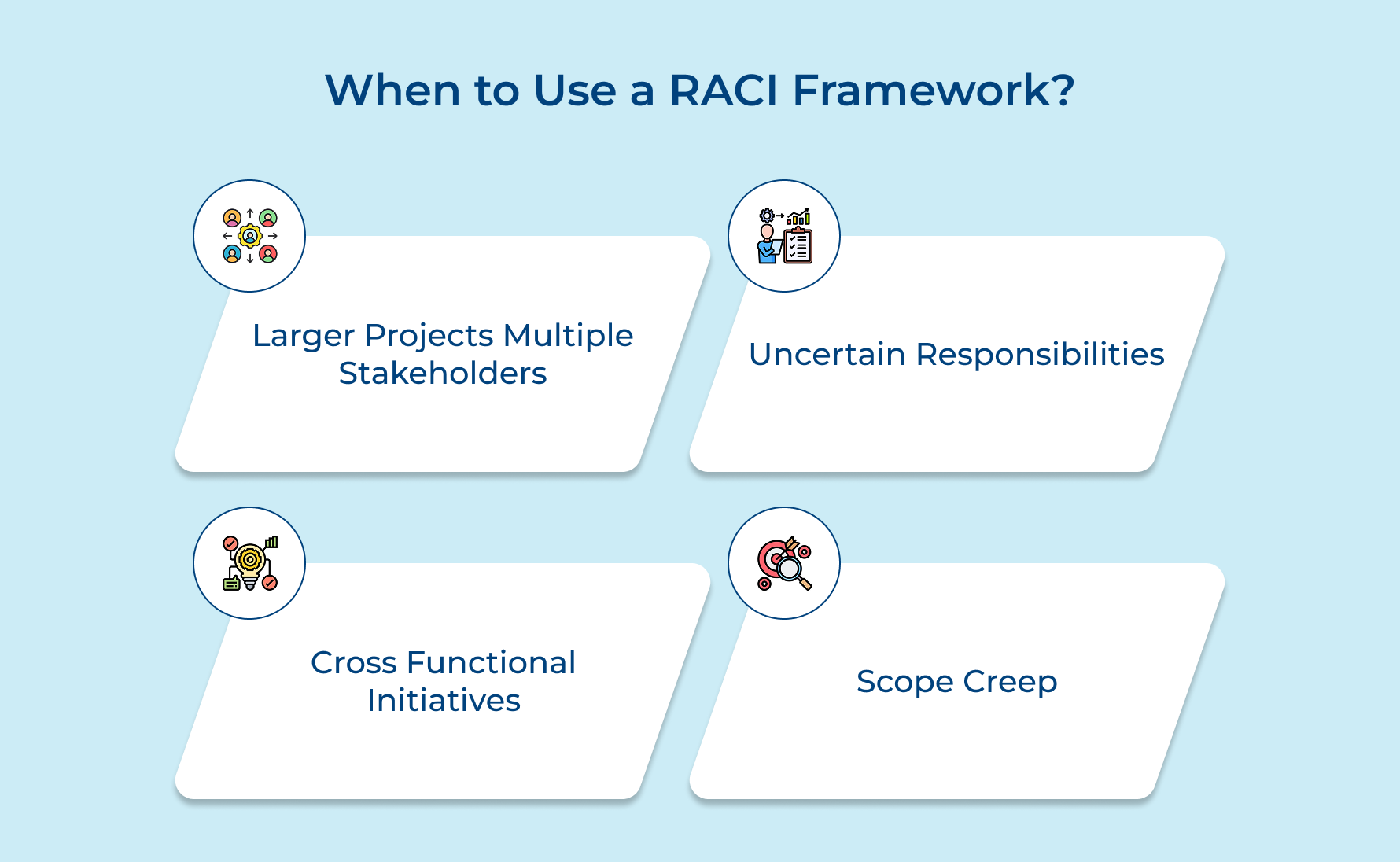
Larger Projects With Multiple Stakeholders
Complex projects involving numerous people naturally breed confusion about who handles what. A RACI chart creates shared understanding across boundaries as well as prevents territorial disputes or gaps in coverage.
Projects With Uncertain Responsibilities
Some initiatives lack clear precedent or involve newly formed teams without established working patterns. The framework forces explicit conversations about ownership early so work can begin confidently.
Cross-Functional Initiatives
The handoffs between groups become potential failure points especially when a project spans multiple departments. A RACI chart bridges cultural differences by creating one unified view of responsibilities.
Projects Experiencing Scope Creep
When objectives keep expanding and new tasks emerge constantly, teams lose track of who committed to what. Implementing a RACI framework reestablishes boundaries as well as ensures new responsibilities get properly assigned.
Types of Responsibility Assignment Matrix
Different projects need different levels of detail when mapping out responsibilities. These variations on the basic RACI model let you customize the framework to match your team’s specific coordination challenges.
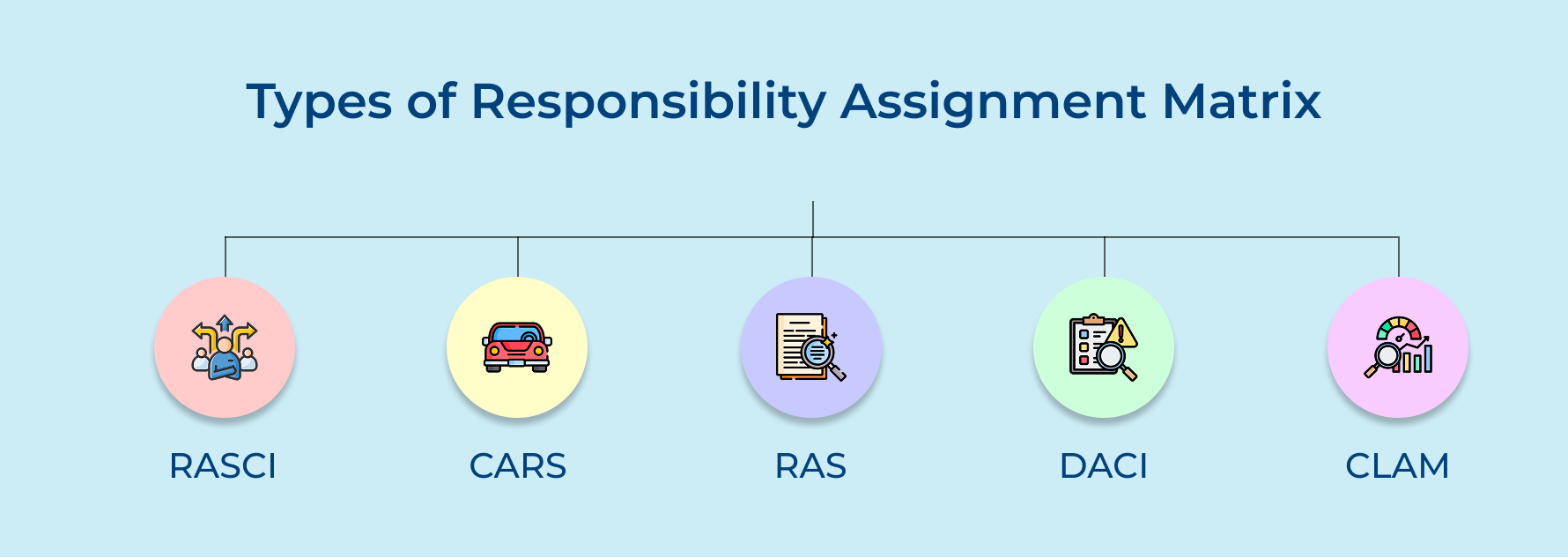
RASCI
The model adds a fifth role called Supportive to the standard RACI framework. The S represents people who provide resources or assistance but don’t own the work itself. They’re helpers rather than doers or decision-makers.
Understanding when to use RASCI helps you map supporting roles more precisely:
- Administrative staff who handle scheduling or logistics deserve recognition in the matrix
- Technical specialists who troubleshoot issues without owning deliverables fit this category
- Budget holders who release funds but don’t approve strategic decisions need their own designation
Imagine a software launch where the IT team is responsible for deployment and the product manager is accountable. The legal team reviews contracts as consulted parties while executives stay informed. The support category captures the documentation team who creates user guides without controlling the launch timeline or technical decisions.
CARS
CARS framework flips the traditional order to emphasize coordination and approval first. It stands for Communicator, Accountable, Responsible and Supportive. The model puts communication at the forefront to prevent information silos.
Client-based organizations benefit when communication breakdowns cost them relationships and repeat business. The explicit communicator role ensures clients receive proactive updates rather than reactive responses when problems emerge.
RAS
This stripped-down version keeps only Responsible, Accountable and Supportive roles for smaller teams or simpler projects. It removes the consulted and informed categories to reduce administrative overhead. The model works when everyone involved needs direct involvement rather than passive awareness.
The RAS approach reshapes how teams think about essential contributions:
- Startup environments with flat hierarchies avoid bureaucratic classification systems
- Quick turnaround projects need speed over comprehensive stakeholder mapping
- Co-located teams already communicate organically without formal informed roles
Think about a small startup launching a new feature with just five people. The developer is responsible for coding while the founder stays accountable. The designer provides supportive assets like icons and layouts. Nobody needs formal consultation or information roles because the team communicates constantly through their shared workspace.
DACI
DACI replaces Responsible with Driver while reordering priorities to Driver, Approver, Contributors and Informed. The driver concept emphasizes active leadership and momentum rather than task execution alone. It suits decision-heavy projects where moving things forward matters more than doing hands-on work.
Project-based organizations use DACI when initiatives stall from analysis paralysis or unclear ownership. The driver role creates forward momentum that prevents projects from languishing in endless committee discussions.
CLAM
This framework stands for Contribute, Lead, Approve and Monitor as well as shifts focus toward collaborative effort distribution. The Lead role differs from traditional accountability by emphasizing coordination over final ownership. It works particularly well for matrix organizations where authority gets shared across reporting lines.
Decision-centric projects benefit from the CLAM structure in specific ways:
- Matrix organizations with dual reporting lines need explicit leadership designation
- Collaborative environments where multiple experts share decision authority benefit from contribute clarity
- Governance-heavy industries require formal monitoring roles to satisfy compliance requirements
Imagine a healthcare system implementing new patient privacy protocols where the compliance officer leads coordination across departments. Individual department heads contribute their operational requirements and constraints.
How to Create a RACI Chart in 7 Actionable Steps?
Ready to unlock the potential of your team’s performance? Here’s a step-by-step guide on how to create a RACI chart.
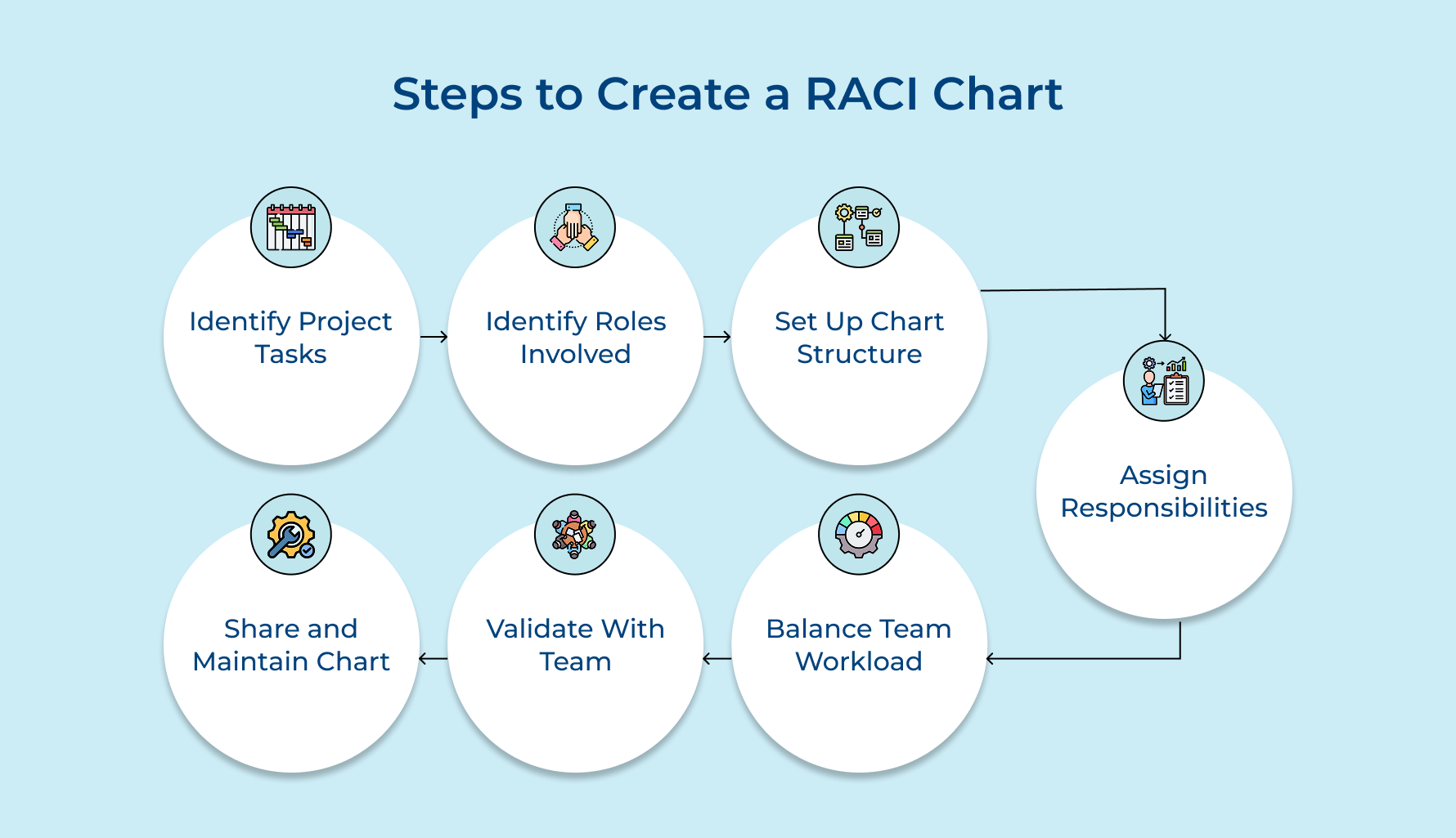
1. Identify Project Tasks and Workload
Start by cataloging every activity your project requires from start to finish. Without a complete task inventory, you can’t assign ownership because you don’t know what work actually needs coverage within the broader project plan. Skipping this step stalls the entire chart-building process and leaves you with an incomplete framework that misses key deliverables.
Use these questions to identify tasks and workload effectively:
- What major deliverables define project completion?
- Which tasks happen sequentially and which can run in parallel across project phases?
- What handoffs between teams or departments need coordination?
These questions reveal dependencies that impact timing and expose areas where miscommunication often derails progress. Answering them upfront prevents clients from discovering missing work halfway through the project life cycle. Once you have clarity, work backward from final deliverables and break each one into the tasks needed to produce it.
2. Identify All Roles or People Involved
This step maps every person who touches your project so no contributor gets overlooked. Missing a key stakeholder creates bottlenecks where decisions stall simply because the right approver wasn’t looped in.
Use these methods to identify project roles comprehensively:
- Review organizational charts and past project files — historical documents often reveal hidden contributors.
- Map the workflow end to end to trace how work moves, including handoffs to external teams.
For example, in a website redesign, you might identify designers and developers early but initially miss the compliance officer. Later, you discover every page needs legal review—an issue that better team collaboration could have uncovered at the start.
3. Set Up the Chart Structure
Transform your task list and people inventory into an organized visual framework. The structure determines if team members can quickly reference responsibilities or get lost scanning messy documentation.
Your format choice depends on complexity:
- Spreadsheets → simple, accessible, ideal for smaller teams
- Project management tools → automated updates, integrated views and the ability to pair your chart with a Gantt chart for timeline context
After choosing the format:
- Place all tasks down the left column
- List people across the top
- Use the intersections to fill in R-A-C-I designations
Adding subtle formatting like alternating row colors helps track long lists without losing your place.
4. Assign Responsibilities Using the RACI Framework
Now bring your chart to life by assigning each role designation correctly. Accuracy here determines if execution flows smoothly or confusion takes over.
Approach it systematically:
- Start with Accountable roles, only one person should approve outcomes.
- Assign Responsible parties based on actual skills and capacity. Avoid overloading your strongest performers.
- Expect disagreements. Facilitate open discussions so assignments reflect both project needs and organizational realities.
Teams working in agile environments can also map these responsibilities to Scrum roles to maintain consistency across methodologies.
5. Balance Workload Across Team Members
This step ensures no one gets overwhelmed while others remain underutilized. Imbalanced workloads lead to burnout and missed deadlines.
Consider these factors:
- Total number of “Responsible” tasks per person
- Overlapping tasks that hit during the same period
- Whether assignments match each person’s skill level
Review each column in your chart to tally workload. Anyone with excessive Responsible or Accountable tasks needs redistributing. Move work to underutilized team members or renegotiate deadlines to avoid bottlenecks.
6. Validate With Your Team
Before finalizing, present the draft chart to everyone involved. Skipping validation often leads to issues later when tasks fail because someone didn’t agree with or understand their assignment.
Tips for effective validation:
- Walk through each row together
- Confirm authority, capacity and clarity
- Use open dialogue to refine ambiguous assignments
- Review the chart using existing communication channels so everyone has easy access
Scheduling this review early helps prevent rework down the line.
7. Share and Maintain the Chart
This step keeps your RACI chart relevant as the project evolves. Without active maintenance, the chart quickly becomes outdated and loses practical value.
Key actions:
- Establish one central location as your single source of truth
- Set regular review intervals, especially during long-running projects
- Communicate updates immediately so everyone stays aligned
Use the chart during status meetings when discussing task progress or delays. When ownership conflicts arise, refer back to the documented assignments for resolution.
For best results:
- Assign one maintainer to manage updates
- Archive older versions so you can track how responsibilities shift over time
RACI Chart Best Practices in Project Management
Creating a RACI chart is just the beginning. Following proven best practices ensures your chart actually improves project execution rather than becoming another dust-collecting document:
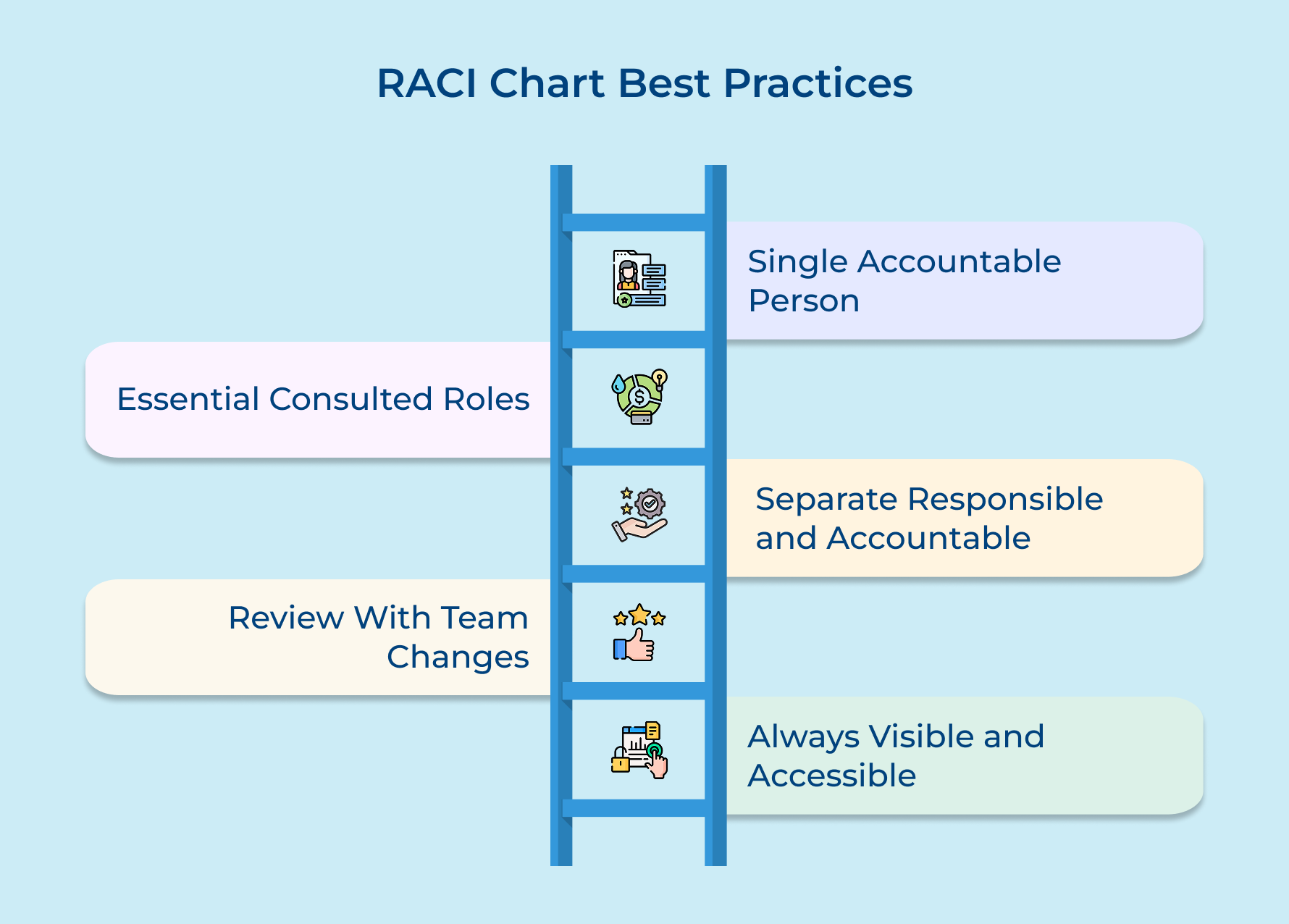
- Keep only one accountable person per task:
Having multiple people accountable creates decision-making gridlock. When ownership is unclear, tasks stall because everyone waits for someone else to approve or act.
- Limit consulted roles to essential expertise:
Too many consulted voices turn every decision into a committee discussion. Reserve this designation for specialists whose input directly shapes your project deliverables, not those seeking visibility.
- Avoid assigning someone as both responsible and accountable:
When one person executes the work and approves it, there’s no built-in quality check. Separating these roles brings fresh perspective and improves overall clarity.
- Review the chart when team members change:
New hires or departures shift team capabilities. Outdated assignments lead to confusion about who currently owns critical tasks.
- Keep the chart visible and accessible:
Don’t bury it in email threads or hidden folders. Pin it in a shared workspace or your project portfolio management software so everyone can reference responsibilities quickly.
Limitations of RACI Charts in Project Management
While RACI charts solve many coordination problems, they come with inherent constraints that can undermine their effectiveness. Understanding these limitations helps you decide when to use them and how to supplement them with other approaches.
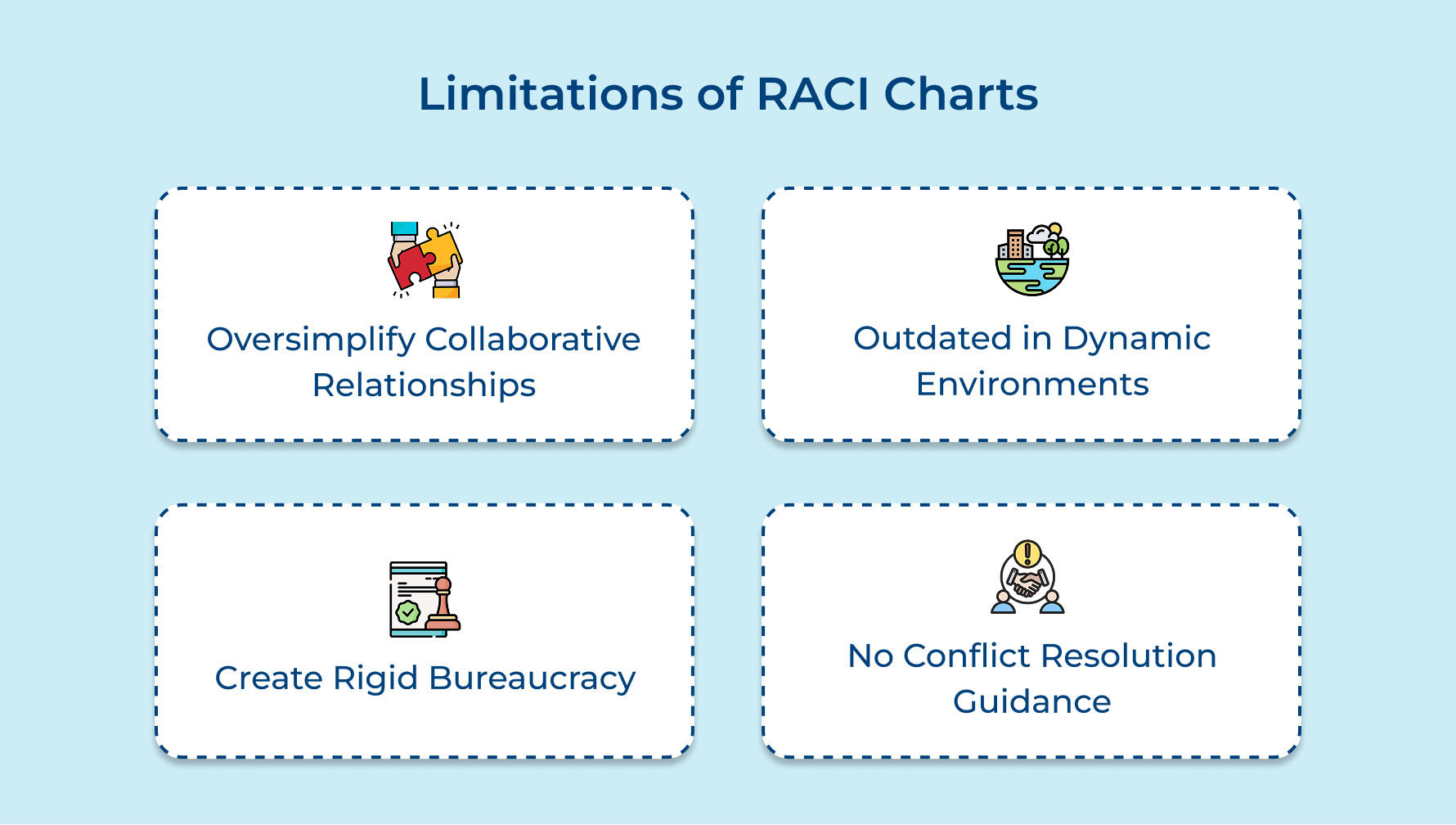
Oversimplify Complex Collaborative Relationships
Real project work rarely fits into four neat boxes because people contribute in fluid ways throughout a project. A developer might be responsible for coding but also gets consulted on design and stays informed about marketing timelines in overlapping capacities.
Become Outdated Quickly in Dynamic Environments
Agile projects with constantly evolving priorities make static RACI charts obsolete almost immediately after creation. The administrative burden of updating the chart after every sprint often exceeds the value it provides to fast-moving teams.
Can Create Rigid Bureaucracy in Small Teams
Startups and tight-knit groups often thrive on flexible collaboration where everyone pitches in wherever needed. Forcing formal role designations introduces unnecessary formality that slows down the natural rhythm people have already established.
Provide no Guidance on Resolving Conflicts
When two people both believe they should be accountable for the same task, the RACI framework offers no resolution mechanism. The chart documents the disagreement but doesn’t help navigate the organizational dynamics required to reach consensus.
- Smart project managers combine the framework with complementary practices that address its blind spots.
- Treat the chart as a living document that gets reviewed at regular intervals rather than a one-time planning artifact.
- Supplement RACI designations with team workshops that strengthen communication beyond formal role assignments.
- Use lighter alternatives like RAS for small teams where full RACI creates more overhead than value.
- Establish clear escalation paths that activate when RACI assignments become contested or unclear.
Real Life Examples and Case Studies of RACI Chart
Seeing how RACI charts work in real projects helps you understand their practical application beyond theory. These case studies show how different industries adapt the framework to solve their specific coordination challenges.
Case study 1:
How a RACI matrix was used in a software development project
A fintech startup building a mobile payment app faced constant confusion about who owned which features during their six-month development cycle. The product manager kept making design decisions that developers had already coded differently while the QA team tested features prematurely.
The RACI framework solved several critical coordination problems they were experiencing:
- Sprint planning became faster because everyone knew their role before meetings started
- Feature releases stopped getting delayed by unclear approval chains and bottlenecked decisions
The team created a RACI chart mapping all major features against their eight-person team plus two external stakeholders. The product manager became accountable for user-facing features while developers were responsible for their assigned modules and the tech lead handled architecture decisions.
Case study 2:
How a RACI matrix was used in a construction project
A commercial office building renovation involved coordinating between the general contractor, three subcontractors, the building owner, city inspectors and an architectural firm. Delays kept happening because nobody knew who approved change orders when unexpected structural issues emerged during demolition.
The RACI implementation transformed their project workflow in measurable ways:
- Change order approvals that previously took five days now happened within twenty-four hours
- Subcontractors stopped waiting for direction because they knew exactly who to contact
The project manager built a comprehensive RACI chart covering every phase from permits through final inspection with all stakeholders mapped clearly. The general contractor was responsible for site management while the owner stayed accountable for budget approvals and design modifications required architect consultation.
Case study 3:
How a RACI matrix was used in a marketing campaign launch
A consumer goods company launching a new product line struggled with missed deadlines and duplicate work across digital as well as retail channels. The social media team created content that contradicted email marketing while the sales team learned about promotional pricing from customers.
The marketing director created a launch-specific RACI chart spanning pre-launch through the first market month with eighteen team members. The brand manager became accountable for customer-facing messaging while channel specialists executed tactics in their domains and the sales director stayed informed about timing.
Empower your Project Team with Clear Direction Through RACI Matrix
A RACI chart transforms confusion into clarity by documenting exactly who does what on your project. It prevents the chaos that emerges when multiple people think they own the same work or when critical tasks have no clear owner.
The framework works because it forces honest conversations about capacity and authority before problems emerge during execution. Teams that invest time building and maintaining their RACI charts spend less time in meetings debating ownership as well as more time delivering results that satisfy clients.
Limit time — not creativity
Everything you need for customer support, marketing & sales.

Neeti Singh is a passionate content writer at Kooper, where he transforms complex concepts into clear, engaging and actionable content. With a keen eye for detail and a love for technology, Tushar Joshi crafts blog posts, guides and articles that help readers navigate the fast-evolving world of software solutions.