Resource Manager Roles and Responsibilities in Project Management
- What is a Resource Manager?
- Why are Resource Managers Important?
- Essential Skills Required to be a Resource Manager
- Responsibilities of the Resource Manager
- Differences Between Resource Manager vs Human Resource Manager
- Common Challenges of a Resource Manager
- Transform Chaos into Clarity with Resource Manager Roles and Responsibilities
- FAQs about Resource Manager Roles and Responsibilities

Key Highlights:
- Strong resource manager roles and responsibilities ensure the right people work on the right projects.
- Core responsibilities include capacity planning, tracking utilization, creating development roadmaps and implementing risk mitigation strategies.
- Proactive resource management prevents burnout, resolves allocation conflicts and maintains high team performance under shifting priorities.
Projects fail at alarming rates even with talented teams and solid plans. The missing piece is often someone who ensures the right people work on the right projects at the right time without burning out.
Your best developers get overloaded while others sit idle when there is no dedicated resource management. Projects fight over the same experts and timelines slip because nobody saw the capacity crunch coming three weeks ago.
A skilled resource manager transforms this chaos into smooth project delivery by mastering capacity planning and strategic allocation. This guide reveals exactly what resource manager roles and responsibilities are as well as how to excel in this critical role.
What is a Resource Manager?
A resource manager in project management is the person responsible for planning and allocating the right people as well as assets to project tasks. They match team members’ skills with project needs while tracking availability and workload. This role ensures projects have what they need when they need it without overloading anyone.
When done well, resource management keeps projects moving smoothly because the right expertise arrives at the right moment. Teams feel less stressed because work gets distributed fairly. Projects finish on time more often since bottlenecks get spotted early and addressed before they cause delays.
Key principles:
- Visibility first: You cannot manage what you cannot see, so maintain a clear view of who is available and what skills they bring.
- Balance capacity with demand: Match the amount of work to your team’s actual bandwidth rather than hoping people will stretch beyond realistic limits.
- Prioritize strategically: Some projects matter more than others, so direct your best resources toward your highest-value initiatives.
- Plan for flexibility: People get sick and priorities shift, so build buffer time as well as backup options into your resource plans.
- Communicate proactively: Tell people about upcoming assignments early so they can prepare rather than surprising them at the last minute.
Why are Resource Managers Important?
23% of projects that fail to deliver on time cite poor resource allocation as the primary cause. Resource managers ensure teams have exactly what they need to succeed. Let’s explore the data behind their impact and understand why this role has become essential.
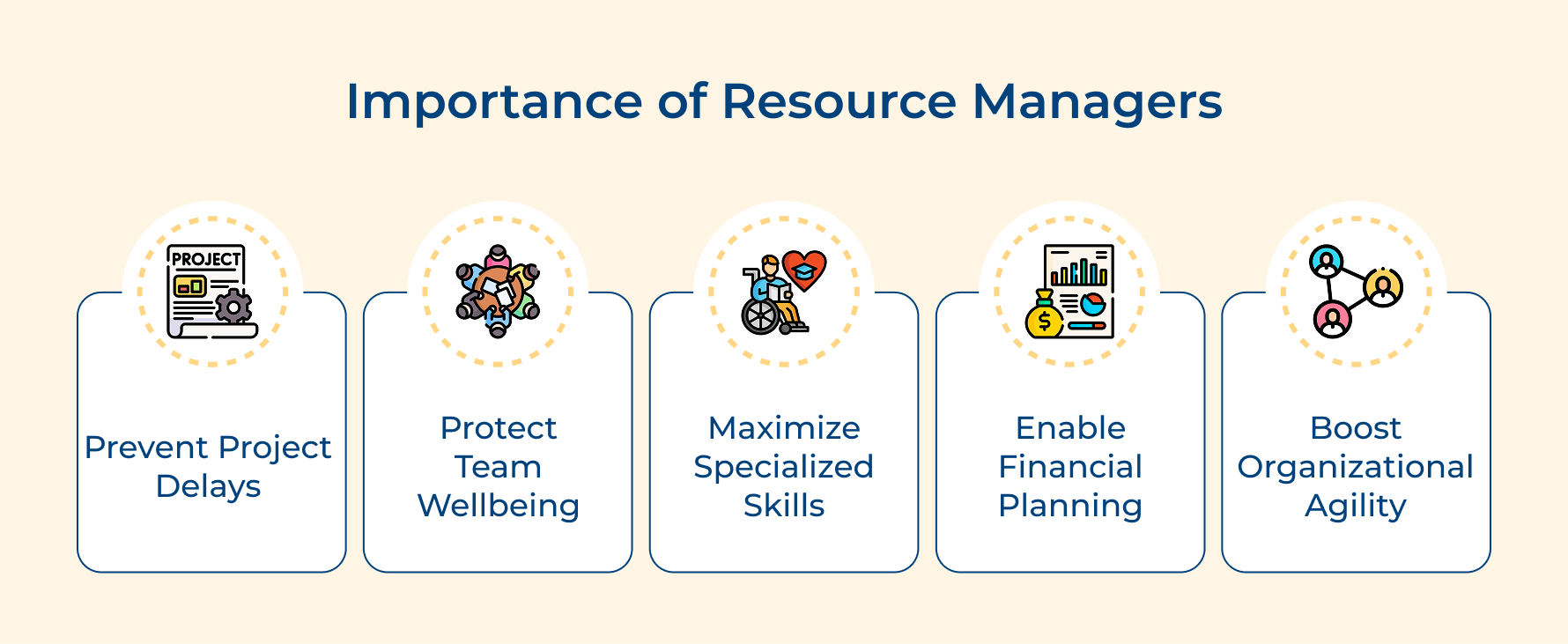
Prevent Costly Project Delays
Resource managers spot allocation problems before they derail timelines. When someone identifies that your design team is already at capacity three weeks out, they can shuffle priorities or bring in contractors now rather than watching deadlines slip later.
Protect Team Wellbeing and Performance
Burning out your top performers by piling on too many assignments creates a downward spiral of mistakes and turnover. Resource managers act as a buffer by tracking workloads while pushing back when requests exceed what people can realistically handle.
Maximize the Value of Specialized Skills
Your most experienced developers or subject matter experts should work on high-impact tasks that actually need their expertise. Resource managers ensure these valuable people spend time where they create the most value rather than getting stuck on routine work.
Enable Better Financial Planning
When you know exactly who is working on what and for how long, you can forecast project costs accurately as well as avoid nasty budget surprises. This visibility helps leadership make smarter decisions about which projects to pursue and how to price them.
Create Organizational Agility
Markets shift and priorities change constantly in business. Resource managers maintain the flexibility to pivot quickly by knowing who becomes available when and what skills exist across the organization that can be redeployed to urgent needs.
Essential Skills Required to be a Resource Manager
Let’s delve into the vital skills every aspiring resource manager should cultivate to excel in their career and drive their organization towards success.
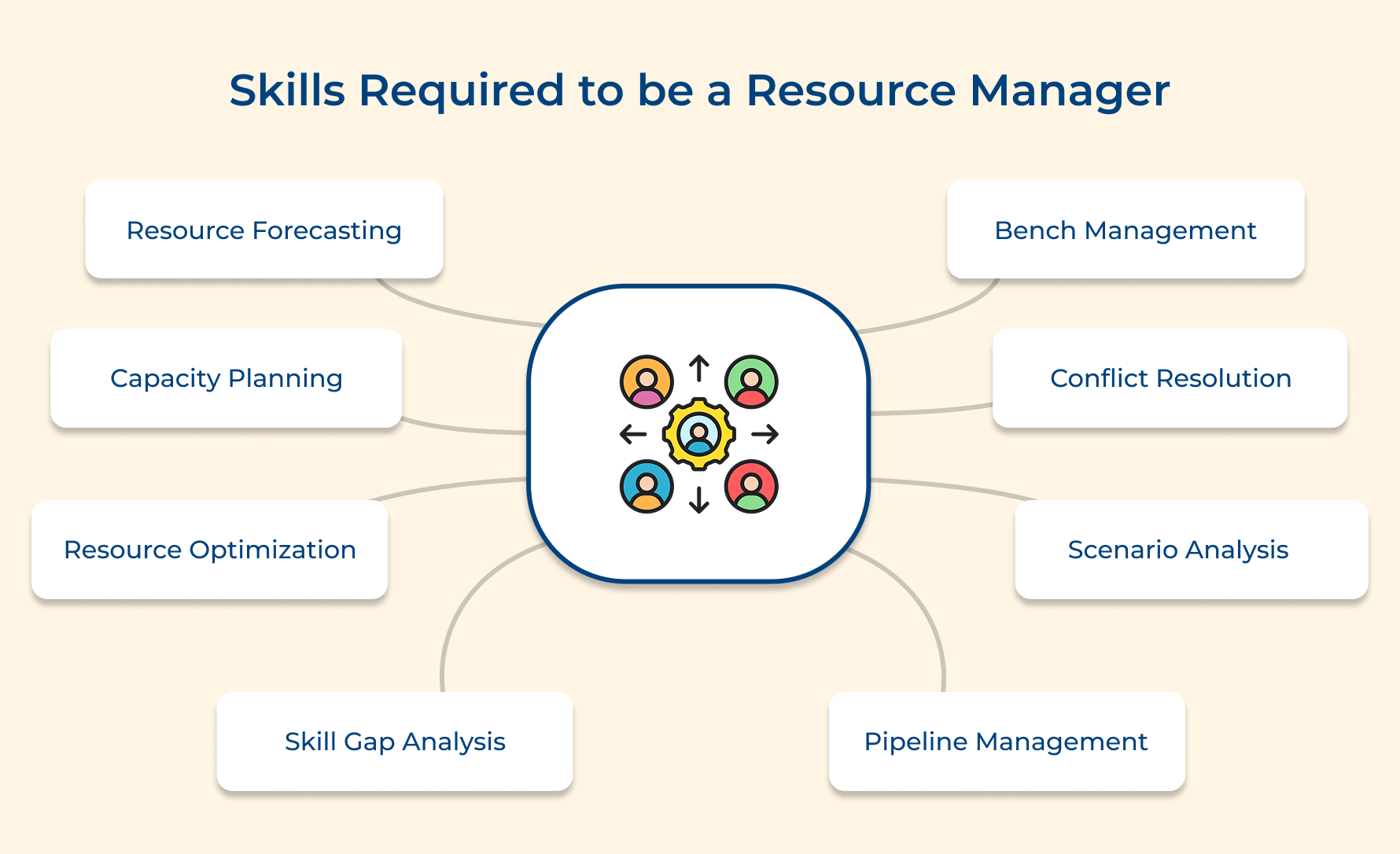
1. Resource Forecasting Capabilities
Resource forecasting is the ability to predict future resource needs by analyzing project pipelines and demand patterns. This skill matters because it prevents last-minute scrambles for talent as well as keeps projects from stalling while you hunt for the right people.
A resource manager skilled in forecasting handles several critical responsibilities in their day-to-day work:
- Demand prediction across multiple project timelines: Track upcoming projects and estimate when specific skills will be needed across different delivery schedules.
- Historical utilization pattern analysis: Review past data to identify seasonal trends and recurring resource bottlenecks that might repeat.
- Future hiring needs identification: Determine which roles need to be filled months in advance based on projected workload increases.
- Capacity gap early warning systems: Flag potential shortfalls before they become critical so leadership has time to act.
Imagine a software development company landing three major client projects that all kick off in Q2. A resource manager with strong forecasting sees this coming in January and realizes they need four additional frontend developers. They alert HR early and those developers are onboarded just as the projects begin instead of scrambling mid-quarter.
2. Forward Capacity Planning
Forward capacity planning involves mapping out long-term resource availability and making strategic decisions about workforce scaling. The resource manager uses this skill to ensure the organization can handle future work without overcommitting or leaving talent sitting idle.
Here are three effective ways a resource manager can develop this critical planning skill:
- Shadow experienced capacity planners: Observe senior planners build capacity models and learn their decision-making approach for effective long-range planning.
- Study business forecasting fundamentals: Learn forecasting, financial planning and statistical modeling to make accurate, data-driven resource capacity decisions.
The best capacity planners combine data analysis with business intuition to make calls that balance risk with opportunity. They learn to read market signals and internal strategy shifts that hint at where resource needs are heading.
3. Resource Optimization Skills
Resource optimization means deploying people where they add the most value while maintaining sustainable workloads. When employees are underutilized or overworked, organizations lose efficiency and talent.
In project management, this skill ensures the right people handle the right tasks—like assigning a senior architect to guide junior developers on a complex migration instead of coding basic features. It balances expertise with task complexity, leading to faster delivery and happier teams.
Two best practices drive effective optimization:
- Match skill levels to task complexity: Assign tasks based on real requirements, not convenience or availability.
- Monitor utilization weekly: Track workload balance often to spot and fix issues early before productivity or quality declines.
4. Skill Gap Analysis
Skill gap analysis identifies the difference between the skills your team has and what future projects will require. It helps resource managers plan effectively by understanding current capabilities versus upcoming demands.
Four key questions guide this process:
- What technical and soft skills does each person have as well as at what level?
- Which future skills are lacking for upcoming projects?
- Can training close the gaps, or is hiring needed?
- How soon must we act to avoid project risks?
A skilled resource manager uses this analysis to build a dynamic skills inventory, uncover hidden talents and plan growth strategically. For example, discovering team members learning React independently can open new opportunities and strengthen the organization’s future capabilities.
5. Bench Management Skills
Bench management is the strategic handling of team members between projects to reduce idle time and prevent disengagement. Idle resources cost money and risk turnover, making proactive management essential. The process starts with real-time tracking of who’s rolling off projects, enabling resource managers to plan next assignments early.
To minimize bench time:
- Maintain a prioritized project waitlist so available talent moves quickly into new work.
- Assign pre-approved internal projects like process improvements or tool evaluations during short gaps.
- Implement rapid redeployment alerts to instantly match free talent with open roles.
Smooth bench-to-project transitions are equally vital. Resource managers identify end dates weeks in advance, align with project leads for overlap and knowledge transfer, schedule introductions with new teams and handle administrative updates before start dates. The result is continuous productivity and higher employee engagement across projects.
6. Resource-Centric Conflict Resolution
Resource-centric conflict resolution is the ability to mediate disputes when multiple projects compete for the same limited talent or resources. Without this skill, a resource manager becomes a passive ticket-taker who simply assigns people first-come-first-served, which leads to political battles and projects failing because the wrong initiatives get priority.
This skill comes into play when two project managers both need your best data analyst next week and neither will budge on their deadline. You facilitate a conversation where everyone shares their business case, then you help them see alternatives like splitting the analyst’s time or finding someone less experienced who could handle one project with support.
Pro tips:
- Show utilization numbers and project impact metrics so decisions are based on facts rather than who yells loudest.
- Look beyond the obvious choice to find creative alternatives like contractors or cross-training that satisfy both parties.
7. Scenario Analysis Capabilities
Scenario analysis involves modeling possible futures to understand how resource decisions hold up under uncertainty. It’s vital for resource managers who face shifting priorities, delays and attrition. To build this skill:
- Practice what-if modeling: Use resource tools to simulate project delays or team changes and study the ripple effects.
- Review past disruptions: Analyze how events like budget cuts impacted allocation to identify useful patterns.
- Join continuity planning exercises: Learn to design alternatives and backup plans for resource disruptions.
Effective resource managers use scenario analysis to prepare, not react. By modeling “what if our top developer quits,” they identify risks early, cross-train staff and ensure projects stay on track regardless of unexpected changes.
8. Pipeline Management Capabilities
Pipeline management is the skill of anticipating and preparing for upcoming projects before they start. It prevents chaos when new work begins by ensuring the right people are ready in advance. Resource managers apply this skill to:
- Pre-staff strategic initiatives: Identify and prepare key team members weeks before launch.
- Balance new work with capacity: Assess whether the organization can handle new projects or needs to delay.
- Manage sequential dependencies: Track how one project’s delay affects others.
- Create early capacity warnings: Predict when multiple projects will compete for limited skills.
For example, if three client projects need senior consultants but only two are available, the resource manager flags it early, enabling timely hiring or schedule adjustments.
Responsibilities of the Resource Manager
A resource manager in project management wears many hats and juggles multiple critical responsibilities. Here are the key areas where they make the biggest impact on organizational success.
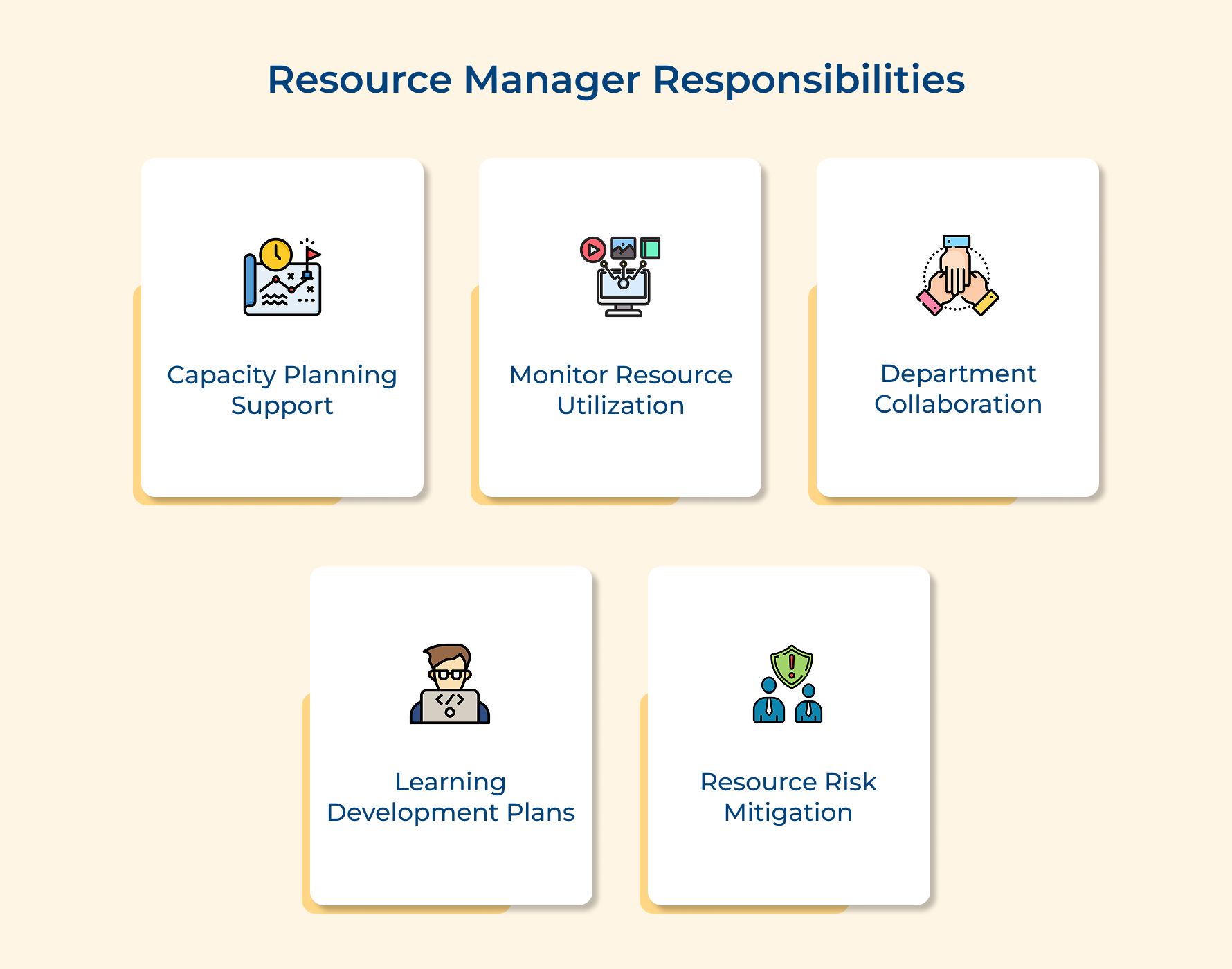
Helps Project Managers with Capacity Planning
Resource managers work closely with project managers to plan ahead for upcoming projects. They look at what’s in the pipeline and figure out how many people (as well as which skills) will be needed in the next few months.
Understanding project complexity can help you judge if the current team can realistically handle the workload. When they spot potential resource gaps or bottlenecks early, project managers can adjust timelines or client commitments before problems arise.
Tracks Utilization and Performance
Keeping an eye on how people spend their time helps maintain both profitability and team wellbeing. Resource managers track utilization rates to make sure no one’s overworked or underused.
They also look at performance patterns, seeing where someone might need extra support or where hidden strengths could be better used. This insight leads to smarter project assignments and healthier teams.
Collaborates Within Departments
Resource managers act as bridges between departments, helping balance competing priorities. They regularly meet with department heads to discuss upcoming projects, understand shifting needs and negotiate resource sharing.
Because they see the big picture, they can help teams make fair trade-offs and prioritize effectively when skilled talent is limited. Building trust is key so everyone feels comfortable being open about their challenges and needs.
Creates Learning and Development Roadmaps
Great resource managers don’t just fill today’s roles, they prepare teams for tomorrow’s opportunities. They identify future skill needs, then create training and development plans to close those gaps.
This often includes aligning team members’ career goals with upcoming business priorities so both grow together. The result? A more capable, motivated team ready to take on future projects.
Develop Resource Risk Mitigation Plans
Since projects rarely go perfectly, smart resource managers always have a backup plan. They identify critical roles where losing one person could jeopardize multiple projects and then reduce that risk through cross-training or contractor relationships.
This ensures continuity – no project gets stuck waiting on one unavailable person and the team stays resilient no matter what changes come their way.
Differences Between Resource Manager vs Human Resource Manager
Understanding these distinctions helps companies structure their teams effectively and ensures the right person handles each critical function.
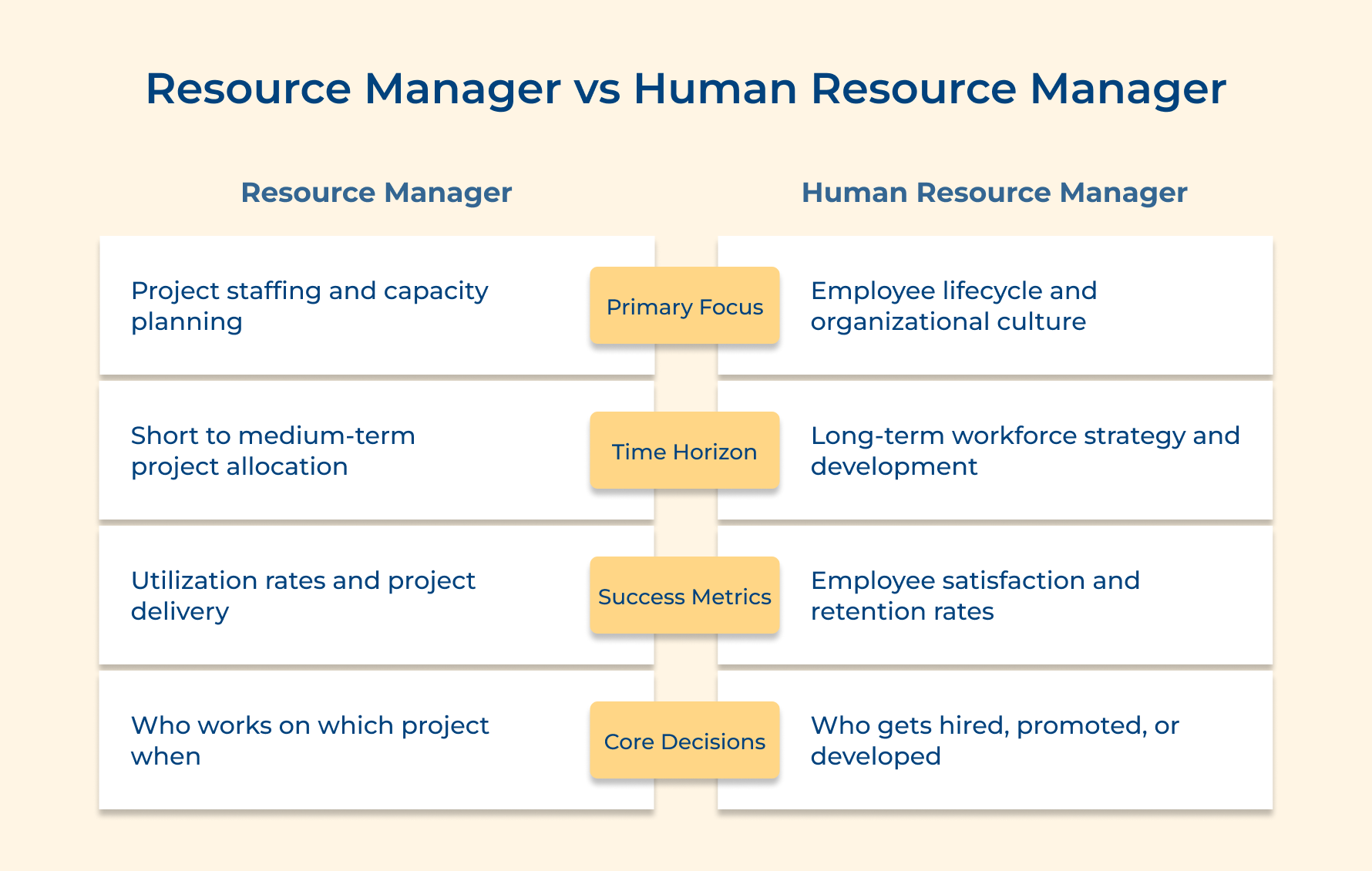
Primary Focus
A resource manager’s main goal is to get the right people on the right projects at the right time. Their day-to-day work revolves around capacity planning, balancing workloads and making sure every project has the skills it needs – without overwhelming anyone.
A human resource manager looks at the bigger picture of the employee journey. They handle everything from hiring and onboarding to performance reviews, compensation as well as culture-building.
Time Horizon
Resource managers think in the short to mid-term, usually weeks or months ahead. Their focus is on the immediate project pipeline – who’s needed where and when.
Human resource managers plan much further ahead. They think in years, developing workforce strategies, succession plans and long-term talent programs that shape the company’s future leadership.
Success Metrics
For resource managers, success shows up in numbers like utilization rates and project delivery metrics. They aim for high productivity, balanced workloads and on-time projects.
Human resource managers measure success through people-focused metrics—employee engagement, retention and time-to-hire. Their wins come from a motivated workforce and a strong talent pipeline.
Core Decisions
Every day, resource managers make tactical calls about staffing priorities—deciding which projects get top talent and resolving conflicts when multiple teams need the same person.
Human resource managers handle broader organizational choices, like defining pay structures, deciding promotions and designing company policies that shape how people work as well as grow.
Common Challenges of a Resource Manager
Resource managers juggle constant change – balancing workloads, forecasting demand and aligning the right talent to the right projects. Their biggest challenge lies in maintaining productivity and morale amid shifting priorities as well as limited resources.
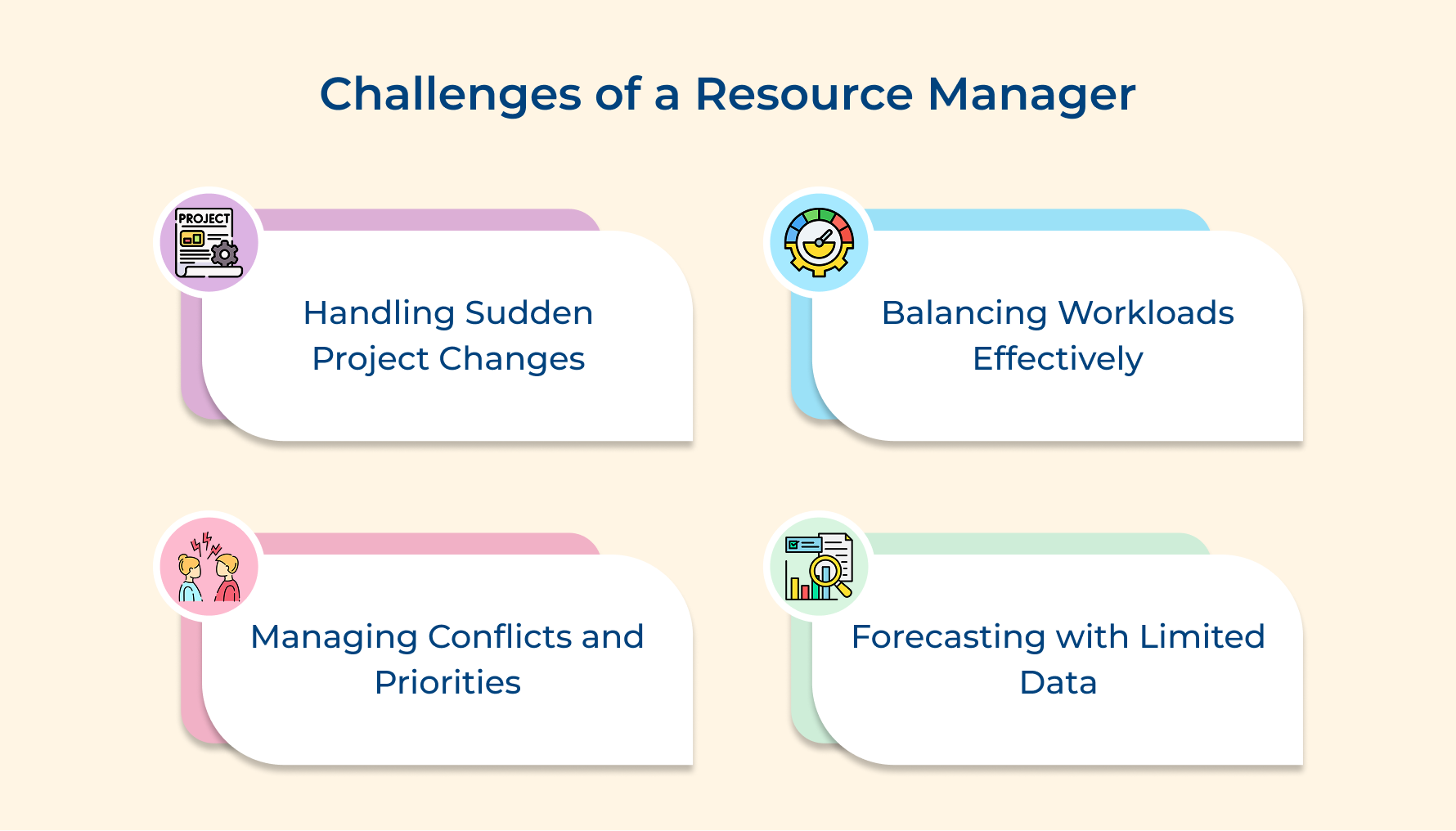
Dealing with Last-Minute Project Changes
Projects rarely unfold exactly as planned and sudden scope changes force resource managers to scramble as well as reassign people mid-stream. A client might accelerate their timeline or leadership could declare a new initiative as top priority, which means pulling your best people off current work.
Managing Overallocation Without Burning Out Teams
The pressure to say yes to every project creates constant risk of overloading talented team members who everyone wants. Resource managers walk a tightrope between maximizing productivity and protecting people from chronic overwork that leads to mistakes along with eventual resignation.
Navigating Politics and Competing Priorities
Different stakeholders believe their projects deserve the best resources and resource managers often find themselves caught between powerful executives. Saying no to a senior leader or explaining why their project can’t have the star performer requires both courage and diplomatic skill.
Forecasting Resource Needs with Incomplete Information
Resource managers must plan weeks ahead based on project pipelines that constantly shift as deals fall through or requirements change. Making staffing decisions with incomplete data means they’re often preparing for a future that may never arrive as anticipated.
Here are five approaches that help navigate complexity and deliver better outcomes:
- Maintain a small reserve of flexible resources so unexpected changes don’t immediately create crisis situations.
- Define when conflicts get elevated to leadership so decisions happen quickly rather than lingering unresolved.
- Use resource management software that shows current allocation at a glance for faster decision-making.
- Share capacity constraints and allocation decisions early so people understand the reasoning as well as can plan accordingly.
Transform Chaos into Clarity with Resource Manager Roles and Responsibilities
Resource manager’s roles and responsibilities bring order to the inherent messiness of project work by ensuring the right people land on the right projects at the right time. Their strategic planning and tactical decision-making transform constant firefighting into predictable project delivery that protects both business outcomes as well as team wellbeing.
Organizations that invest in strong resource management see fewer failed projects and higher team satisfaction because someone is finally watching the big picture. When resource managers execute their responsibilities well, chaos gives way to clarity and projects move from hope-based planning to confidence-backed execution.
Limit time — not creativity
Everything you need for customer support, marketing & sales.

Shivank Kasera is part of the marketing team at Kooper, where he focuses on building content that helps agencies and service providers grow. With a keen interest in SaaS, operations, and scalability, he translates practical insights into actionable resources for business leaders.