8 Best Tips on How to Increase Billable Hours as Consultants
- What are Consulting Billable Hours?
- Benefits of Efficiently Increasing Consultant Billable Hours
- Top 8 Tips to Increasing Your Billable Hours for a Consultant
- Challenges Faced When Increasing Billable Hours as Consultants
- Increase Billable Hours to Grow Your Consulting Business
- FAQs about How to Increase Billable Hours as Consultants

Key Highlights:
- Discover how to increase billable hours as consultants using systematic time tracking, prioritization and tech tools for client value.
- Learn billable hours strategies. Set goals, manage tasks and track consulting billable hours to enhance both client satisfaction as well as revenue.
- Optimize productivity and consulting billable hours with automation, clear communication as well as efficient workflows.
Most consultants struggle to maximize their billable hours because they lack systematic approaches to time management and client relationship optimization. You’re likely leaving money on the table every month through inefficient processes and unclear boundaries.
This challenge becomes even more frustrating when you realize that working harder doesn’t necessarily translate to earning more revenue. Many consultants find themselves trapped in cycles where increased effort doesn’t produce proportional income growth.
Then, how to increase billable hours as consultants? The solution lies in strategic optimization techniques that transform how you track time, manage projects, and structure client relationships. These proven methods will help you increase billable hours while maintaining quality service and avoiding burnout.
What are Consulting Billable Hours?
Consulting billable hours represent the time consultants spend working directly on client projects that can be charged to the client. These hours form the foundation of how consulting firms generate revenue and measure consultant productivity.
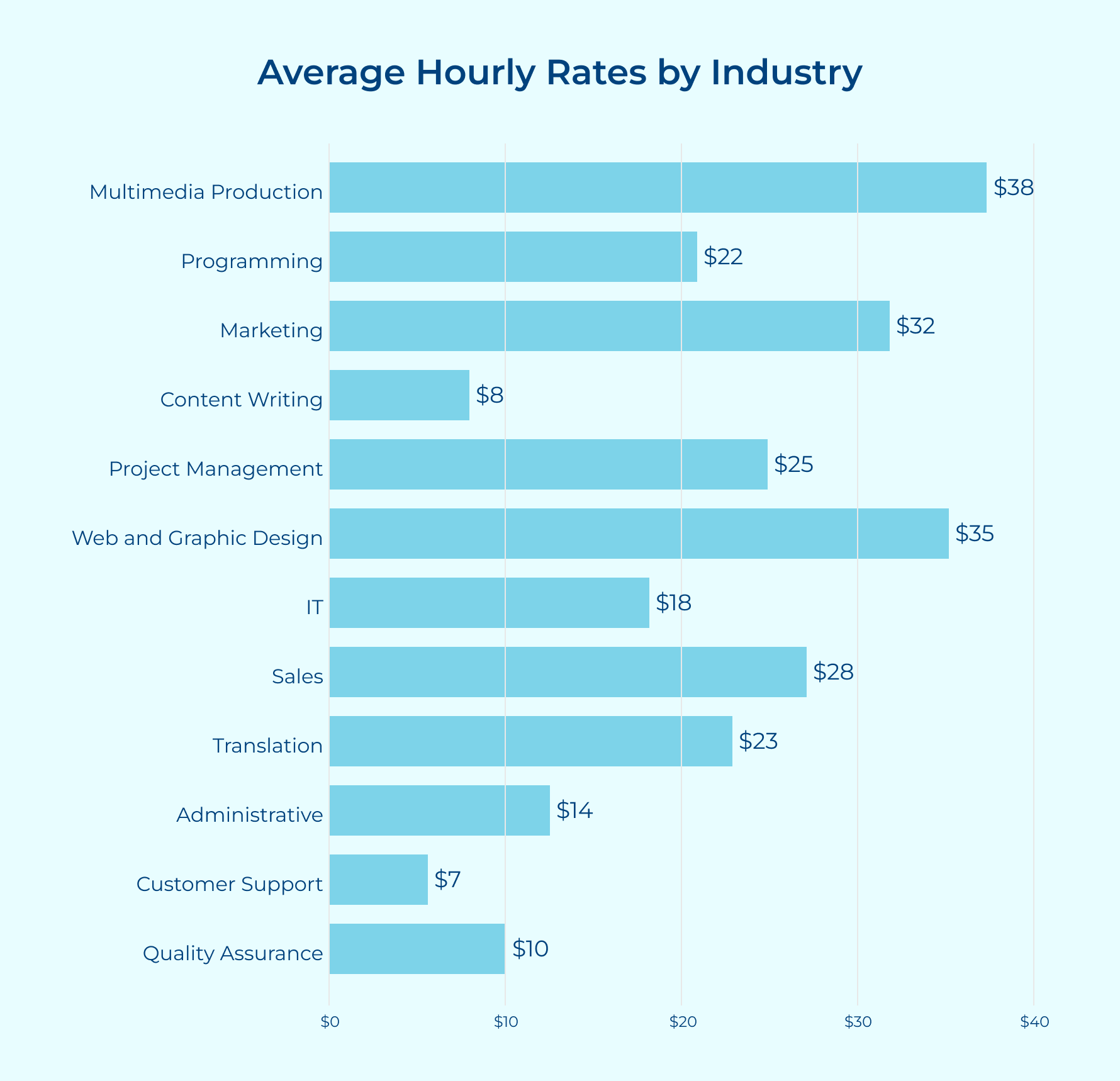
Consultants track their daily activities and categorize time as either billable or non-billable. Only work that directly benefits the client gets billed like research, analysis, meetings with clients, or creating deliverables. Administrative tasks, internal meetings and business development don’t count toward billable hours since they don’t create direct client value.
Key priorities:
- Accuracy matters most: Every minute must be tracked honestly because clients pay for actual work performed.
- Direct client value determines billability: If the task doesn’t directly help solve the client’s problem, it’s not billable.
- Documentation supports billing: Detailed records of what was accomplished justify the charges to clients.
- Utilization rates measure efficiency: The percentage of total work hours that are billable indicates consultant productivity.
- Transparency builds trust: Clear explanations of how time was spent strengthen client relationships and justify fees.
Benefits of Efficiently Increasing Consultant Billable Hours
Maximizing billable hours while maintaining quality transforms both individual consultant careers and firm profitability in measurable ways.
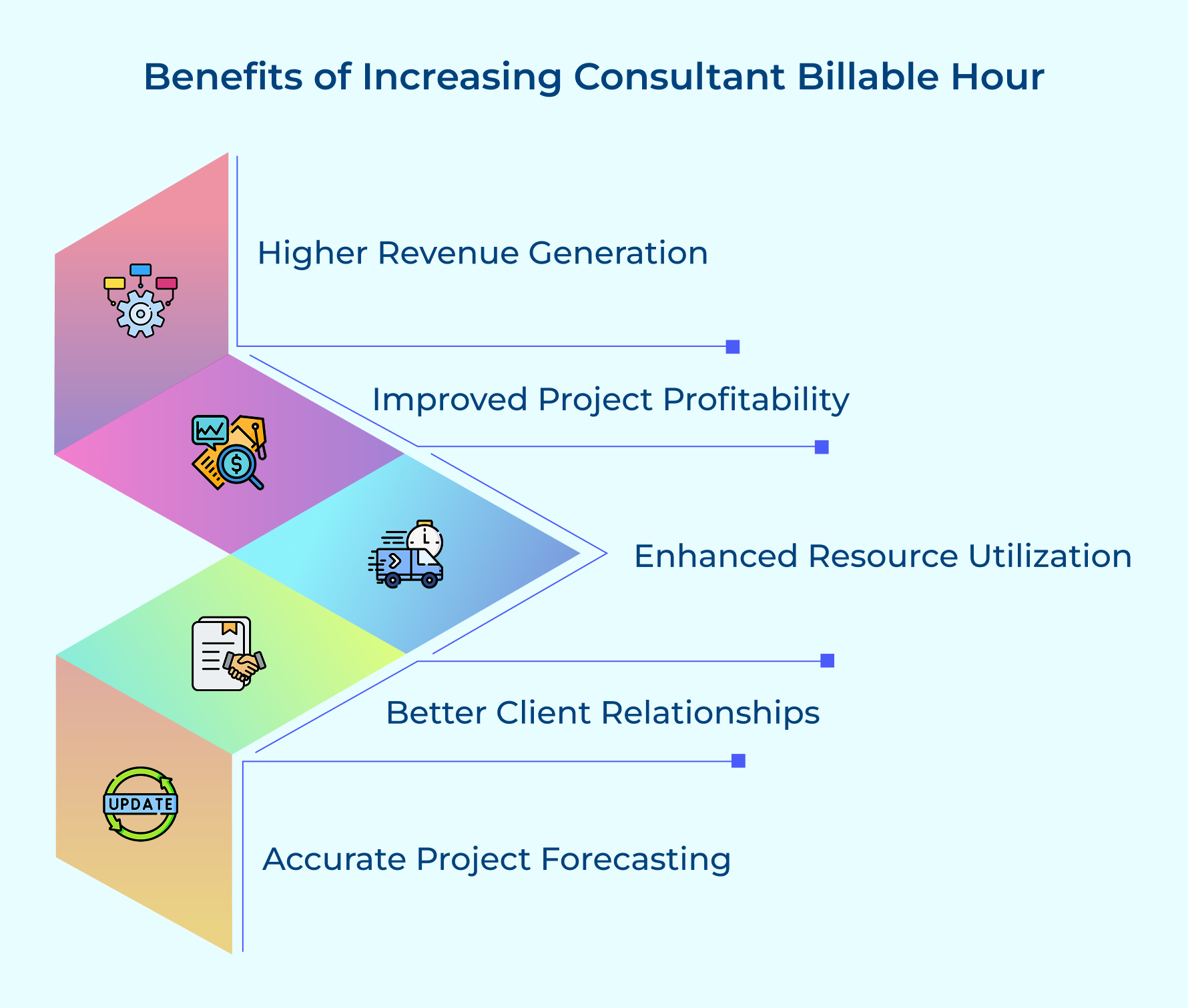
Higher Revenue Generation
Every billable hour adds to your revenue. It’s like turning downtime into income. When consultants track their hours properly, they can earn more without working extra. Efficient billing processes help you get paid for the time you already spend on work.
Improved Project Profitability
Managing billable hours well keeps projects on budget and protects your profit margins. You avoid going over costs and can deliver great results without surprises. Tracking time correctly across tasks and client meetings also helps make projects more financially predictable.
Enhanced Resource Utilization
Good time tracking shows how your team spends their hours. This helps firms assign work more wisely and make sure no one is sitting idle. When you see how time is really used, it’s easier to shift workloads and use everyone’s skills better.
Better Client Relationships
Clear billing processes create trust. Clients like seeing exactly what they’re paying for. When you show detailed records of tasks and client meetings, they feel they’re getting real value. That kind of transparency builds strong partnerships and repeat work.
Accurate Project Forecasting
Looking at past billable hours helps you plan better for new projects. You can give more realistic timelines and staffing estimates. Knowing how long similar work took before means you’re less likely to undercharge or overpromise on delivery.
Top 8 Tips to Increasing Your Billable Hours for a Consultant
Let’s explore eight tried-and-true tips to help you increase your billable hours, ensuring your talent and time are recognized as well as rewarded.
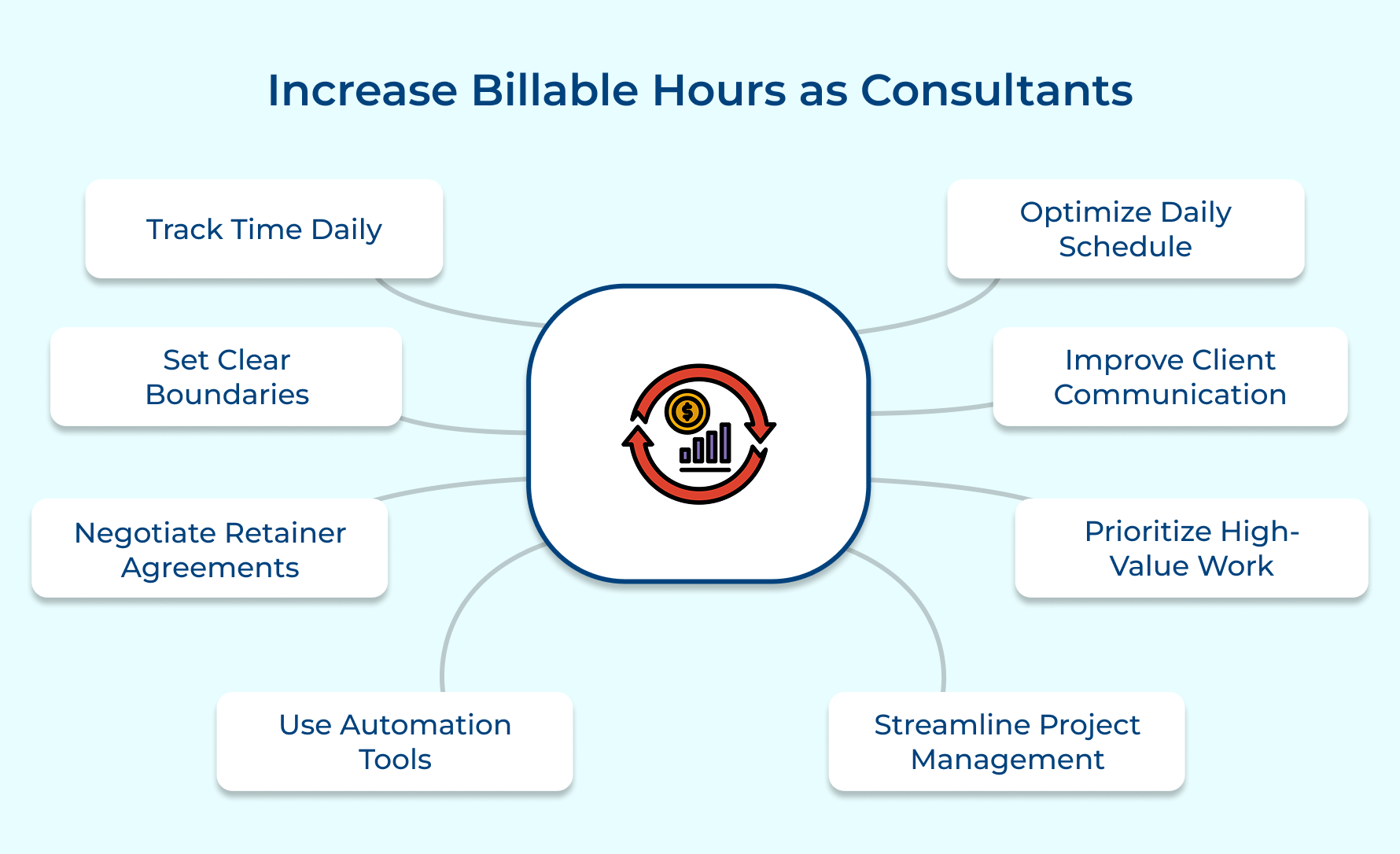
1. Track Your Time Meticulously Daily
Time tracking forms the foundation of billable hour management because you cannot improve what you don’t measure accurately. Without precise tracking, consultants lose revenue opportunities and struggle to justify their rates to clients effectively.
Here are four specialized tools that streamline time tracking for consulting projects:
- Kooper: Provides time tracking with expense management and invoicing capabilities specifically designed for professional services.
- Toggl track: Offers intuitive interface with project categorization and detailed reporting features for consulting teams.
- Clockify: Features unlimited users and projects with robust reporting tools perfect for growing consulting firms.
- Time camp: Combines time tracking with project management features and automatic time detection for improved accuracy.
How can you maintain consistent time tracking habits throughout your workday beyond software solutions? Start by setting phone reminders every two hours to log your activities. Keep a simple notebook beside your computer to jot down tasks as you switch between them. This physical backup ensures nothing gets forgotten when you update your digital tracking system later.
2. Set Clear Boundaries Between Tasks
Boundary setting separates profitable work from administrative activities that drain resources without generating client revenue. Clear distinctions prevent consultants from accidentally giving away valuable time that should be compensated properly.
When consultants blur the lines between billable and non-billable work, they unknowingly subsidize client projects with unpaid labor. This practice erodes profit margins and creates unsustainable business models that hurt long-term growth.
Common examples of non-billable activities that reduce consulting revenue include:
- Internal team meetings about project strategy that don’t involve client input or deliverables.
- Business development calls with potential clients where no paid work gets performed.
- Administrative tasks like invoicing and contract management.
Establishing clear boundaries requires consistent application across all client relationships to maintain profitability standards. Three effective solutions for maintaining clear task boundaries:
- Written activity guidelines: Create detailed documentation that defines which activities qualify as billable versus internal overhead costs.
- Client expectation setting: Communicate upfront about what work gets billed and what gets included as part of relationship management.
- Regular boundary reviews: Schedule monthly assessments to identify tasks that may have shifted from non-billable to billable status.
3. Negotiate Retainer Agreements Strategically
Retainer agreements guarantee minimum monthly revenue while providing clients with priority access to consultant expertise and availability. These arrangements create predictable income streams that support better resource planning and business growth.
Here’s how to effectively pitch retainer agreements to clients in project management:
- Guaranteed availability approach: Emphasize how retainers secure their spot in your schedule during peak demand periods. Explain that retainer clients receive priority scheduling and faster response times compared to project-based arrangements.
- Cost savings framework: Demonstrate how retainers reduce their overall consulting costs through discounted hourly rates and eliminated project setup fees. Show concrete examples of savings they’ll achieve compared to traditional project-based billing structures.
- Strategic partnership positioning: Present retainers as partnerships rather than service contracts where you become an extension of their team. Highlight how ongoing relationships enable deeper understanding of their business and more effective solutions over time.
What happens when clients resist retainer agreements? Address concerns by offering flexible retainer structures with rollover hours or partial refunds for unused time. Start with shorter commitment periods to build trust before proposing longer arrangements that benefit both parties.
4. Leverage Technology for Automation Efficiency
Technology automation reduces manual work that consumes consultant time without creating client value or generating billable revenue. Automation transforms repetitive tasks into streamlined processes that free up consultant capacity for high-value client work.
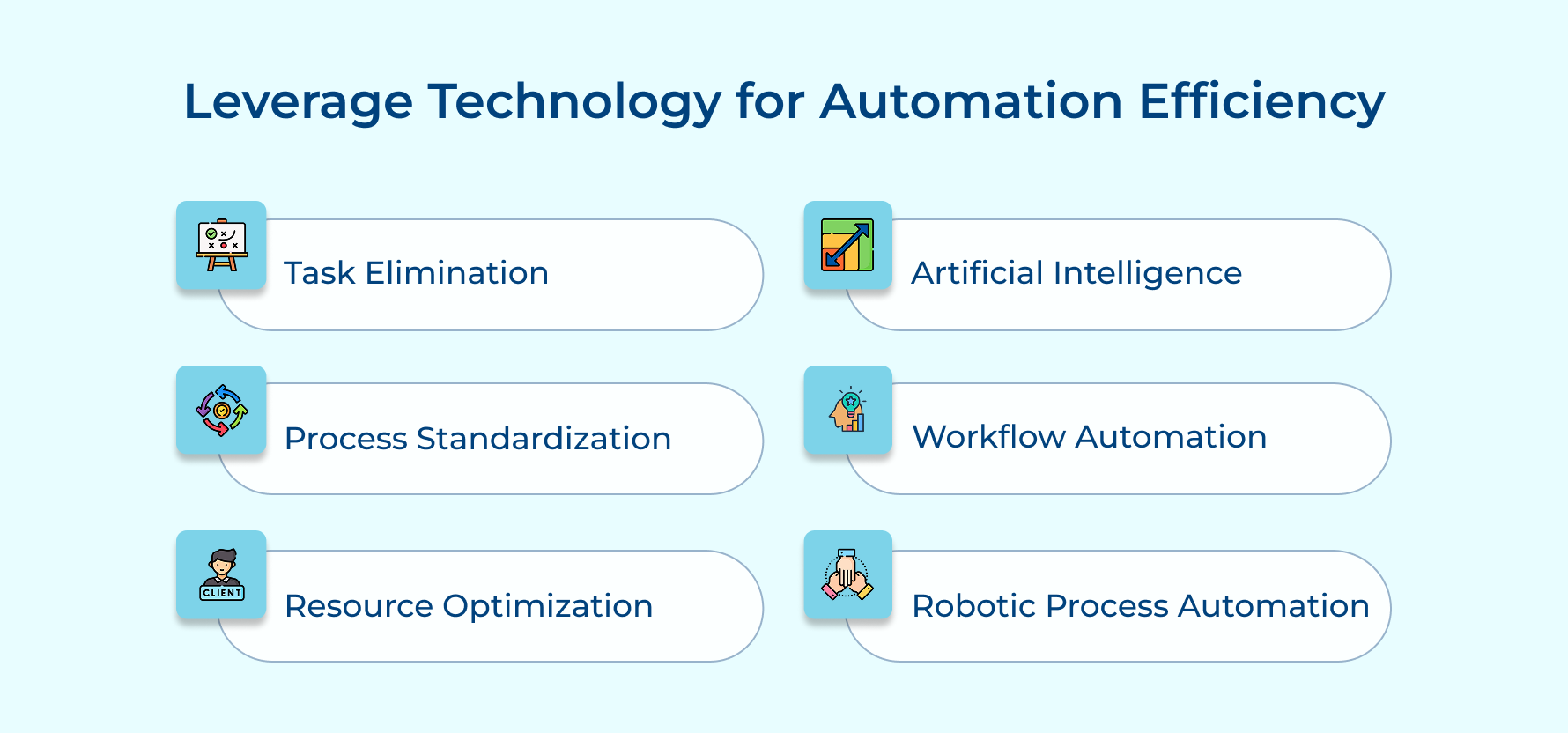
Here are three key ways technology enhance automation efficiency:
- Task elimination: Automation removes repetitive administrative work like data entry and report generation from consultant workflows entirely.
- Process standardization: Technology creates consistent workflows that reduce errors and eliminate time spent on decision-making for routine activities.
- Resource optimization: Automated systems allocate consultant time to highest-value activities while handling background processes without human intervention.
Consider a consulting firm that previously spent five hours weekly creating client status reports manually. After implementing automation, the same reports generate automatically from project management data, freeing those five hours for billable client work that generates immediate revenue.
Four core technologies or features to consider:
- Artificial intelligence: Machine learning algorithms analyze project patterns and predict resource requirements while automating routine data analysis tasks.
- Workflow automation: Digital process automation connects different systems and triggers actions based on predefined rules without manual consultant intervention.
- Robotic process automation: Software robots handle repetitive computer tasks like file transfers and data updates following programmed instruction sets.
5. Optimize Your Daily Schedule Structure
Schedule optimization maximizes productive time by organizing consultant activities around peak performance periods and client priorities. Structured scheduling prevents fragmentation that reduces focus while creating inefficiencies that diminish billable hour potential.
Answer this questions:
- What time blocks work best for your most challenging client work?
- Which daily activities consistently interrupt your billable work flow?
- How much time do you currently lose switching between different project contexts?
- What non-billable tasks could be batched into specific time slots?
These questions reveal scheduling patterns that either support or undermine billable hour maximization across consultant workflows. Understanding your natural rhythms and work interruption sources enables strategic schedule design that protects high-value client time.
How do you actually restructure your schedule once you understand these patterns? Set aside your most productive hours only for billable work. Do admin tasks during times when your energy is lower and deep thinking is harder.
6. Improve Client Communication and Documentation
Enhanced communication creates transparency that builds client trust while protecting consultant time through clear expectations and boundaries. Documentation serves as evidence of work performed and prevents scope creep that reduces effective hourly rates.
Effective communication and documentation systems capture all client interactions as well as project decisions in organized formats that support billing accuracy. This approach eliminates time wasted on recreating information and provides clear records that justify consultant charges to clients.
Pro tips:
- Schedule regular check-ins at consistent intervals to maintain project momentum and address issues before they become time-consuming problems.
- Create standardized templates for common communications like status updates and meeting summaries to reduce writing time while ensuring completeness.
7. Focus on High-Value Activities Only
High-value focus concentrates consultant energy on activities that generate maximum revenue per hour worked. The strategic approach prevents time dilution across low-paying tasks that reduce overall profitability and career advancement potential.
Focusing on high-value activities starts by identifying tasks with the highest billing rates requires a systematic analysis of which activities clients pay premium prices for consistently. You accomplish this by reviewing past invoices and noting which services commanded the highest hourly rates from different client types.
Here are four essential components for identifying billing opportunities:
- Client willingness to pay premium rates for specialized expertise
- Market demand levels for specific consulting services offered
- Competitor pricing analysis for similar high-value service categories
- Personal expertise depth in particular consulting domain areas
How do you transform this knowledge into premium service specialization? Develop deeper expertise in those specific areas through additional training and certifications. Then position yourself as the go-to expert for those particular challenges rather than accepting any project that comes your way.
8. Streamline Your Project Management Processes
Process streamlining eliminates redundant steps and creates efficient workflows that maximize consultant time spent on revenue-generating activities. Streamlined processes reduce administrative overhead while improving project delivery speed and client satisfaction levels.
Proven methods for streamlining consulting project management workflows:
- Standardized project templates: Use ready-made templates for similar projects. They come with set milestones and formats for deliverables. It saves planning time and keeps your work consistent across all clients.
- Automated status reporting: Set up tools that pull updates from project data and create reports automatically. No need to spend time making reports by hand. Clients also get real-time updates on progress.
- Centralized communication hubs: Keep all project messages and files in one place. This saves time spent searching across emails or chats. It also makes sure no important info gets missed.
Consider a consulting firm that previously spent two hours weekly creating custom project plans for each new client. After implementing standardized templates, they reduced this time to thirty minutes while maintaining quality standards and client satisfaction.
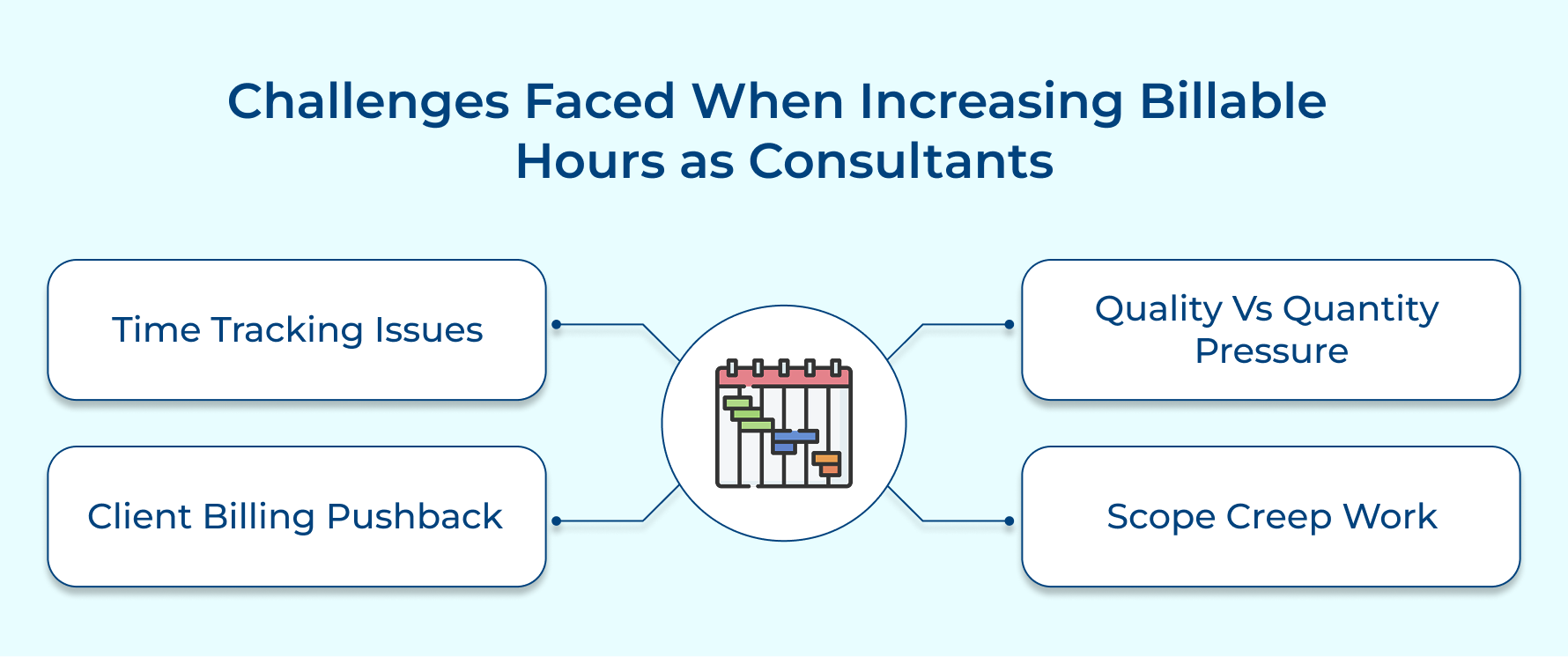
Challenges Faced When Increasing Billable Hours as Consultants
Maximizing billable hours sounds straightforward in theory, but consultants face real obstacles that can sabotage their efforts. These challenges often stem from conflicting priorities between client service and revenue optimization.
Time Tracking Resistance and Forgetfulness
A lot of consultants find time tracking frustrating. It feels like just another admin task that breaks their creative flow. Logging hours in real-time doesn’t always fit with deep problem-solving work that needs focus and zero interruptions.
Client Pushback on Detailed Billing
Sometimes clients push back when they see detailed time logs. They may not want to pay for work they see as overhead, even if it’s essential. This can make it tricky to stay transparent in your billing without hurting the relationship.
Balancing Quality with Quantity Pressure
Trying to increase billable hours can backfire. It might tempt consultants to rush, take on too much, or cut corners, hurting quality in the process. When that happens, clients notice, and repeat business becomes harder to secure.
Scope Creep and Unpaid Additional Work
Clients often ask for “just one more thing” without realizing the time it takes. Consultants feel the pressure to say yes, even when that extra work isn’t covered. Over time, this eats into profits and lowers the value of your hourly rate.
Overcoming these challenges takes strategy, not just more hours.
- Start by using smart time tracking software that captures work automatically, so you don’t have to remember to log it all.
- Be crystal clear about what’s billable in your contracts. Define boundaries so client relationships stay strong and fair.
- Use repeatable processes and templates that save time without sacrificing quality across projects.
- Offer premium services at higher rates, so you earn more without just doing more.
- Rely on tech and time-tracking tools to handle routine admin, so your best hours go toward actual client work.
Increase Billable Hours to Grow Your Consulting Business
How to Increase Billable Hours as Consultants starts with recognizing that billable time is the foundation of long-term consulting growth. When you turn your time into measurable revenue, you create a path to sustainable success. But without smart strategies to manage those hours, even top consultants can find it hard to stay profitable.
The key is to track time systematically, set clear boundaries with clients, and focus on premium services that justify higher rates. These steps not only boost your revenue, they also improve client relationships. When you deliver work consistently as well as provide clear documentation of your time, clients see the value, trust you more and are more likely to stick around.
Limit time — not creativity
Everything you need for customer support, marketing & sales.

Pooja Deshpande is a content contributor at Kooper, focused on creating insightful resources that help agencies and service providers scale efficiently. Passionate about SaaS trends, content strategy, and operational excellence, she delivers practical, easy-to-implement guidance for modern business leaders.