A Complete Guide to Retainer Fees for Professional Services

Key Highlights:
- Retainer fee provides stable revenue streams for providers and predictable costs for clients.
- Long-term engagements enhance client relationships and boost efficiency which also encourages strategic partnerships.
- Retainers streamline workflows and ensure priority access to services through ongoing feedback as well as collaboration.
In the evolving space of professional services, retainer fees have become more than just a payment model – they’re a strategic approach to building sustainable business relationships.
If you’re a service provider considering offering retainer arrangements or a client evaluating their benefits, understanding the nuances of retainer fees is crucial for making informed decisions.
Let’s explore how retainer fees work, their benefits for both parties, and how to structure them effectively for maximum value.
What is a Retainer Fee?
A retainer fee is an upfront payment made by a client to secure ongoing professional services for a specified period. It functions as a reservation of time, expertise, and resources, where the client pays in advance to ensure priority access to services, typically on a monthly or quarterly basis.
For service providers, retainers offer predictable revenue streams, enabling better resource planning and financial stability. They provide a buffer against income fluctuations and allow firms to maintain consistent service quality by dedicating specific resources to retain clients.
For clients, retainers ensure priority access to expertise, often at preferential rates, and guarantee service availability when needed. The arrangement builds stronger client-provider relationships, as both parties are invested in long-term success.
Primary objectives:
- Secure consistent revenue: Establish predictable cash flow through guaranteed monthly or quarterly payments, enabling better business planning and resource allocation.
- Ensure resource availability: Guarantee dedicated professional resources are available when clients need them, preventing capacity constraints or service delays.
- Build long-term relationships: Facilitate deeper client partnerships through ongoing engagement and consistent service delivery.
- Optimize service delivery: Enable proactive service planning as well as execution through committed resources and established workflows.
What are the Types of Retainer Fee?
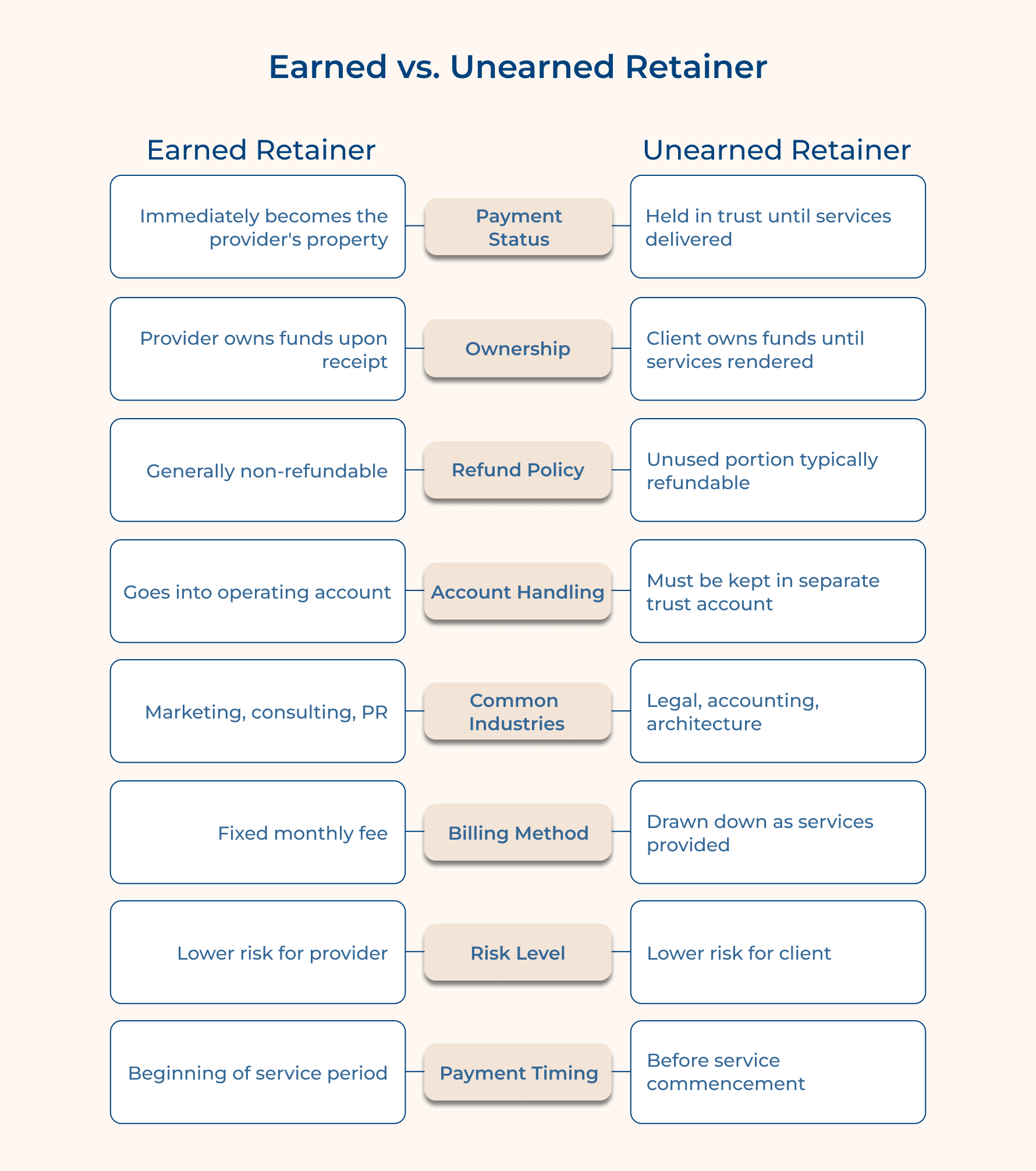
Understanding the types of retainer fees helps businesses and clients establish clear expectations. Let’s learn the two common types and how they help your payment plan along with future services.
Earned Retainer Fee
A fee paid in advance for specific services becomes the service provider’s property immediately upon payment. Common in consulting or marketing agencies, where monthly retainers cover predetermined deliverables. Once paid, these fees belong to the provider regardless of service completion or client satisfaction.
Examples:
- Marketing agency charging $5,000 monthly for social media management
- IT consultant receiving $3,000 monthly for system maintenance
- PR firm collecting $8,000 monthly for media relations
- Business advisor charging $4,000 for monthly strategic guidance
Unearned Retainer Fee
An advance payment is held in a separate account until services are delivered. Lawyers often use this model, depositing client funds in trust accounts and drawing from them as work is completed. Unused portions remain client property and may be refundable.
Examples:
- Law firm holding $10,000 in trust, billing against it hourly
- Accountant keeping a $5,000 deposit for tax season work
- Architect maintaining a $15,000 deposit for project phases
- Consultant reserving $7,500 for upcoming project work
How Does a Retainer Fee Work?
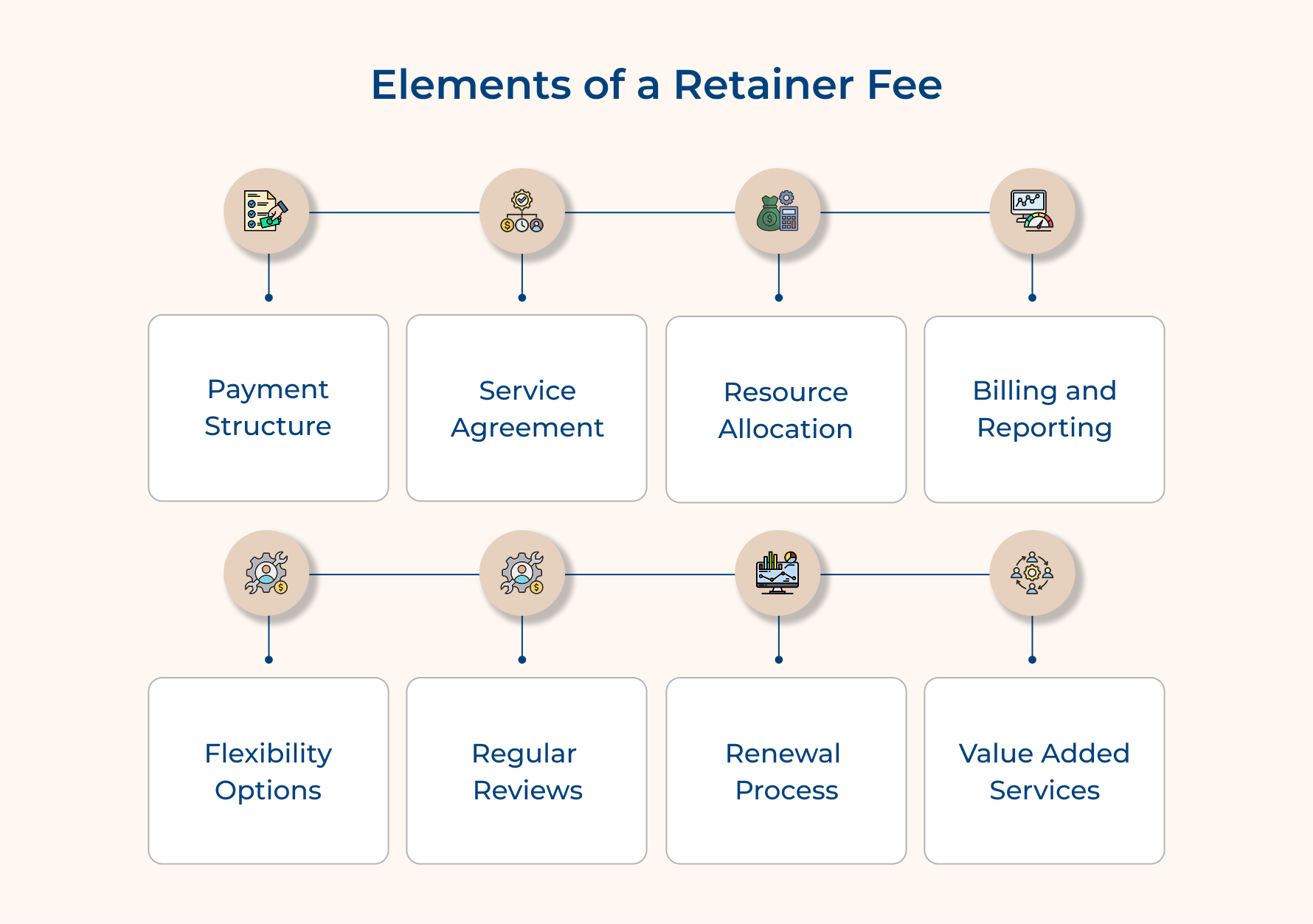
Retainer contract includes a fee related to resource allocation, service agreements, and more. Let’s look into a few of those factors that add to the retainer fee.
Payment Structure
Retainer clients make upfront payments, typically monthly or quarterly, to secure access to professional services. These fees are calculated based on estimated hours, the scope of work, and the level of expertise required. Some retailers operate on a “use it or lose it” basis, while others allow unused hours to roll over.
Service Agreement
A formal contract outlines all the details—covered services, response times, communication channels, and deliverables. It also specifies the work scope, additional charges for extra services, and how priorities are managed.
Resource Allocation
With a retainer, service providers dedicate specific resources to clients. Team members are assigned, calendar slots are blocked, and guaranteed response times are ensured, making the service consistent.
Billing and Reporting
Monthly reports track how services are used, hours consumed, and deliverables completed. These reports accompany invoices, giving clients a transparent view of the value they’re receiving.
Flexibility Options
Retainers often include flexibility, such as adjusting service levels or rolling over unused hours. Many providers also offer tiered packages with varying levels of service and priority access.
Regular Reviews
Quarterly performance reviews ensure that the retainer arrangement works for both parties. These discussions explore service usage, necessary adjustments, and alignment with changing business needs.
Renewal Process
Most retainers auto-renew unless either party gives notice. Annual reviews provide opportunities to adjust terms, update the scope, and modify fees based on usage patterns.
Value Added Services
Retainer clients often enjoy premium perks like priority scheduling, discounted rates, strategic planning sessions, and exclusive advisory services. Hence, building deeper partnerships as well as added value over time.
How to Determine a Retainer Fee?
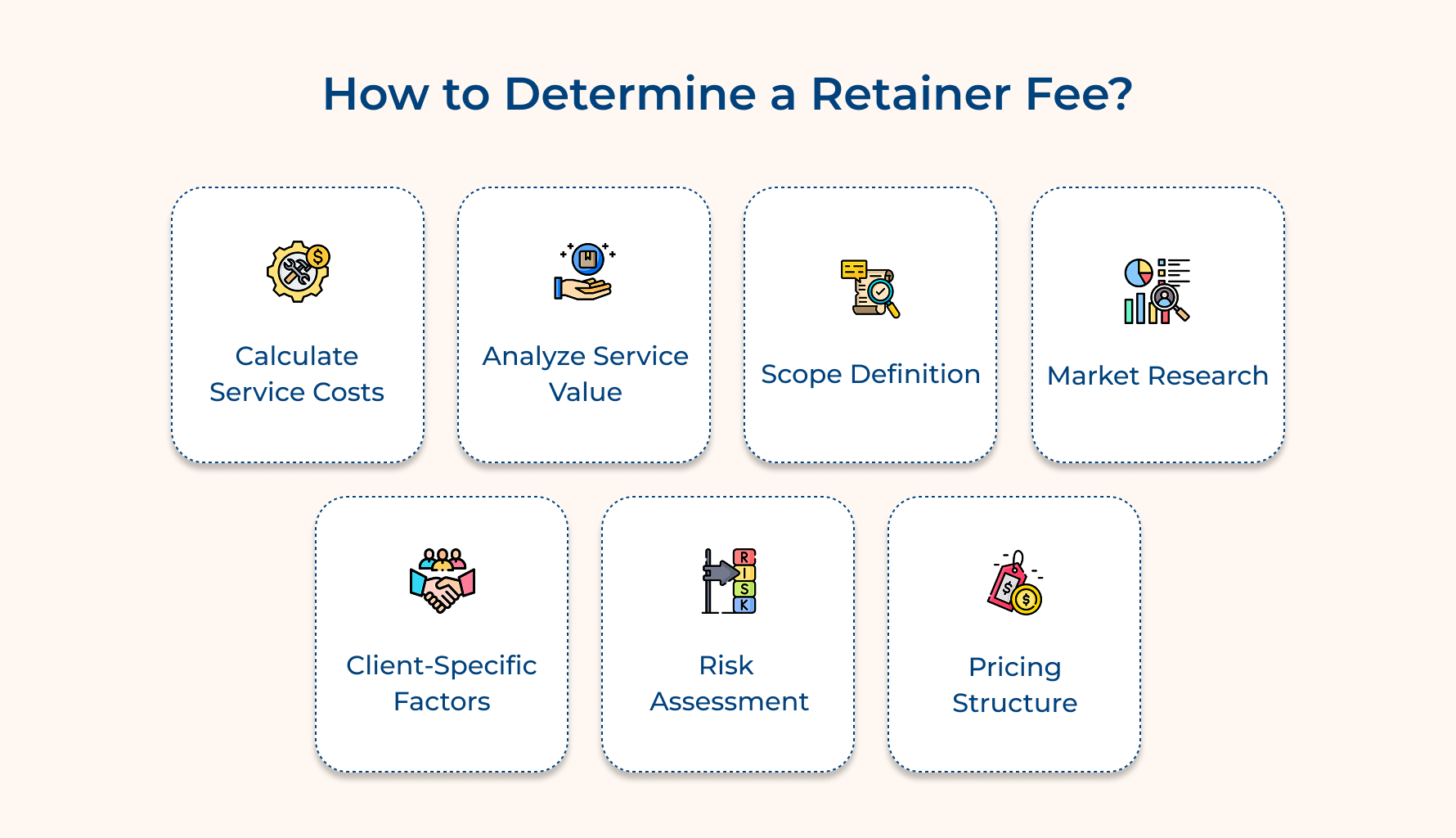
Setting the right retainer fee is key to ensuring a fair exchange of value between service providers and clients. But, how to determine it right? These tips can help.
1. Calculate Service Costs
Accurately determining a retainer fee is essential for balancing profitability and client satisfaction. By understanding all associated costs, you can set sustainable pricing that ensures long-term success.
- Calculate total costs: Include all direct as well as indirect expenses, such as labor, operational overhead, tools, and technology required to deliver the services.
- Ensure profitability: Accurate cost estimation helps maintain profitability and service quality. Underpricing can lead to losses and compromise long-term business viability.
- Use cost breakdowns: Create detailed spreadsheets to break down each component of your service. Track time and resources used in similar projects to establish realistic baseline costs.
- Account for overheads: Don’t forget to factor in overheads like office expenses and administrative costs to get a full picture of your service pricing.
- Add buffers for unexpected costs: Include a buffer percentage in your pricing to cover unexpected expenses or last-minute changes.
- Review regularly: Update cost calculations quarterly to ensure they align with current expenses and business realities.
Pro Tips:
- Keep detailed time-tracking records for all team members to analyze resource usage effectively.
- Use historical data from past projects to refine your cost estimates and avoid underpricing.
2. Analyze Service Value
Determining the true value of your services is crucial when setting a retainer budget. It’s not just about covering costs, it’s about showcasing the expertise, results and competitive edge you bring to the table. A value-driven approach not only ensures fair compensation but also demonstrates the return on investment (ROI) clients can expect.
Here’s how to focus on value analysis:
- Assess service worth: Evaluate the expertise, market positioning, and unique advantages your services offer. Highlight what sets you apart from competitors.
- Focus on ROI: Consider how your services contribute to the client’s success. Value-based pricing works best when clients can see the tangible and intangible returns.
- Document benefits: Outline the specific outcomes clients can expect, such as increased efficiency, better results, or growth. Case studies and success metrics are great tools for this.
- Develop value propositions: Craft compelling statements that showcase how your services solve client pain points and deliver measurable results.
Pro Tips:
- Create case studies that quantify client success stories and ROI from similar retainer setups.
- Build clear value metrics and reporting systems to consistently demonstrate the ongoing benefits clients receive.
3. Scope Definition
A well-defined scope is the backbone of any successful retainer agreement. It’s essential to document all services, deliverables, frequencies, and boundaries to ensure clarity from the start.
Clearly outlining what’s included and what incurs additional charges prevents misunderstandings, scope creep, as well as potential disputes. To achieve this, create detailed service catalogs and retainer agreements that leave no room for ambiguity.
Include specifics like deliverables, timelines, and response times. Service-level agreements (SLAs) with measurable metrics can further enhance accountability and ensure clients know exactly what to expect.
Actionable Tips:
- Regular scope reviews with clients are crucial to maintaining alignment and addressing potential grey areas.
- By building a comprehensive service matrix that outlines all included and excluded services, you create transparency as well as build stronger client relationships.
4. Market Research
Setting the right retainer fee involves more than just crunching numbers—it requires a deep dive into market dynamics. Here’s how to stay competitive and profitable:
- Analyze competitor pricing: Study what competitors are charging for similar services. You get to benchmark your fees while highlighting areas where you can offer more value.
- Consider industry standards: Stay informed about pricing trends within your industry. It ensures your fees align with what clients expect while maintaining a competitive edge.
- Evaluate market demand: Assess how much demand exists for your services in your sector and geographic area. High demand can justify premium pricing, while low demand may require strategic adjustments.
- Account for economic factors: Keep an eye on economic conditions that might influence client budgets, such as inflation or market downturns, and adapt your pricing accordingly.
- Engage potential clients: Survey clients about their budget ranges and their perception of value. This feedback provides valuable insights for refining your pricing strategy.
Tips to consider:
- Set up a system to monitor competitor pricing quarterly and track any changes in the market.
- Use client surveys to understand their pricing expectations and ensure your services align with perceived value.
5. Client-Specific Factors
Every client is unique, and your pricing should reflect that. Analyzing client-specific characteristics—like their size, industry, complexity, location, and long-term growth potential—helps you create pricing that’s fair as well as tailored to their needs. It builds a balance between service delivery costs and the value the client brings to your business.
Start by developing a client assessment framework. Use it to evaluate key factors systematically, such as the scope of their requirements, industry-specific challenges, and their potential as a long-term partner. From there, you can create tiered pricing models to suit different client segments, ensuring flexibility and fairness.
It’s also important to account for industry-specific nuances. Some industries may demand more resources or expertise, which should be reflected in your pricing. Adding these considerations helps you offer customized solutions without compromising profitability.
Actionable Tips:
- Build a standardized client assessment checklist to ensure consistency when evaluating new clients.
- Introduce industry-specific pricing adjustments for clients with unique complexities or high resource demands.
6. Risk Assessment
Understanding and planning for potential risks is crucial to delivering consistent as well as profitable services. Approach risk management effectively with the following,
- Assess potential risks: Identify areas like service delivery challenges, resource allocation issues, market changes, and scope management conflicts that could impact operations.
- Plan for contingencies: Develop contingency plans for various scenarios, such as unexpected workload spikes or economic downturns, to ensure smooth service delivery.
- Add risk premiums to pricing: Incorporate a risk buffer into your pricing to account for unforeseen challenges without compromising profitability.
- Monitor key indicators: Establish systems to track potential risks, such as market trends or client-specific issues, and address them proactively.
Tips to consider:
- Conduct monthly risk review sessions to spot potential issues early and adjust your strategies as needed.
- Develop clear escalation procedures for different risk scenarios, assigning specific responsibilities to your team for faster resolution.
7. Pricing Structure
Creating a clear pricing model helps clients understand your services and makes the sales process smoother. Here’s how to do it:
- Set base rates: Decide on standard rates for your main services.
Create Service Tiers: Offer different packages to suit various budgets and needs. - Define payment terms: Be clear about when and how payments are made.
- Add extra charges: List costs for additional services or work outside the agreement.
- Include discounts: Offer perks for bulk work or long-term commitments.
Pro Tips:
- Design three service tiers with clear distinctions in features and value to suit varying client budgets as well as needs.
- Use standardized pricing calculators that factor in all variables for consistent and accurate quotes.
Key Benefits of Retainer Fee You Should Know
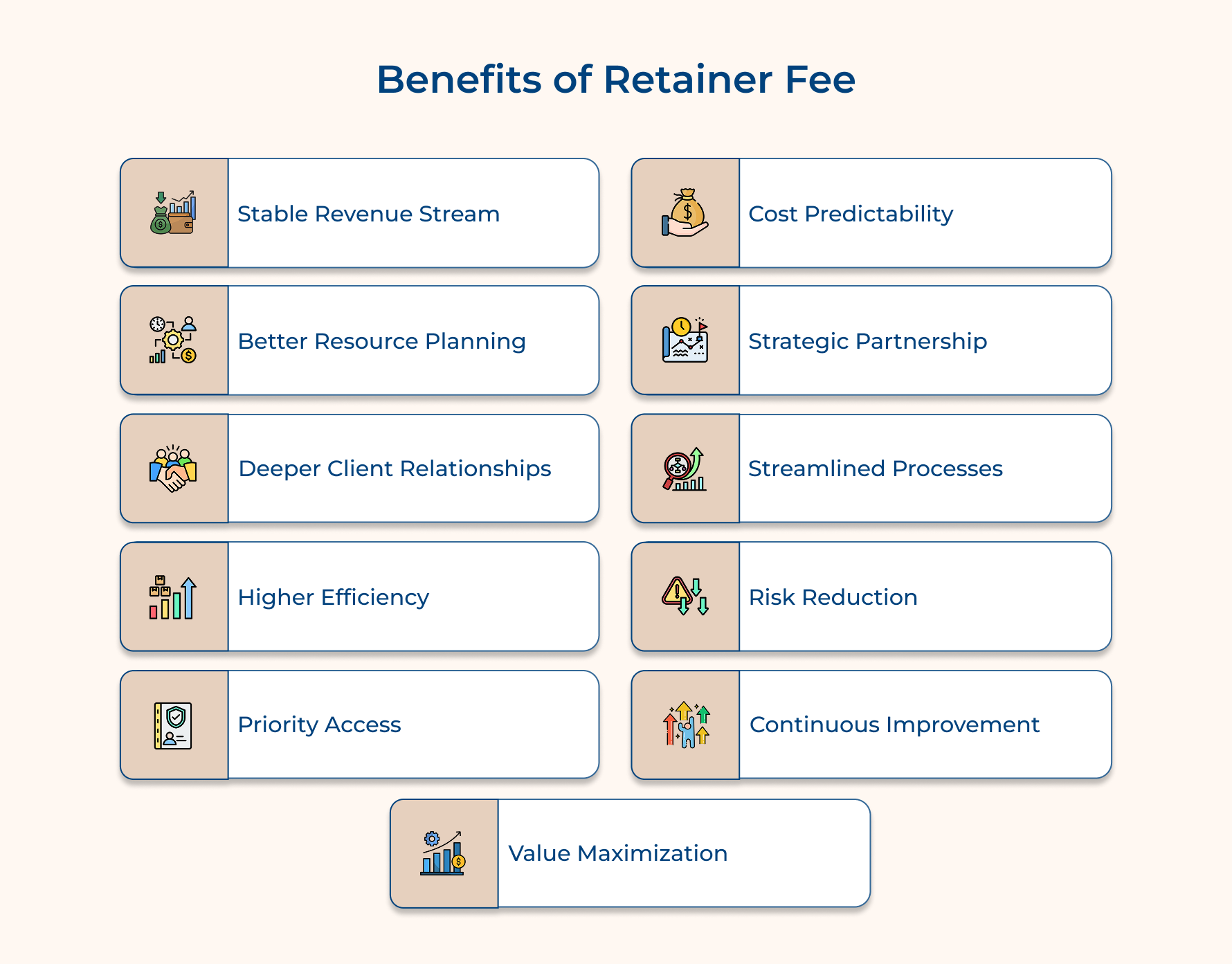
A retainer fee ensures dedicated support, streamlined workflows, and long-term collaboration benefits. Let us delve into other aspects that you benefit from the retainer fee agreement.
Benefits for Service Providers:
Stable revenue stream Predictable monthly income enables better business planning and cash flow management. Regular payments reduce financial uncertainty, support consistent resource allocation, and enable long-term investment in team development.
Better resource planning Guaranteed workload allows precise capacity planning and efficient resource allocation. Advanced knowledge of service demands enables optimal staffing levels, reducing both over-hiring and resource shortages.
Deeper client relationships Ongoing engagements build stronger client understanding and trust. Regular interactions lead to better service alignment, proactive problem-solving, and increased client loyalty over time.
Higher efficiency Familiarity with client needs reduces startup time for new tasks. Established workflows and communication channels increase productivity while also reducing administrative overhead.
Benefits for Clients:
Priority access Guaranteed service availability when needed, often with faster response times. Dedicated resources ensure consistent service quality and immediate attention to urgent matters.
Cost predictability Fixed monthly fees simplify budgeting and financial planning. Predetermined rates often offer savings compared to ad-hoc service purchases.
Strategic partnership Regular engagement enables service providers to develop a deeper business understanding. Proactive advice and strategic insights become natural outcomes of ongoing relationships.
Streamlined processes Established workflows to reduce administrative burden and project startup time. Familiar teams require less briefing while delivering more relevant solutions faster.
Risk reduction Long-term relationships reduce uncertainty for both provider and client. Mutual commitment encourages investment in relationship success as well as quality improvement.
Continuous improvement Regular feedback enables ongoing service refinement and optimization. Both parties benefit from accumulated knowledge and process improvements over time.
Value maximization Aligned interests drive focus on long-term value creation. A strategic partnership mindset replaces a transactional service approach, benefiting both parties.
Practical Examples of the Retainer Fee
Understanding retainer fees is easier with real-world examples. Here’s a simple breakdown to illustrate how retainer agreements work in practice.
- Legal Services Retainer
A corporate law firm charges a $10,000 monthly retainer for ongoing legal counsel to a tech startup. The arrangement includes regular contract reviews, employment law advice, and IP protection work. Urgent matters receive same-day response, while routine queries are addressed within 48 hours. Additional complex litigation work incurs separate charges based on agreed hourly rates. - Marketing Agency Retainer
A digital marketing agency maintains a $5,000 monthly retainer fee with an e-commerce business. Services include social media management, content creation, and email marketing campaigns. The package covers the creation of 20 social posts, two email newsletters, and monthly performance reporting. Additional services like special campaign designs are billed separately. - IT Support Retainer
An IT consulting firm provides managed services to a mid-sized accounting firm for $7,500 monthly. The agreement covers 24/7 system monitoring, cybersecurity management, help desk support for 50 users, and quarterly technology reviews. Emergency response is guaranteed within one hour, while regular maintenance occurs during predetermined time slots. - Business Advisory Retainer
A management consulting firm charges $8,000 monthly to provide strategic advice to a growing manufacturing company. Services include monthly strategy sessions, quarterly business reviews, financial analysis, and on-call advisory support. The consultant dedicates two days per month on-site and provides unlimited email/phone consultation.
Retainer Fees: A Smart Approach to Sustainable Revenue Streams
Retainer fees present an effective way to ensure financial stability while strengthening client relationships. Service providers enjoy consistent income and ongoing projects, while clients benefit from dedicated, on-demand access to expertise.
As business environments become increasingly complex, well-designed retainer agreements will continue to play a crucial role in building strong professional partnerships, ensuring service quality, and driving mutual growth. The key lies in regular evaluation, open communication, and continuous optimization of these arrangements to meet evolving business needs.
Clear terms around pricing and scope help set expectations, paving the way for successful, long-term collaborations that drive business growth as well as client satisfaction.
Limit time — not creativity
Everything you need for customer support, marketing & sales.

Pooja Deshpande is a content contributor at Kooper, focused on creating insightful resources that help agencies and service providers scale efficiently. Passionate about SaaS trends, content strategy, and operational excellence, she delivers practical, easy-to-implement guidance for modern business leaders.