Project Review: How to Conduct One That Drives Change
- What is a Project Review?
- Why is Project Review Process Important in Project Management?
- 4 Types of Project Management Reviews to Consider
- How to Conduct a Project Review: 7-Step Process
- 5 Best Practices of Project Review
- Project Review Examples to Consider in Different Industries
- Transform Evaluations Into Actionable Insights With Project Review.
- FAQs about Project Review

Key Highlights:
- A project review measures progress, risks and deliverables against the original plan to give teams a decision point to prevent costly problems.
- Segmentation of data sharing and live discussion makes every review sharper as well as more actionable.
- Reveal whether delivery is recovering or quietly deteriorating by tracking variance trends across multiple project reviews.
A project can hit its budget, stay on schedule and fail, but barely anyone notices until it reaches the client. The gap between is exactly what most teams identify too late.
Less than 31% of projects in a service firm actually succeed on time, budget and scope. A project review closes that gap by checking actual progress and the original plan before escalating into a real problem.
Let’s understand the definitive guide to what a review actually involves, types and a step-by-step process for running one well.
What is a Project Review?
A project review is a structured checkpoint for teams to formally track progress, risks and deliverables with respect to the original plan. It serves as a decision point that shapes resourcing, timelines and the next action plan for the project.
So when does a review actually happen? Most service firms form the project review session at phase gates, milestones or fixed intervals. The project manager, sponsors and key stakeholders are the key participants of the session.
A good review in project management leads to accountability that turns assumptions into action plans before escalating to problems.
Key Goals:
- Validate that the project remains aligned with its original business objectives.
- Identify risks and roadblocks before they escalate into costly delays.
- Confirm resource allocation still matches actual project demands.
- Create a documented record that supports future decision-making and accountability.
Why is Project Review Process Important in Project Management?
A review process forms the foundation to keep a project honest with proper management of deadlines and preventing blown budgets down the line.
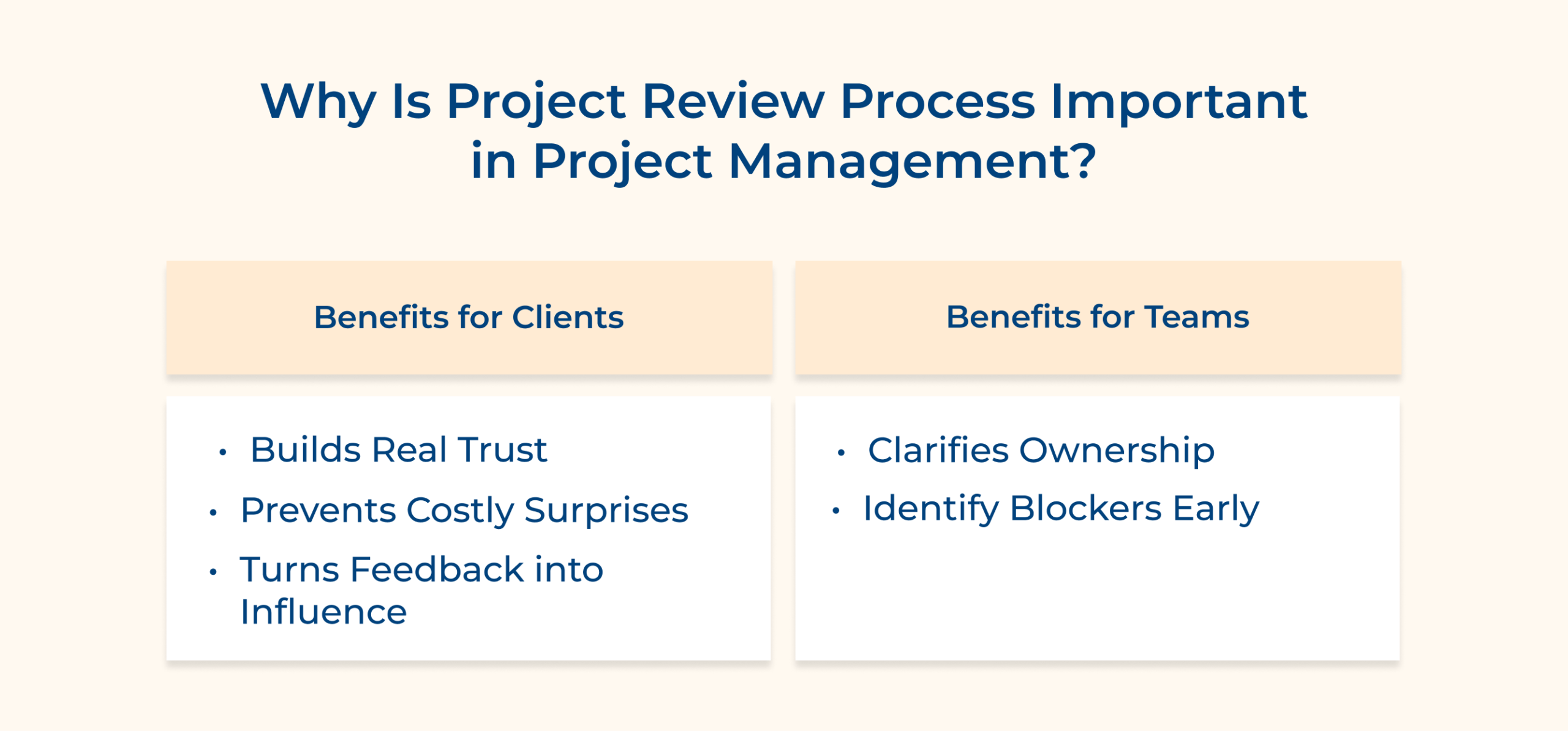
Benefits for Clients
Builds Real Trust
A good project review gives clients real-time visibility into actual progress instead of polished status reports. This transparency builds confidence before any final delivery date arrives on the calendar.
Prevents Costly Surprises
Regular reviews help in identifying scope changes in projects the moment they happen, meaning clients never get surprised by sudden cost increases deep into the engagement.
Turns Feedback Into Influence
Clients know their input genuinely shapes the direction of work delivered. The shift in the review technique turns passive recipients into stakeholders who feel heard across the entire project cycle.
Benefits For Teams
Clarifies Ownership
Teams can reveal accountability for each deliverable at any stage of project execution. The clarity helps in reducing finger-pointing later, when some scope drifts off track despite best intentions.
Identify Blockers Early
Proper review techniques give teams a judgment-free moment to manage issues honestly before they escalate in client frustration. It helps in addressing issues before deadlines slip unexpectedly.
4 Types of Project Management Reviews to Consider
Each review type serves a different purpose, and using the wrong project affects everyone’s effort. Let’s explore how common types actually function:
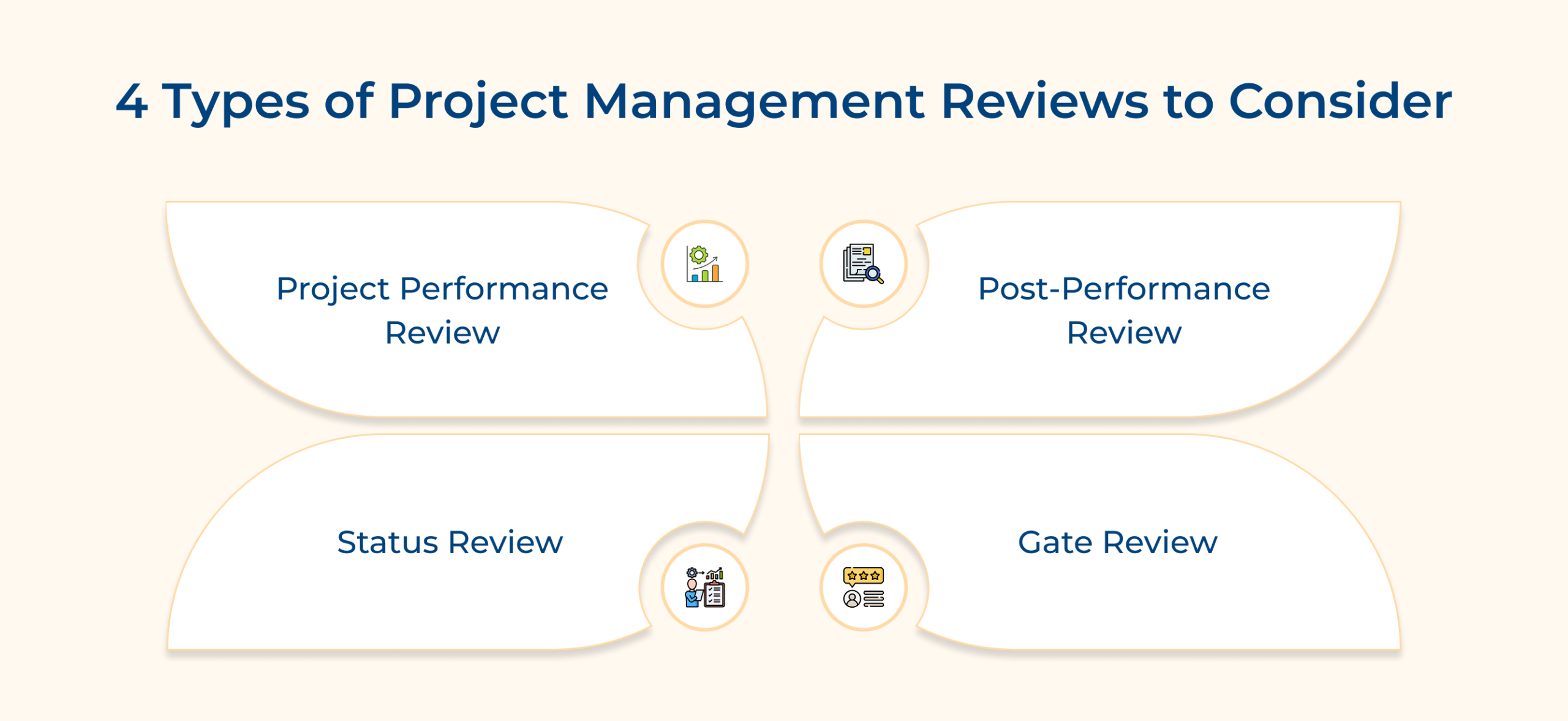
1. Project Performance Review
Tracks ongoing metrics such as budget, schedule and quality with respect to the original plan. This type of project management review is done mid-project instead of at the end.
Performance review is a health check where you catch early drifts to adjust course without affecting the deadlines entirely out of reach.
So, what does an experienced PM look for during the review?
- Deeper resourcing problems underneath when schedule variance creeps past 10%
- Actual work completion affected by budget burn rate.
- Project deadlines are on track, but quality metrics are slipping
2. Post-Performance Review
The review session is held after project delivery and closure, focused entirely on areas where improvement can be made instead of fixing anything that’s done.
Can teams skip this one under deadline pressure? No, this is the mistake that quietly repeats the same problems project after project without addressing them. It prevents next quarter’s work from inheriting the same issue.
3. Gate Review
A gate review template forms a go or no-go checkpoint positioned between major phases of projects. No work can pass until predefined criteria have been met along with formal approval by stakeholders.
Don’t consider it a rubber stamp exercise where satisfaction is the priority. It removes all the weak business cases before the organization invests more money and time into them.
A good gate review template includes these questions for your project:
- Is the business case justifying the remaining spend on this project?
- Are the assumptions on project kickoff held up against actual delivery data?
- Is your team requesting more time or avoiding a hard conversation?
4. Status Review
The most lightweight check-ins, which are usually done every week, cover all the tasks that are done and currently blocked in the project. This is tactically fast for the teams that are actually doing the work.
So, how does it differ from performance reviews? Status reviews rarely touch the budget in real depth. It works to keep momentum visible and identify blockers before escalating into bigger problems.
How to Conduct a Project Review: 7-Step Process
A thorough project review doesn’t have to be a daunting task. Below are the right step to become an illuminating journey of discovery and learning
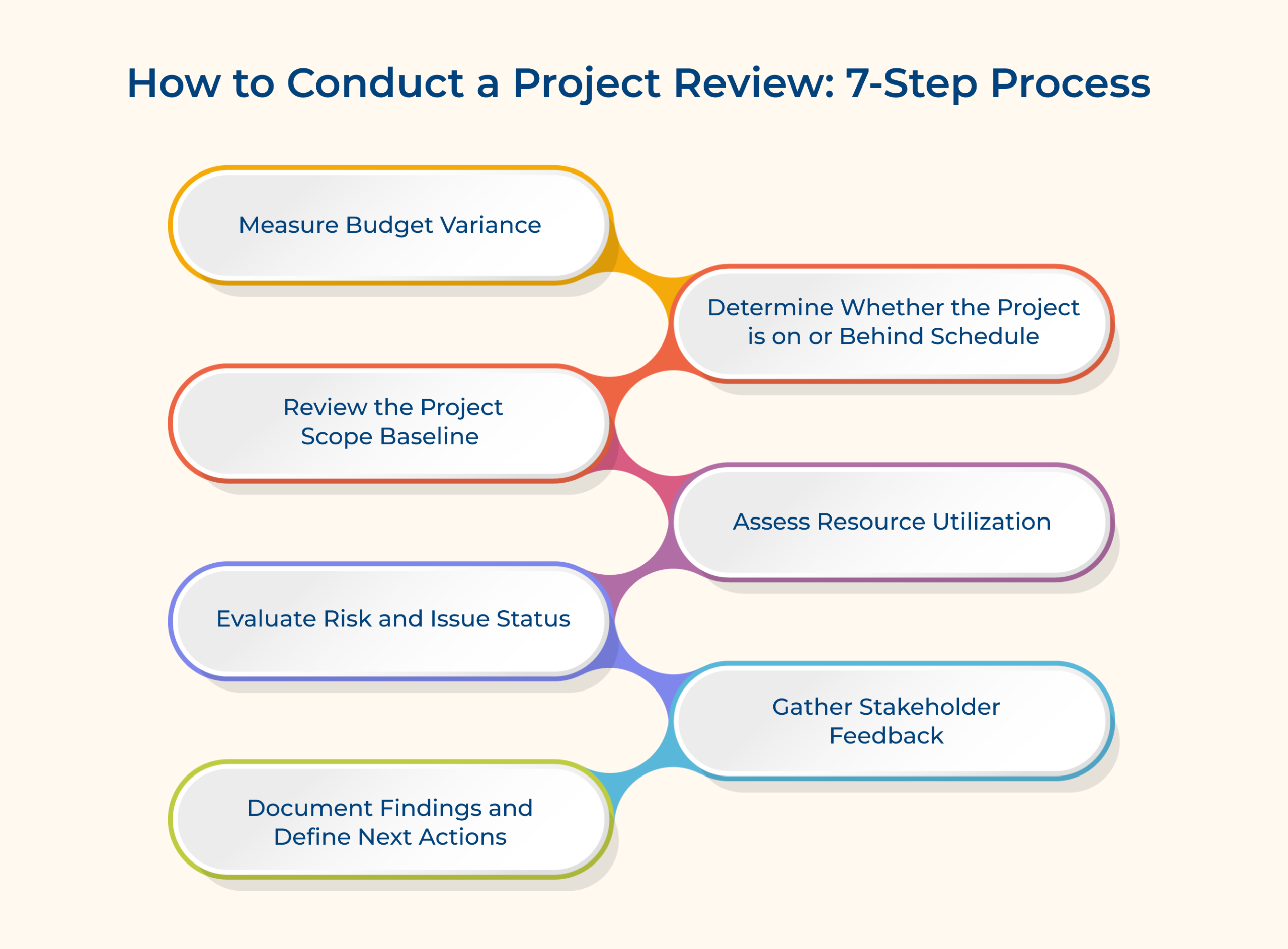
1. Measure Budget Variance
Budget variance helps in identifying whether actual spending is on track with the originally approved plan at any given phase. Early drift tracking prevents manageable overage from quietly compounding into an unrecoverable deficit.
How to measure budget variance accurately?
- Cost Variance (CV): Compare earned value vs actual cost spent on the project. A negative number in the review meaning the project is currently consuming more budget.
- Cost Performance Index (CPI): This ratio reveals how the available budget is converted into actual completed work. A score below 1.0 signals inefficiency that requires immediate investigation.
- Category-Level Tracking: Instead of just viewing overall budget, break total spend down based on individual line items to reveal one specific category absorbing the entire budget alone.
Consider the example of a six-month project with proper review identifying total spend is perfectly healthy, but the design phase burned 40% of the entire budget. The detailed analytics only surface when measuring variance by category instead of glancing.
2. Determine Whether the Project Is On or Behind Schedule
A project with good schedule health determines whether it still realistically meets the committed deadline. It catches slippage early, before it becomes irreversible or escalates to the client.
Pro tip: The analysis is done based on actual progress and not optimistic assumptions.
Assess schedule health with this quick checklist:
- Are all milestones on the original date committed to stakeholders?
- What tasks are currently running on the critical path?
- Are there any dependencies affecting downstream work?
- Does the timeline for completion realistically fit the deadline?
Now that you have identified where things stand, it’s time to dig deeper by comparing actual milestones against the original timeline. A comparison reveals:
- All completed milestones against their original planned date
- The exact gap in days for each deliverable across the project
- Indicate any milestones that are delayed more than a week
Once gaps are visible, it is an obvious question of “which is the cause of these?” The critical path tasks causing delays slip back to holding up everything.
3. Review the Project Scope Baseline
Once schedule and budget are accounted for, scope becomes the next to verify. For most businesses, unchecked scope quietly escalates while undermining both already reviewed numbers.
Check Deliverables Against Originally Approved Scope
Compare actual builds against the documented scope statement signed off with approval at project kickoff. What if there is a mismatch discovered? Immediate clarification from stakeholders is needed before any further work.
Identify Any Unapproved Scope Changes Added
The step catches work that crept in informally over time, through verbal requests. None of this ever passed through a formal scope change review process, which is exactly the risk that most projects fail before delivery.
Document Scope Creep for Stakeholder Visibility
Log every unapproved addition and its actual time as well as cost impact on the project. Most stakeholders require this record to make real-time decisions for any future requests they are considering.
4. Assess Resource Utilization
Once the scope is confirmed it’s time to review the team’s actual capacity for delivering what was planned. Resource utilization helps in measuring the exact gap. Starts by reviewing workload data across entire team:
- Compare planned hours vs actual hours logged per person
- Identify anyone consistently using more than 100% capacity
- Track team members that are well below planned utilization
Managers can track the utilization efficiently, but overallocation rarely gets revealed through formal flags from the team. It requires proper review technique in project management to show up indirectly as missed deadlines.
So before concluding as poor performance from the team, it’s worth asking, is this resource actually overloaded or poorly scheduled from the beginning?
5. Evaluate Risk and Issue Status
Risk and issue review across different projects identifies threats that take the form of problems. A risk is something that might happen, but an issue is already present. Considering and treating both the same way wastes time on wrong responses.
So why do teams let risks sit untouched for weeks? Situation when nobody owns the follow-up, the risk without any ownership turns into the next emergency. Follow the tips to keep the project review sharp:
- During each single project management review, revisit open risks instead of doing it for the new ones.
- Make sure urgent issues don’t bury slow-moving threats by separating risk discussion from status updates in a proper document.
6. Gather Stakeholder Feedback
Proper stakeholder feedback fills in the part that a simple spreadsheet can’t capture. Feedback reveals early dissatisfaction to course-correct the relationship.
Sponsors often notice the friction point before it is identified through formal metrics or status reports. This means relying entirely on review data that can look fine, but project delivery erodes behind the scenes.
How to gather stakeholder feedback during a project management review?
- Structured questions over open-ended ones: Direct specific questions related to deliverables and expectations result in hard answers. Use open-ended questions such as “any concerns?” which produce polite responses.
- One-on-one conversations before group settings: Most stakeholders raise concerns that are skipped entirely in a group project review. Early identification prevents these surprises from surfacing later.
- Written follow-up after verbal feedback: Request stakeholders to provide verbal feedback in writing documents. It removes ambiguity and also creates a record that protects other deliverables from the same concern.
7. Document Findings and Define Next Actions
Every project review has to end and that ending should produce more concrete results than a simple wrap-up. Here you will be turning all analysis into decision-making activities.
A review without proper documentation of the action plan is just a conversation and the same issues tend to appear in the next phase with no real progress. A document should include a summary of key findings across all resources, along with specific ownership of each follow-up action and Clear deadlines attached.
Common mistakes when creating proper documentation:
- Writing findings without context: The phrase “budget is over” without proper explanation leaves readers to work on assumptions.
- Skipping the paper trail entirely: Depending on memory or a quick verbal recap leaves no defense later. Disputes over what was actually agreed become impossible to resolve.
Pro tip: Before closing the review, set the date for the next review to prevent the gap from quietly stretching two weeks into two months.
5 Best Practices of Project Review
Follow these best practices to separate project reviews that genuinely drive change from those that fill calendar time without productivity.
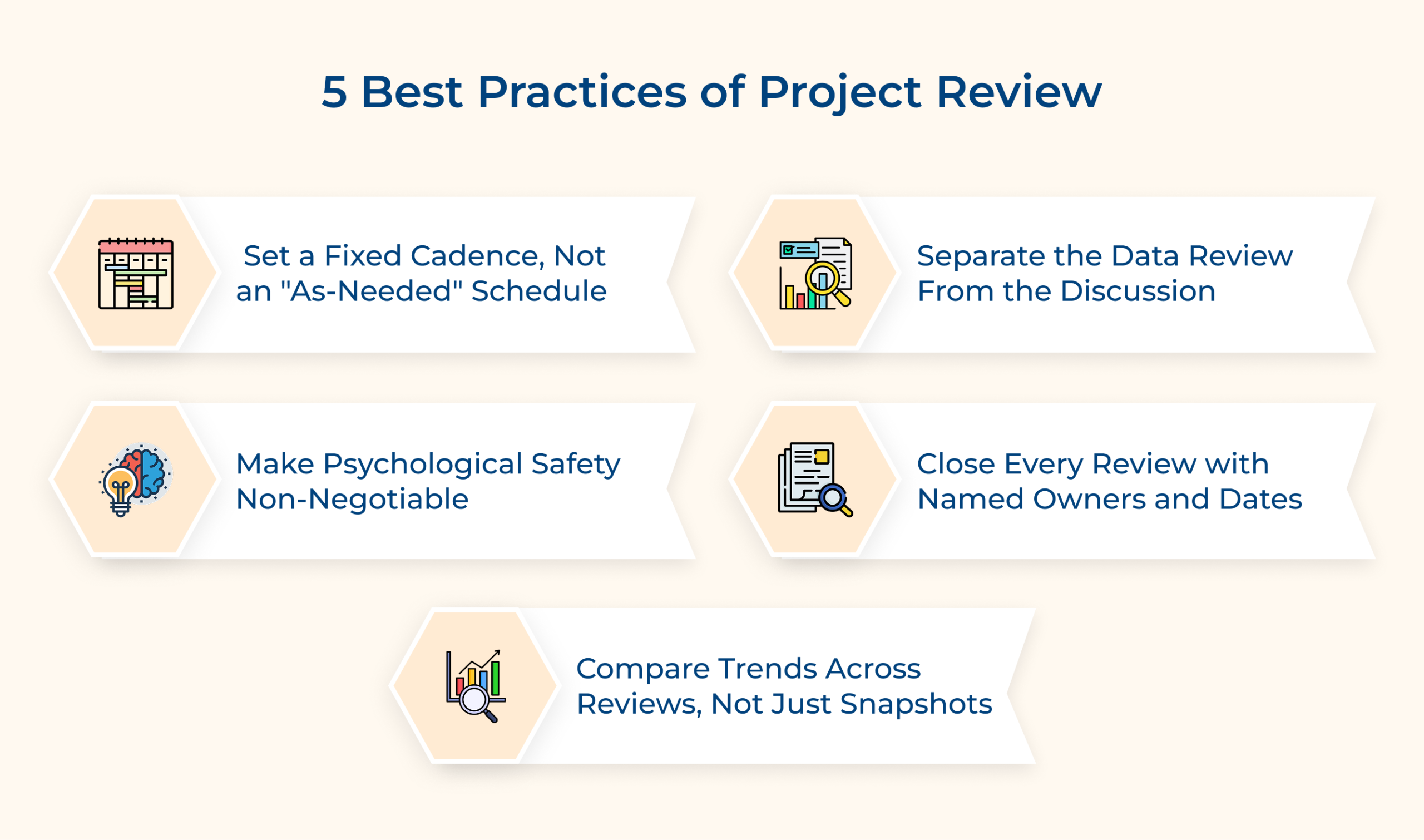
1. Set a Fixed Cadence, Not an “As-Needed” Schedule
Reviews scheduled only when problems arise end up too late to prevent the real damage. Defining a fixed cadence helps in catching drifts before it turns into an expensive surprise for everyone involved in the project.
2. Separate the Data Review From the Discussion
Before the start of the meeting, share metrics to let people walk into the meeting well prepared with the information. The actual session then becomes a focused conversation instead of a slow, read-through of numbers that takes time to digest.
3. Make Psychological Safety Non-Negotiable
Teams that fear blame quietly hide bad news until it is completely unfixable by the time. A proper project management review process only works as intended if people feel safe to report problems honestly without the chance of repercussions.
4. Close Every Review With Named Owners and Dates
A review that ends without a clear action plan is just a simple meeting that happened. Ownership that is not assigned leads to deadlines becoming actual change before the next review rolls.
5. Compare Trends Across Reviews, Not Just Snapshots
Teams that use a single review in isolation miss the larger pattern that is forming underneath. Track variance across multiple review samples to reveal if the project is genuinely recovering or getting worse despite looking stable.
Project Review Examples to Consider in Different Industries
Project reviews are not the same across every industry because risks worth watching shift depending on deliverables. Let’s explore how four different industries approach.
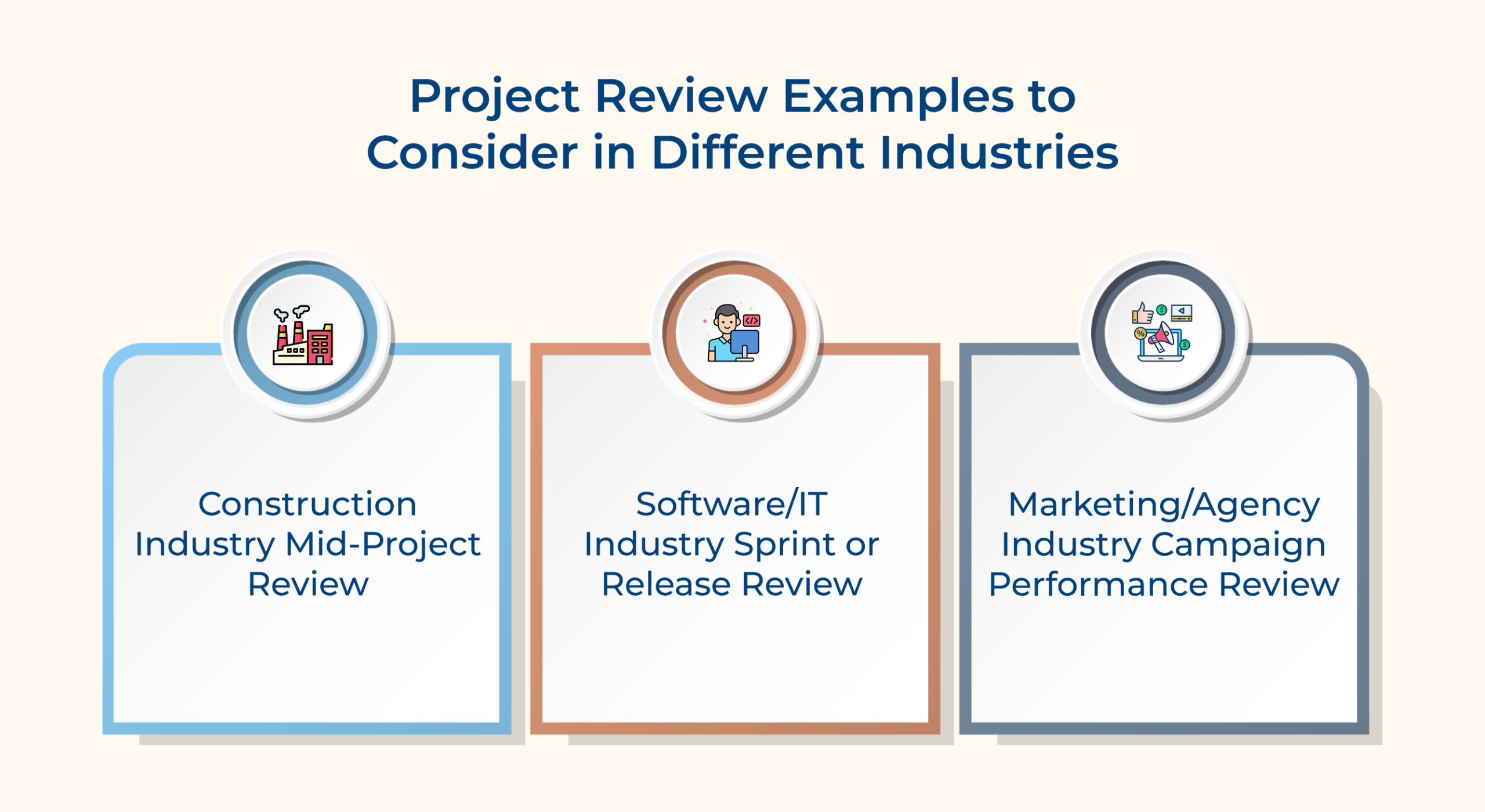
1. Construction Industry Mid-Project Review
A mid-project review in construction happens right after a major phase. The focus moves heavily on safety compliance and material costs that have quietly eaten into the original schedule.
In comparison to software projects, construction reviews always involve a physical site walk as well as paperwork. A manager that only focuses on check reports misses the foundations that a five-minute site visit would catch immediately.
2. Software/IT Industry – Sprint or Release Review
Software development reviews happen at the end of each phase that sync directly to the team’s existing rhythm. The focus is all around:
- Completed story points
- Unresolved bugs
- Genuine delay in release.
So, what makes this review distinct? The speed. Software teams iterate fast which means even a two-week-old feels outdated. Stakeholders get immediate response to their feedback instead of sitting in a backlog.
3. Marketing/Agency Industry – Campaign Performance Review
Agencies tend to revolve around campaign performance metrics and client satisfaction to match the creative deliverables with the original brief.
What’s unique to agency work is subjective? A client’s reaction to creative direction rarely shows in a spreadsheet. An annual project review leans heavily on direct stakeholder conversation than historical data.
Transform Evaluations Into Actionable Insights With Project Review.
A project review is only valuable when it transforms past performance into clear next steps and not just a checklist. It becomes the foundation of smarter planning on future projects.
- Honest evaluation of what is completed and the remaining
- Clear documentation so that teams can actually reference for future projects
- Specific action items with respect to measurable improvements
Ready to run a sharper process? Start by using a structured project review template to guide your evaluation.
A strong review makes the difference between repeating mistakes and actual improvement with every project.
Limit time — not creativity
Everything you need for customer support, marketing & sales.

Neeti Singh is a passionate content writer at Kooper, where he transforms complex concepts into clear, engaging and actionable content. With a keen eye for detail and a love for technology, Tushar Joshi crafts blog posts, guides and articles that help readers navigate the fast-evolving world of software solutions.