How to Prioritize Projects and Deliver Maximum Business ROI
- What is Project Prioritization?
- Why is Project Prioritization Important in Project Management?
- Key Benefits of Project Prioritization for Business
- 7 Methods of Project Prioritization
- How to Prioritize Projects Effectively: 7-Step Framework for Max ROI
- Common Challenges of Project Prioritization & How to Overcome Them
- Elevate Your Workflow With Smart Project Prioritization Strategies.
- FAQs about Project Prioritization in Project Management

Key Highlights:
- Project prioritization makes sure resources flow across the highest-value work instead of the loudest efforts.
- Weighted scoring criteria turn political project approval into objective and data-backed ranking every quarter.
- Re-prioritizing the portfolio every quarter keeps the process aligned with business goals as team capacity shifts.
Too many projects but not enough hands to deliver? Sound familiar? It gets worse.
Less than 42% of organizations say their projects are aligned with strategic goals, which means teams are giving their most effort to achieve the wrong target. Project prioritization helps in ranking portfolios against weighted criteria to make sure resources always flow toward the highest-value work.
Understand different project prioritization scoring models, how to prioritize projects and a step-by-step process.
What is Project Prioritization?
Project prioritization is the process of ranking projects based on their value, urgency and overall impact on your business. It helps teams identify projects that require resources and attention before it escalates.
Simply, the meaning of project prioritization comes down to making deliberate and informed choices. Teams evaluate every project with respect to criteria and then sequence them based on importance.
So, how can ranking matter in real project management? Most organizations work with limited resources at any given moment. A good project prioritization method ensures that scarce resources flow toward the right tasks that genuinely scale your business.
Key objectives:
- Strategic alignment: Ensure each client’s’s projects align with the broader business goals and objectives.
- Resource optimization: Prioritization of budget, talent and tools toward the highest-value project.
- Risk reduction: Identify high-risk projects before they start draining the resource capacity.
Why is Project Prioritization Important in Project Management?
Project prioritization is important for most firms because it connects everyday execution with business strategy. Teams without the right method stayed only on urgent tasks, while high-value projects were missed
- More than 44% of strategic initiatives fail due to a lack of alignment between business goals and project objectives.
- Successful project delivery on time, budget and scope in only 31% of projects, which shows the actual gap in prioritization efforts.
- More than 72% of organizations are expecting their project management strategy role to expand with the right framework
Organizations that can prioritize tasks effectively can protect their resources and deliver more value than expected.
Key Benefits of Project Prioritization for Business
The benefits of project prioritization extend far beyond an organized spreadsheet that directly impacts your business outcomes.
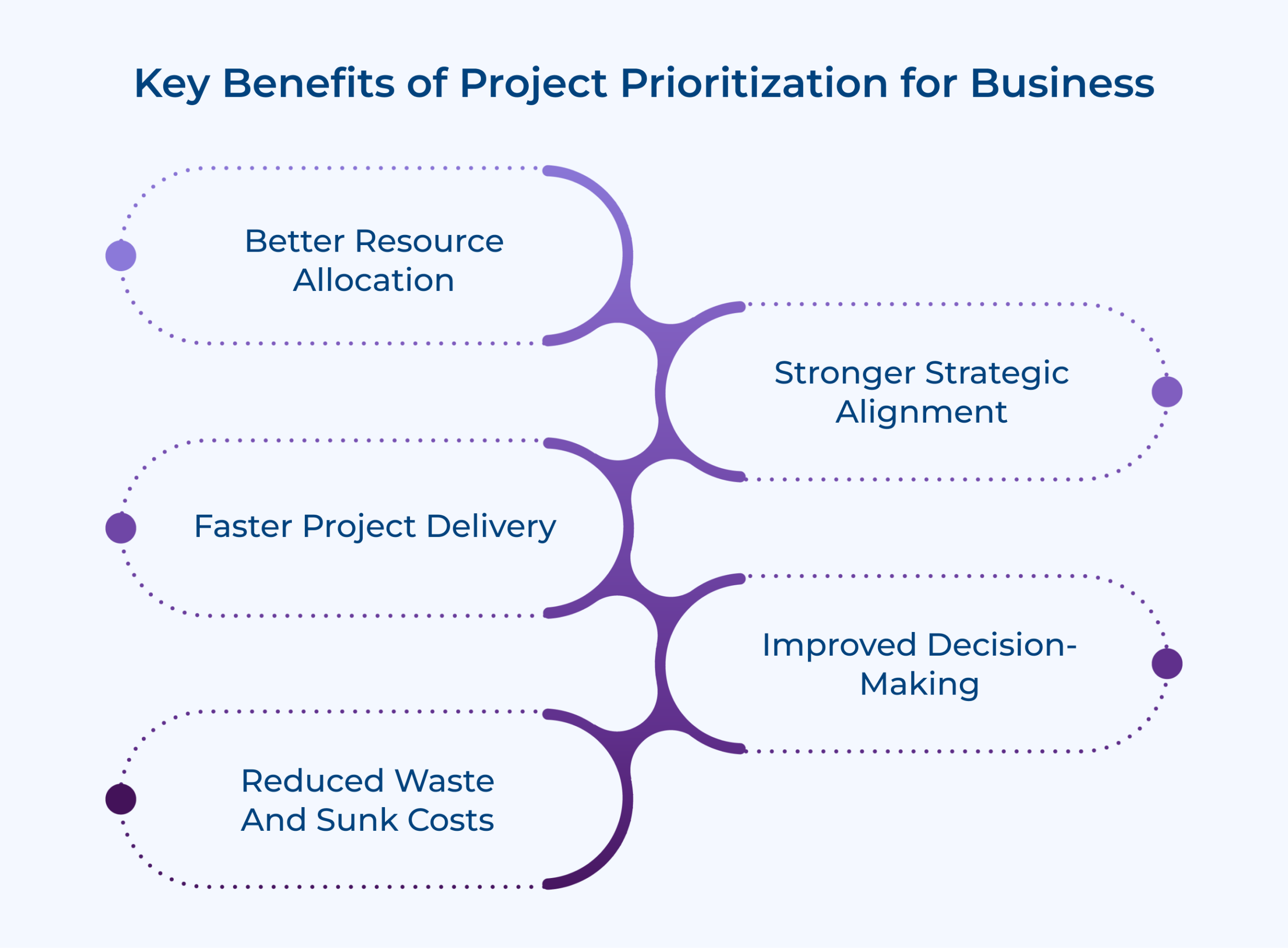
1. Better Resource Allocation
Most of the time, your best people stop getting used across different portfolios at once to deliver only focused work. A proper prioritization method makes the budget and skilled talent consistently flow toward projects that have the highest ROI.
2. Stronger Strategic Alignment
A well-defined business goal always aligns an approved project to its place in the pipeline. This keeps the entire organization moving in one unified direction instead of losing resources on scattered efforts.
3. Faster Project Delivery
Clear project prioritization reduces context switching. A silent killer of delivery in most service firms. Teams that prioritize only a few projects at a time finish them with more accuracy and better quality
4. Improved Decision-Making
A properly ranked priority list removes assumptions and internal politics from the project approval process. Leaders can confidently say no to less valuable portfolios as the data and rankings back every decision.
5. Reduced Waste and Sunk Costs
Businesses can filter out low-value projects with the right before they consume serious resources and effort. Teams can identify struggling initiatives at the right moment instead of continuing to fund.
7 Methods of Project Prioritization
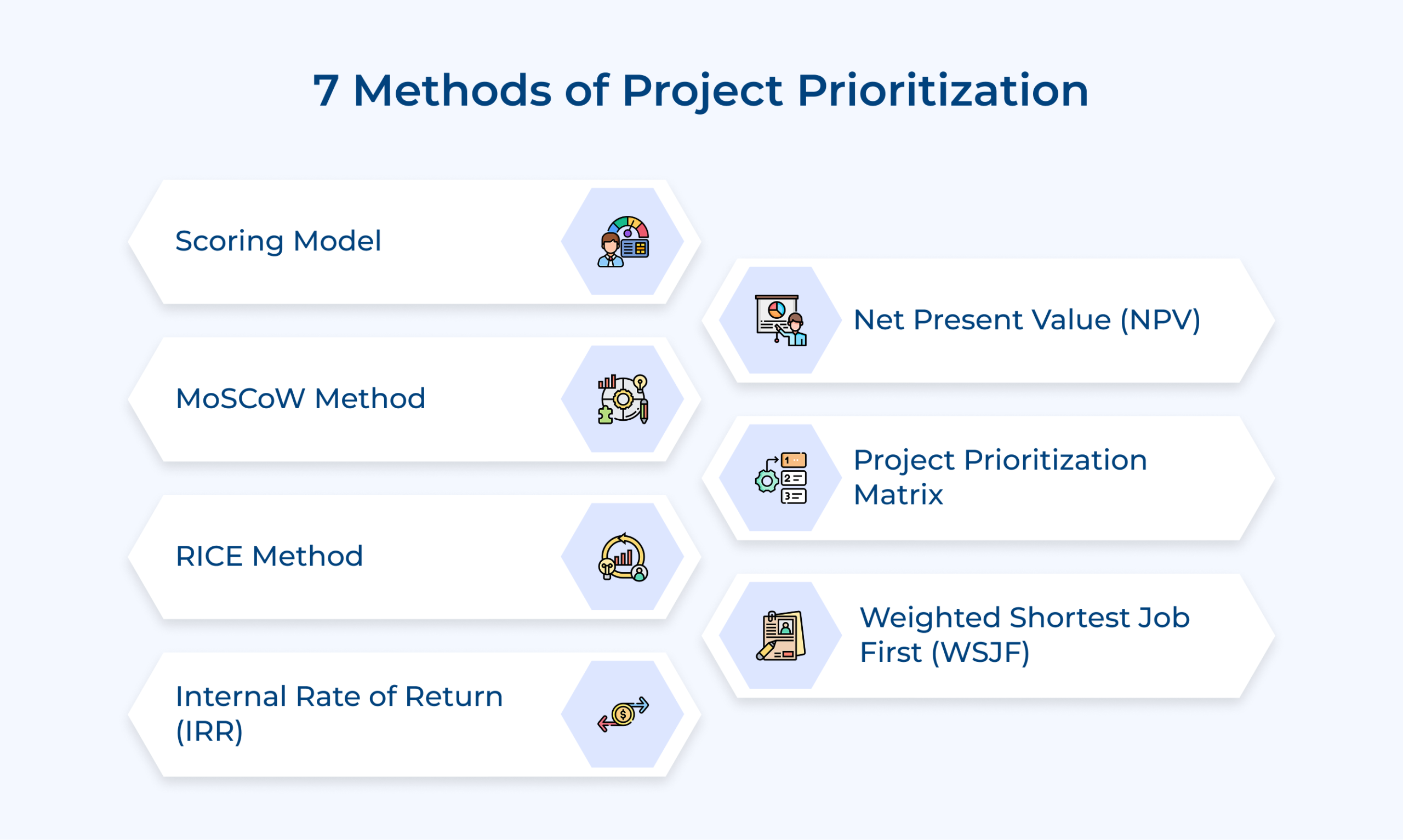
Every professional service has defined its own business value there, so there is no single way to rank projects. Understand these proven methods of prioritizing projects in detail.
1. Scoring Model
A prioritization scoring model helps in allocating numerical values to each project against defined criteria. It is like a report card where strategic fit, revenue impact and risk all lead to a final ranking.
The weights of the project matter more than the scores. A model that scores every criterion equally ends up not affecting actual business strategy. Most scoring models are defined around below criteria:
- Strategic alignment: Direct impact of projects on current business goals
- Financial return: defined revenue gain for measurable cost savings
- Resource demand: Total people, time and budget projects are consuming
So, how can organizations implement this model? Get approval on the criteria from leadership before accepting any projects. Score projects in a group to avoid individual bias and review them quarterly as priorities shift
2. MoSCoW Method
MoSCoW sorts your work into four buckets that work brilliantly for ranking entire project portfolios across any business. Below are the categories of MoSCow:
- Must have: Projects that the business cannot function or comply without
- Should: Include Important initiatives that can handle a short delay
- Could: take a project if there is enough capacity available for the team
- Won’t have: Explicitly parked work, off the table for this project cycle
“Won’t have” is the real value of this framework, which most teams underuse. This project prioritization technique becomes a “must-have” unless you define a strict rule for the category, roughly 60% of your total capacity.
3. RICE Method
RICE scores every initiative based on a straightforward formula where you multiply the first three factors and divide by effort to get a score for comparison across projects.
- Reach
- Impact
- Confidence
- Effort
So, why do most firms want this project prioritization model? The confidence this model gives forces honesty into a proper process.
Firms that treat RICE outputs as absolute truth handed down from above always fall into a trap. The score only tells you which conversations are worthy and not those decisions that are already made.
4. Internal Rate of Return (IRR)
IRR helps in calculating the annual growth rate a project is expected to generate. The higher the percentage is, the more financially attractive the project becomes.
This model is preferred by the finance teams because it analyzes projects of different sizes equally. For example, a small project with 30% return can outrank a flagship initiative that returns 12%.
Consider this limitation of IRR before considering it your true prioritization model:
- IRR ignores strategic value, which means a low-return project might still deserve the top slot
- A higher IRR rate hides absolutely small payoffs as it reveals no details about project size.
- It assumes returns get reinvested at the same rate, but in reality, it varies depending on the demand and current market conditions.
5. Net Present Value (NPV)
NPV indicates the project’s total future cash flows based on the current value. A positive score means the project creates genuine value even after the full cost of capital.
So, how is NPV different from IRR in real practice? NPV tells the complete value a project will create, while IRR only shows the return rate. Most businesses use both together instead of picking a single:
- Identify which project in your pipeline creates the largest amount of investment using NPV.
- Apply the IRR model to reveal the efficient way each project uses invested capital
- Use a combination of both models when ranking large capital projects against smaller returns.
6. Project Prioritization Matrix
A project prioritization matrix allocates every project in your pipeline on a two-axis grid. The classic version compares value against effort
The advanced versions evolve into a full project selection matrix with multiple weighted criteria that produce a composite score. This visual approach is best where dense spreadsheets frustrate people.
Managers can create a matrix in thirty seconds, making the project alignment speed faster and far less political. The four quadrants that guide your next actions:
- Start these immediately when High value, low effort and quick wins.
- High value with high effort defined major projects that need proper planning
- Low value and low effort mean do them only when capacity allows
7. Weighted Shortest Job First (WSJF)
The model helps in ranking projects by dividing cost of delay by the duration of the task. It answers “What does waiting actually cost the business?” that most project management prioritization methods ignore.
Weighted shortest job first is best when market timing matters more than raw project value. For example, a medium-value project in your firm that loses money every week is waiting to jump ahead in the queue.
Consider these simple practices to apply WSJF in your service firm:
- Maintain proper comparison of projects relatively instead of chasing the precise cost-of-delay
- Include time-sensitive factors such as contract deadlines and competitor moves
- Perform monthly queue re-ranking because the cost of delay changes as markets shift
How to Prioritize Projects Effectively: 7-Step Framework for Max ROI
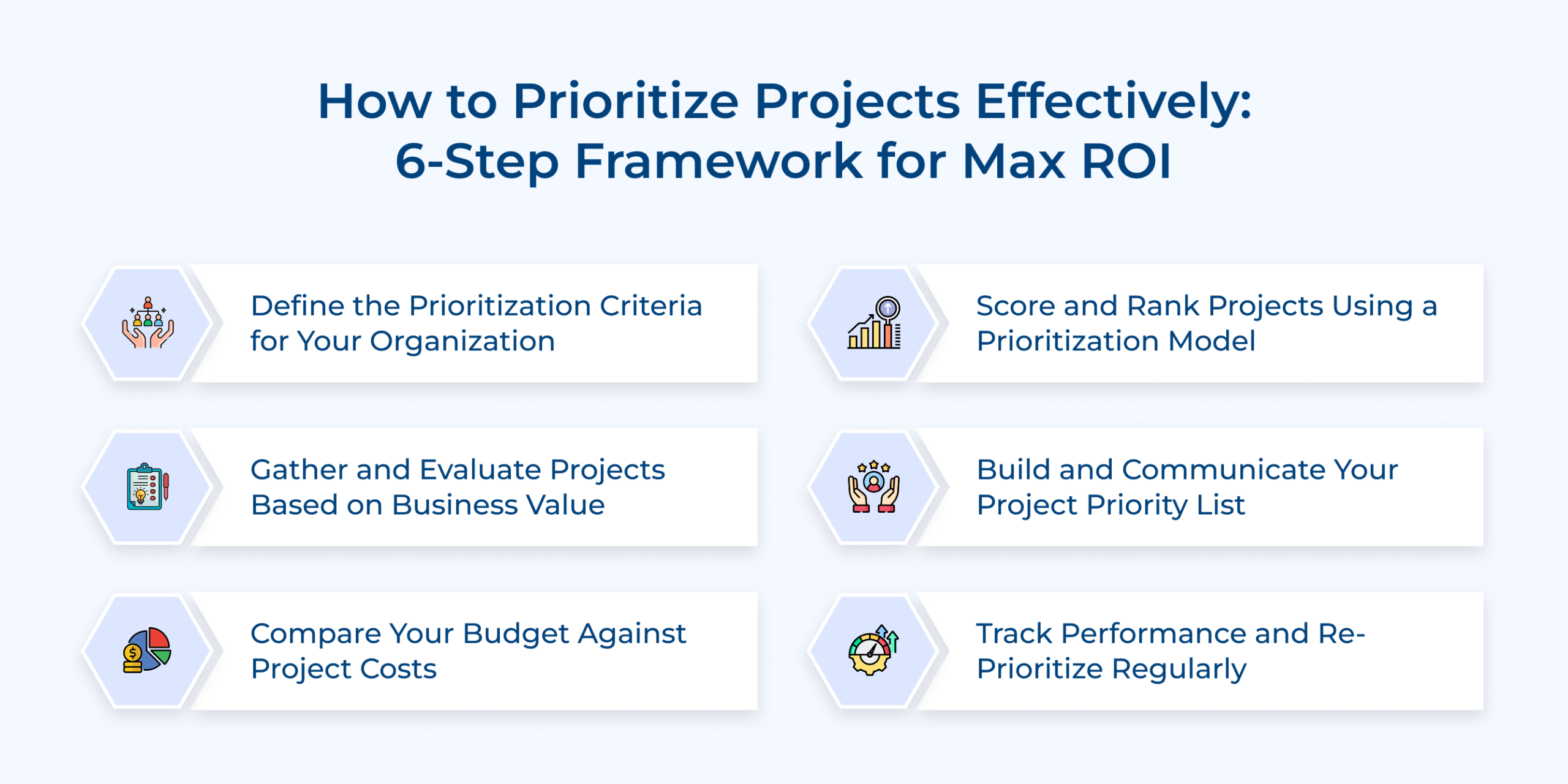
What separates an organization that delivers real ROI from those that simply stay busy is the project prioritization framework. Let’s explore the steps that can be run every single quarter.
1. Define the Prioritization Criteria for Your Organization
Project prioritization criteria decide what actual “valuable” means to your business, as without this foundation, every decision turns into a contest of who argues loudest in the meeting room.
Don’t know where to start with defining criteria? Consider this checklist:
- What are the business goals that projects must support this year?
- What is the actual weight that financial return carries based on strategic positioning?
- What is the level of risk the team is genuinely willing to accept?
- Which regulatory obligations are non-negotiable?
- How will we measure success after six months of project delivery?
So, can this checklist actually translate working criteria for your team? Yes, absolutely. Each answer acts as a scoring factor and those weights force the team to commit in real trade-offs.
Pro tips:
- Limit yourself not more than seven criteria, as scoring becomes noisy and teams stop trusting the model beyond that.
- Prevents relitigating the same debate every quarter by documenting why each weight was chosen.
2. Gather and Evaluate Projects Based on Business Value
As you have defined the criteria, it’s time to gather every project request in one place and measure its genuine value.
What happens if the team skips this? It ended up ranking projects that have the highest number of sponsors, not the values.
Follow these best ways to evaluate business value:
- Run structured intake forms: Maintain one template for project request collection. It will capture expected revenue, savings and strategic impact. Teams will get comparable data instead of persuasive storytelling.
- Hold cross-functional value workshops: Hold a collaborative meeting with sales, operations and finance teams to score value. Each can identify benefits as well as risks from their perspective that others might completely miss.
- Demand evidence over enthusiasm: Projects without evidence get a penalty in their final score, so ask every sponsor to back their value claims with customer proof.
Consider an example of a mid-sized firm scoring a flashy customer app against a dull warehouse upgrade. The upgrade win is based on hard savings data.
Most sponsors try to inflate value estimates to scale their main projects forward, leading to effects on your business goals. Keep a record of every estimate publicly and review actual results later, because proper accountability keeps the next round transparent.
3. Compare Your Budget Against Project Costs
A project prioritization without comparing budget and team capacity always creates confusion. It looks brilliant on paper, but will quietly collapse by the second quarter. So consider the below things in mind:
- Total cost of ownership: Count maintenance and support costs along with the initial expense.
- Resource capacity: Consider both available people as well as money because they are required in every portfolio.
- Funding timing: Define the proper time for a project that fits in the annual budget breaks in a single quarter.
- Contingency reserves: Keep 10-15% of the budget as backup for the surprise scope changes that always come.
A functional aspect that most teams overall will prioritize at this stage is that two perfectly affordable projects can still clash badly if they both need the same specialist team during the delivery window.
5. Score and Rank Projects Using a Prioritization Model
Opinion and assumptions will now be replaced by structured judgment because every shortlisted project gets measured against your defined criteria.
So which project prioritization model is best for scoring? It completely depends on the portfolio’s nature. For example, financial models are best for capital-heavy projects while scoring models handle strategic portfolios better.
Keep your scoring session clean and credible with this sequence:
- Score each project based on one criterion at a time instead of doing it in bulk.
- Maintain the evaluator score independently first, followed by comparing results together
- Scoring more than two points requires proper discussion
6. Build and Communicate Your Project Priority List
A ranked spreadsheet changes nothing except organizational behaviour, so turn your scoring output into a project priority list that every department can see and reference daily.
A genuinely useful priority list always includes:
- Ranked order: Every approved project with its clear number positioned
- Reasoning: Justification of the rank for each project.
- Status: What’s the current status of the project active, queued or explicitly parked
- Owner: Proper accountability for every single entry.
Can you implement without communicating the reason for the ranking? Proper communication is non-negotiable. People accept decisions more readily when they understand the logic clearly.
Pro tips: Explain to sponsors what would change the ranking next cycle for the portfolios that don’t make the cut.
7. Track Performance and Re-Prioritize Regularly
Project prioritization is not a one-time event because today, a top priority can become irrelevant the next day. Start building a review rhythm to keep your entire ranking maintained over time.
As the name suggests, track performance against original value claims. For example, a project that finishes on time but misses its business impact directly influences the way you score similar proposals next.
Maintain a proper checkpoint to review cadence:
- Monthly: Track progress and flag projects drifting starting from the scope or budget
- Quarterly: Adjust rankings by re-scoring the complete portfolio against your criteria
- Annually: As the strategy evolves, revisit the criteria and weights themselves
Most project management prioritization succeeds and fails at the same time. Organizations that win are not the ones with the cleverest model, but the disciplined ones that are able to onboard most of the valuable projects.
Common Challenges of Project Prioritization & How to Overcome Them
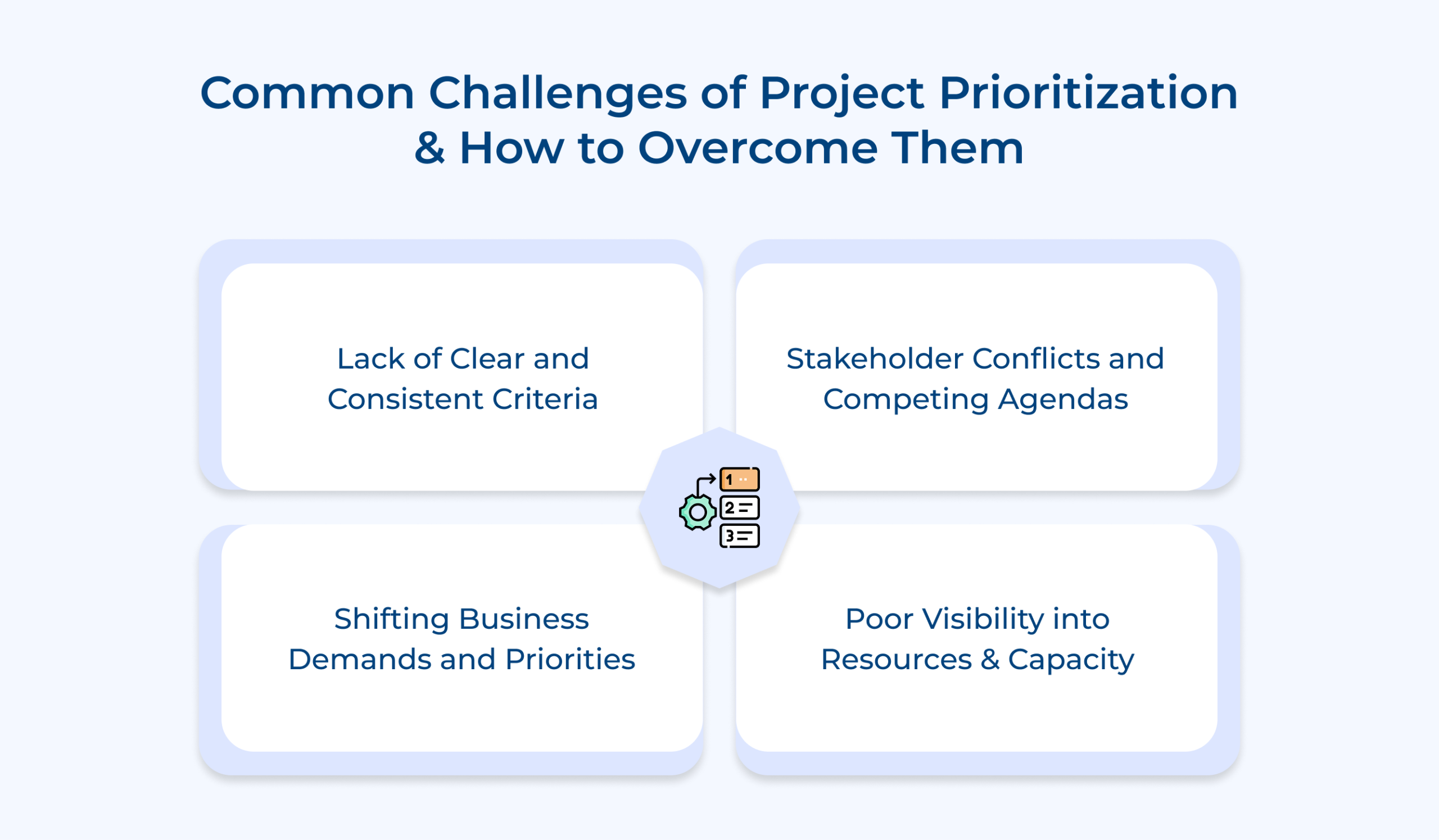
Even the most disciplined teams fail when the ranking and challenges of project prioritization tend to repeat every time. Let’s explore the mistakes in advance
1. Stakeholder Conflicts and Competing Agendas
Most department heads want their project to deserve the top slot. These competing voices can kill the entire ranking exercise. Missing neutral criteria in place can prioritize decisions won by seniority instead of genuine business value.
2. Lack of Clear and Consistent Criteria
Teams that jump directly into ranking projects without knowing the actual makes one project more important than another. This mistake in project prioritization leads to inconsistent decisions that shift when a new voice enters the room.
3. Poor Visibility Into Resources and Capacity
Many organizations give approval to a rank list that has an unrealistic capacity to deliver on time. The ranking might look perfect, but still projects stall midway because there is nobody to review if the right people are actually available.
4. Shifting Business Demands and Priorities
Priority lists get outdated without a single charter move and leadership changes direction. Teams treating prioritization as an annual event find themselves slower to adapt than competitors.
Below are four solutions matched to the challenges above:
- Use properly weighted scoring along with leadership sign-off to turn neutral criteria into objective comparisons.
- Define and document criteria before ranking, as written project prioritization frameworks lead to consistent decision-making.
- Build capacity with a priority list to approve only the work that your teams can deliver.
- Review and re-rank the portfolio every quarter, as a regular cadence keeps priorities aligned with the demands.
Elevate Your Workflow With Smart Project Prioritization Strategies.
Project prioritization is all about making deliberate choices to rank every initiative against clear criteria to make sure the best resources are allocated to the highest-value work. A consistent process can maximize ROI naturally.
- Define weighted criteria first: Neutral standards transform political debates into objective decisions.
- Use a proven model: RICE or a prioritization matrix, next to bring structure to the ranking.
- Re-prioritize quarterly: Project prioritization criteria can shift based on current markets.
Ready to put the right framework in action? Master the right project prioritization model to help build your business with the most valuable portfolios. Most organizations fail due to funding, not due to a lack of ideas.
Limit time — not creativity
Everything you need for customer support, marketing & sales.

Neeti Singh is a passionate content writer at Kooper, where he transforms complex concepts into clear, engaging and actionable content. With a keen eye for detail and a love for technology, Tushar Joshi crafts blog posts, guides and articles that help readers navigate the fast-evolving world of software solutions.