How to Execute Project Handoff in 7 Steps?
- What is Project Handoff?
- What are the Benefits of a Smooth Project Handoff Process?
- What are the 6 Essential Elements of a Project Handoff?
- How to Execute Project Handoff in 7 Steps?
- How to Improve a Smooth Project Handoff?
- Common Challenges in Project Handoff
- When Do Project Handoffs Occur in Workflow?
- Revolutionize Your Project Transfers With Project Handoff.
- FAQs about Handoff in Project Management
Key Highlights:
- Project handoff is the transfer of deliverables, knowledge and ownership between teams during transition.
- More than one-third of projects fail due to poor communication, which is exactly where handoffs break.
- Teams that improve handoff outcomes start transition work mid-project instead of final weeks
Ever happened to your firm when months of project work unravelled when ownership changed in one week?
It happens more often but the reason is rarely due to lack of talent. In most service firms one third of the projects fail due to ineffective communication and handoffs are exactly where it breaks first.
Think of hand-off as a structured transfer of deliverables, knowledge and ownership from one team to another, so the new team does not lose context. Explore essential elements, execution processes and common mistakes to run every project transition with confidence.
What is Project Handoff?
A project handoff is a formal transfer of project ownership from one team to another. It includes the handover of all deliverables, knowledge and responsibilities so work continues without losing momentum.
Why is the project handoff procedure important?
Most failed projects, when traced back after delivery, show the loss of context or unclear ownership during the transition. It simply happens because nobody captured the knowledge and resources the original team had.
A proper project handoff process protects every context your team built over the last few months to make sure that the new team can operate confidently. That confidence makes a difference in a smooth transition from confusion.
Key objectives:
- Knowledge transfer: Transfer the complete project context to a new team without any gaps.
- Ownership clarity: Define the ownership and decision-making role for each task after the transition.
- Continuity assurance: Maintain smooth operation without disruption or downtime.
- Accountability setup: Establish clear points of contact, such as documentation for issues that are identified later.
What are the Benefits of a Smooth Project Handoff Process?
A well-executed project handoff is less on “closing a chapter” and more about delivering the real impact across teams as well as organizations. Let’s explore the benefits in details
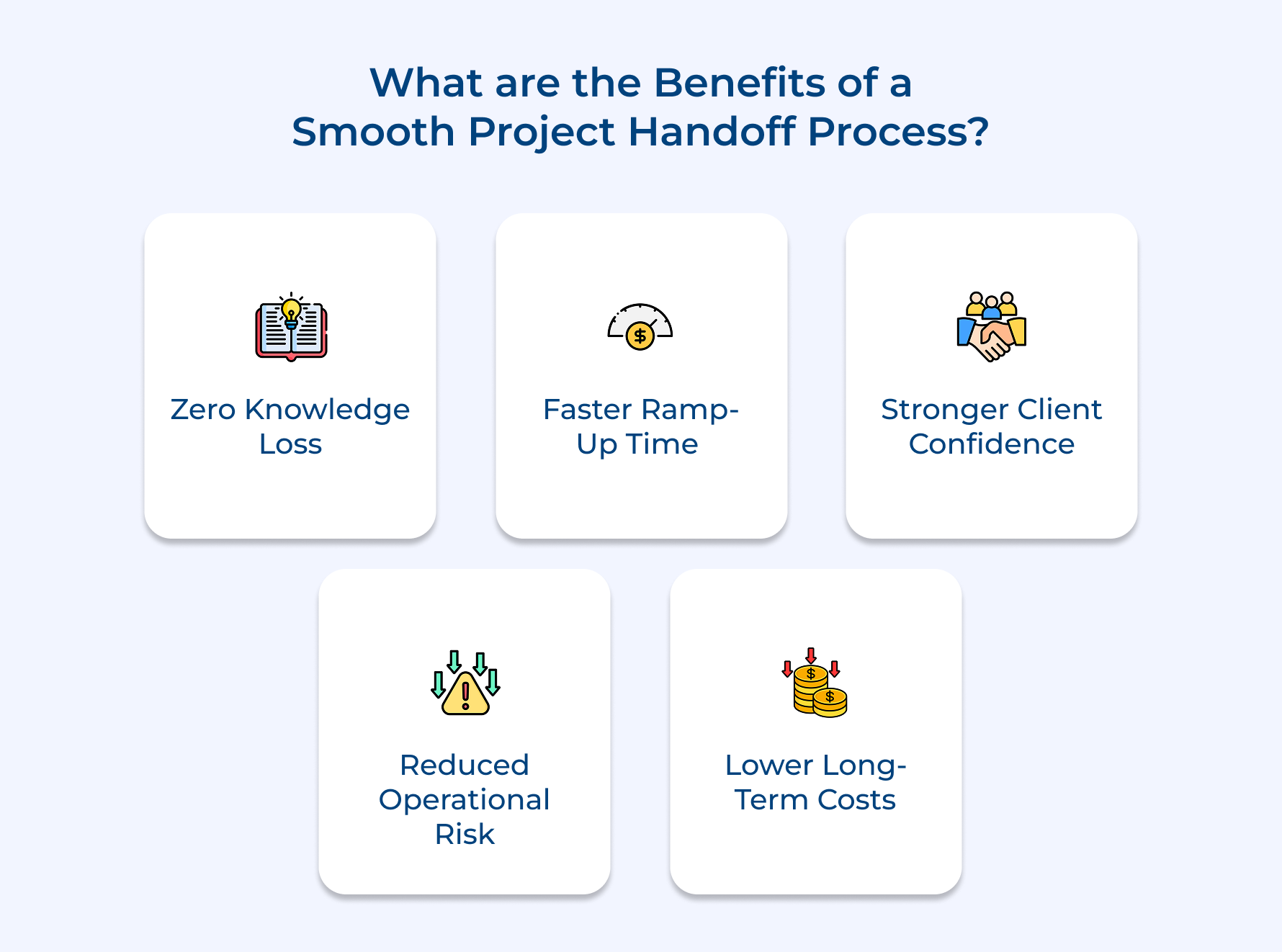
1. Zero Knowledge Loss
Most of the critical project information stays intact with a structured transition that follows. It helps the new team inherit every decision easily instead of going through painful trial and error.
2. Faster Ramp-up Time
A clear project handoff process helps the receiving team start contributing meaningfully to delivery within days. Guesswork after transitions slows down even the most capable teams, so a faster ramp-up means they start giving results sooner.
3. Stronger Client Confidence
Clients always look for transitions that happen without any repeated questions. A smooth handover procedure of their projects demonstrates professionalism and reassures that the investment remains in capable hands.
4. Reduced Operational Risk
A proper documentation of responsibilities leads to fewer risks after handover from the original team. Issues get resolved more quickly when everyone knows who owns what from the first to protect both the project and people running it.
5. Lower Long-term Costs
A good handoff process of the project helps in significantly reducing rework and emergency fixes. It also saves money by reducing confusion and miscommunication that would otherwise quietly burn.
What are the 6 Essential Elements of a Project Handoff?
Experienced managers know certain elements of a project handoff simply cannot be skipped. Even missing one of them means paying the price later.
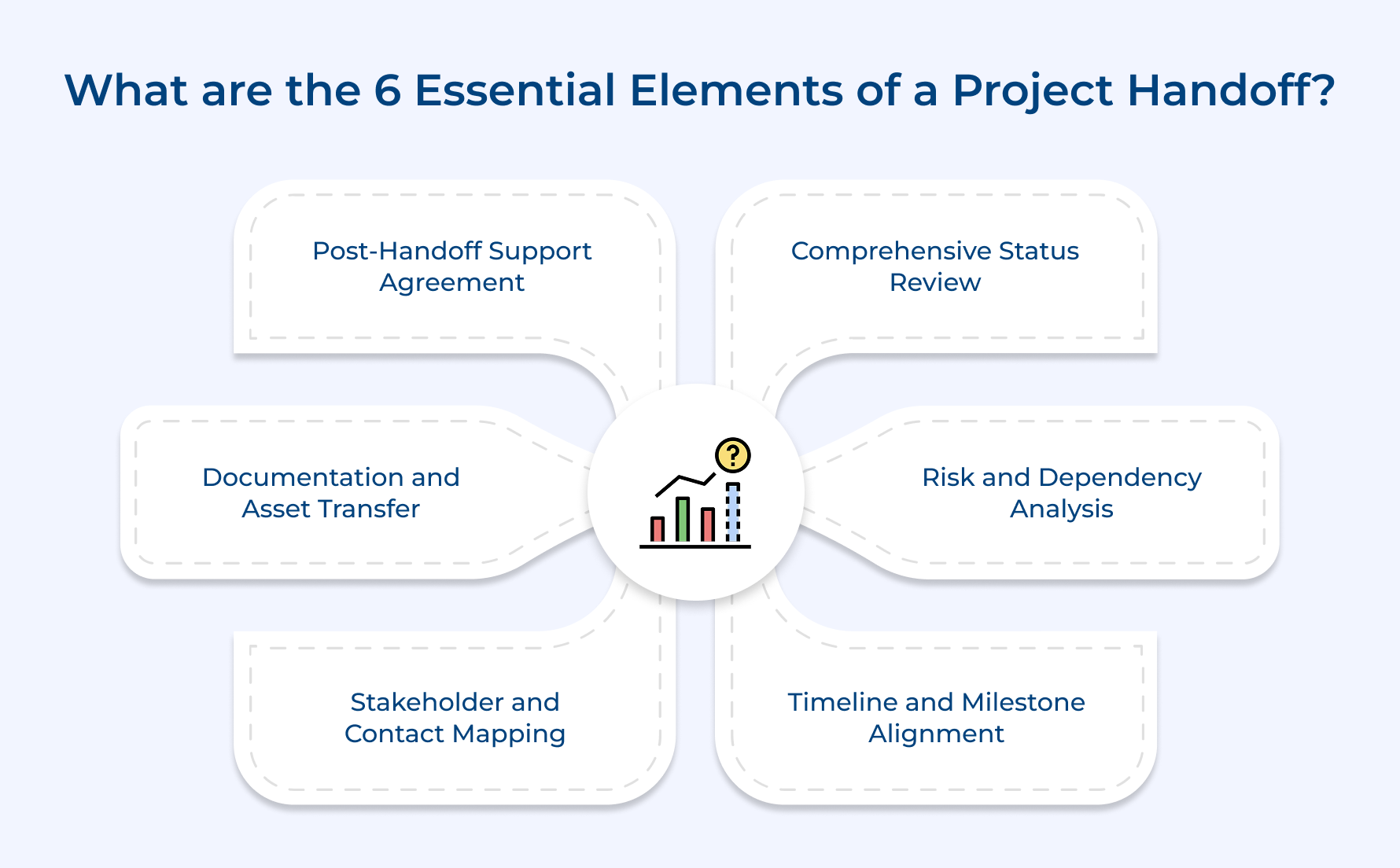
1. Comprehensive status review
A status review includes completed deliverables and open tasks to keep a record of where your project stands at the moment of transition.
So what are most teams up to at this stage? They record only the good news while hiding the problems. An honest review session uncovers unfinished work and known issues, as hiding them only delays the pain of involvement.
2. Risk and dependency analysis
Every successful project comes with its own risks that the original team has managed over time. A proper handover helps in identifying these risks in the document so that nothing is missed.
Dependencies need equal attention in this analysis because they often hide outside the project. Proper vendor and systems dependencies identification ensures that the new team never faces difficulty.
3. Timeline and milestone alignment
Project Timeline alignment during the handoff prevents the receiving team from inheriting deadlines they never agreed to. A written timeline gets misread easily, but a shared milestone walkthrough session builds genuine commitment for both teams.
4. Stakeholder and contact mapping
The receiving team must have contact with every person who depends on the project. Use simple contact mapping to show each stakeholder their role and expectations. It removes the awkward pause after transition is complete.
5. Documentation and asset transfer
Every file, credential and tool license in projects requires new ownership before the handover. A project handoff document ties all of these assets into one centralized place for proper management.
Verification matters more than the transfer, so the receiver actually opens each file and logs into each system before anyone declares this element completely.
6. Post-handoff support agreement
Even the best transition leaves questions behind without a proper approval that surfaces after everyone has moved on. A support agreement helps in defining a timeline for the original team availability across a specific channel.
Maintain a structured support window with a clear end date, as open-ended support slowly drains your team while a defined period pushes toward true ownership.
How to Execute Project Handoff in 7 Steps?
The seven steps below transform your handoff theory into a practical execution playbook that your team can follow every time.
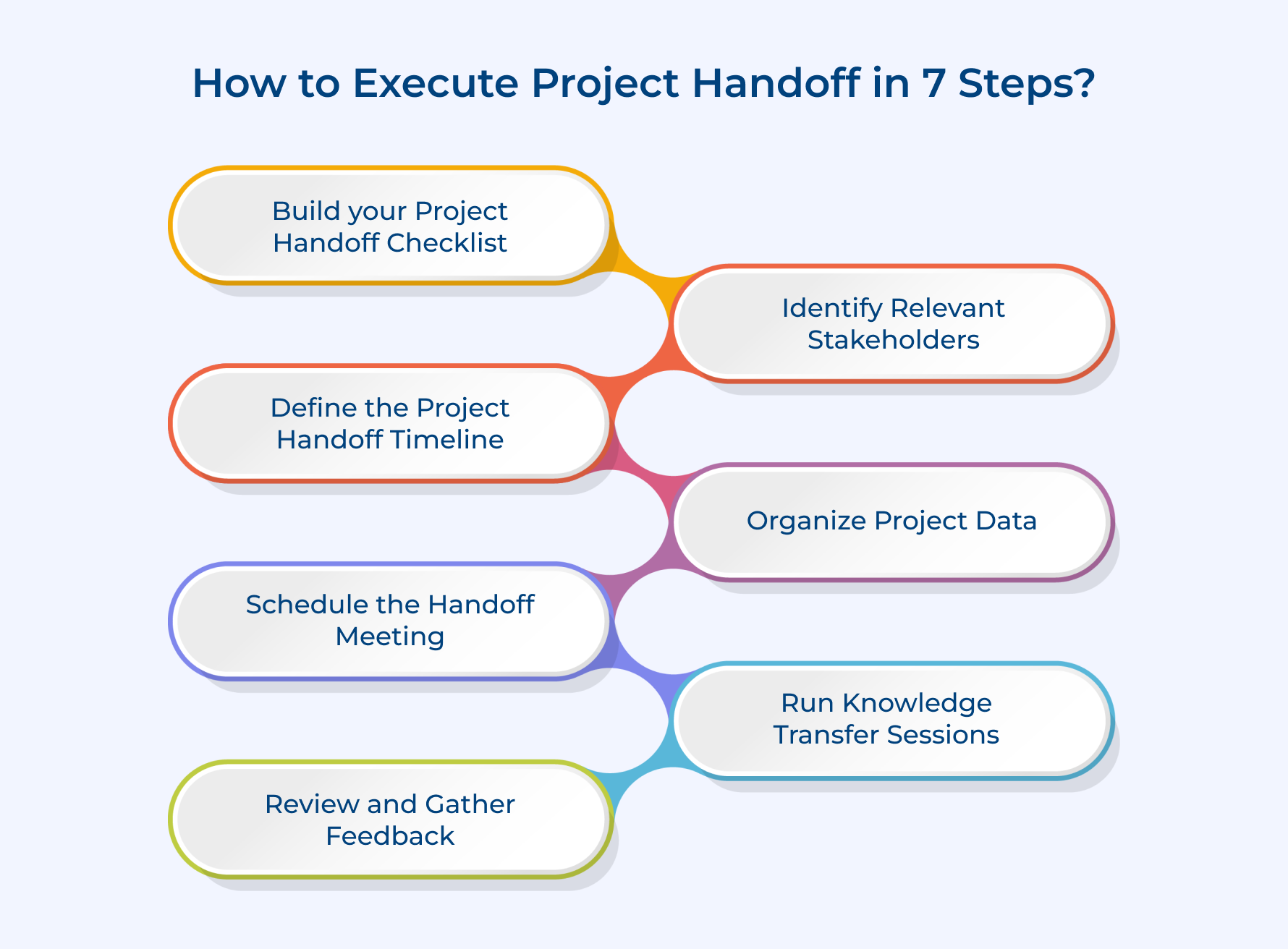
1. Build Your Project Handoff Checklist
A planned checklist transforms the entire project handoff into trackable actions so that nothing is missed. Teams that execute this without depending on memory get access faster as assumptions fail under pressure.
So, what’s the key consideration for defining a checklist? Specificity over volume. A checklist that says “transfer documents” helps nobody, while “verify new team edit budget tracker” eliminates any room.
Below are key things to include in an ideal project handoff checklist:
- Action items: Every task needs a clear description before transition.
- Owners: Assign ownership to each item listed across the task.
- Deadlines: Every single action is tracked with specific dates and milestones.
- Completion criteria: proper documentation is required as proof before an item gets done.
Pro tip: the implementation is ideal when the checklist lives in a shared tool instead of someone’s notebook. Maintain a weekly review so stalled items surface early, problems are fixed while still cheap.
2. Identify Relevant Stakeholders
Every handoff procedure includes more stakeholders than the project sponsor or team leads and missing even one means objections appear just after decisions are locked in.
So, how to identify stakeholders during the project handoff process?
- Review the approval history: include members who signed off on past deliverables, as they hold influence over the transition. Their absence from handoff might guarantee friction.
- Follow the budget trail: Add investors to the handoff call, as they deserve visibility into the ownership change. Finance contacts help in identifying requirements that nobody else mentions.
- Ask the delivery team directly: Maintain an informal contact list as frontline members know whom to call when something breaks.
- Check system access logs: People regularly use project tools, so track them to reveal dependencies that documentation often misses.
Consider the example of a software project going through a handoff process from an agency to an internal team for support. The agency mapped the client sponsor but missed the IT security lead causing the entire transition to stall for weeks over approvals nobody anticipated.
3. Define the Project Handoff Timeline
A timeline without a realistic date forces the transition to drag on indefinitely. It slowly drains both old and new teams because nobody understands the urgency of closing pending items. So, start defining the timeline with this checklist.
- What are the actual moments for your team to operate independently?
- Which handoff phases need to finish first before starting another?
- What is the exact buffer time needed for unexpected delays?
- What delivery date works for final sign-off from all approvers?
A proper phasing in transition is just as important as the end date. Organizations that break the handoff process into stages, such as document, training and shadowing, give teams visible checkpoints instead of a single deadline.
So, how does this actually work on a real project? Prepare bottom up approach means starting from the final sign-off date and working backward. It exposes timeline conflicts before they transform into emergencies.
4. Organize Project Data
New teams that spend their first week of transition looking for files across inboxes and personal drives burn out faster. Scattered data is the silent killer of any solid handoff..
Centralize All Files in One Shared Location
Start by picking a single repository and moving everything into it before transitioning. A folder organized by function is far better than one organized by date, as new owners look for purpose rather than chronology.
Prepare the Project Handoff Document Early
The document includes everything the new team requires for each item, so start early to prevent a last-minute scramble. Documents that are created over weeks capture more details than one written in a panic or rush.
Archive What the New Team Won’t Need
Old drafts hide the files that are genuinely needed by the receiving team, so move them into a clearly labeled archive to keep the workspace clean. It is also recommended to avoid deleting anything outright since these files answer questions months later.
5. Schedule the Handoff Meeting
Many organizations think documentation is enough to complete a transition. No, it’s a misunderstanding because written words always leave gaps.
A proper meeting sets both teams to close those gaps in real time and confirm a shared understanding of the action plan.
So, how to run the meeting effectively?
- Share materials in advance: Send key documents two days early because people who arrive prepared ask sharper questions than those looking the first time.
- Walk through live systems: Open the actual tools and files during the session, as real-time navigation builds understanding that slides never can.
- Capture every open question: give ownership to all logged unresolved items along with a deadline as questions without owners vanish after the meeting ends.
Pro tip: End the meeting by finalizing an action plan while both teams are present. Verbal commitment creates accountability that a follow-up email rarely achieves.
6. Run Knowledge Transfer Sessions
A single meeting cannot transfer months of working knowledge. Set a transfer session to distribute the learning so the receiving team absorbs context instead of losing in it.
So what separates this from a wasted one? It let the new team take the wheel. A session where the new team performs while the original team watches reveals gaps more efficiently than passive demonstrations.
Best practices:
- Keep each session not more than 90 minutes because retention collapses in marathon meetings.
- Schedule your sessions based on topics instead of covering everything in one sweep.
7. Review and Gather Feedback
Most teams stop short and lose the long-term value without a proper review process. It transforms a one-time event into a loop that improves with every project delivery.
You might wonder why it matters most when the handoff feels completed? “Done” and “successful” are two different checkpoints. The following few weeks of new team’s experience will prove the success of the transition.
Use these below questions during the review session:
- Which item in the handoff plan is taking longer to achieve?
- What did the receiving team struggle with during their first week?
- Which documents are delivering the most genuine value?
Track project handoff progress against the checklist and identify items that need explicit decisions to either close them now or formally hand them over to the new team.
Optimize the feedback loop by:
- Deliberately review the project schedule: perform it for two weeks after the transition to identify the real gaps.
- Collect input from both sides: involve both teams, as the receiving team feels the knowledge gaps while the departing team sees process flaws.
How to Improve a Smooth Project Handoff?
A team with solid transitions can still boost its approach by implementing the right practices. These five practices separate average handoffs from excellent ones across many projects.
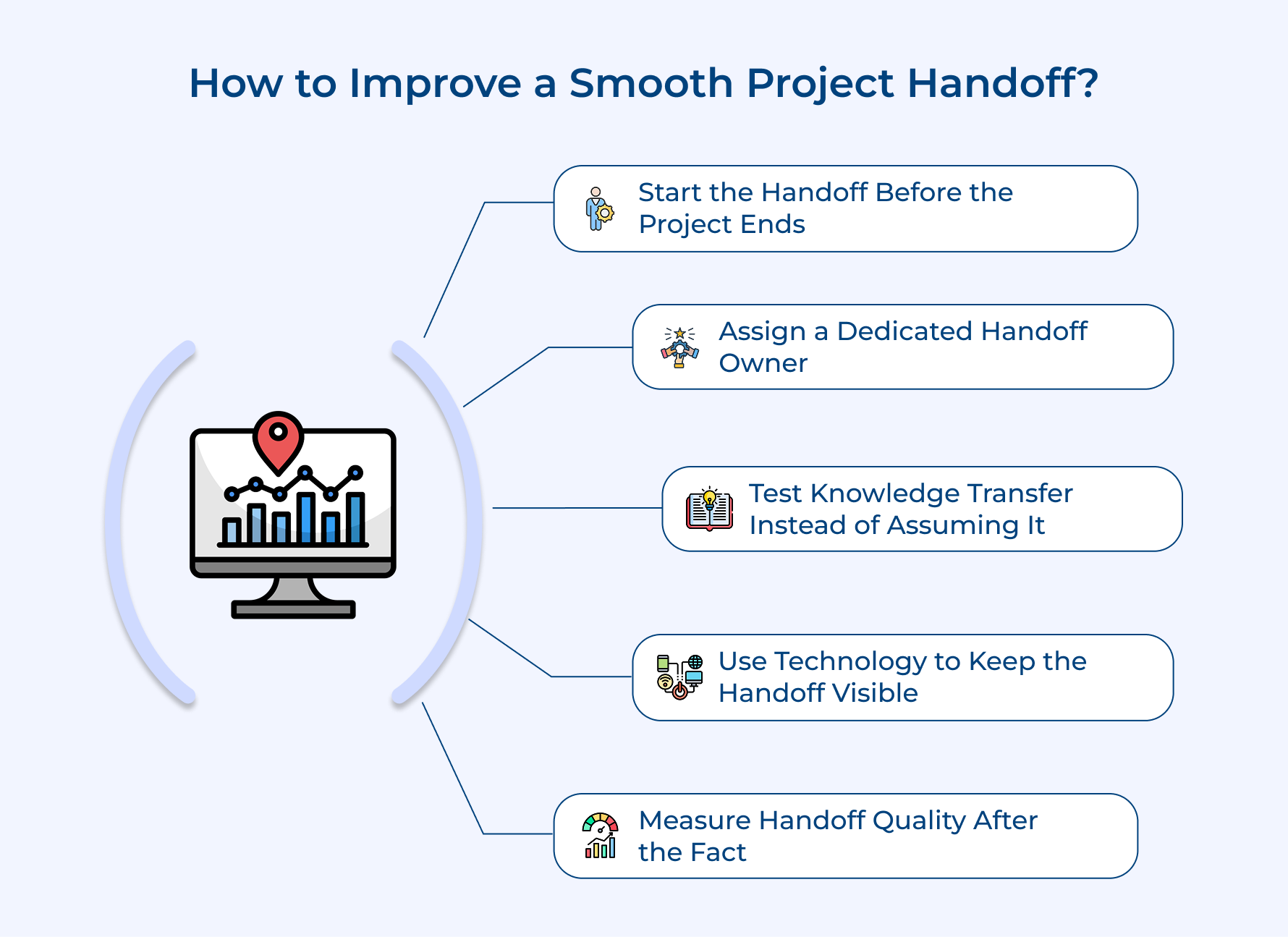
1. Start the handoff before the project ends
Most teams wait until the final weeks to begin transition work, but the best time to improve project handoff is mid-project, when documents still form naturally.
Treat handoff as an ongoing discipline to remove project panic. Teams that document decisions in real time hand over living knowledge, which shows the level of confidence.
2. Assign a dedicated handoff owner
Proper accountability for the entire project handoff changes the effectiveness of achieving every single task. The owner does not do all the work, but they make sure it gets done. This keeps the role realistic enough to chase senior people when items stall.
3. Test knowledge transfer instead of assuming it
Test whether the knowledge is truly landing on the other side. Assumption is comfortable, but verification actually protects the project. Before sign-off, follow these verification handoff methods:
- Run a routine task unassisted with the new team
- During the Handoff session, explain the riskiest areas in the project
Tasks that they cannot complete reveal the point where transfer mostly fails. Fix those gaps with a two-hour retest now to beat the crisis before everyone leaves.
4. Use technology to keep the handoff visible
Transitions that are managed across scattered emails immediately lose momentum. The right technology in project handoff gives teams one live view of progress as well as pending items.
5. Measure handoff quality after the fact
Track simple signals, such as the number of questions raised post-transition. It shows the exact success of the handover across the team. An even number of support requests within the first month also gives a clear story.
A steady drop in those signals proves your project handoff procedure is successful. Teams that are tracking this consistently find it easier to justify time spent on transition.
Common Challenges in Project Handoff
A well-planned transition can also hit predictable obstacles and understanding these challenges in advance lets you overcome this early.
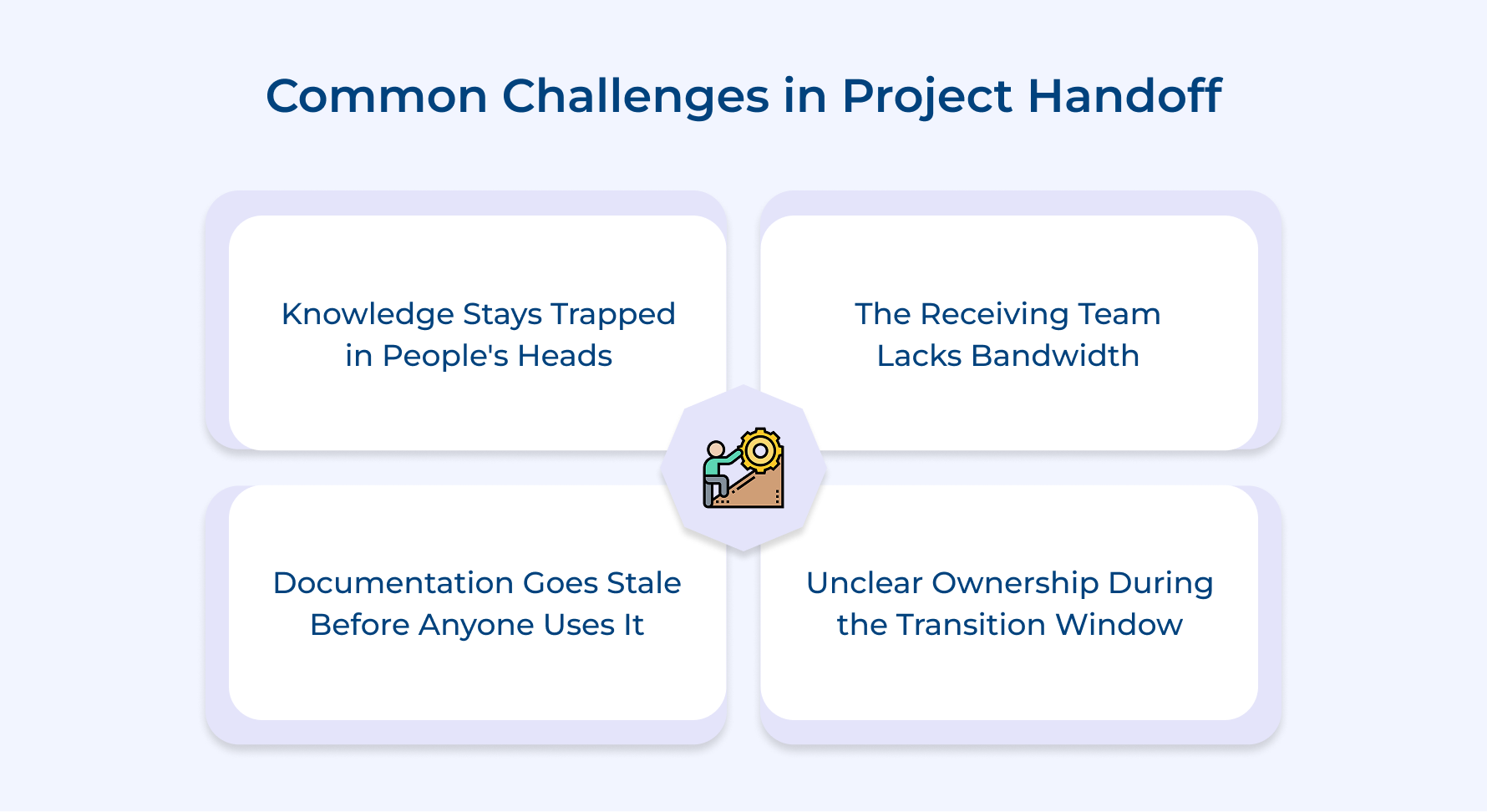
1. Knowledge Stays Trapped in People’s Heads
The most experienced team members carry critical context that can’t be documented. The receiving team inherits files without that context and weeks later, faces confusing decisions that nobody can explain.
2. The Receiving Team Lacks Bandwidth
No new owners sit idle waiting for a transition; instead, they juggle the handoff with existing commitments. It means transfer sessions get rushed or postponed. A handoff procedure squeezed into spare hours always produces a shallow understanding as well as burnout.
3. Unclear Ownership During the Transition Window
Every transition has an awkward middle phase for which both teams share responsibility. All Issues during this window bounce between teams as no one wants to take responsibility. Clients feel this confusion faster, leading to a loss of trust.
4. Documentation Goes Stale Before Anyone Uses It
Transition documents written weeks before describe a project that no longer exists. It leads the receiving team to make decisions based on outdated information without realizing it. The client can notice the changes easily during the delivery.
Below are key solutions that directly counter each problem above.
- Run working sessions: Perform proper tacit knowledge transfers through doing things together.
- Negotiate protected time for the receiving team: Formally reduce leadership commitment during transition.
- Publish a single ownership matrix: keep a record of complete ownership of every task shows exactly along with its date.
- Update project handoff checklist up to sign-off day: Make real-time documentation until the transition closes.
When Do Project Handoffs Occur in Workflow?
Most project handoffs happen at several points across the workflow and each carries its own risks worth understanding.
1. Phase-to-phase Transitions
Every time a project moves from one phase to another, work changes hands. Each phase transfers ownership even when the same organization is involved. Teams that casually treat these moments lose context in the next phase.
Common phase transitions include:
- Discovery to design: Research findings are transferred to the design team for analysis.
- Design to development: Approved designs are transferred to the hands of builders.
- Development to testing: Completed builds are transferred to assurance owners.
2. Internal to Client Handoffs
This is the right moment where a completed deliverable is handed over to the client. At this transition, the client doesn’t get any internal context that your team takes. Things clients need most during this handoff:
- A complete guide written for their team, not for the engineers or the developers
- The proper owner of the deliverable so that Real people can reach when something breaks.
3. Team-to-team Handoffs Within the Organization
These transitions between internal teams and specialists, when priority changes, look low-risk because everyone works for the same company. The assumptions are also precise about why it fails. The internal team skips the formality, so it is automatically transferred to the external ones.
Key moments that trigger internal team handoffs:
- Restructuring: Any merger or split in departments and projects moves with them.
- Specialist takeover: Work passes from the common list to a dedicated expert team.
- Staff departures: A key member leaves their portfolio and needs a new team.
Revolutionize Your Project Transfers With Project Handoff.
A successful project handoff is all about preparing clear ownership along with verified knowledge transfer. Teams that follow this structured framework protect months of hard work from being lost in transition.
- Instead of waiting for the final weeks, start handoff work mid-project.
- Use a project handoff checklist with proper ownership and completion criteria.
- Test the actual landing of knowledge before signing off on anything.
Ready to put into practice? Download our free project handoff template and perform your smoothest transfer. The right system in place becomes an opportunity to build trust instead of losing momentum.
Limit time — not creativity
Everything you need for customer support, marketing & sales.

Neeti Singh is a passionate content writer at Kooper, where he transforms complex concepts into clear, engaging and actionable content. With a keen eye for detail and a love for technology, Tushar Joshi crafts blog posts, guides and articles that help readers navigate the fast-evolving world of software solutions.