Project Charter vs Project Plan: What Every PM Needs.
- What is a Project Charter?
- Why is a Project Charter Important?
- Key Components of a Project Charter
- What is a Project Plan?
- Why is a Project Plan Important?
- Key Elements of a Project Plan in Project Management
- What Are the Key Differences Between a Project Charter vs Project Plan?
- How to Develop a Project Charter and a Project Plan
- Charter vs. Plan: Distinguish your Project Success with Clarity
- FAQs about Project Charter Vs Project Plan

Key Highlights:
- Project charter vs project plan determines project authorization and deliverables across two different stages.
- Separate project charter and project plan by spanning purpose, timing, flexibility and risk treatment that protects delivery from initiation to close.
- Project plan converts charter-level commitments into tasks, owners and deadlines that the team executes.
Ever wondered why most projects fail before execution even starts? It is because most service firms are treating project charter and the project plan as the same document. Organizations waste ninety-seven million dollars for every billion invested due to unclear initiation and planning flow.
A project charter includes proper authorities for a project and defines its boundaries, while a project plan is the operational blueprint that manages execution. Both documents serve two distinct purposes.
Understand the definitions, differences, components and development process of both to get a complete reference for project management techniques around project charter vs project plan.
What is a Project Charter?
A project charter is the formal document that authorizes a project to exist. It defines the purpose so that the project manager can set the boundary for what the team is committed to deliver.
For service firms such as consulting, IT services, or marketing agencies, a project charter is more than just paperwork. It is like a document that protects from scope creep before the project execution starts.
So, can a project plan and execution be completed without a charter? No, without a charter, a project will always run into authority conflicts and unclear accountability.
Key Considerations:
- Sponsorship clarity: Identify the final ownership and accountability for project success.
- Scope boundaries: Define milestones that are within scope and those that are out.
- Objective alignment: Make sure project goals are directly synced to business outcomes.
- Authority assignment: Explicitly define the project manager’s decision-making power and limitations.
Why is a Project Charter Important?
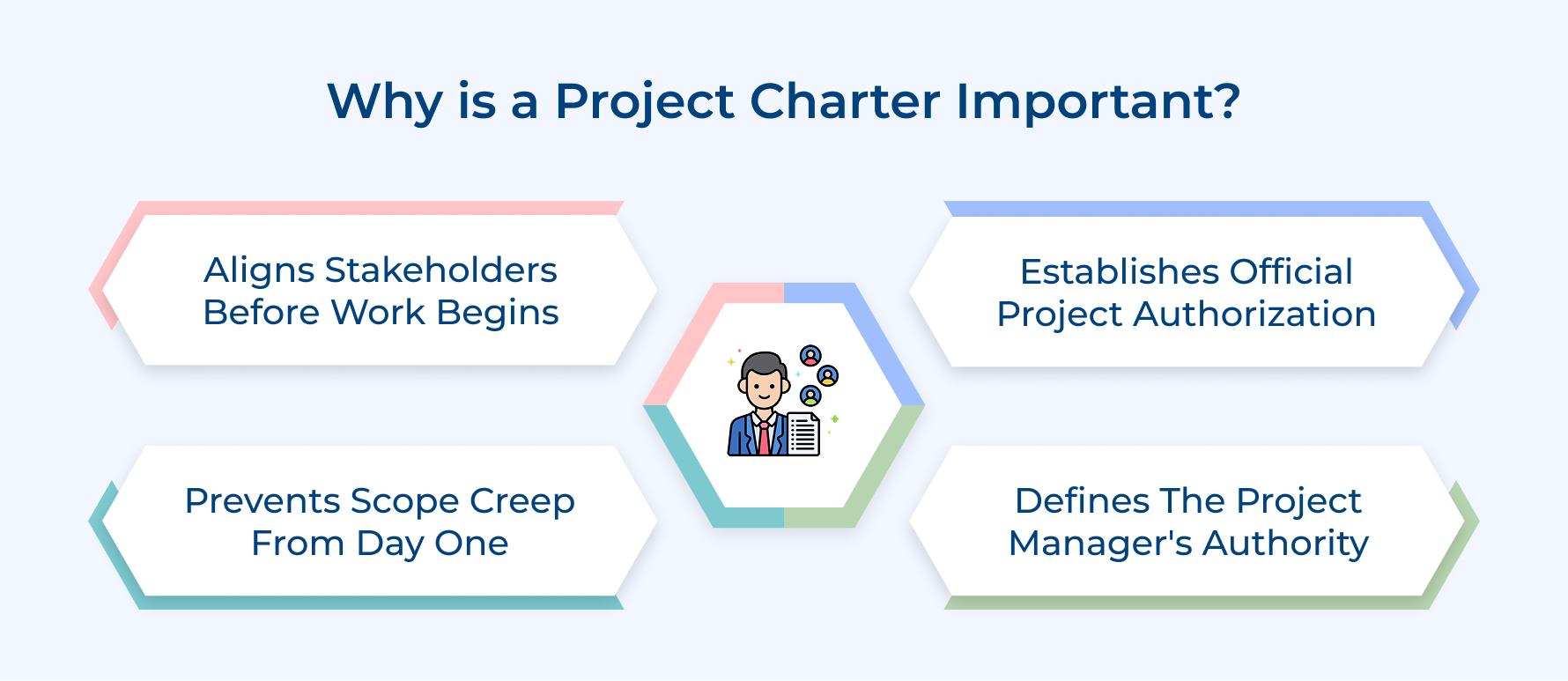
A project charter acts as a foundational agreement that keeps every stakeholder, team member, and decision maker aligned across the project lifecycle.
1. Establishes Official Project Authorization
Most projects exist only as an idea floating in email threads without a signed charter. It converts that idea into a recognized initiative with allocated resources and ownership.
2. Defines the Project Manager’s Authority
A project charter can publicly grant the project manager the authority to act within a certain scope. Every resource request and decision without this becomes a negotiation step instead of an execution.
3. Prevents Scope Creep from Day One
Scope creep does not happen all at once. It scales through small undocumented auditions over time. A well-written project charter defines clear boundaries for the team and provides a legitimate basis to push back on unplanned requests.
4. Aligns Stakeholders Before Work Begins
Misaligned expectations between stakeholders are another reason for project failure. A charter allows an alignment conversation to happen early, when corrections are still easy to make.
Key Components of a Project Charter
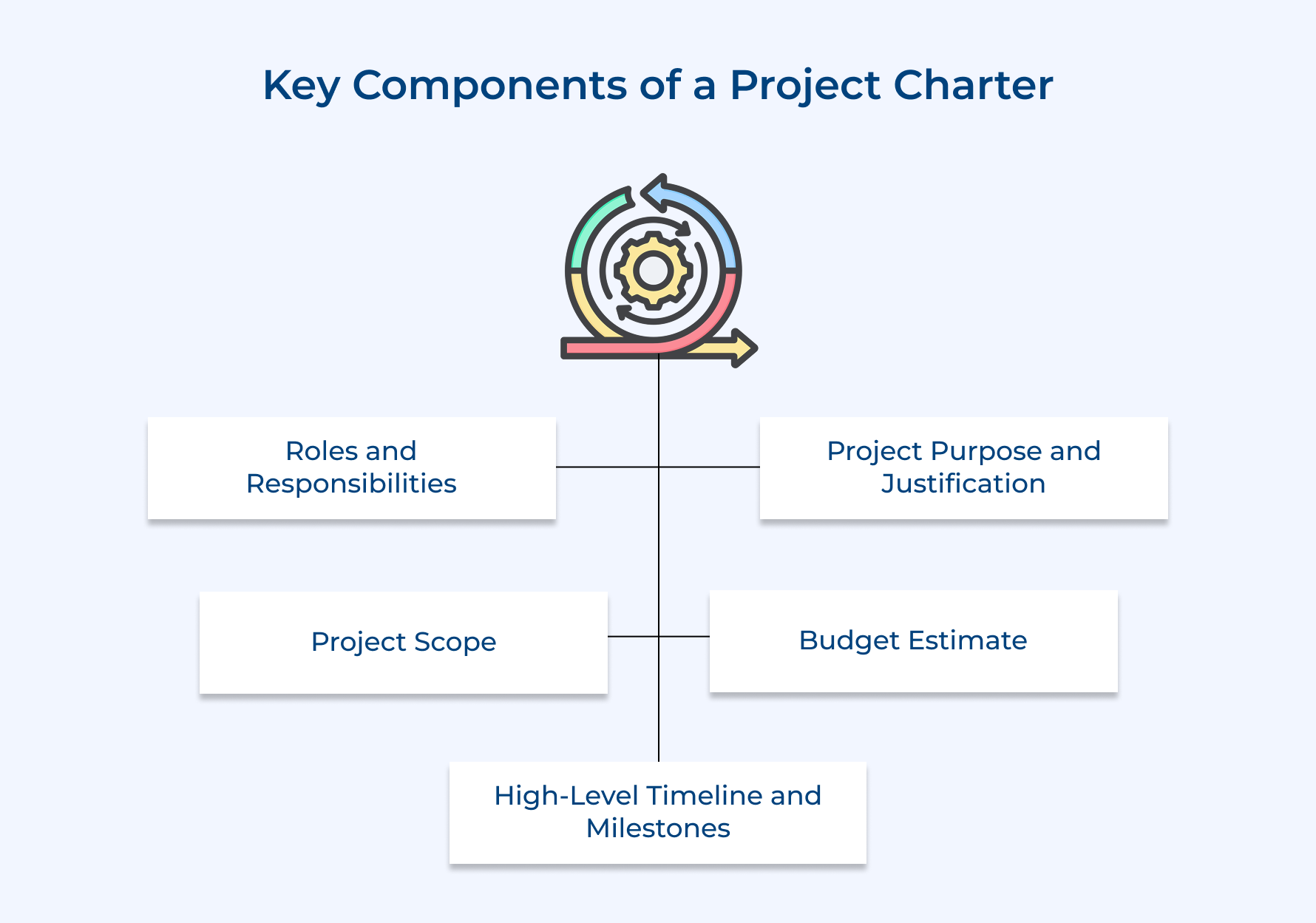
Below are six essential elements working together to give every project a clear foundation before starting execution
1. Project Purpose and Justification
Every team member needs a clear answer to one question: “Why does this project exist?” An undocumented purpose often leads teams to find themselves solving the wrong problem with the right resources.
The section connects the project to real business needs. It makes sure that everyone understands what the actual outcome of the project is ultimately serving.
2. Project Scope
Scope is the fence that protects your project. It defines exactly what needs to be delivered and what are not deliverables under this project.
A well-defined scope section covers:
- In-scope deliverables, which include clearly listed outcomes, are the team’s responsibility
- Out-of-scope items that prevent assumption-driven additions
- Acceptance criteria is the standard against which deliverables will be measured
3. Roles and Responsibilities
“Who owns what?” The question that derails more projects. The roles section within a project charter removes ambiguity by assigning decision-makers and accountable parties upfront.
A strong roles section also defines the decision-making boundary so that escalation paths are clear to all team members from day one.
Every role section must clearly define:
- Project sponsor: Manages executive authority and removes organizational blockers
- Project manager: Owns execution and timelines for day-to-day decision-making
- Core team members: Responsible for specific deliverable areas across the project
4. Budget Estimate
Can a project charter include a rough budget and execution plan before detailed project planning starts? Absolutely, the budget estimate at the charter stage is a committed range that sets financial expectations.
The estimation protects teams from surprise conversations later in the project. It also tells stakeholders that resources have been considered and are not unlimited.
5. High-Level Timeline and Milestones
A project charter does not need a daily schedule; instead, it belongs in the project plan. It does need a realistic timeline to show key milestones and a target completion window.
This high-level view enables stakeholders to understand the commitment in terms of timeline. It also develops early accountability by storing major delivery points before proper project scheduling starts.
What is a Project Plan?
A project plan is the operational document that defines the flow of project execution, monitoring and control. It transforms high-level intentions of the project charter into structured tasks, timelines and assigned responsibilities.
For service firms such as IT consulting or managed service providers, a project charter is a document used before execution, while a project plan is the engine that keeps deliverables accurate and on track. Both combined give the entire team a shared operational reality instead of working from assumptions.
So, does a project plan replace project charter, or do they work together? No, the charter authorizes the project while the plan tells teams the delivery process.
Key Considerations:
- Task breakdown structure: Break down deliverables into actionable tasks with clear ownership.
- Realistic timeline: define schedules considering actual team capacity instead of ideal conditions.
- Dependency mapping: Identify tasks that are blocked by others before the start of execution.
- Resource allocation: Assign the right people to the right tasks without over-allocation to maintain a balanced workload.
Why is a Project Plan Important?
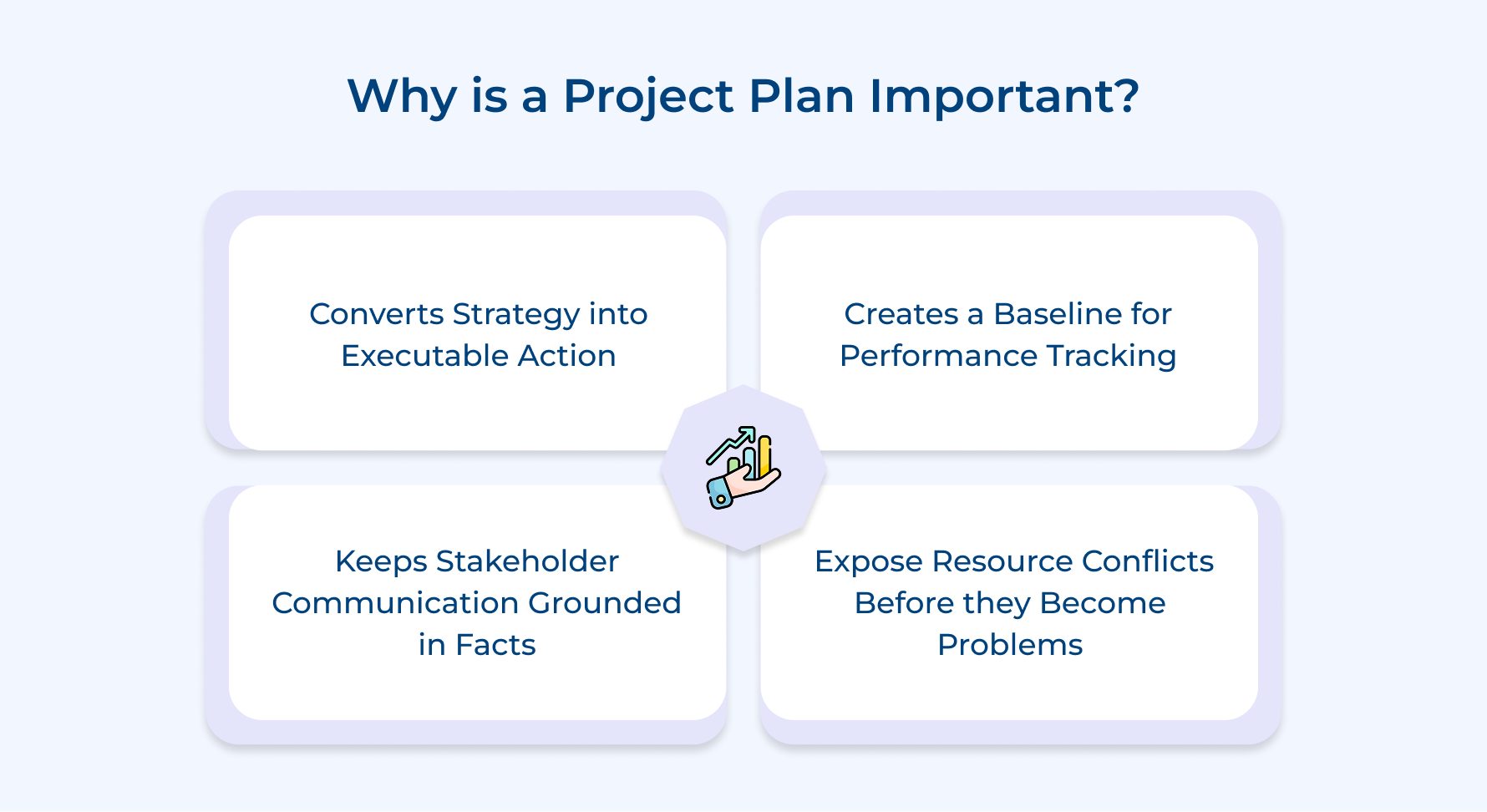
A project plan separates structured delivery from organized chaos by giving the team a blueprint that connects tasks, resources and deadlines to the intended outcome.
1. Converts Strategy into Executable Action
A project charter initially sets direction, but it does not assign it, so the project plan breaks down the intent into specific tasks with owners and deadlines. It also defines the dependencies for teams to act on it immediately.
2. Creates a Baseline for Performance Tracking
Projects without a documented plan lead to unclear objectives for measuring the timeline. The plan includes a benchmark of scope, schedule and budget against which real progress is measured.
3. Expose Resource Conflicts Before They Become Problems
A good project plan forces resource allocation conversations early. A proper task mapping against team capacity helps in identifying conflicts on paper rather than in the middle of a critical delivery phase.
4. Keeps Stakeholder Communication Grounded in Facts
Stakeholder greetings updates without a project plan is just guesswork. A well-maintained plan gives managers factual data to report against what is completed, what is delayed and what is at risk.
Key Elements of a Project Plan in Project Management
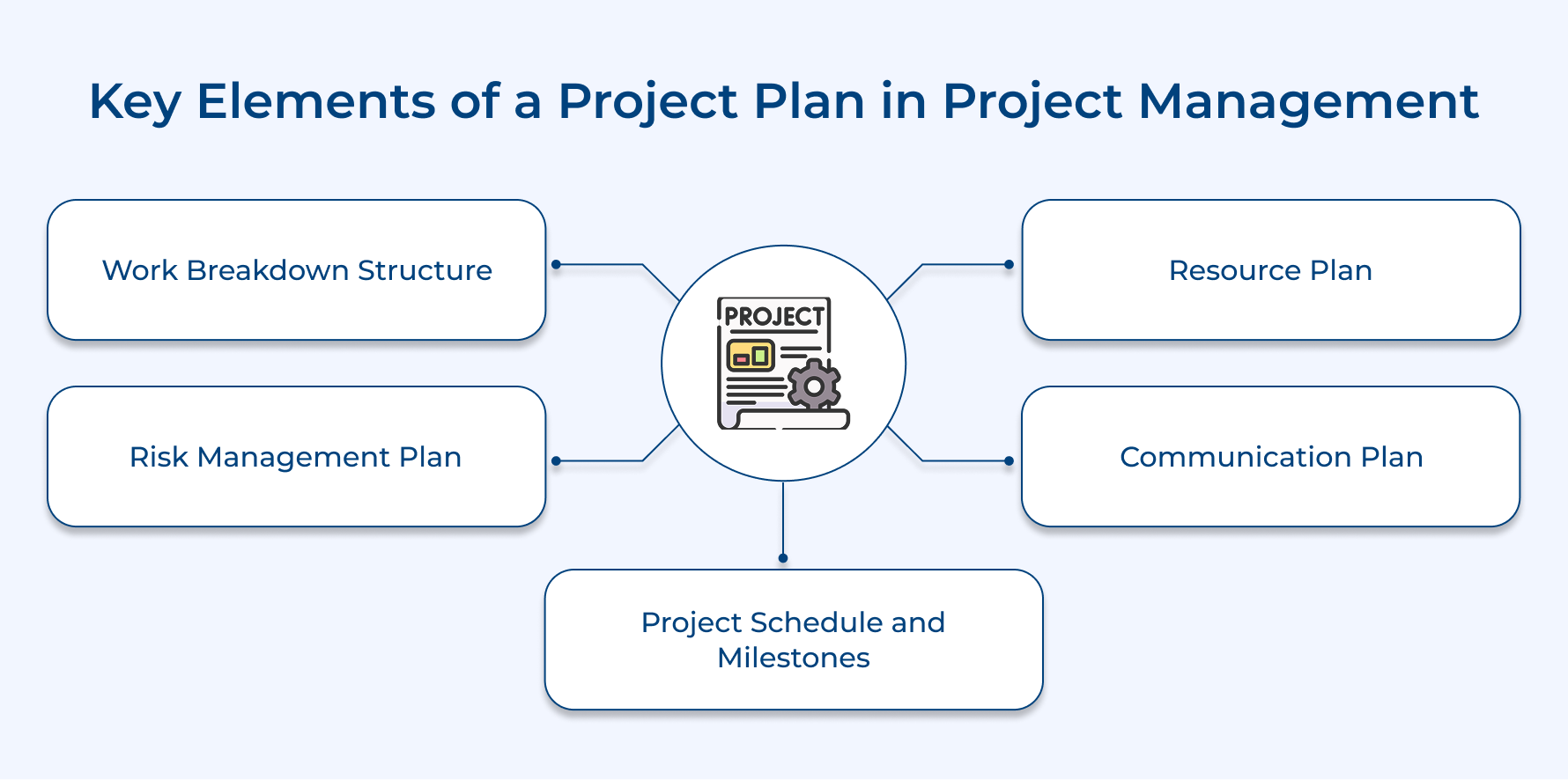
Below are specific elements of the project plan that combine to drive predictable delivery even under pressure and a tight schedule.
1. Work Breakdown Structure (WBS)
High-level deliverables get decomposed into actual executable tasks within the work breakdown structure. It makes a project feel manageable by breaking complexity into trackable units of work.
2. Project Schedule and Milestones
“How long will this actually take?” This is the question most stakeholders ask, for which a proper schedule is the answer, backed by evidence. A realistic schedule is built on dependencies, team capacity and a buffer for unexpected.
Milestones within the schedule serve as checkpoints for keeping your teams accountable. They also give stakeholders clear progress to track without diving into every task level.
A strong project schedule includes:
- Task-level timelines: every actionable work is assigned with proper start and end dates
- Critical path identification: the sequence of tasks that directly impact the project completion rate
- Buffer periods: planned timing built with respect to high-risk or dependency phases
3. Resource Plan
A resource plan answers “Who is doing what and when?” and skipping this element leads to team members and missed deadlines simultaneously.
The resource plan goes beyond just assigning an owner to tasks and maps availability, skill requirements and workload distribution. IT ensures execution stays sustainable across the project lifecycle.
Three areas that must be defined in every resource plan are:
- Role-to-task assignment: Each task is linked to a specific responsible individual
- Availability mapping: Team capacity are distributed across the full project timeline
- External dependencies: Third-party vendors or contractors are involved and impactful into delivery schedule
4. Risk Management Plan
Every project carries its own risk. The comparison between experienced as well as inexperienced managers helps in identifying risks early within project charter and project plan. A proper risk management strategy documents common threats and defines strategies to overcome them.
5. Communication Plan
A good communication plan defines ownership of receiving the information and how frequently. Most project updates become reactive and inconsistent without this structure, leading to a quick erosion of stakeholder confidence.
What Are the Key Differences Between a Project Charter vs Project Plan?
The difference between project plan vs project charter separates reactive managers from deliberate ones, serving different purposes and using one in place of the other
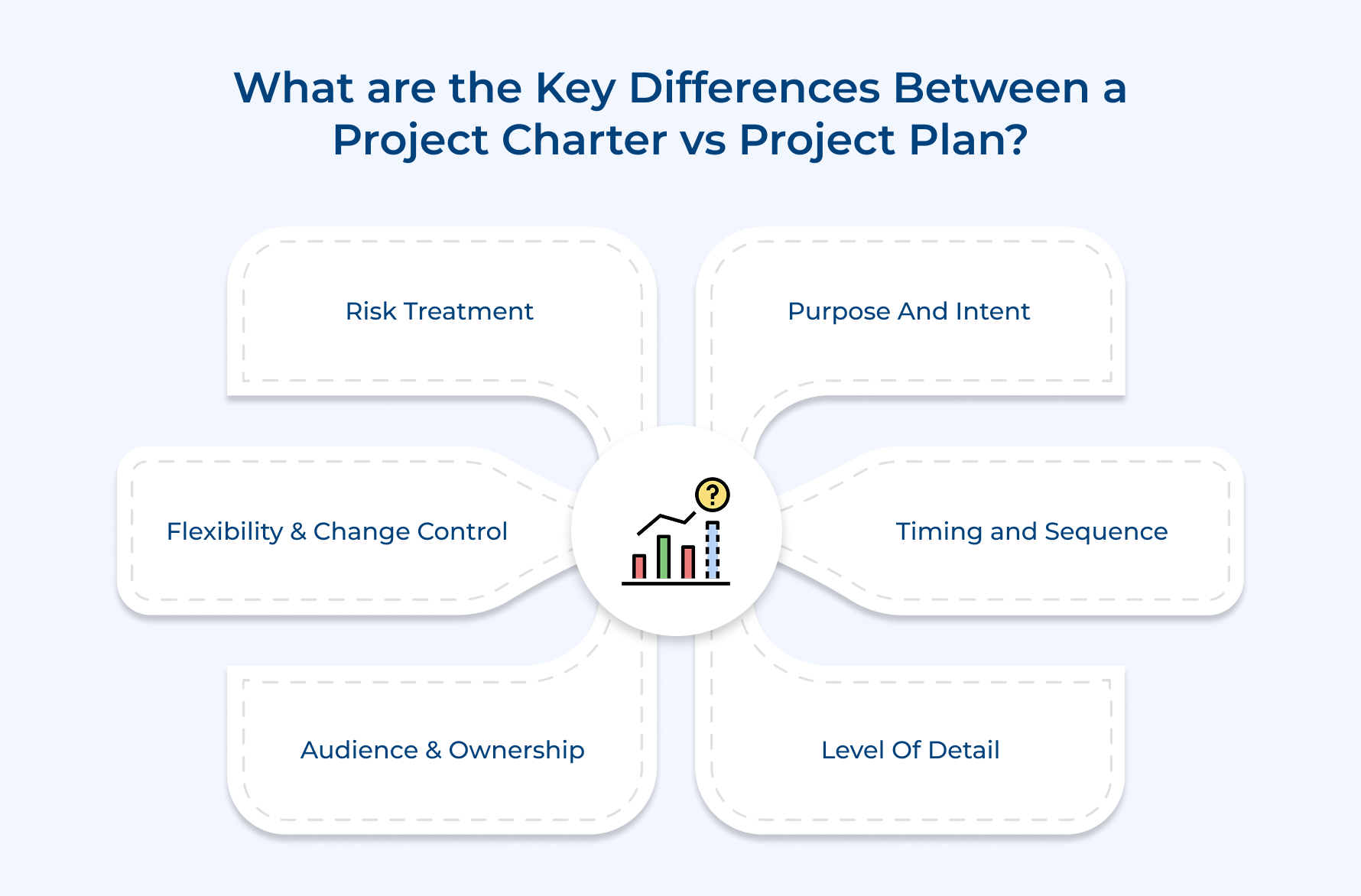
1. Purpose and Intent
A project charter is all about authorization. It answers the question about project scope and goals, giving a green light that converts an idea into an organizational commitment with executive backing.
The charter is a contract between the sponsor and the organization, as without it a manager has no legitimate authority to make binding decisions on behalf of the business.
Below are key questions every charter answers before signing off:
- Does the project align with the current strategic business priority?
- Has the sponsor approved the project’s existence?
- Is the manager’s authority documented and communicated?
The difference between a project charter vs project plan comes down to answering the question “how the authorized project will be delivered”. It transforms charter-level commitments into structured action.
A project plan is managed in the execution world, where tasks have owners and deadlines are tracked in real time. It evolves as the project progresses through its lifecycle.
2. Timing and Sequence
A project charter is created before any project plan starts and is executed. It is a prerequisite document that needs to exist before the manager starts allocating time and resources to planning work.
Most managers who skip the project charter and jump straight to plan make a mistake that appears later as disputes as well as scope disagreements. A proper sequence is important because the charter defines the boundaries within which the plan will operate.
Consider these sequencing questions before shifting from charter to planning:
- Is the charter approved before officially kicking off the planning phase?
- Are scope boundaries tight enough to guide proper planning?
The project plan vs project charter comparison starts after the charter is approved and serves as the next phase of formalization. It takes authorized boundaries from the charter and builds a detailed delivery flow for your team.
The project plan cannot be built without a charter because there is no strong evidence to plan against. The charter its non-negotiable constraints such as
- Budget ceiling
- Scope boundaries
- Strategic objectives.
3. Level of Detail
A project charter is not meant to answer every question. It captures what and why of a project without prescribing the delivery flow.
Consider it as a one-page strategic brief that an executive manager reads and approves in fifteen minutes. Operational overloading actually weakens it by putting the key authorization decisions in unnecessary complexity.
So what a high-level detail looks like inside a charter:
- Scope statement: high-level boundaries only with no task lists or delivery sequences
- Budget: An approved range without a line-item cost breakdown
- Timeline: key milestones only instead of a week-by-week schedule
A project plan operates at a granular level as execution demands specificity. Every task needs a proper owner and deadline, while every dependency needs to be mapped before work starts.
The depth of a project plan vs. a project charter directly impacts a team’s ability to execute without clarification.
4. Audience and Ownership
A project charter is specifically written for senior stakeholders and executive sponsors that needs to authorize the project. The language within the document is strategic, while the focus is on business outcomes instead of operational mechanics.
The people who will actually execute the work daily with the project team need it. It needs to be specific enough so that it can be used on any given day to know exactly what each member should be working on.
Ownership of each document must be clearly assigned from the first:
- Charter ownership: The Project Sponsor holds final authority over the content as well as approval
- Plan ownership: The Project Manager is responsible for managing and updating the plan across the delivery cycle.
5. Flexibility and Change Control
A project charter is a static document once its formal approval is done and changes in this is a fundamental shift in project direction. It also requires a formal re-authorization process instead of simple updates.
A situation when a charter does not need to change means something in the project plan and execution has shifted:
- Business objective
- Budget ceiling
- Project scope boundary.
The level of change needs executive attention that has never been handled at the team level. Signs of a charter amendment that may be needed during execution:
- The original justification no longer reflects current organizational priorities
- The approved budget has proven insufficient for the defined project scope
- A new executive stakeholder has taken sponsorship with separate expectations
A project plan, is designed to be flexible, as execution rarely follows a script. In some cases, the plan absorbs these changes without the need for executive re-authorization:
- Task sequences shift
- Resources change,
- Timelines get compressed
6. Risk Treatment
The process of risk management makes the difference between a project plan vs project charter. Project plan considers operational level risk, combined with a dedicated register that tracks:
- Probability
- Impact
- mitigation actions.
Every identified risk gets an owner and a response flow before it starts to materialize. A project charter helps in identifying the top uncertainties that threaten the project’s viability for approval. The goal is not only to eliminate risk but also to make informed decisions at the sponsor level.
Questions a charter-level risk section must address:
- Are there any organizational dependencies that might block project initiation?
- Does the project depend on budget or resource approvals?
- Are there external or regulatory factors that invalidate the business case?
Key takeaways:
- Charter documents the top five strategic risks that could stop the project before execution.
- The project plan assigns a named risk owner to every item in the register, whether it is an unowned risk or an unmanaged risk.
How to Develop a Project Charter and a Project Plan
Correct project charter and project plan development help project managers to build a strong foundation for client deliverables.
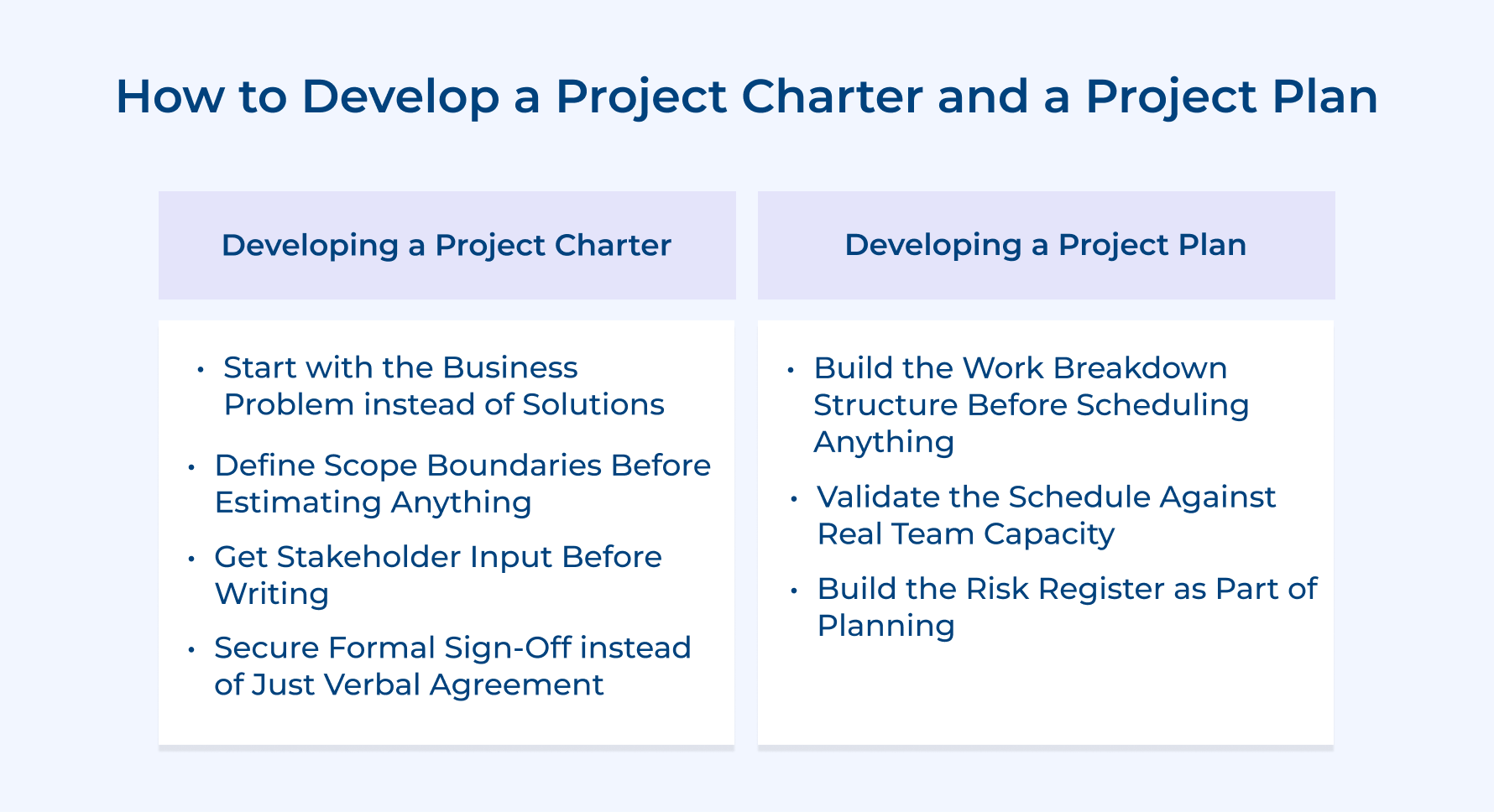
Developing a Project Charter
1. Start with the Business Problem instead of Solutions
A common mistake most teams make when developing a charter is jumping straight into deliverables before understanding the actual business problem.
For example, a firm might charter a project around “implementing Salesforce” instead of “reducing client response time”. That difference between project plan and charter changes the decision that follows.
2. Define Scope Boundaries Before Estimating Anything
Run a scope boundary workshop where every proposed deliverable is categorized as in-scope or out-of-scope before there are any changes in numbers entering the conversation.
3. Get Stakeholder Input Before Writing
Conduct structured interviews with each key stakeholder before drafting the project charter. For example, a technology project reveals that the CTO prioritizes scalability, while the CFO wants cost containment. This conflicts can be resolved directly in the charter stage and not mid-delivery
4. Secure Formal Sign-Off instead of Just Verbal Agreement
A verbal agreement will be remembered differently six weeks into execution. A sponsor signs a charter with a two-hundred-thousand-dollar budget but cannot get authorization without a formal amendment. That paper trail gives the project manager real leverage in difficult conversations.
Developing a Project Plan
1. Build the Work Breakdown Structure Before Scheduling Anything
Run a WBS workshop where each deliverable is decomposed into small tasks. Also, assign a single owner to each task along with a clear completion criterion.
2. Validate the Schedule Against Real Team Capacity
A schedule built on availability instead of actual capacity already fails before execution starts. Build a capacity map in a spreadsheet showing each team member’s availability against allocated tasks before the schedule is baselined.
3. Build the Risk Register as Part of Planning
Risk identification, when bolted on after planning, generates a register that misses project’s real vulnerabilities. Run a risk identification process after resource allocation and after dependency mapping. These activities identify different risk categories that the previous step could not see.
A risk register captures these three elements for every risk:
- Probability and impact rating: A simple high, medium, or low assessment for each risk
- Mitigation action: The specific step that reduces the likelihood or impact
- Risk owner: The named individual responsible for maintaining and responding
Charter vs. Plan: Distinguish your Project Success with Clarity
Project charter and project plan are sequential commitments that together form the backbone of disciplined project delivery. Understanding the starting and ending of each separates projects that finish based on clarity from those that finish with conflict.
- A charter authorizes a plan to be executed that never collapses the two into one document.
- Scope boundaries are defined in the charter that directly control the quality of the plan built.
- Both documents need a proper formal sign-off, where verbal agreement is not accountability.
Ready to structure your next project? Master the difference between a project charter vs project plan to learn the foundational skill that keeps projects aligned from authorization to delivery.
Limit time — not creativity
Everything you need for customer support, marketing & sales.

Neeti Singh is a passionate content writer at Kooper, where he transforms complex concepts into clear, engaging and actionable content. With a keen eye for detail and a love for technology, Tushar Joshi crafts blog posts, guides and articles that help readers navigate the fast-evolving world of software solutions.