How to Identify and Manage Project Assumptions in Firms
- What Are Project Assumptions in Project Management?
- Why Are Project Assumptions Important for Service Firms?
- How Do You Identify Project Assumptions?
- How to Write Assumptions for a Project in Project Management: 7 Steps
- How to Manage Project Assumptions: 6 Best Practices
- Examples of Project Assumptions
- Types of Project Assumptions to Consider for Firms
- Mistakes to Avoid When Making Project Assumptions
- Navigate Uncertainty with Confidence using Project Assumptions
- FAQs about Assumptions in Project Management
Key Highlights:
- Project assumptions are accepted by teams as true without concrete proof to form an invisible foundation across timeline, budget and resource decisions.
- A centralized assumptions log with proper ownership prevents undocumented beliefs from becoming scope disputes mid-execution.
- Resource, cost, scope and time carry a distinct risk that needs to be tracked separately across the project management cycle.
Do you know what separates projects that stay on track from those that quietly fail before execution? It is all about inconsistent project assumptions that are accepted as facts and never questioned.
Inaccurate initial assumptions planning leads to more than 35% of projects failing before delivery.
Project assumptions are the conditions or team accepts as true without concrete proof. They form the invisible foundation across every timeline, budget and resource decision your plan depends on.
Explore everything from defining and identifying assumptions in project management to logging and managing them across the entire project lifecycle.
What Are Project Assumptions in Project Management?
Project assumptions are facts that managers accept as true at the start of a project without concrete proof. They form the base of your entire planning and drive early decisions before real data is available.
Every project starts with a set of beliefs about resources, timelines and stakeholder availability that the team cannot confirm upfront. These are the assumptions in project management that shape planning decisions before data arrives.
Think of your assumptions like the invisible foundation beneath the project plan. Identify and record them early so that your team gets a clear view to evaluate risks before they turn into costly surprises.
Key objectives:
- Establish a scope baseline: Define the conditions on which the project plan is built first.
- Enable early risk detection: Spot the project assumptions that carry the highest uncertainty.
- Align stakeholder expectations: Ensure everyone agrees on the list of assumptions before execution.
- Support decision-making: Maintain documented project assumptions to guide trade-offs with real conditions.
Why Are Project Assumptions Important for Service Firms?
Project assumptions not only save your team but also quietly begin the process of success.
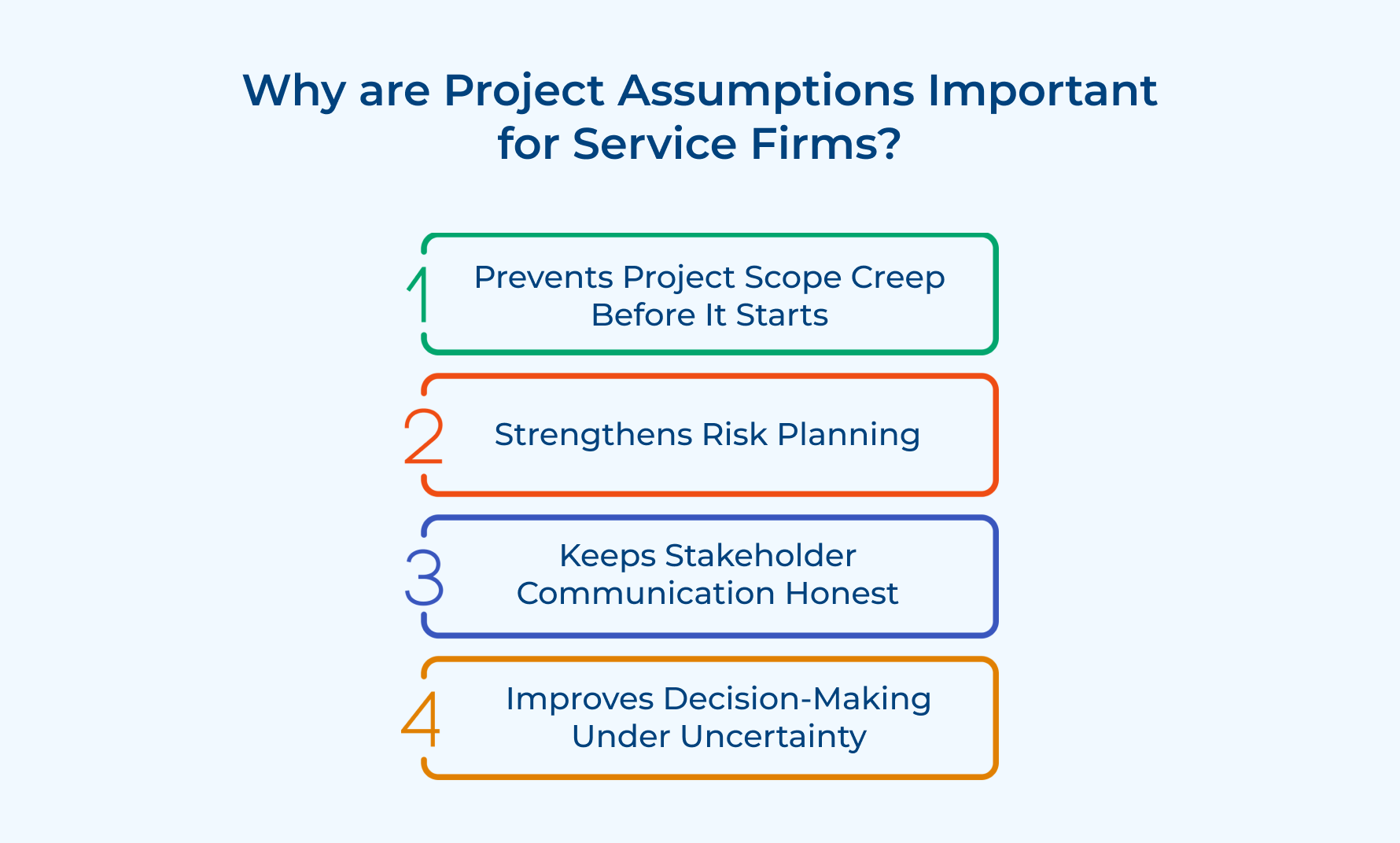
1. Prevents Project Scope Creep Before It Starts
Project assumptions, which are documented upfront, draw a clear boundary around the initial planning. Undocumented beliefs are the number one reason deliverables expand without a budget or project timeline.
2. Strengthens Risk Planning
Teams that log facts early can evaluate the assumptions with the highest uncertainty and build plans around them. Project assumptions and risks are directly connected, leading to the identification of potential issues.
3. Keeps Stakeholder Communication Honest
Proper assumptions lead to early conversations between managers and stakeholders related to things that are being taken for granted. This communication eliminates the gap between team’s beliefs and client’s expectations.
4. Improves Decision-Making Under Uncertainty
A documented assumption acts as a decision-making anchor that has complete information at kickoff. You can go back to your assumptions log and evaluate your project based on this when conditions shift.
How Do You Identify Project Assumptions?
Project assumptions identification is not a one-time activity. It requires structured thinking, conversations and consistent documentation across the project lifecycle.
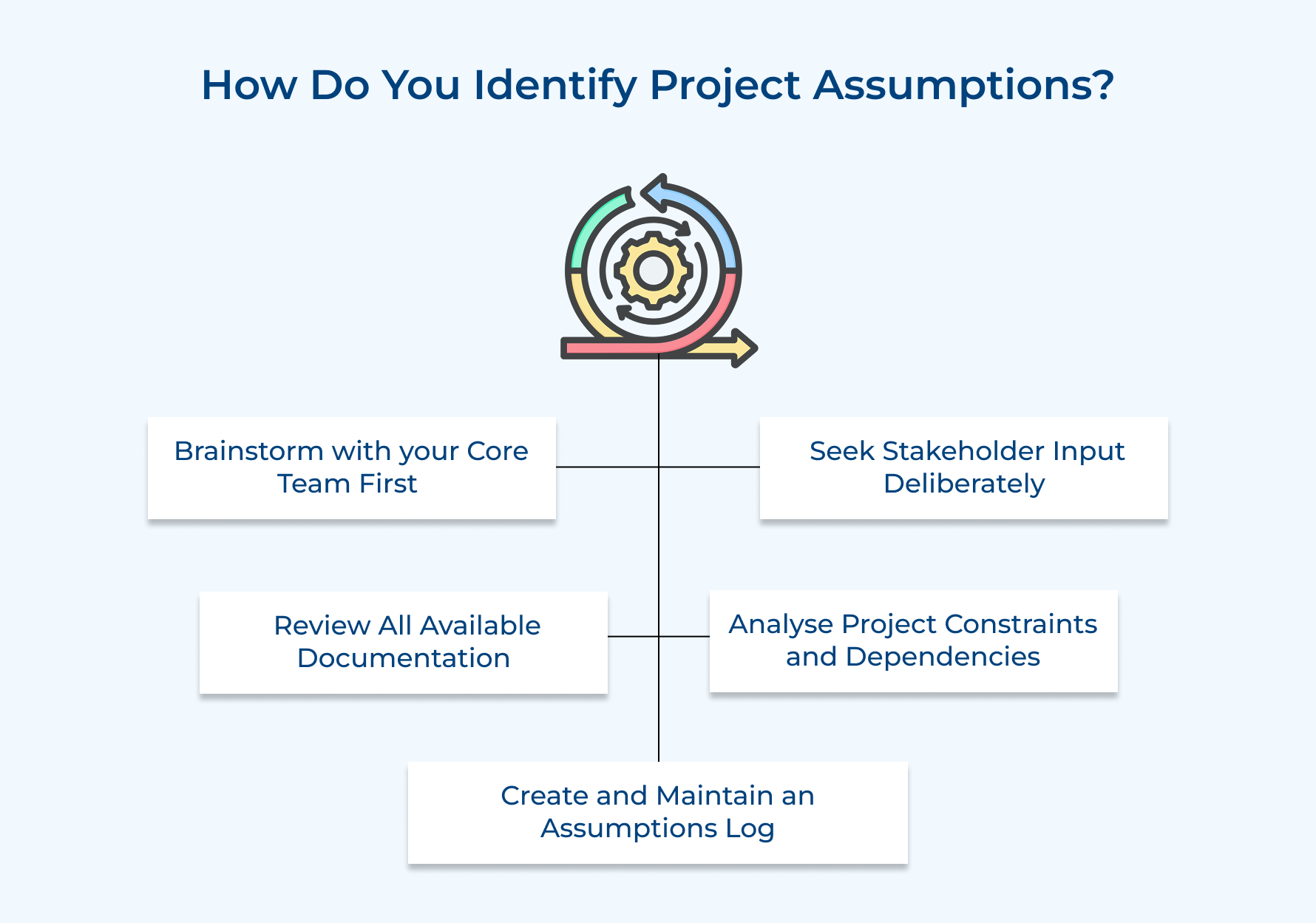
1. Brainstorm With Your Core Team First
Build up a core team and start by asking one question: “What are we taking for granted here? It identifies assumptions about timelines, resources and technical project dependencies.
Run this session before any meeting as it sharpens the team’s thinking first. It is all about aligning your team on their own beliefs before validating with others.
2. Seek Stakeholder Input Deliberately
Stakeholders are the key people who carry assumptions that most of your leadership team members will never identify on their own. An input session from a stakeholder turns hidden beliefs into documented project assumptions.
Pro tip: Do not rely on casual conversations, instead, use a structured format for specific planning scenarios and decision points.
3. Review All Available Documentation
Documentation review helps you spot conditions that were assumed during earlier phases but never formally recorded or planned.
For example, a software development project in which technical decisions from discovery carry to execution phase, documented assumptions help in making proper execution planning..
4. Analyse Project Constraints and Dependencies
Every project constraint is synced to an assumption when you map them together. The patterns from this reveal what the team is depending on to keep the plan intact. Dependencies between tasks and teams are a rich source of hidden guesswork.
5. Create and Maintain an Assumptions Log
Once project assumptions are identified, the log becomes a single source of truth for tracking complete details. It also helps you monitor which facts have been verified from the ones that still carry risk.
The process without proper logging fades away and reappears later as disputes. Treat the log as a living document that gets reviewed and updated at every project milestone.
How to Write Assumptions for a Project in Project Management: 7 Steps
Let’s walk through the seven steps that will help you master the project assumptions process and set a firm foundation for achieving your objectives.
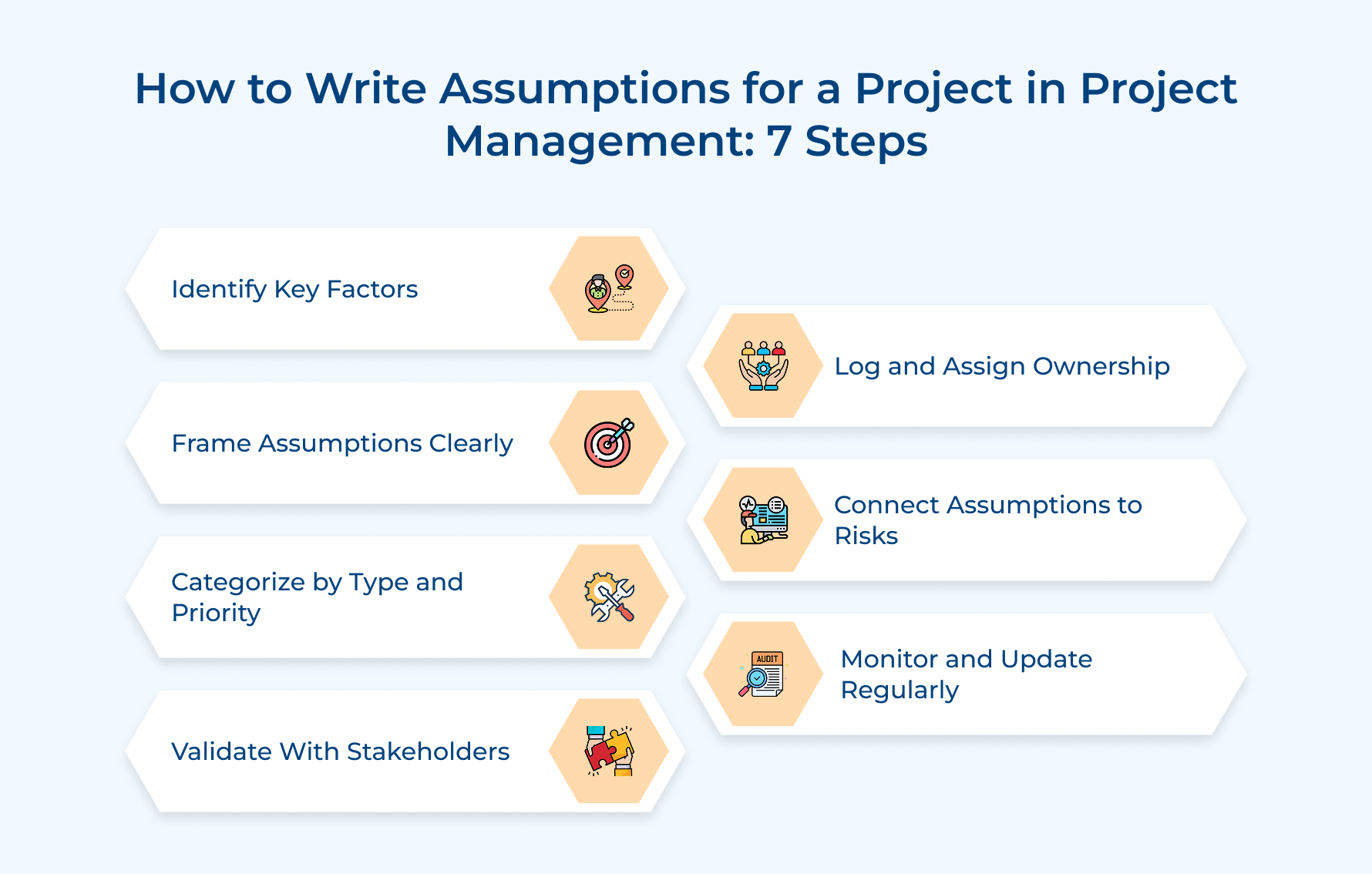
1. Identify Key Factors
Before starting preparing a single assumption, identify what conditions your project depends on. It gives you a factual base instead of a guesswork foundation.
Consider this critical question checklist to start the foundation:
- What resources will be available across the lifecycle?
- Which external vendors are we depending on without commitments?
- Are there regulatory approvals we are treating as already secured?
- What are the current budget conditions we are assuming will remain stable?
These will force the team to confront what they are depending on and turn invisible planning into documented assumptions the team can manage.
So how does identifying factors change the way of the project? You start planning around documented conditions. Every resource gap, vendor and approval timeline becomes a named guesswork rather than a background risk.
Pro Tips:
- Run a dependency mapping session before your meeting to surface hidden conditions early.
- Use a simple three-column format, which will include the fields as factor, assumption statement and owner.
2. Frame Assumptions Clearly
Clear assumption framing separates a usable document from a vague list nobody refers to from the project team. It should be specific, declarative and directly tied to a project decision. Follow these proven approaches:
- Write in declarative statements: Read each document as a confident statement of condition. For example, “The client will provide feedback within x days” is a framed assumption, while “the client responds quickly” is only wishful thinking.
- Avoid vague or ambiguous language: Words such as “sufficient,” “adequate,” or “timely” are considered as different things to different stakeholders. Make it measurable and specific, which leaves no room for interpretation.
- Tie each assumption to a deliverable: A project assumption that floats without a specific deliverable loses accountability. Mapping each to deliverables lets the team know exactly what is at stake if the assumption is wrong.
Assumptions farming is all about giving a backbone that holds up when real-world conditions start pushing against original thinking.
3. Categorize by Type and Priority
Categorize assumptions based on type as well as priority once identified and framed. It turns a flat list into an actionable planning tool. All assumptions look equally important as each manager loses control.
Most projects encounter assumptions that fall into four buckets:
- Scope assumptions: Conditions on included or excluded from project deliverables
- Resource assumptions: based on team availability, skill sets and budget stability
- Timeline assumptions: guesswork around approval cycles, vendor delivery and milestone readiness
- External assumptions: proper dependencies on client decisions or third-party systems
A wrong high-priority assumption derails the project immediately without a viable workaround. Internal and external documents carry different risk profiles that need to be managed separately in the project assumptions log:
- Internal assumptions include the team’s own capacity, decisions and systems
- External points depend on clients or regulators and carry a higher risk
- As a point of entry, assume as internal or external at the point of entry
4. Validate With Stakeholders
Validation is where your assumptions move from the manager’s beliefs to shared and agreed-upon across the team. Firms that skip this step mean they are planning on a foundation of only one person reviewing.
Share Your Assumptions List Before Project Kickoff
Sharing the list before kickoff to give stakeholders a chance to challenge and adjust the plan. Assumptions that are unreviewed in the execution phase are the ones that create the most surprises.
Confirm Alignment With Key Decision Makers
Decision maker’s alignment is more than a quick email acknowledgment of your project assumptions document. It is all about collaborating with budget owners, sponsors and functional leads to walk through assumptions that affect the area of ownership.
Document All Disagreements and Open Items Formally
Disagreement itself acts as a critical piece of project information when a stakeholder disagrees. Proper documentation on project assumptions and constraints protects the manager when disputes are later identified during the execution phase.
5. Log and Assign Ownership
An assumptions log without assigned ownership in a project is just a simple document that nobody uses. Proper conflict logging with a named owner makes it an accountable and manageable planning asset.
Consider this checklist before closing out this step:
- Do all conditions entered into the project assumptions log have a clear statement?
- Is there any individual responsibility for managing the assumed assumption?
- Does each conflict have a proper post-project review date or condition attached to it?
The checklist empowers teams to treat assumption documentation as a managed item instead of a passive note, creating a natural audit trail.
So How documentation of alignment and disagreements strengthen the log? It separates proactive project management from reactive damage control when things go wrong.
6. Connect Assumptions to Risks
Every unevaluated project conflict is a risk that has not been named. Syncing your assumptions and risks gives a stronger foundation in real project conditions. Follow these practical approaches that boost your risk planning process:
- Map each assumption to a specific risk statement: Write a corresponding risk statement, such as “if this assumption is wrong,” for every individual assumption. This direct mapping helps in identifying any consequences of a conflict failing mid-project.
- Evaluate impact before the project begins: Assess the outcome of each timeline, budget and scope when assumptions prove false. Project assumptions and risks reviewed in the planning stage give a clear view of where your plan is most affected.
- Build contingency plans for high-risk assumptions: Only the higher-priority assumption needs a contingency plan. Consider the example of a construction project, when assumptions about material availability prove wrong, teams that have pre-built contingencies recover in days while others take weeks.
The most common challenge is that teams consider assumptions and risks as two separate registers, leading to affecting your project delivery. Overcome it by scheduling a risk review session to pull up the assumptions log and work through the documents in a collaborative approach instead of isolation.
7. Monitor and Update Regularly
Project assumptions analysis is a continuous loop that runs in parallel to project execution. An assumption that was valid during kickoff can become a live risk within a few weeks if external conditions shift. Stay ahead of assumption failures by making this a regular practice:
- Schedule assumption reviews at every milestone: Treat assumption reviews as an agenda item in meetings instead of an optional checkpoint.
- Use a live project assumptions log: Update the log in real time so the team always works from current information.
- Assign monitoring responsibility by assumption owner: Let each owner track their assumption and flag changes.
- Set trigger conditions for escalation: set a benchmark for changes in conditions that need immediate escalation.
Pro tip: Build assumption reviews into your cadence to surface problems early to course-correct instead of focusing on recovery.
Now that you have monitored the assumption it’s time to update it based on the insights, but how to do it? Update the assumption statement immediately and reassign its priority level.
How to Manage Project Assumptions: 6 Best Practices
Project assumptions management is a discipline that runs as a loop across each phase of your project. Explore the best practices below in detail:
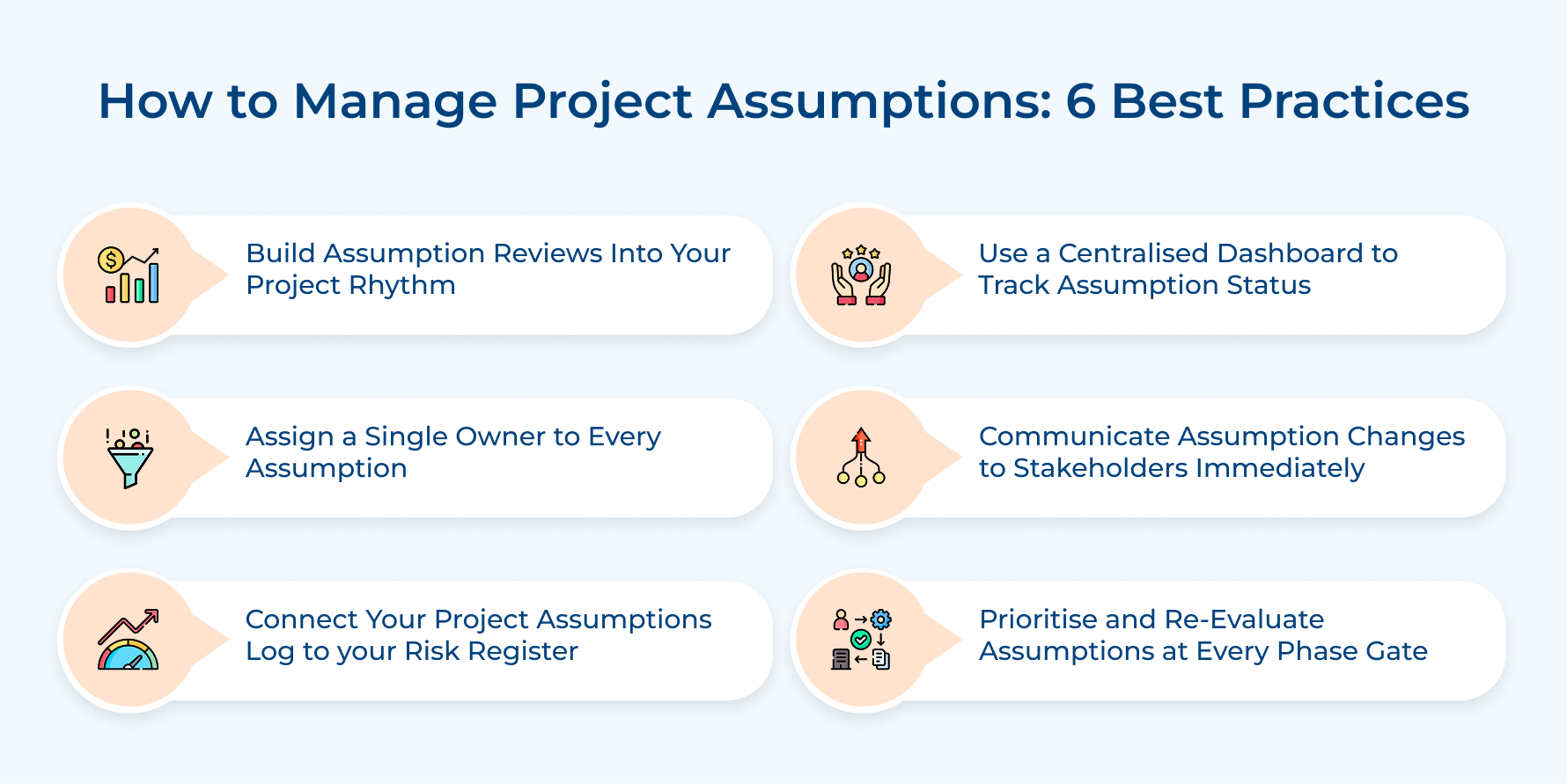
1. Build Assumption Reviews Into Your Project Rhythm
A common practice among most project teams is to document assumptions at kickoff and never revisit them. Treat assumption reviews the way you treat status meetings as both serve the same purpose of keeping the project in reality.
- So what does a structured review cover?
- Track assumptions that have changed since the last review
- Manage high-priority assumptions that show early warning signs
- Stakeholder re-confirmation is needed for open conversations before the next phase
Don’t think of it as a “long session”; instead, consistency is the key to success. A fifteen-minute check at every milestone is enough to track shifting conditions before they escalate into risks.
2. Assign a Single Owner to Every Assumption
The fastest way to lose a project objective is to have shared ownership of assumptions. Situations when everyone has some responsibilities can lead to an unvalidated assumption quietly becoming a project crisis. So, what to do now?
- Assign a single owner per conflict to create direct accountability, which shows up in your project assumptions log.
- Each owner is responsible for tracking, flagging and escalating conditions when no longer held.
3. Connect Your Project Assumptions Log to Your Risk Register
Teams that manage project assumptions without a risk register create a blind spot in the planning phase, leading to delays in delivery trust. The list of non-validated conditions is essentially a risk and not formally acknowledged.
This connection is critical in scenarios such as:
- Vendor commitment uncertainty: Vendor assumptions at kickoff transform to uncertainty mid-project. It means the risk register needs to reflect that shift immediately.
- Regulatory approval delays: Approval timelines, assumed to be straightforward, hit unexpected delays. Both documents need proper updates within the same review session.
- Resource availability shifts: Resource assumptions change due to organisational decisions. The impact needs to be optimized across both documents.
Pro tip: Treat your project assumptions log and risk register as common documents that need proper review together.
4. Use a Centralised Dashboard to Track Assumption Status
Scattered tracking across channels such as emails, meeting notes and individual spreadsheets leads to assumption failure. Maintain a proper centralised dashboard for your entire team to get a real-time view of each assumption and its status.
A good assumption tracking dashboard answers these questions:
- Which assumptions are validated and which ones are still left?
- How many high-priority assumptions are left to review?
A well-structured project assumptions dashboard should show assumption status, priority level, owner and last review date. It makes sure that anyone on the team can identify risk without going through the entire document each time.
5. Communicate Assumption Changes to Stakeholders Immediately
During project management, you discover an assumption has changed and by the time the decision-making communication happens, the window is already closed. So build your communication process around these principles:
- Low-priority changes: Capture in the next status update without affecting the project flow.
- Medium-priority changes: Communicate with the project manager within 24 hours of the change identification
- High-priority failures: Escalate to the project sponsor on the same day with a properly documented assessment.
Effective communication around assumptions is all about building a clear escalation path starting from the assumption owner to the project manager and the relevant stakeholder. It does not need formal communication; instead, it needs to be immediate and documented.
6. Prioritise and Re-Evaluate Assumptions at Every Phase Gate
Don’t underestimate the low-priority project assumptions that are perfect for the planning phase but might become critical by the execution stage. It is recommended to re-evaluate priorities to make sure your team is always focused on the assumptions that carry current risk.
For example, a project assumption about software integration seemed straightforward during discovery, but looks different once development starts. Phase gate reviews are the natural checkpoint for re-evaluation. The project context shifts and new information is available.
Examples of Project Assumptions
Below are some examples of assumptions that reflect conditions project managers document and manage.
Project Assumptions Example: Marketing Agency
A mid-sized marketing agency is taking on a brand relaunch project. The manager documents every condition because leaving these beliefs undocumented leads to timelines collapsing and budgets blowing out.
Below are the assumptions agency logs before execution:
- Client availability: The client’s marketing lead is available for weekly review calls across the six-week development phase.
- Content approvals: All deliverables will receive client feedback within a few days of submission.
- Brand assets: The client will give all brand assets and guidelines before discovery.
- Budget stability: The agreed budget remains fixed with no scope after sign-off.
The client’s marketing lead goes on unplanned leave and response times increase. The project manager had immediate grounds to raise an impact instead of absorbing the delay that a single assumption prevented scope dispute.
Types of Project Assumptions to Consider for Firms
The different types of assumptions help project managers document and monitor them with far greater precision.
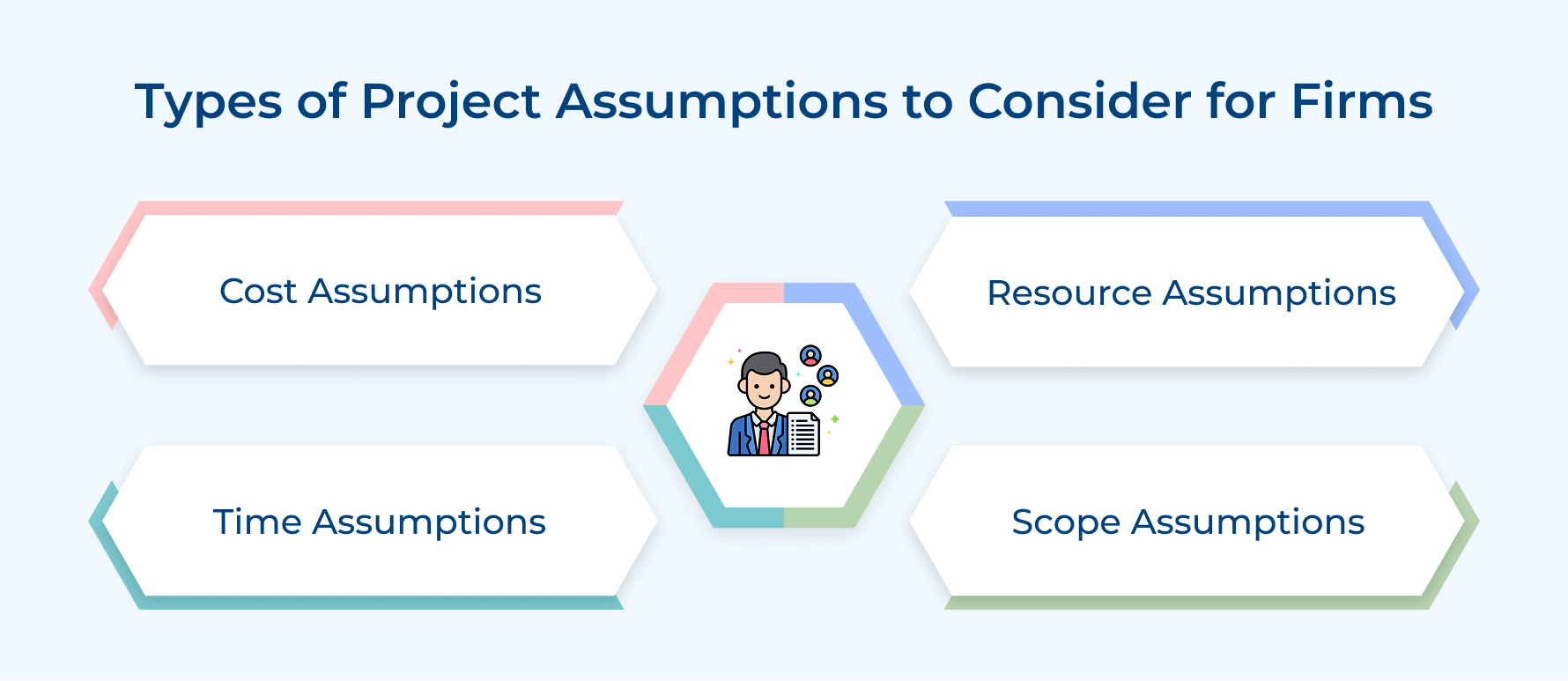
1. Resource Assumptions
Resource assumptions include people, tools and systems on which the project depends. A team member, when assumed to be fully dedicated, gets pulled into another project and your entire delivery schedule feels that impact immediately.
2. Cost Assumptions
Cost assumptions define the financial conditions of your budget, including vendor pricing and procurement timelines. For example, a single unvalidated cost assumption in a multi-phase project can cost the budget overruns that pile up in every phase.
3. Scope Assumptions
Scope assumptions keep a record of elements included in the project along with those falls outside the agreed boundaries. These are the most disputed assumptions in project management, as scope boundaries mean different things across the project team and clients.
4. Time Assumptions
Time assumptions reflect your schedule, including factors such as approval turnaround times and stakeholder availability. It creates a cascading effect where one delayed milestone pushes every dependency off track.
Mistakes to Avoid When Making Project Assumptions
Most experienced managers fall into traps when documenting project assumptions, so knowing these mistakes upfront helps in creating a solid framework that solves.
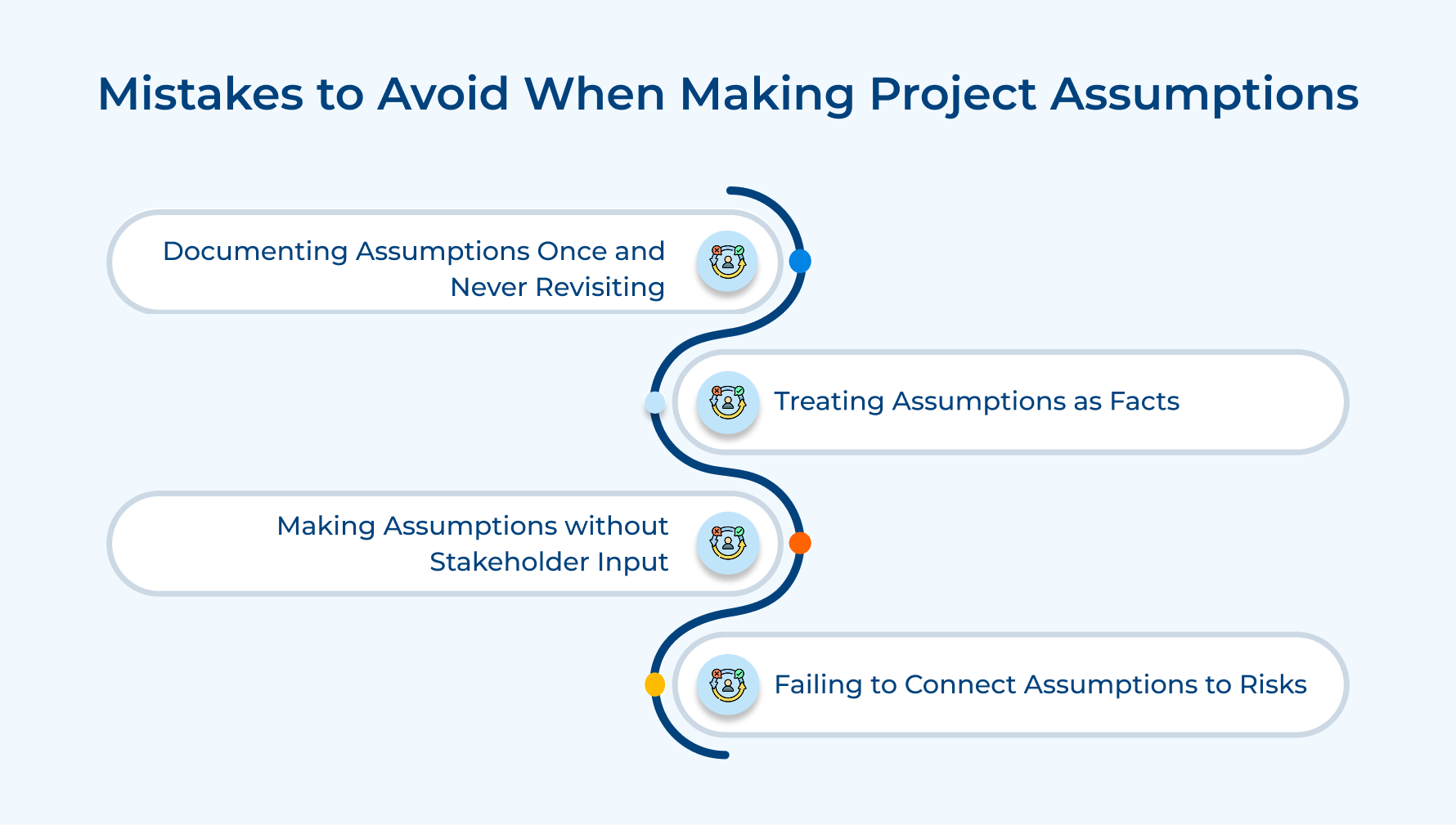
Treating Assumptions as Facts
Your team develops a blind spot the moment they start treating predefined assumptions as a confirmed reality. It led to mid-project surprises that nobody saw coming, despite early warning signs being present.
Documenting Assumptions Once and Never Revisiting
Project assumptions log at kickoff and archiving it immediately is a costly project management habit. For example, an assumption that was reasonable in the first week can become completely invalid by the fourth week.
Making Assumptions Without Stakeholder Input
Assumptions built on the project team often miss critical conditions that only the clients know. The gap between team beliefs and the client’s expectations increases silently until it transforms into a conflict.
Failing to Connect Assumptions to Risks
Documenting project assumptions and risks separately creates a dangerous planning gap. Every unvalidated assumption is a potential risk and managing them leaves your contingency planning incomplete.
Each has a straightforward fix worth implementing:
- Run the assumption through a stakeholder review process before it transforms into a planning dependency.
- Treat your project assumptions log as a real-time document with a structured review at every milestone.
- Bring clients into the assumption identification process before the project brief is finalised.
- Create a risk entry log that captures the consequences of being wrong for each assumption.
Project assumptions are not just a documentation formality but also a planning tool that defines how your project handles uncertainty. Assumptions, when identified and logged properly they give clarity to move to the next stage with confidence.
- Document assumptions before planning starts, instead of doing it after problems surface
- Assign ownership to every assumption and connect with the corresponding risk
- Throughout execution, treat your project assumptions log as a real-time document for updates
Ready to bring structure to your process? Explore our project management resources or download our assumptions log template to get started. Most projects fail because conditions were never documented or managed properly.
Limit time — not creativity
Everything you need for customer support, marketing & sales.

Neeti Singh is a passionate content writer at Kooper, where he transforms complex concepts into clear, engaging and actionable content. With a keen eye for detail and a love for technology, Tushar Joshi crafts blog posts, guides and articles that help readers navigate the fast-evolving world of software solutions.