What is Project Visibility & How to Improve it?
- What Is Project Visibility?
- 5 Components of Project Visibility for Better Decision Making
- What Are the Benefits of Visibility in Project Management?
- How to Improve Project Visibility? 8 Proven Strategies
- Best Practices for Sustaining High Project Visibility in Project Management
- Examples of Project Visibility in Project Management
- Track Unseen Project risk with Clear Project Visibility.
- FAQs about Project Visibility
Key Highlights:
- Project visibility is the operational process that streamlines if project milestones, risks and resources stay on track or fall behind.
- Strong visibility combines task status with communication, risk documentation, resource tracking and not only a dashboard view.
- Teams sustain real-time visibility without increasing manual burden by defining automation workflows and regular framework reviews.
Most project managers are failing to deliver on time, not due to poor skills. It is because they cannot see real-time progress across the project. It leads to tasks slipping while risks go unnoticed and stakeholders are left guessing as deadlines quietly move closer.
Inadequate communication and poor information flow across teams as well as clients, lead to 39% of projects failing. It is the visibility problem that scales every single day and it goes unaddressed.
Explore everything from the core components to proven strategies for improving it across your projects. Also, get a practical framework that makes project management visibility an in-built part of team operation.
What Is Project Visibility?
Project visibility means giving your team a real-time view of milestones, resources and risk across the project anytime. This level of clarity makes your project progress in real time to improve management and delivery.
Why Is Project Visibility Important for Success?
In complex project management, the teams with skill gaps do not struggle instead, the ones operating in the dark get affected the most. Project visibility without real-time just creates confusion among stakeholders and managers as they are unable to track progress. It grows into project-killing problems.
Most project failures include one root cause. A breakdown in information flow between teams. So ask yourself: Does everyone involved in your project know the progress? If not, your visibility in project management needs immediate attention.
Key objectives:
- Real-time progress tracking: track at what stage every task and milestone stands in the project lifecycle.
- Early risk identification: Identify blockers and issues before they scale into costly delays.
- Stakeholder alignment: Keep clients, leadership and teams updated in real time without depending on back-and-forth calls.
- Accountability across teams: Assign proper ownership of tasks and deadlines clearly so nothing falls through the cracks.
5 Components of Project Visibility for Better Decision Making
The core components of project visibility enable you to build a structure where every decision is backed by real-time information.
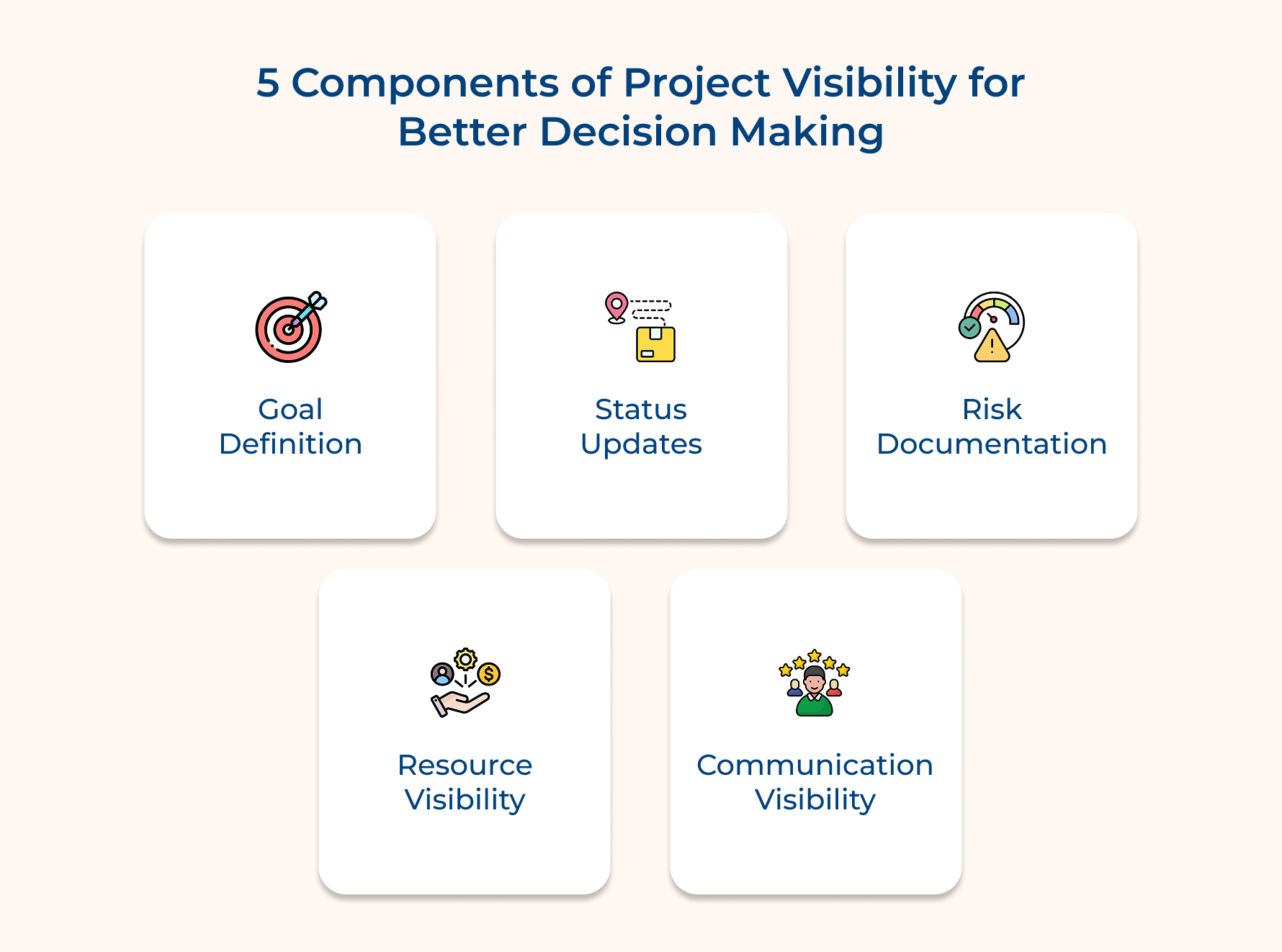
1. Goal Definition
A project without defined goals is similar to travelling without a destination. Goal definition is the foundational element of any solid project visibility plan. It sets the benchmark against which all real-time progress is measured.
So, how does a well-defined goal look in practice? It is time-bound and assigned to a clear owner, not a vague outcome floating in a project brief. A strong goal definition includes:
- A measurable outcome with a pre-defined deadline
- Clear ownership so one person is accountable for project delivery
- Alignment with the broader objective to make sure nothing exists in isolation
2. Status Updates
Regular status updates are the earliest warning system for any task going off timeline. A well-structured update cadence gives your entire team a live pulse on where it currently stands in comparison to the predefined benchmark.
3. Risk Documentation
Most project risks show early signs that are simply missed due to not maintaining proper documentation. A live risk log as part of your framework keeps you always one step ahead instead of reacting after damage is done.
Do teams treat risks as active responsibilities or just passing concerns? Not really, it depends heavily on the way risks are documented and assigned. A strong risk documentation includes:
- The risk itself is described clearly, along with context
- A proper accountability who is responsible for monitoring the risk
- A clear mitigation plan so that the response is never improvised under pressure
4. Resource Visibility
Tracking your team’s availability is as important as knowing what needs to be done. Projects with clear resource visibility only lead to overall allocation that silently burns out some team members while other capacity goes unused.
Treat resource visibility as a direct input into every scheduling decision. Your project management visibility sharpens and your delivery timelines become realistic when you can see the number of overutilized as well as underutilised members.
5. Communication Visibility
The real breakdown is that most projects happen due to a conversation gap. Clear communication means having a real-time record of decisions made, along with instructions given and updates shared, to ensure nothing is left inside someone’s inbox.
Key considerations to maintain clear communication visibility:
- A centralised space for keeping a record of all project discussions and decisions
- Clear documentation of approvals to eliminate the gap of saying “I never agreed to this”
What Are the Benefits of Visibility in Project Management?
Improvement in project visibility across your workflows fundamentally changes how your team operates and delivers across all deliverables.
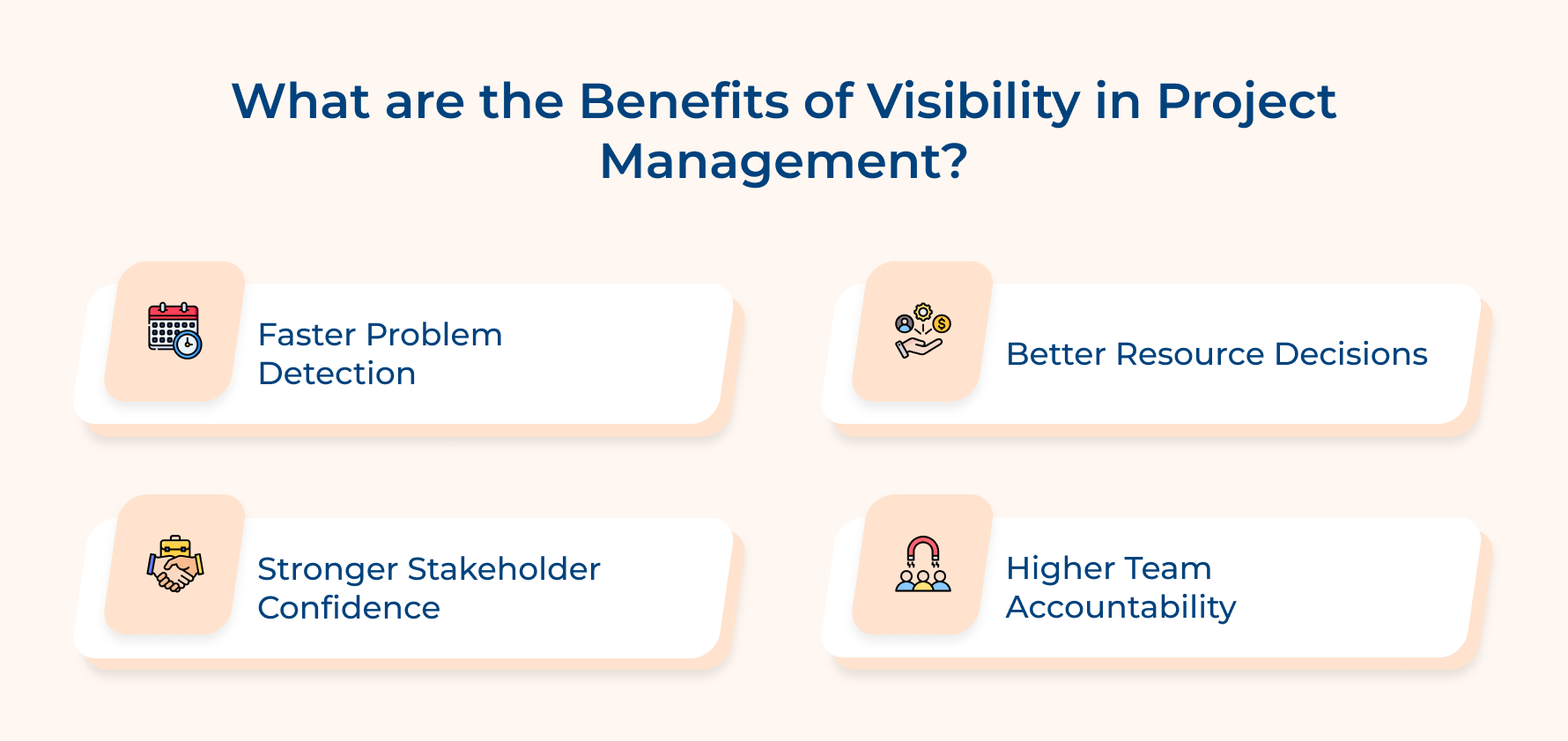
1. Faster Problem Detection
Projects staying within the defined timeline does not mean having zero problems. They are the ones where problems are identified faster. Clear project visibility gives early signals for proper management, as it quietly derails your timeline.
2. Stronger Stakeholder Confidence
Situations when a project gets delayed from the defined time, stakeholders lose trust, not because of this, but because there was no communication. Project visibility when built based on your defined plan, everyone stays informed without any dependencies.
3. Better Resource Decisions
The most overlooked benefit of visibility in a project is its impact on resource planning. It transforms your allocation decision-making from guesswork to being based on real data.
4. Higher Team Accountability
In projects where work is visible to everyone, ownership becomes a non-negotiable part. Team members automatically consider their task deadlines more seriously. It happens frequently when progress is part of a shared project visibility framework which both leadership and peers can view.
How to Improve Project Visibility? 8 Proven Strategies
The strategies will equip the necessary tools to keep your project delivery on time, even if you are dealing with tight schedules or complex stakeholder networks.
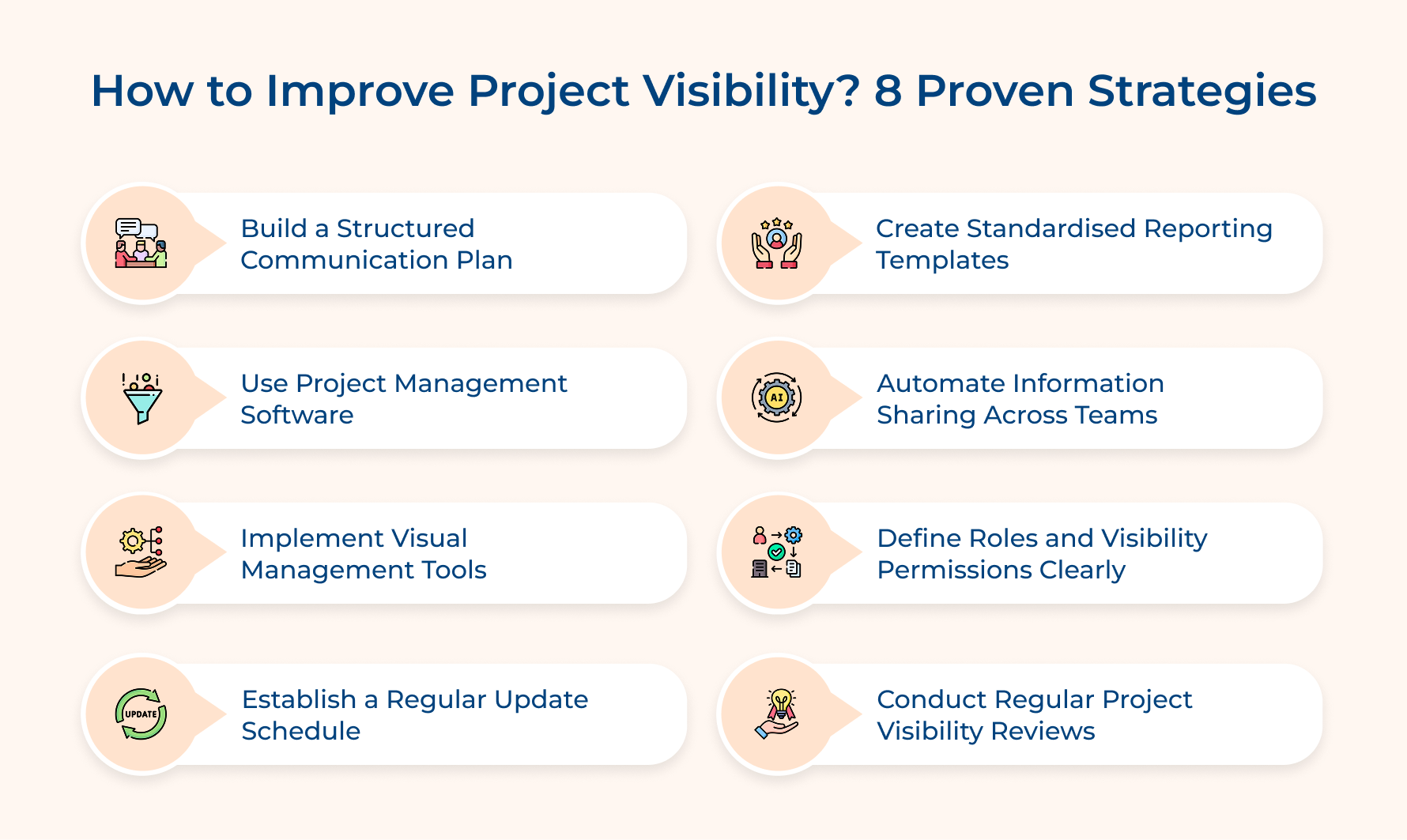
1. Build a Structured Communication Plan
Communication decides how information flows across your entire project, as without a defined plan, updates get missed and stakeholders end up getting frustrated.
Build a communication plan for better project visibility by:
- Defining stakeholder communication layers: Since every stakeholder needs different details, map out who needs what and personalise it so that updates stay relevant.
- Assign clear ownership for each channel: Assign members to each specific communication channel, so updates never fail due to assumed responsibility.
- Document escalation paths in advance: maintain a document with solutions defined in it and manage a crisis before it hits. Teams must know the follow-up of the notification and to keep visibility intact.
Consider a practical example, a project visibility where the project manager is running a SaaS product launch. The manager created separate update cadences for dev team and client. A proper standup update runs across the team while weekly summaries with the client, providing proper visibility.
2. Use Project Management Software
The right project management software is the single source of truth, keeping your entire team aligned. Visibility in project management becomes a seamless process when everyone works from the same platform.
See how to choose the right project management software for better visibility:
- Real-time visibility across all tasks: Tool should be capable of showing live task status without any manual updates from team members.
- Cross-team dependency tracking: choose software that maps task dependencies so that bottlenecks are visible early, before blocking delivery.
- Customisable dashboard and reporting views: The dashboard should be customizable in real time, as different stakeholders need different views.
Adaptation rate is what makes a tool successful in your system. It determines whether your project management visibility framework actually works. The best tool fits naturally into a setup in which teams already work.
Consider these use cases of the best software for improving real-time visibility:
- Milestone tracking: Automatically notify when a milestone is at risk with respect to current task progress and team capacity.
- Resource allocation view: Complete visualisation of over-allocation and redistribution of work before burnout affects delivery.
- Stakeholder reporting: Generate project visibility reports from real-time data without spending hours on manual work.
- Risk and blocker logs: Maintain a log of risks so nothing gets lost in email threads or chat messages.
3. Implement Visual Management Tools
The first question that comes to mind is, what are visual management tools? It eliminates the need for data interpretation. The status is immediately obvious right after someone views the board. This is why visual tools are key for improving visibility..
Before implementing visual management tools, consider this checklist:
- Are all active tasks and current status visible on the board?
- Is the board accessible to all team members?
- Are status indicators clearly defined across all projects?
- Does the layout reflect the workflow stages of the project?
This checklist makes sure your project visibility analysis does not start with misleading data. A board that is half-filled or creates more confusion for each team member.
So, how are visual tools used in a project visibility plan? Think of a Kanban board as a live status meeting that runs 24/7. Anyone can look at the board to track the status of every work stand without asking a single question.
Pro tips:
- Limit work-in-progress to prevent transformation bottlenecks from going invisible under task volume
- Review completed tasks every week to keep the board clean and current
4. Establish a Regular Update Schedule
An update schedule creates touchpoints where project visibility flows across teams, all teams in a defined rhythm. It manages updates reactively and problems are only identified after the window to fix them has passed.
Setting the Right Cadence Based on Project Complexity
Since every project doesn’t need daily standups, update frequency should match the risk level of the project. A high-frequency cadence used on a low-complexity project creates noise without adding any real value.
Running Standups That Actually Drive Visibility
A standup converts a status monologue, killing team engagement fast. Keep the format tight by including target achieved, what is progress and blocked to make sure every standup directly feeds into your project management visibility.
Aligning Update Formats With Stakeholder Expectations
Most internal teams need minor task-level updates while clients need high-level efforts. Build the separation into your schedule to keep communication relevant for each audience without overwhelming anyone.
5. Create Standardised Reporting Templates
Reporting inconsistency is the silent killer of project management visibility. Every team member manages reports differently and stakeholders decode updates differently than acting on them.
So what does a standardised reporting template actually contain?
At a minimum, it covers so that every report tells a complete story, regardless of who fills it in
- Current progress
- open risks
- active blockers.
Consider a situation when a project manager is handling multiple workstreams and rolls out a weekly template for all teams. The consolidated project visibility report lands stakeholders in the same format and sections with zero chasing.
A strong standardised reporting template looks like:
- Progress against milestones: track actual vs planned progress to get clear visibility without any interpretation needed.
- Risk and blocker section: A dedicated section for risks and blockers to make sure these never get hidden under positive updates.
- Next steps with owners: Every report closes based on defined next plan assigned to specific people, so accountability is aligned with the format.
6. Automate Information Sharing Across Teams
Think about situations when you spend a long time manually sending updates and following up on overdue tasks. All this time is being used for actual project work. Automation helps in streamlining these workflows, giving it a straight back.
Explore where automation creates the most impact in our visibility cycle:
- Trigger-based milestone alerts: The moment a milestone status changes, automated notifications are sent to relevant stakeholders without any human intervention.
- Scheduled report distribution: Project visibility gets auto-distributed, so leadership always has current information.
- Overdue task escalations: An automatic escalation is sent when a task reaches its threshold before it silently delays the next dependency.
The real value of automation is all about consistency. Manual information may fail under pressure, but automated workflows keep the visibility on your project with intact management even during chaos.
7. Define Roles and Visibility Permissions Clearly
A stakeholder with a full project board view gets overwhelmed by the task-level details and starts raising questions. Too much visibility is as bad as a little less for the wrong audience.
So, how do you define permissions without the entire setup? Merge stakeholders into the following tiers:
- full access for team members,
- Summary-level access and clients
- read-only access for external collaborators.
Pro tip: It is recommended to review as well as update permissions across major milestones because team composition and involvement shift as the project progresses.
Can this permission structure protect your project visibility framework:
- Data integrity: Limits edit access to make sure each project’s data stays updated only by people directly responsible.
- Stakeholder focus: Proper structure keeps the conversations strategic instead of getting pulled into operational noise.
- Audit trail clarity: real-time permission changes tracking and creates a clean record of resource planning during project escalations.
8. Conduct Regular Project Visibility Reviews
Teams that treat the review process after delivery practice face the visibility gaps and the damage is already done. A proper review during the ongoing project actually protects your delivery timeline.
What does a mid-project visibility actually look like? It is a structured audit of your entire flow. Verifying if updates reach the right people and alignment of your project visibility plan.
Below are examples of questions that can be used during every visibility review:
- Are your stakeholders receiving updates at the right frequency?
- Are there proper risks and blockers documented or just logged?
- Does the project visibility dashboard board reflect real-time status?
The findings are the direct inputs for refining project visibility analysis. It helps teams to spend less time because problems are caught before they compound. A strong visibility review always produces the following things:
- A gap log: A documented list of information flow, broken down in specific phases.
- An updated visibility plan: Revised communication frequencies that reflect the current state of the project.
- Assigned corrective actions: Specific fixes with defined ownership to ensure review findings transform into real improvements.
Best Practices for Sustaining High Project Visibility in Project Management
The best practices help you manage high visibility in project management, meaning you can reduce the burden on your team.
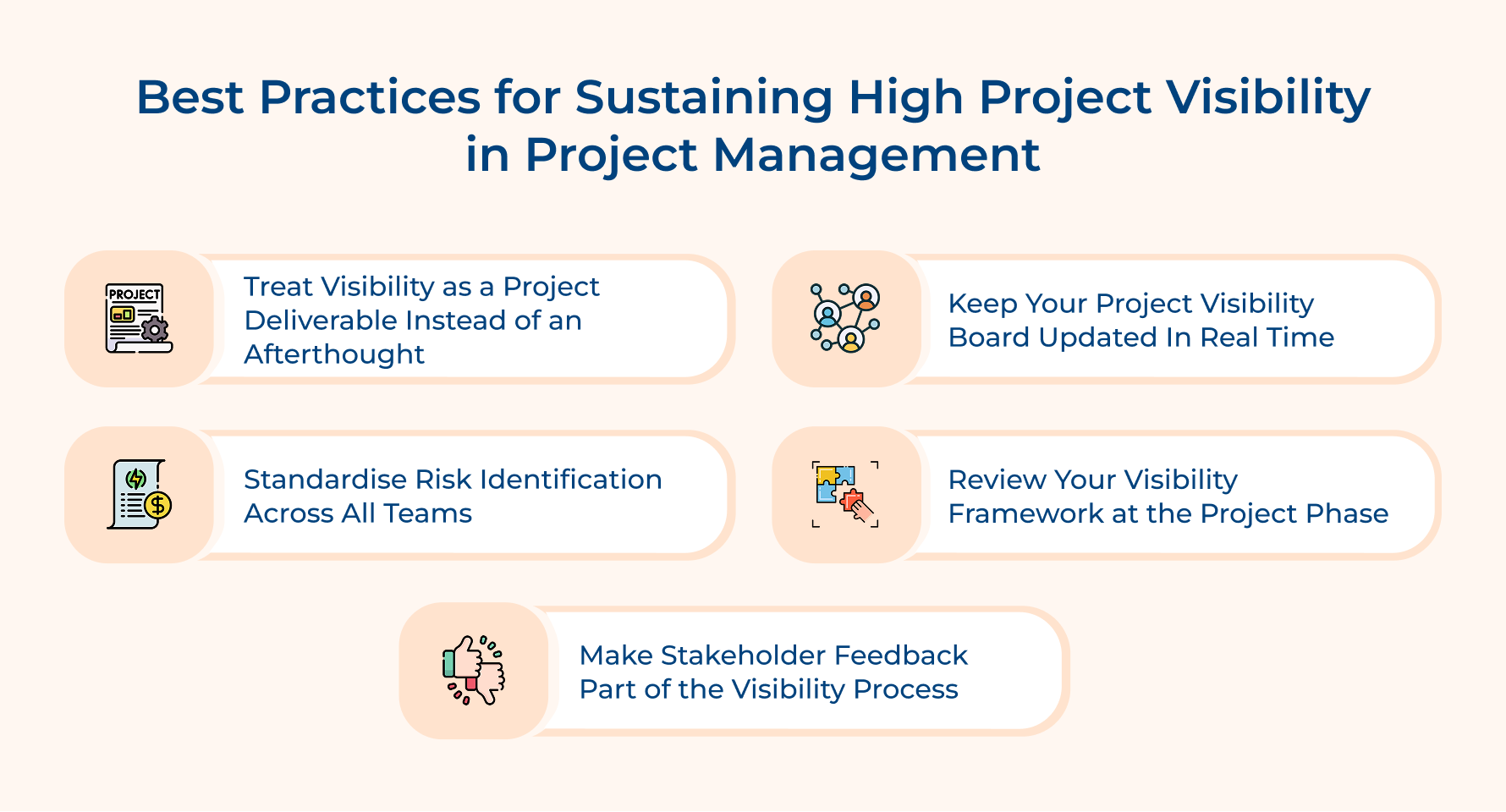
Treat Visibility as a Project Deliverable instead of an Afterthought: Build proper checkpoints into your project plan from the first. It gives the same priority as any core project deliverable.
- Keep your project visibility board updated in real time: A board view with even a one-day delay can create false confidence across the entire team. Allocate a dedicated owner to keep it in a continuous flow.
- Standardise risk identification across all teams: Maintain a common process across your team for identifying risks without exception. It makes sure nothing gets filtered out until it reaches the project manager.
- Review your visibility framework at the project phase: The process that might work in the planning phase rarely succeeds during execution. Revisiting and optimizing your framework is the best as the project evolves.
- Make stakeholder feedback part of the visibility process: Ask stakeholders if the updates are actually useful. Their feedback helps in identifying blind spots that are impossible to see within the project.
Examples of Project Visibility in Project Management
These examples of project management visibility include different aspects but share one common outcome for better decision-making and fewer mistakes in your own firms:.
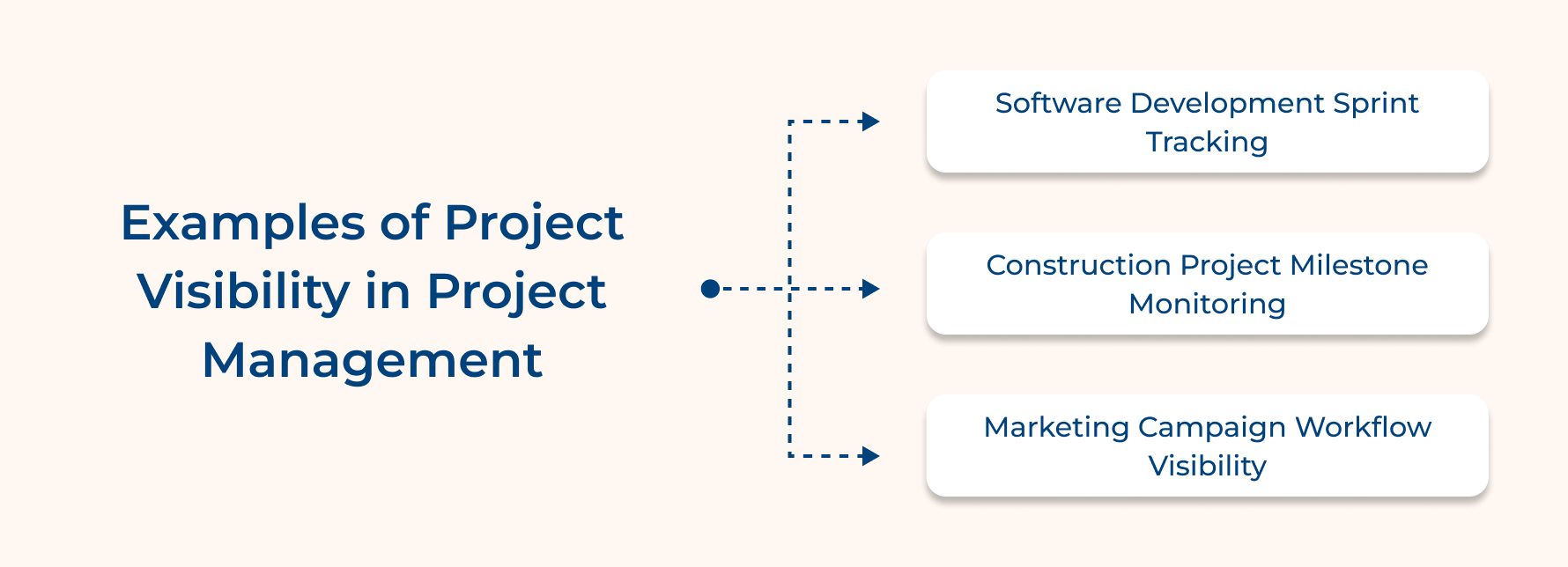
1. Software Development Sprint Tracking
Consider a development team using a Kanban board for tracking sprint progress, providing stakeholders a live view of project progress and blockers. It eliminates the need for status calls as the board answers every progress in real time.
2. Construction Project Milestone Monitoring
A large construction project has a visibility board against weekly milestones for the manager to track which workstreams are on schedule. Situation when the concrete pour gets delayed, the downstream impact on plumbing work is immediately visible, allowing schedule adjustments.
3. Marketing Campaign Workflow Visibility
A marketing team running a product launch by using multiple channels, combining with shared project visibility analysis to track content approvals, asset delivery and go-live dates all in one centralised place. In situations when a design asset gets delayed, the manager can see which dependent tasks are at risk before affecting the launch date.
Track Unseen Project risk with Clear Project Visibility.
Project visibility is the operational foundation determining whether your project succeeds or quietly fails. Bad visualization leads to slow decision making and problems compound faster which makes any team hard to recover.
- A strong project visibility plan is not only task status but also includes communication, risk documentation, resource tracking and reporting.
- Sustainable project visibility needs consistent frameworks, reviews and feedback built into the process.
- The right tools with automation workflows remove the manual burden to keep visibility intact.
Ready to take the next step? Start auditing your current gaps using the strategies and checklist. Pick one weak area and fix the process around it. Teams maintaining clear project management visibility build a system that makes future projects smarter to execute.
Limit time — not creativity
Everything you need for customer support, marketing & sales.

Neeti Singh is a passionate content writer at Kooper, where he transforms complex concepts into clear, engaging and actionable content. With a keen eye for detail and a love for technology, Tushar Joshi crafts blog posts, guides and articles that help readers navigate the fast-evolving world of software solutions.