Sales to Customer Success Handoff: What it is & How to Create One
- What Is Sales to Customer Success Handoff?
- What is Sales to CS Handoff Important For Modern Business?
- 7 Steps of the Sales to Customer Success Handoff Process
- What Should Be Included in a Sales to CS Handoff Document?
- Common Sales to CS Handoffs Challenges & How to Overcome
- How to Improve the Sales to CS Handoff: Best Practices
- Tools for Managing Sales to Customer Success Handoff Process
- Handoff from Sales Is the Promise You Make as a CS Team
- FAQs about Sales to Customer Success Handoff

Key Highlights:
- Sales to customer success handoff transfers a closed customer to the CS team along with every goal and commitment made during sales.
- A good onboarding quality directly depends on customer renewal, making the handoff process the foundation of long-term retention.
- Transform handoff from formality to retention strategy by deep-dive information gathering, structured kickoff meetings and post-handoff feedback loops.
Think, suppose you have closed the deal, but that doesn’t mean it’s a win. The real work starts now.
The steps involved in the next 48 hours determine if your customer becomes a long-term account or quietly churns.
74% of customers’ renewal directly involves the quality of the onboarding. That window opens the moment the contract is signed and it’s the sales to CS handoff that sets up the foundation.
Explore what the sales to customer success handoff means and how to build one that works every time. It also covers the documentation and the best practices your team needs to know for stopping customer churn.
What Is Sales to Customer Success Handoff?
The sales to customer success handoff is the process of transferring a closed customer from the sales team to the customer success team, followed by all the context, expectations and commitments offered during the sales cycle. It acts as a bridge between a customer saying “yes” and what they are actually experiencing based on the promise.
A proper handoff helps CSM walk in already knowing the customer’s goals and what was sold to them. Customers do not need to repeat themselves, leading to an increased relationship where the sales conversation left off.
How does the sales to CS handoff affect the CX? Smooth transition makes customers feel like they made the right decision, but when it breaks, the first 30 days become a damage-control session instead of a value-driven.
Types of Sales to Customer Success Handoff:
- Warm handoff: The sales rep introduces CS to the customer through a meeting before stepping out of the account.
- Document-based handoff: The sales rep fills out a structured document that includes deal context, customer goals and that CSM uses to take ownership.
- Automated handoff: CRM triggers automatic notification of the CS team and populates account data once a sales deal is closed to reduce manual steps in the handoff process.
- Phased handoff: Sales and CS collaborate on the account together for some period before full transition used in consultancies.
- Silent handoff: The CSM manages the account through internal notes with no direct introduction, making it the weakest approach to friction.
What is Sales to CS Handoff Important For Modern Business?
A good handoff process is the foundation on which customer retention and long-term trust are built.
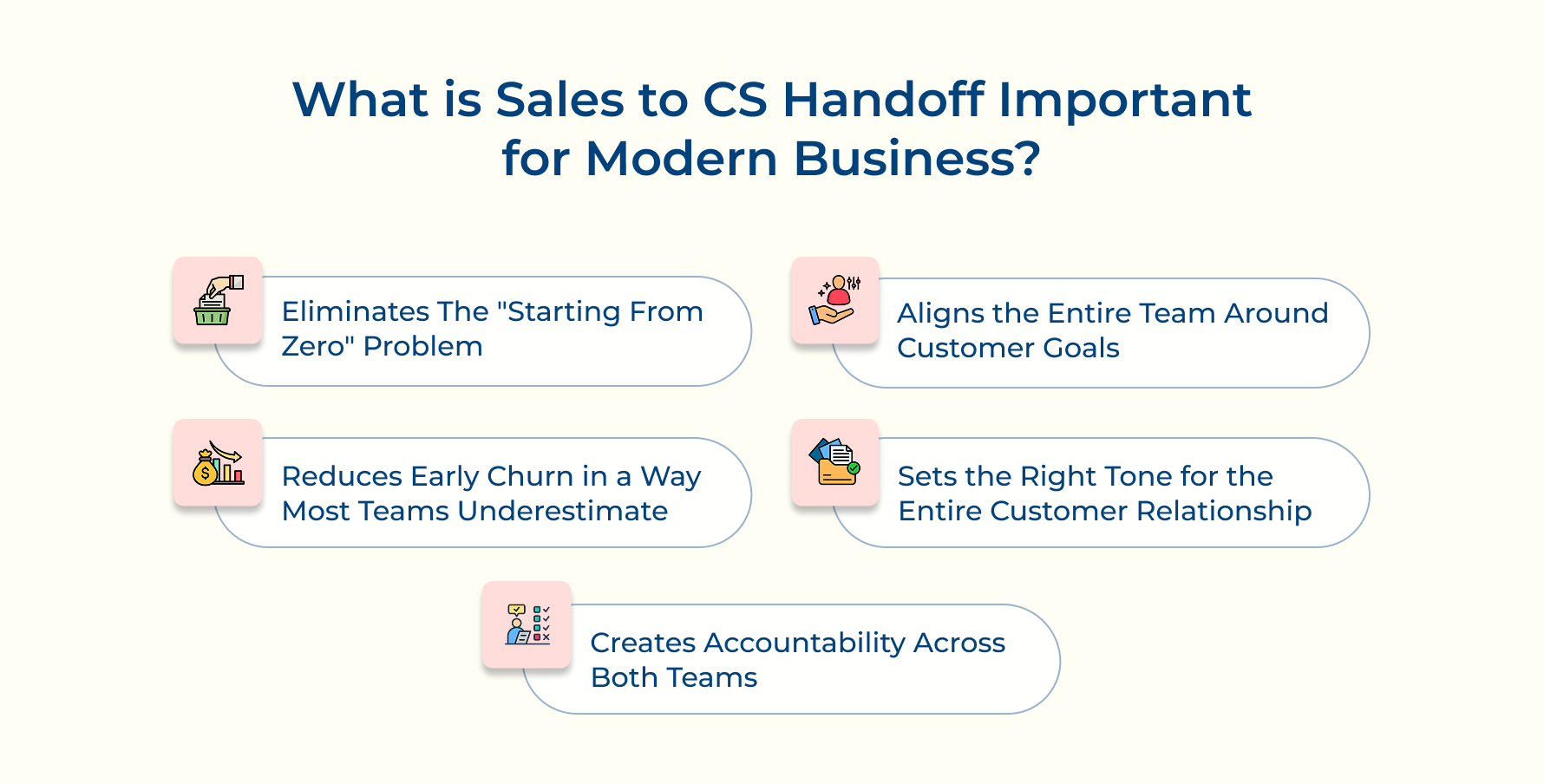
1. Eliminates the “Starting From Zero” Problem
A proper transition from sales to CS helps them to already know the commitment and where the client information is available. The customer never has to explain their business problem, saving the relationship at the most fragile stage.
2. Aligns the Entire Team Around Customer Goals
A structured workflow forces both teams to agree on the commitment for each account before handoff. The CS team can deliver on the exact promise sales made with a clear picture of customer success metrics,
3. Reduces Early Churn in a Way Most Teams Underestimate
A good sales to customer handoff process in professional services firms helps to identify gaps quickly after a deal closes. Remember the most customer churn in the first 90 days is a handoff problem that nobody wants to own.
4. Sets the Right Tone for the Entire Customer Relationship
The first interaction a customer has with CSM heavily depends on how well the context is handed off. If the success team appears informed as well as prepared, the customer feels valued, and their first impression tends to retention.
5. Creates Accountability Across Both Teams
Both teams have clear ownership of responsibilities from the first day, when there is a well-defined process. A structured sales to customer success-focused handoff in consultancies prevents the internal blame game, as everyone appears on the same page when handed over.
7 Steps of the Sales to Customer Success Handoff Process
Your team can improve customer experience, reduce churn rates, and drive growth by implementing the following seven essential steps:
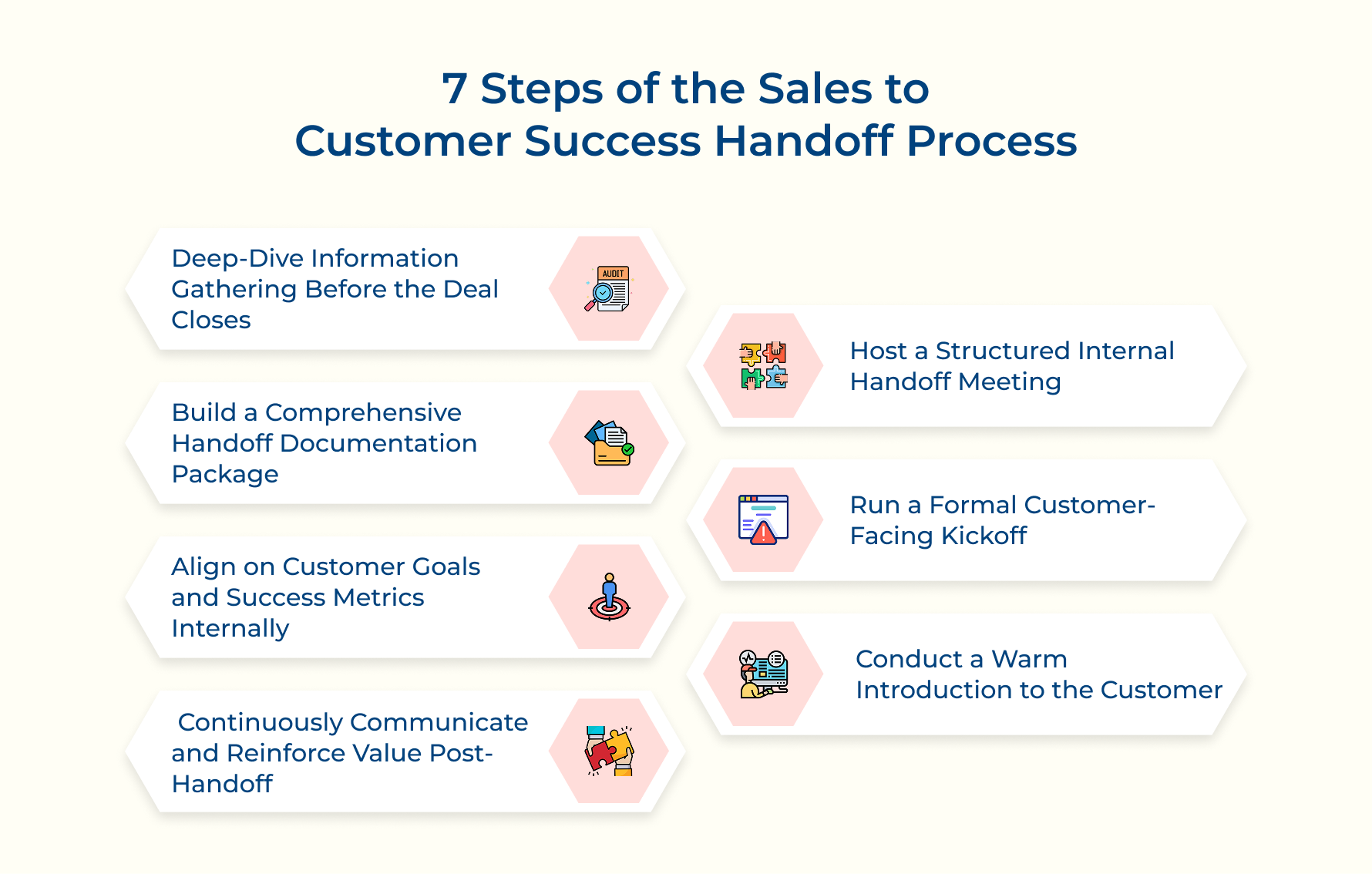
1. Deep-Dive Information Gathering Before the Deal Closes
Information gathering is the intelligence layer that defines the entire sales to CS handoff. It does not start on assumptions or guesswork. The information you provide directly shapes the customer interaction with the success team going forward.
Consider this question checklist to start your deep dive:
- What specific pain led this customer to buy?
- What exact outcomes does your sales team commit?
- What are the key stakeholders and what responsibilities do each carry?
The checklist forces the sales team to identify the context. These are the stuff that stayed in call recordings and informal conversations but never made it to the CRM. Considering this step as part of the sales-to-customer success handoff, meaning proper information gathering rather than a non-negotiable part of closing.
Pro Tips:
- Document all discovery and closing calls to make them accessible to CSM before the meeting
- Create a pre-close checklist inside CRM, so the sales team cannot close a deal-won without achieving it
2. Build a Comprehensive Handoff Documentation Package
Now, what transforms every gathered piece of information into a single source of truth? A documentation package works best as, without it, critical context lives in people’s heads.
Consider these effective methods to build a handoff documentation package:
- Standardized handoff template: Use a pre-defined template for every sales rep to use after every closed deal. It includes customer background information, goals, scope and any commitment made during the sales cycle.
- Risk and red flag log: Set a dedicated benchmark in your documentation for anything that felt behind the threshold in the sales process. Such as pricing pushback, unrealistic timelines or a champion who went near the close.
- Stakeholder map: Document every key contact on the customer side, along with their key role and level of influence. It helps CSM to understand the prioritization points and engage them.
So, what does poor documentation cost you? The first 30 days were spent gathering information that had already been handed over.
This sales-to-customer success handoff looks like a project brief in a professional services firm that includes a signed SOW, the client’s stated success criteria and any clarifications that happened during negotiation.
3. Align on Customer Goals and Success Metrics Internally
Here sales to customer success handoff process moves to strategic alignment to make sure both teams are actively building around them. CS inherits an account without an alignment, which leads to an unclear direction to move in.
Define the look of customer success with one direct question: What is the buying intent of the customer? Define the concept concretely before the handoff:
- Reduced time-to-value: Customer achieves their meaningful outcome within 30 days of onboarding
- Adoption milestone hit: Users are using the product or service during the sales process
- Stakeholder satisfaction confirmed: The primary champion validates that delivery matches as promised during the sale
Based on goals, should you also tie KPIs to customer outcomes at this stage? What KPIs should be used? It solely depends on what the customer said they would measure success by, what the product is capable of delivering and a realistic scope within the first 90 days.
- Time-to-first-value
- Product adoption rate
- Stakeholder engagement score
- Onboarding completion rate
As a final process, define key milestones to give both CSM and the customer success team a shared roadmap. It provides every interaction with a clear purpose from the first.
4. Host a Structured Internal Handoff Meeting
The internal handoff is all about the sales team transferring the documentation and alignment work, along with ownership to CS, with complete clarity.
Sales Walks CS Through the Full Account Context
It is a structured walkthrough where the sales rep takes the CSM through the customer’s background, the problem they were solving and the commitment set along the way. The success team also ask questions while the sales rep shares insights
Document Action Items With Deadlines and Owners
Internal handoff meeting completed with a written summary discussion, what needs to happen next and who is the owner for each item. This is the mechanism that keeps the momentum from the sales cycle seamless during the transition.
5. Conduct a Warm Introduction to the Customer
The warm introduction is the first touchpoint for customers with your success team beyond the sales relationship. A structured sales to CS warm handoff separates businesses that retain customers from those looking to recover them.
Sales introducing the CSM is more than a courtesy. Things to get right before starting the introduction:
- Has the CSM been fully briefed and confident about the account context?
- Is the introduction structured as a positive progression instead of a sales exit?
- Are the right channels selected for the meeting?
- Does the introduction communicate the role?
This checklist ensures that the introduction feels less like a handover and more like the beginning of a dedicated relationship. It makes customers confident about their decision.
Pro Tips:
- Design an introduction email together by making sales write it, but CS reviews it to set the right agenda
- Always include the CSM’s direct contact details so there is zero ambiguity about the next step.
6. Run a Formal Customer-Facing Kickoff
This is the official moment where the CSM takes the lead. It determines if the client feels comfortable that they are in expert hands or is already questioning their decision.
Make your customer-facing kickoff meeting effective with:
- Goals and expectations reset: Open the kickoff by recapping customer expectations to immediately signal that you were listening across the entire process.
- Onboarding plan walkthrough: Walk the customer through a milestone-based plan that directly leads to the goals. Maintaining an unstructured timeline at this stage causes customers to disengage from getting started.
- Success metrics sign-off: Get the customer to agree on how you are going to measure success before the meeting ends. This gives the customer success manager a clear benchmark to work from.
The customer fills the vacuum with their own assumptions when you skip the kickoff and jump into delivery. The guesswork is always misaligned with your team’s plan.
7. Continuously Communicate and Reinforce Value Post-Handoff
Post-sales CS handoff communication is to keep the customer engaged and remind them of their decision. It does not end at the kickoff but also evolves into a structured pattern that sustains the relationship.
Follow these moments where early value communication makes an impact:
- First milestone achieved: Send a summary of accomplishments and connect it directly to the customer’s goal defined during the sales conversation.
- Positive usage signal detected: situation key stakeholder engages, calls it out and ties it back to the outcome they are chasing.
- 30-day check-in: provide a progress summary based on the success metrics agreed upon and not just a generic response to a “how is everything going” conversation.
Apart from this, build a regular cadence of value-driven touchpoints to schedule proactive communication instead of waiting for inbound. The team that shows up consistently with relevant insights is the one whose customers never churn.
What Should Be Included in a Sales to CS Handoff Document?
Explore what exactly is needed to be in it to make the sales to CSM handoff genuinely actionable.
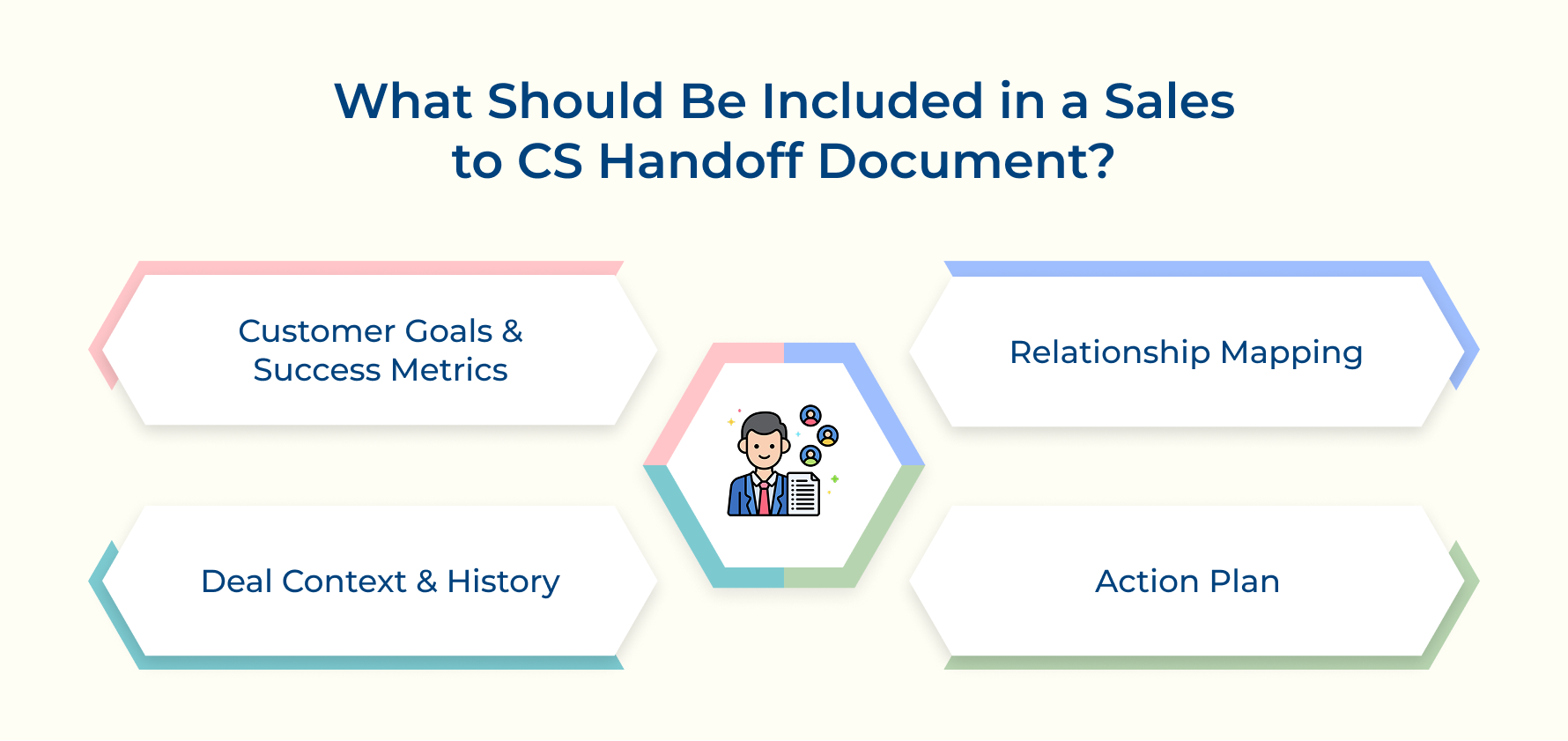
1. Customer Goals and Success Metrics
Define what the customer scope and what their expectation is to see delivered. This helps CSM to essentially set what success looks like for the account.
What does this section capture?
- Primary business objective: The single most important outcome that the customer is trying to achieve.
- Measurable success metrics: The specific milestones the customer will use to evaluate.
2. Deal Context and History
The deal context section includes the full story behind the account. It is not only about what was sold but also what the customer bought. A customer success team with this context walks into every conversation already moving ahead.
3. Relationship Mapping
Relationship mapping helps the success team navigate the customer’s internal politics and identify who drives decisions with respect to who attends meetings.
What a strong relationship map includes is the champion economic buyer, along with Key stakeholders and their priorities that they personally care about in their preferred communication style.
4. Action Plan
The action plan converts the handoff document from a reference file into a guide that CSM can execute. An unclear action plan in professional services firms, especially causes the first 30 days to feel chaotic for both the team as well as customers to settle.
Common Sales to CS Handoffs Challenges & How to Overcome
The four challenges come up most often and exactly how to fix them for seamless sales to Customer success handoff.
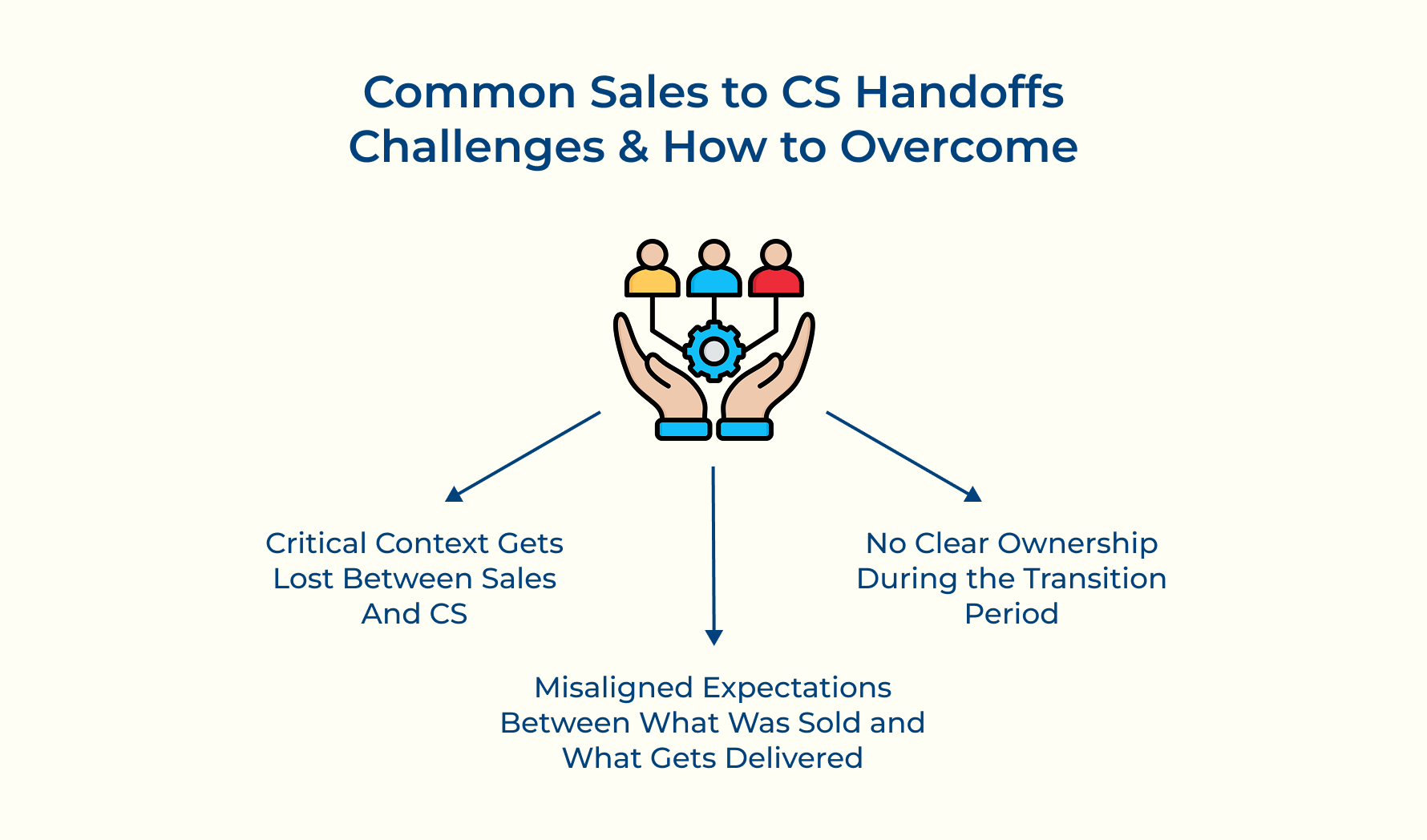
1. Critical Context Gets Lost Between Sales and CS
Sales have months of relationship stored in their heads, but during hand-off, most of that context never transfers to CSM. It ends up the customer repeating themselves and CSM also needs to spend time catching up instead of delivering value.
2. Misaligned Expectations Between What Was Sold and What Gets Delivered
Expectation misalignment drives the earliest churn, which is almost always a symptom of a broken sales to CS handoff process instead of delivery failure. The customer’s disappointment is inevitable when sales overpromises to close a deal, while CS inherits those commitments without understanding.
3. No Clear Ownership During the Transition Period
The gap between sales closing and CS taking over is where accounts are vulnerable. In agencies and consultancies, ownership ambiguity can stretch the Sales-to-customer success handoff, leaving the customer without a clear point of contact.
Consider these solutions that actually work when you commit to solving each one properly.
- Build a pre-close information checklist for the sales team to complete before closing the deal won in the CRM.
- Create an expectations document during the sales cycle for both sales and CS to sign off on before the customer kickoff.
- Set a clear ownership date in every sales to customer success handoff process to avoid any grey area about who the customer should talk to.
- Treat the handoff with structured touchpoints instead of a single meeting that both teams walk away from, assuming the other has covered.
How to Improve the Sales to CS Handoff: Best Practices
These best practices separate teams that occasionally get it right from those getting right every single time.
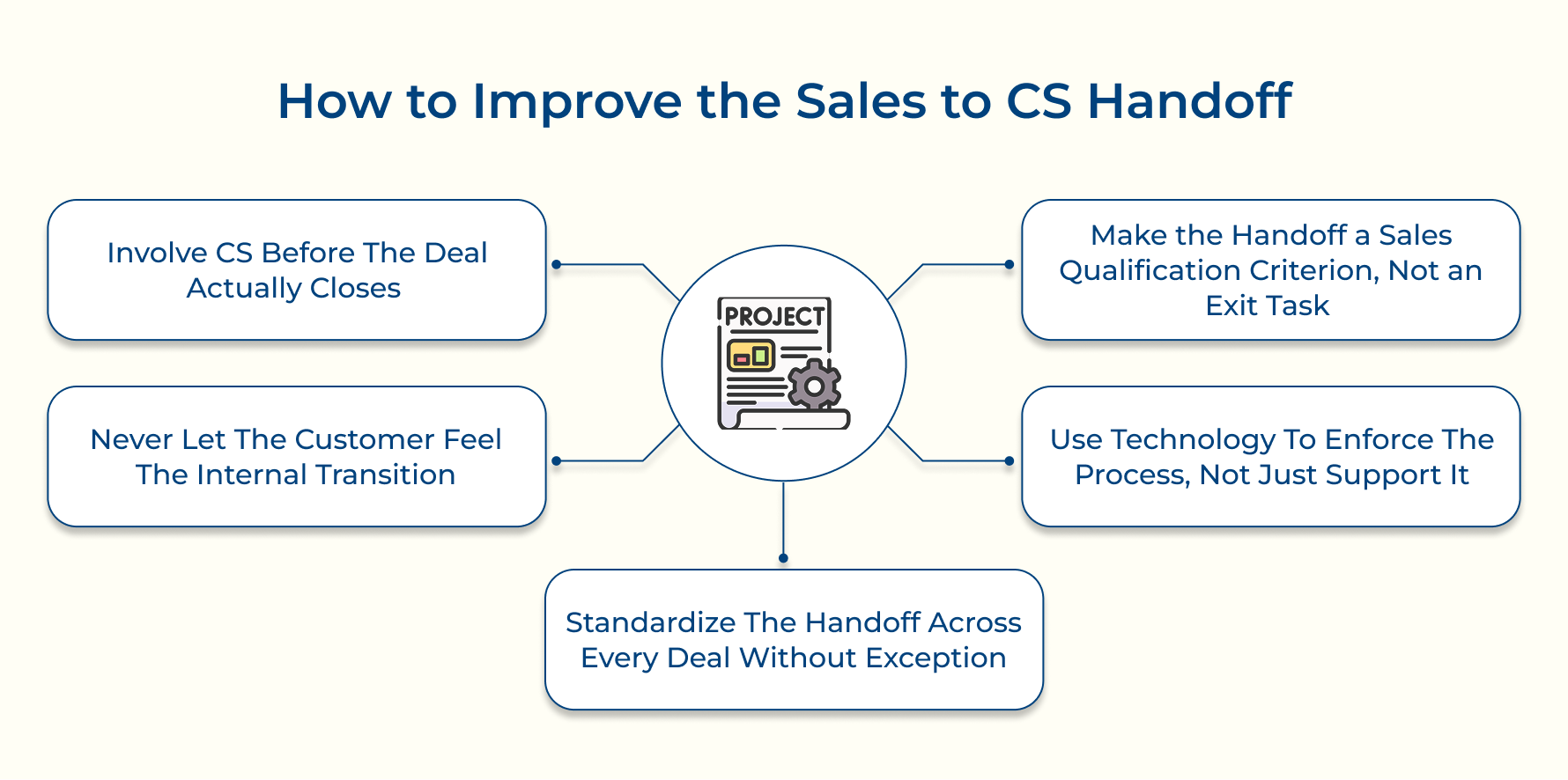
1. Make the Handoff a Sales Qualification Criterion, Not an Exit Task
Treat handoff readiness as part of the evaluation process of a deal’s close instead of considering it after the contract is signed. It leads to improved quality automatically across every account.
2. Involve CS Before the Deal Actually Closes
Bring the customer success team in the final stages of the sales cycle to provide them with context that no document can capture. It also tells customers their success is already planned before sign-up.
3. Never Let the Customer Feel the Internal Transition
The sales to customer success transition is invisible to the customer. They should feel it as a continuity instead of a handover. Every introduction, communication and first interaction needs to reinforce the same level of care experienced in sales.
4. Standardize the Handoff Across Every Deal Without Exception
A handoff that applies to complex deals is not a process; instead, it is a preference. Standardize the sales to CS handoff across each deal to make sure no customer falls through the cracks, regardless of the deal size.
5. Use Technology to Enforce the Process, Not Just Support It
CRM workflows, automated alerts and handoff templates are the key tools that you must to genuinely configure. These technologies in professional services and agencies streamline the sales handoff process, which remains consistent even when teams are stretched across multiple accounts.
Tools for Managing Sales to Customer Success Handoff Process
Consider these four tools every team should evaluate when running a structured sales to CS handoff process.
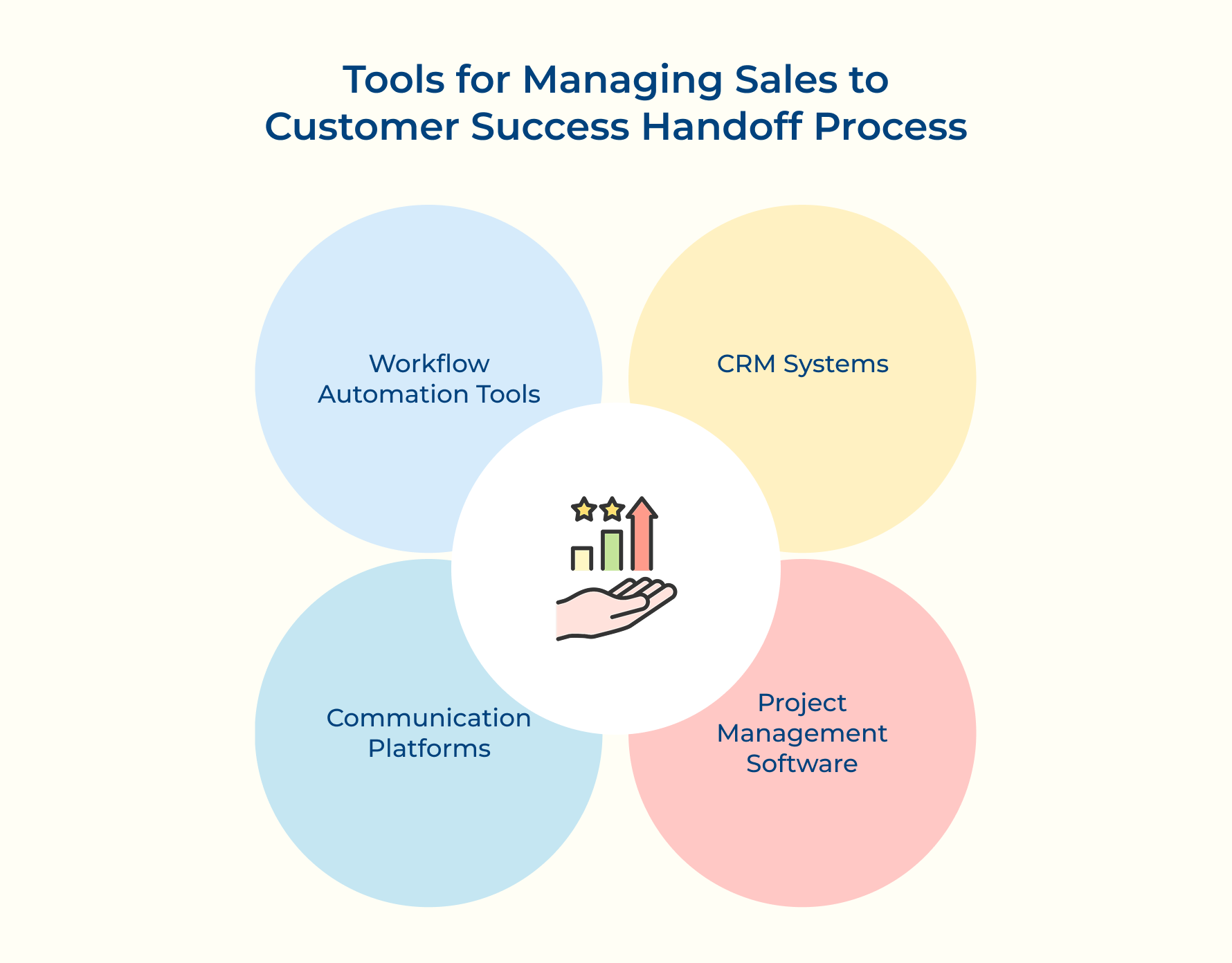
1. CRM Systems
A CRM is where deal context, customer history and documentation are all stored in one accessible place. The customer success team used to inherit a complete view of account details the moment ownership transferred from sales.
2. Project Management Software
Project management tools give a structured way to execute the action plan. They turn documentation into tasks with deadlines and owners to make sure nothing falls through the cracks during handoff.
3. Communication Platforms
A dedicated communication platform makes sure sales, CS and customers stay aligned without losing critical content in email threads. It keeps the sales to customer success handoff feeling seamless from the customer’s perspective in agencies and consultancies
4. Workflow Automation Tools
Automation tools take a well-defined sales to CSM handoff process that triggers notifications and populates templates without manual efforts. The quality of handoff stops depends on how organized a sales rep is.
Handoff from Sales Is the Promise You Make as a CS Team
Don’t think sales to customer success handoff is a formality. It is the moment where your retention either starts or breaks. Every closed deal deserves a transition as strong as the pitch that won it.
- A handoff without documentation just creates confusion, misaligned expectations and early churn.
- The best CS teams treat handoff as a strategic process with defined steps and success metrics
- The real foundation is a culture where sales and CS are jointly accountable for the customer’s outcome from the first
Ready to build a handoff process that your customers actually feel? Use the best sales to CS handoff template and checklist to give every new customer the start they deserve.
Limit time — not creativity
Everything you need for customer support, marketing & sales.

Neeti Singh is a passionate content writer at Kooper, where he transforms complex concepts into clear, engaging and actionable content. With a keen eye for detail and a love for technology, Tushar Joshi crafts blog posts, guides and articles that help readers navigate the fast-evolving world of software solutions.