9 Best Customer Onboarding Benefits for Retention & Growth
Key Highlights:
- Reduced churn rate, faster time-to-value and stronger product adoption are some benefits of customer onboarding.
- Businesses with structured onboarding programs gain 82% higher retention in comparison to those running without a defined process.
- Early trust building improves NPS and referral generation with ROI tracking, making onboarding a revenue driver.
Ever wondered why some businesses retain 90% of customers while others have struggled for the past three months? Because retention is an onboarding problem that most teams don’t catch until churn.
Companies with structured onboarding programs get up to 82% higher customer retention in comparison to those without a defined process. Explore the core customer onboarding benefits that impact retention, product adoption and long-term revenue growth. It focuses on what actually needs to be done to scale your growing businesses.
What is Customer Onboarding?
Customer onboarding is a structured process to guide new customers from sign-up to their first meaningful outcome. It includes everything from initial setup to product adaptation and the moment a customer is confident.
So, is onboarding similar across all industries? No, for a SaaS company, onboarding means educating users about the benefit of the service they subscribe to until they meet the first “aha moment”. It is the touchpoint where they genuinely see the value.
B2B firms and service-based businesses take onboarding even further. A missed step in the adaptation journey not only confuses but also directly affects retention rate and long-term revenue.
Key objectives:
- Value delivery: Make customers experience the product’s core benefit with onboarding.
- Expectation alignment: Make sure customers clearly understand the product’s use cases and features.
- Engagement building: Clear strategies to enhance customer retention and revenue.
- Churn reduction: Identify and resolve friction points before escalating into a cancellation reason
- Relationship foundation: Build trust and communication channels that support long-term business success
9 Benefits of Client Onboarding for Retention and Acquisition
Explore these compelling benefits of client onboarding that can help boost your business’s retention and customer acquisition.
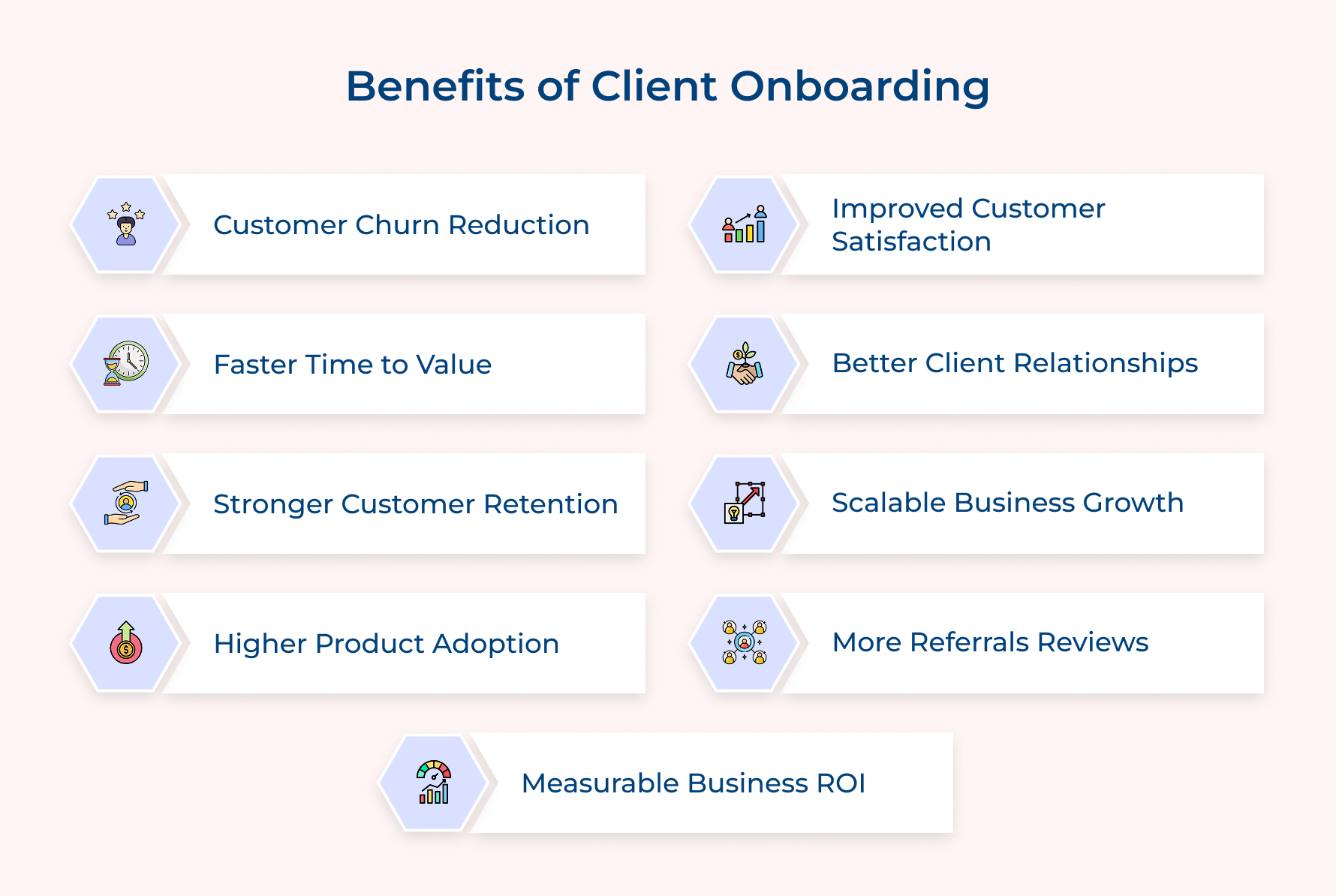
1. Reduces Customer Churn Before It Even Starts
Many businesses treat churn as a renewal problem, so real-time data shows leaving decisions are made much earlier than cancellation date. The first 30 days are the crucial time when customer confidence is built.
A structured onboarding process creates early intervention that catches disengagement before transforming into a churn decision. So, look for these early gaps that silently damage retention:
- No clear starting point: Customers start using the product without knowing the next step.
- Feature overload: Complex process creates decision fatigue and inaction
- Delayed first value: Lengthy setup flow processes push the onboarding completion process far out.
Progress feels tangible and personal when milestones are tied to specific customer goals. It keeps a new user engaged enough to become a loyal customer.
Below are the warning signs of an onboarding process loss retention:
- Customers completed the sign-up process but never returned after the first day.
- High ticket volume within the first few weeks of basic setup means an early exit
2. Accelerates Time-to-Value for New Customers
Time-to-value identifies the gap between a customer signing up and their first experience of a meaningful outcome. A higher gap means risk of losing increases before the customer even understands use cases of the product or service.
So here’s what most teams do wrong? They design the onboard around the features instead of customer goals. A customer doesn’t need every functionality first. They want to solve their most important pain point.
Consider asking these questions before designing the flow:
- What is the most important outcome a customer needs in the first week?
- Are there steps in the current flow which are time consuming without adding value?
This is where benefits of customer onboarding software come in place to remove the friction that slows customers on their path to value.
- Behavior-triggered guidance
- role-based flows
- automated milestone tracking.
3. Builds a Strong Foundation for Customer Retention
A common misconception among most businesses is that retention is a renewal-stage problem. No, in reality, a user who churns at month six had mentally made a decision in the third week when onboarding feels unsupported.
So why do well-built products still lose customers? It is due to the lack of differentiation of product quality and customer experience. Both are entirely different aspects. Onboarding is just a bridge that covers the gap between product features and customer goals.
A retention-focused onboarding framework should include:
- Shared success plan: designed based on the customer’s goals to define what success looks like.
- Milestone-based check-ins: Schedule conversations around product progress in real time,
- Risk identification: Track accounts that show low engagement within the first 2 weeks.
One of the simple customer onboarding benefits examples is how Slack delayed monetization until teams do 2,000 messages. They know that retaining users is more valuable than starting an early upsell conversation.
4. Drives Product Adoption Across the Entire User Base
Product sign-up and product adoption are two very different milestones. Most SaaS businesses lose revenue between this gap quietly. Customer onboarding flow is the mechanism that provides the benefit of closing that gap by introducing features instead of overwhelming users.
Poor adoption rate kills the upsell opportunity. A customer using 20% of a platform will never get the confidence to expand their contract for the product internally.
Consider these tactics that move customers toward a deeper adoption process:
- Contextual feature introduction: Identify new capabilities when the customer’s behavior signals are ready
- Use-case specific paths: Build personalized onboarding journeys for different customer profiles and industries
- Adoption milestones: Set specific usage benchmarks that signal growing product depth
The benefits of a customer onboarding platform are most measurable. Tools such as Pendo or Appcues give teams a clear visualization of exact drop-off, making it possible to streamline adoption gaps with precision.
5. Improves NPS and Customer Satisfaction Scores
Customer satisfaction score in the early stage is driven by how confident and supported a customer feels while using the product. User onboarding provides the benefit of directly shaping confidence and replacing it with clear progress.
A common pattern that repeats across most B2B businesses is a structured onboarding, which measurably increases NPS scores in a two-week window. Things that move satisfaction scores during onboarding:
- Personalized experience: Reflects the customer’s specific industry and goals, feels intentional.
- Proactive communication: Reach out to clients before problems arise, and the team is invested in their success
- Quick win design: Early milestones around achievable outcomes create immediate sentiment
So does personalization increase NPS numbers? Yes, it’s one of the most underutilized benefits of user onboarding where customers feel seen, which significantly improves their experience.
6. Strengthens Communication and Relationship Building
The highest-attention window in the customer relationship is the onboarding period. Customers pay close attention to the team’s responsiveness and impressions that set the tone of every interaction.
Below are some communication habits that lead to long-term relationships:
- Structured kickoff calls: Align with the customer’s goals and document next-step plan
- Single point of contact: Eliminate customers’ frustration of repeating the same context to multiple team members
- Feedback loops: Collect feedback after each milestone to make it feel like an active participant.
This is one of the core benefits of client onboarding that automation cannot replace. Scaled communication tools can manage it, but the human moments added in the flow create an emotional connection that drives loyalty.
7. Supports Scalable Business Growth Through Automation
Customer success scaling based on team headcount and customer growth is neither sustainable nor financially stable for businesses. Automated onboarding works as a charm here by shifting it from being a nice-to-have to a core performance requirement.
The real benefits of customer onboarding software at scale are about consistency. It provided the same quality of onboarding experience to each customer, regardless of team bandwidth, time zone, or account size.
Consider these areas where automation provides the most value in the onboarding process:
- Behavior-triggered sequences: Communication based on customer behavior instead of fixed calendar dates
- Automated escalation alerts: Real-time notification the moment engagement drops below a threshold
- Self-serve resource delivery: the right help content reaches customers at the right time when needed.
The goal of automation implementation is to remove humans from the parts of onboarding that don’t require. Automation handles the repetition so that the team focuses on complexity.
Business outcome after building automation:
- Onboarding completion rates increase as no follow-ups are missed through the cracks
- CSM capacity expands without increasing headcount for teams to manage more accounts
- Automated systems capture milestone data consistently to make reporting more accurate.
8. Boosts Customer Acquisition Through Referrals and Reviews
Most of the growing teams treat onboarding as a post-sale function, but customer experience is the strongest acquisition asset a business can build. Referrals and reviews are direct factors for buyer decisions, which develop from a good onboarding window.
80% of B2B buyers perform in-depth reviews for shortlisting the right software to achieve the core benefits of customer onboarding. Review is not done for the product, but rather how they measure how the onboarding process feels.
Here’s how a strong experience feeds acquisition:
- Review generation: Customers’ responses during peak moments leave higher-quality and more specific reviews
- Case study pipeline: Accounts with clear onboarding success metrics help with proper case study conversations
- Referral activation: Customers refer others when they feel an onboarding experience.
One of the advantages of onboarding users in your product is revenue. Consider a situation where the customer success and marketing teams align on success stories. Onboarding makes the acquisition funnel stronger without increasing costs, leading to a boost in revenue.
9. Delivers Measurable Business Performance and ROI
Every onboarding investment needs to be synced with a business outcome to make it easily trackable. So what is the most difficult thing teams face? It is about measuring the impact of onboarding in the wrong way that ties to revenue and retention performance.
Tracking onboarding ROI is all about going beyond completion rates to looking at the downstream. Look for the onboarding completion to predict 12-month retention at a statistically meaningful rate or not.
Metrics that connect onboarding to business performance:
- Time-to-first-value by segment: Reveals onboarding customization based on customer types.
- Onboarding completion vs. 90-day retention correlation: The direct retention value of finishing the adoption journey
- Feature adoption depth at 60 days: Indicates whether onboarding is building engaged users or surface-level ones
The importance becomes a point of conversation for customers onboarding when these numbers are tracked consistently. Invest in a positive adaptation flow to improve 20 to 30 percent improvements in early-stage retention. It scales the revenue impact across your business.
5 Roles of Client Onboarding in Customer Retention
Customer retention is a direct result of building a well-structured onboarding process that sets up long-term success.
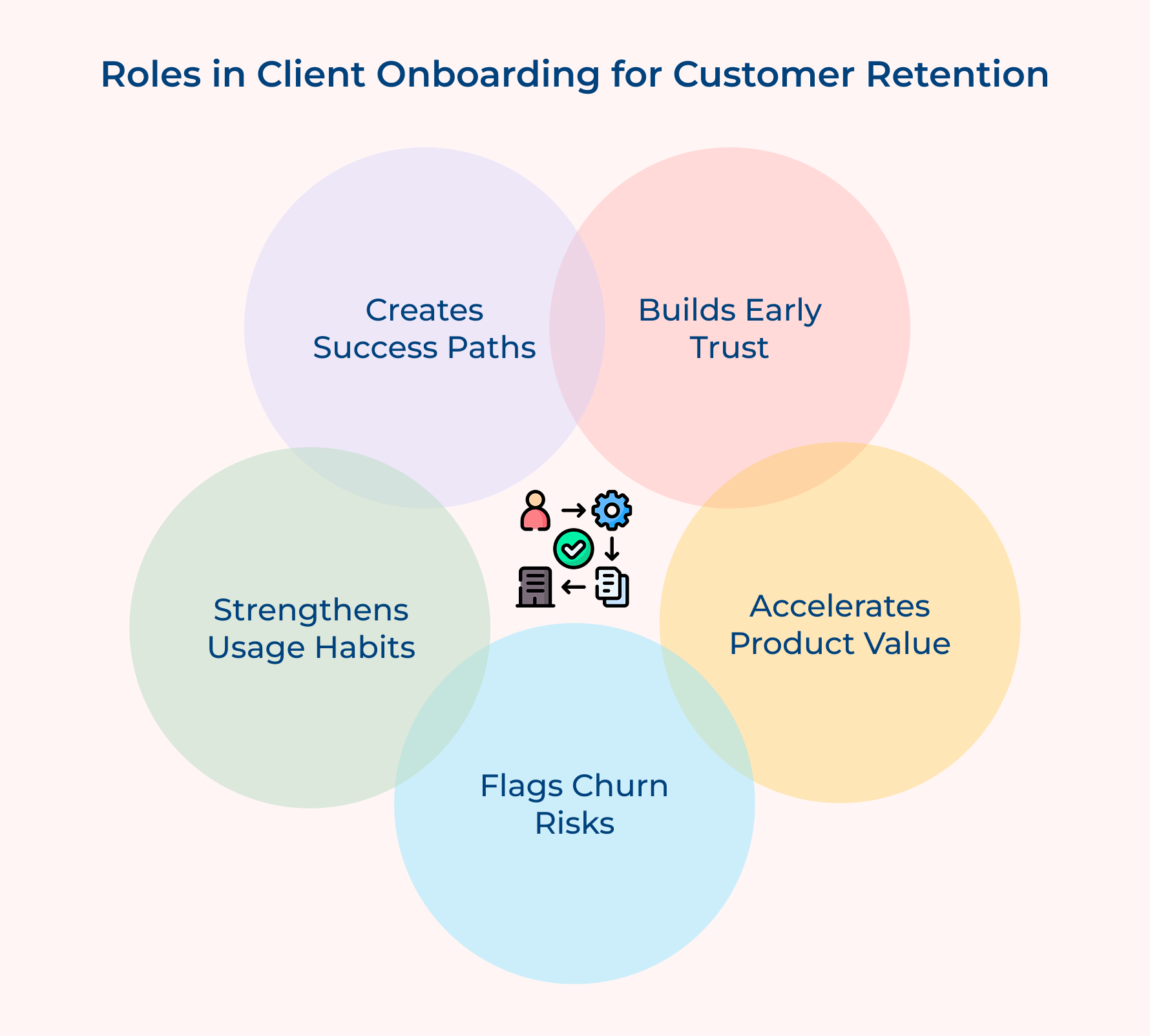
1. Establishes Early Trust and Confidence
Think of a situation where a customer feels guided and supported in the first 2 weeks, develops a trust that no marketing campaign can generate. It becomes the emotional foundation on which every future renewal is built.
2. Connects Customers to Real Product Value Faster
Customer onboarding provides the benefit of shortening the sign-up process and the moment a customer experiences a gap to get a genuine outcome from your product. Customers get a reason to retain when that value moment happens early in the adaptation stage..
3. Identifies At-Risk Customers Before Churn Becomes a Decision
A structured user onboarding process provides the advantage of creating checkpoints to identify disengagement before it becomes irreversible. It is easier for teams to recover users who haven’t logged in after day seven than those who moved on by week six.
4. Builds Long-Term Usage Habits During the Most Receptive Window
The onboarding phase is ideal to share when customers are most open to learning your product. Teams that use this time create customers whose workflow becomes genuinely dependent on the product over time and increase revenue.
5. Creates a Personalized Success Path That Reduces Drop-Off
Generic onboarding treats every customer the same, while a personalized flow built around specific goals and use cases gives a clear reason to keep progressing instead of quietly stepping away.
How to Improve Customer Onboarding: 7 Best Practices
Following these essential best practices consistently separates high-retention onboarding programs from average ones.
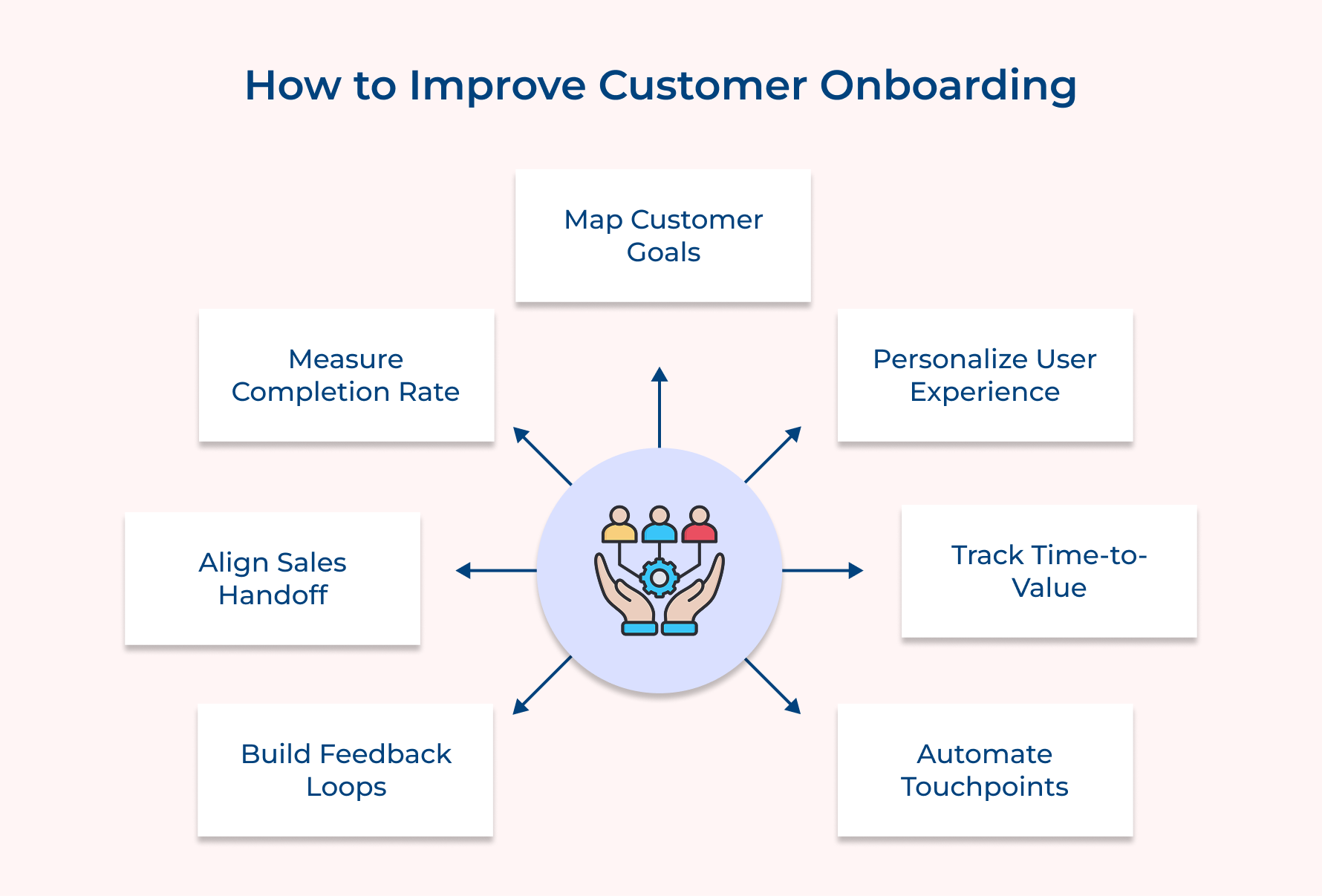
- Map the onboarding journey to customer goals: Start by understanding what success looks like for each customer segment and build everything around it instead of a feature checklist.
- Personalize the experience based on role and use case: A one-size-fits-all onboarding makes each customer feel the same. Segment it based on customer industry, role, or goal to make it feel intentional.
- Define and track a clear time-to-value milestone: Every program needs a list of metrics that signal a customer’s progress in the flow. Track how long it takes to reach the milestone and relentlessly work.
- Automate repetitive touchpoints based on human element: Use onboarding automation for managing routine follow-ups and reserve human for complex conversations that require relationship depth.
- Build feedback loops at every onboarding milestone: Collect customer feedback at each stage of the onboarding. It reveals friction points early so that there is still time to fix.
- Align sales handoff notes with the onboarding team: The gap between sales promises and what onboarding delivers breaks user trust. Build a structured handoff process to make sure the onboarding team knows what the customer expects.
- Measure onboarding completion rate: Completion rate is just a metric without connecting it to retention performance. Track both the correlation consistently to find the highest onboarding improvement opportunities faster.
Strong customer onboarding is the foundation on which every retention and growth strategy is built. Businesses that invest in structured onboarding outperform those that treat it as a post-sales formality.
- Retention starts at onboarding: The first 2 weeks determine either customer retention or silent churn.
- Value drives loyalty: Customers reaching outcomes early build genuine reasons to renew.
- Automation plus personalization wins: Scalable onboarding works best when tools handle repetition, and humans manage relationships.
Ready to transform customers’ experience of your product from the first? Book a demo to see how a structured onboarding changes your retention. The real customer onboarding benefit is displayed in revenue data. A lower churn with stronger adoption and faster growth tracks how well the first journey was designed.
Limit time — not creativity
Everything you need for customer support, marketing & sales.

Neeti Singh is a passionate content writer at Kooper, where he transforms complex concepts into clear, engaging and actionable content. With a keen eye for detail and a love for technology, Tushar Joshi crafts blog posts, guides and articles that help readers navigate the fast-evolving world of software solutions.