How to Track Project Profitability in Professional Services
- What Is Project Profitability in Professional Services?
- Why Is Measuring Project Profitability for Professional Services Important?
- What Are the Benefits of Measuring Project Profitability for Professional Services?
- How to Calculate Project Profitability in Professional Services? 7 Effective Strategies
- Practical Methods to Measure Project Profitability in Professional Services
- Common Challenges in Professional Services Project Profitability
- Achieve Excellence Through Enhanced Project Performance
- FAQs about Project Profitability in Professional Services
Key Highlights:
- Project profitability in professional services measures financial return after delivery costs such as labor, tools. etc.
- Only 20% of firms hit their project profit margin, making structured measurement a direct advantage.
- Cost baseline setup, real-time analytics and post-project review help services firms track as well as protect profitability across every engagement.
Do you know why professional services firms win strong revenue, yet their margins shrink frequently? It’s not the quality of the work. It is the absence of structured profitability measurement at the project level.
Billable utilization has dropped to 68.9% across services firms, which is below the threshold to sustain healthy project margins. Project profitability in professional services is the financial metric that measures the ROI from each engagement after accounting for all direct costs and billable work delivered.
Explore the seven effective strategies for measuring project profitability in professional services. Establish cost baselines, track return of investment, analyze scope creep and conduct post-project reviews. You will leave with a framework that transforms the profitability index into a real-time delivery discipline.
What Is Project Profitability in Professional Services?
Project profitability is the primary metric for measuring the financial return in professional services, after accounting for all costs involved in project delivery. It goes beyond revenue to reflect how efficiently a team converts work into a real business outcome.
Project profitability analysis breaks down every cost and revenue for a professional service to reveal where margins are healthy.
What happens when you do it right? Profitability analysis becomes a decision-making tool in project management that shapes future project scope, pricing and resources. It transforms conversation from “did we deliver?” to “did we deliver profitably?”.
Key objectives:
- Accurate cost visibility: Identify where budgets are being consumed across labor, tools and overhead.
- Margin protection: Address scope creep and resource inefficiencies before they affect financial health.
- Smarter pricing decisions: Build a pricing model with real project data to reflect the true cost of your service.
- Resource optimization: Assign the right talent to maximize billable efficiency without overallocation.
Why Is Measuring Project Profitability for Professional Services Important?
Service firms that skip profitability measurement are doing the guesswork. They are winning projects, but simultaneously losing margin at every single phase.
- On-time delivery reduced to 73.4% in 2024, which showcased client satisfaction and overall project profitability across professional services firms.
- 57% of businesses have defined a profit margin target for projects, but only 20% achieve it every time.
- Billable utilization has fallen from 73.2% to 68.9% in 2024 and is below the threshold needed to maximize revenue.
Measuring project profitability gives professional service firms the clarity to protect margins. It makes smarter delivery decisions and builds a business that grows.
What Are the Benefits of Measuring Project Profitability for Professional Services?
Project profitability tracking gives project leaders of professional services the clarity to make accurate decisions at every phase of delivery cycle.
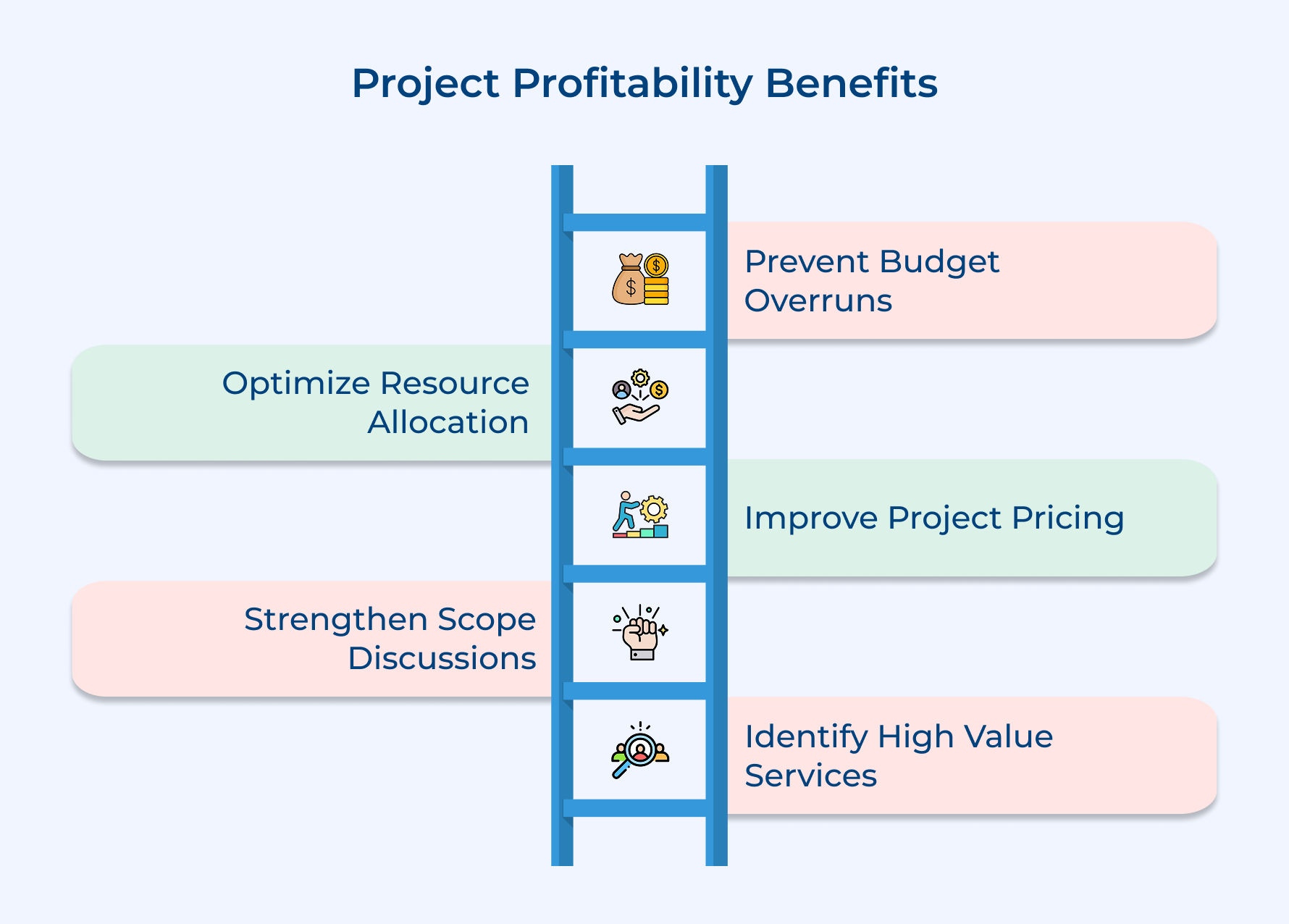
1. Early Detection of Budget Overruns
Budget overruns don’t happen overnight. They escalate silently through small, untracked hours and unplanned scope. Measuring profitability at regular intervals helps professional services for identifying these warning signs early to take appropriate action.
2. Smarter Resource Allocation Across Projects
What happens when profitability data is available at the project level? You can see exactly where talent is underutilized. This real-time visualization enables resource decisions to be driven based on financial impact instead of availability.
3. More Accurate Pricing for Future Projects
Firms using project profitability build a cost benchmark that removes guesswork from pricing and billing. It boosts the future proposals to become grounded in real delivery data instead of estimation that affects margins.
4. Stronger Client Conversations Around Scope
Profitability data gives project leaders in service firms a factual foundation for discussing scope changes with clients. Teams can view how additional requests affect project economics.
5. Identification of High-Value Service Lines
Do all service offerings deliver equal returns? No, some engagements consistently outperform while others underdeliver. Profitability measurement surfaces which service lines deserve more investment in the ones that need restructuring.
How to Calculate Project Profitability in Professional Services? 7 Effective Strategies
Explore these effective strategies that give your business an upper hand to boost its profitability and value proposition.
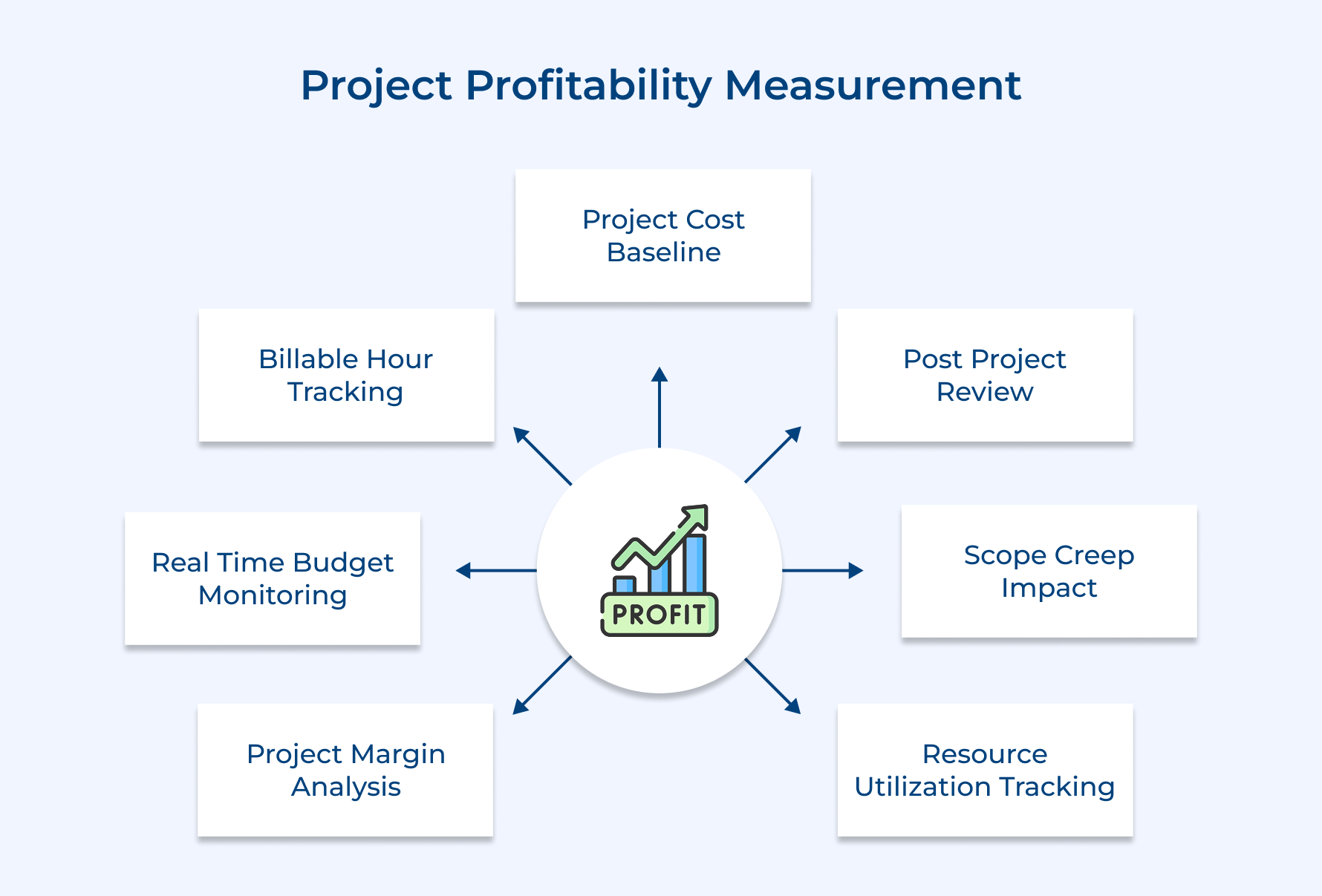
1. Establish a Clear Project Cost Baseline
The first question that comes to mind is what is a cost baseline? It is the financial backbone of every profitable project, measuring whether delivery is protecting or losing margin.
Capture every cost layer before starting any work. Not just staffing, but also the indirect costs are consistently underestimated during scoping.
How to establish a clear project cost baseline:
- Map direct labor costs: allocate a realistic hourly rate for every team member involved in delivery.
- Include contingency buffers: Create a percentage benchmark for risk-related costs from the first stage.
- Validate with historical project data: take reference from similar past projects to pressure-test cost assumptions before delivering.
So what does a good cost baseline do? It protects scope conversations and keeps teams financially aligned. It becomes the single reference point against which every change request and decision should be measured.
2. Track Billable vs. Non-Billable Hours Rigorously
Billable utilization is one of the key metrics for measuring project profitability in professional services. Non-billable hours represent real delivered effort with zero ROI to the firm.
Formula:
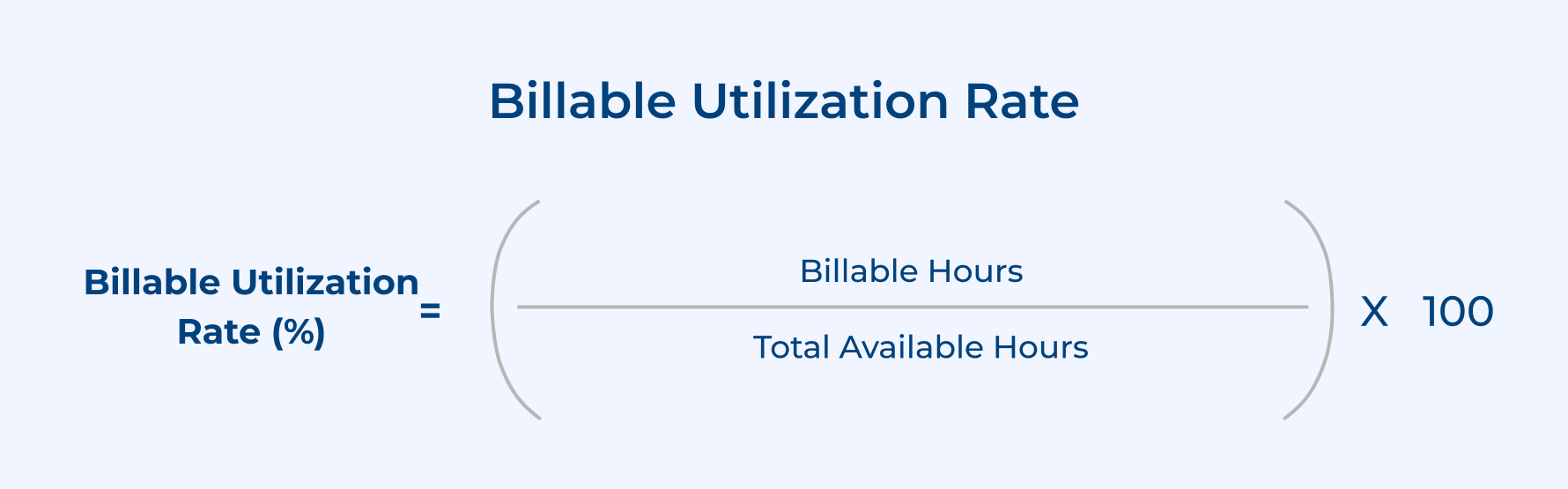
So, what is the actual benchmark of a healthy Billable vs. Non-Billable ratio?
- Target 75–80% to sustain healthy project margins without losing team value.
- Non-billable hours of more than 25% of total hours means an operational efficiency problem that needs to be investigated.
- Billable ratios below 65% are a direct warning of low project profitability and scope management needs urgent attention.
Non-billable drift consumes billable capacity and causes margin erosion. Tracking billable and non-billable hours gives the full financial view of where time is actually going.
Firms can see which members are having high non-billable hours. This level of visibility turns time tracking into a genuine profitability analysis in project management.
How to improve?
- Role-based time tracking so each team member logs hours against specific tasks daily.
- Review non-billable hours weekly to identify utilization drift before it compounds and leads to a margin problem.
3. Monitor Budget Consumption in Real Time
Real-time budget monitoring converts project profitability management to a proactive process in professional services. It offers the financial visibility to course-correct errors that can cause profit loss in the future.
Setting budget checkpoints at defined stages. It makes sure financial performance is reviewed consistently. Examples of checkpoints in professional services where the project’s profitability is reviewed:
- Project kickoff checkpoint: Record onboarding and setup costs align with the estimated benchmark.
- Mid-project delivery checkpoint: Assess cumulative spend against time completed to identify early cost-to-completion risks.
So, what can be done other than setting a benchmark? Planning spending on a weekly cadence to reduce the element of surprise and embed financial accountability directly into delivery operations.
4. Calculate Gross and Net Margin Per Project
Gross and net margins reveal if a project is simply generating revenue or delivering financial value to the business.
What does each margin metric do for measuring project profitability in professional services?
- Gross margin: Measures leftover revenue after subtracting direct project delivery costs.
- Net margin: Track true profit after all costs, such as overhead or indirect expenses.
Formulas:
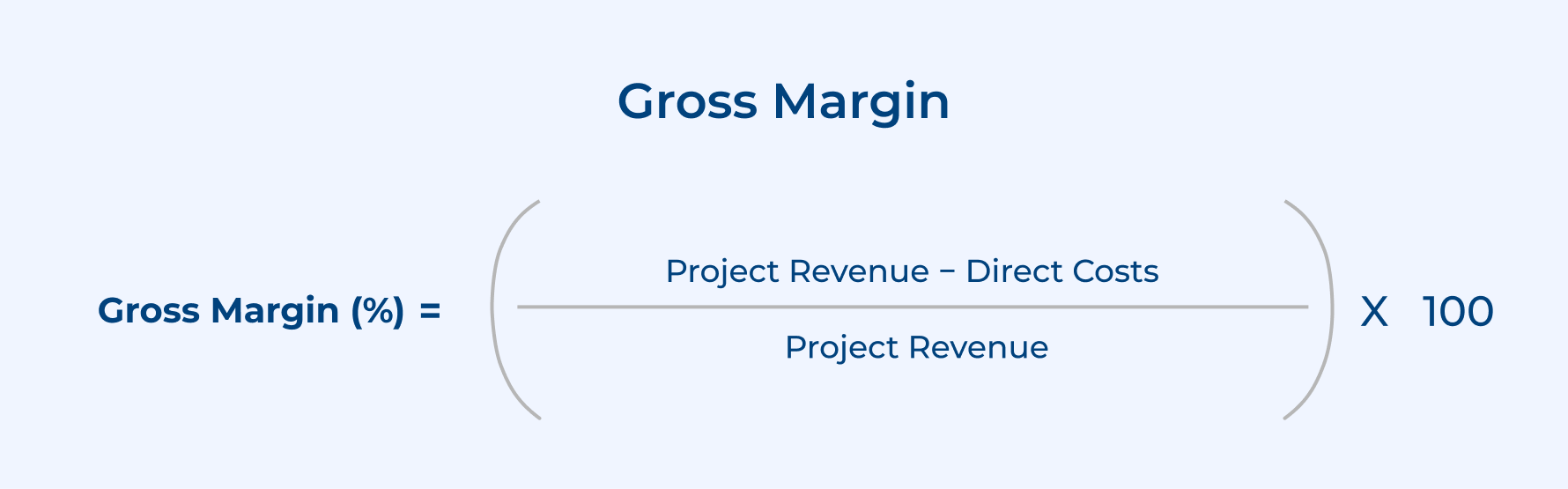
So what does a healthy project’s profitable margin actually look like in professional services? 30–60% means well-controlled delivery costs, while 15–25% is considered strong across most firms.
Follow these steps to calculate gross and net margin per project:
- Capture total project revenue: Include costs such as billable fees, reimbursements and approved change order amounts.
- Identify and total direct costs: Sum up labor, subcontractor and direct tool costs specific to delivery.
- Add indirect and overhead costs: Allocate a proportional share of overhead expenses to the project.
- Apply both formulas and benchmark: calculate and compare against the original profitability target set at kickoff.
Build a financial performance library over time by tracking both margins across every project. It makes future scoping and resource decisions more accurate.
5. Measure Resource Utilization Against Planned Allocation
Resource utilization gaps are a project profitability management problem in professional services. Project margins are under pressure when actual hours consistently deviate from planned allocation.
Consider this checklist before reviewing resource utilization:
- Do allocated hours reflect the actual complexity of each deliverable?
- Which team members are logging hours beyond planned allocation?
- Are the right seniority levels assigned to the right project tasks?
Answering this question at regular intervals reveals the exact touch points where your planned assumptions break down.
So, how to start measuring project profitability utilization in project management? Compare forecasted hours to actual logged hours at the role-based level. It gives data to make targeted corrections before margins drop.
6. Analyze Scope Creep and Its Financial Impact
Scope creep is the most damaging and least formally tracked variable. Every unlogged addition to the scope is a direct increase of margin.
Most firms acknowledge it, but very few quantify its financial cost per project. Logging it with an associated cost estimate builds a compelling case for stronger change control. More than disciplined contract conversations.
pro tips:
- Track a scope change log from the first day, so every addition is captured with a time and cost value.
- Set a scope trigger that acts when unplanned additions cross a defined threshold of project value.
7. Conduct a Post-Project Profitability Review
A post-project profitability review is an underleveraged process in professional services, financial analysis and management. Firms close projects financially, but very few extract data that actually teaches them about performance.
Every completed project’s profitability in project management holds a real cost dataset that no market report can duplicate. Post-project data is considered as an institutional knowledge rather than a historical record to separate high-performing firms from average ones.
Effective ways to conduct a post-project profitability review:
- Conduct estimated vs. actual margin analysis: Compare the margin projected at kickoff against the margin delivered to the finish, exactly where the financial plan broke down.
- Identify recurring cost and delivery patterns: Analyze multiple projects to spot consistent overrun categories. It reveals systemic estimation that needs structural fixes.
- Feed findings directly into future pricing models: Use project margin data to recalibrate hourly rates, scope assumptions and contingency buffers.
Consider an example of a mid-sized professional service firm that consistently underpaid at discovery phases, leading to less project profitability. It surfaces 40% more hours consumed than estimated, without changing the delivery approach at all.
Practical Methods to Measure Project Profitability in Professional Services
Understanding project profitability needs practical methods to fit professional services teams to actually deliver work.
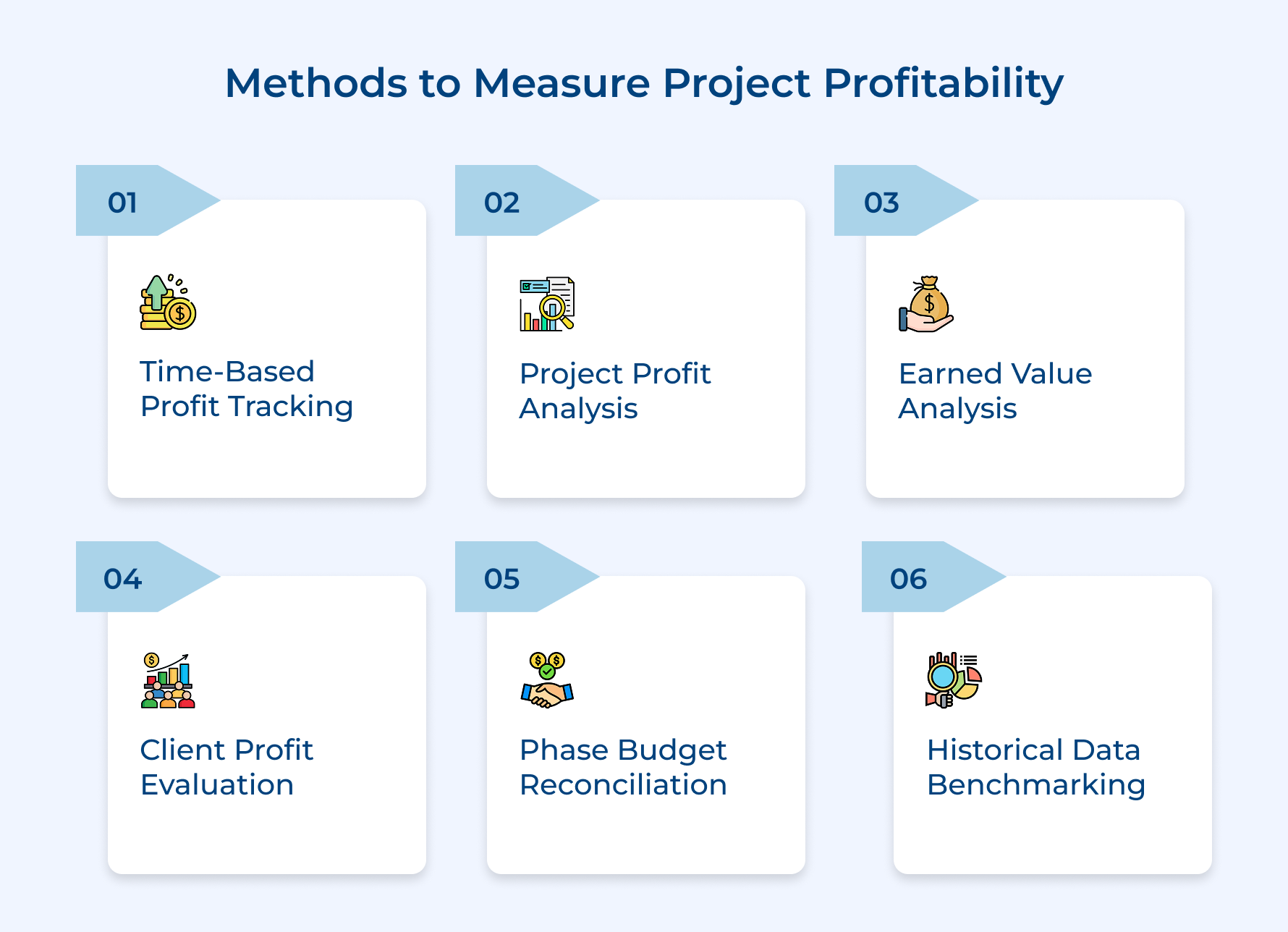
1. Time-Based Profitability Tracking
How time is logged and reviewed determines whether a project finishes on timer or not. Treating time tracking as administrative rather than financial is essential for operating without profitability index.
So, what does time-based tracking actually work? Every hour must be tagged with a specific deliverable and budget line.
- Are billable hours logged daily or reconstructed at the end from memory?
- Are you having a clear separation between billable and internal coordination time?
- Do you track budget consumption at least weekly to review time data?
Clean and consistent time data is the most reliable warning system for profitability. It gives project leaders faster visibility into project delivery trends toward margin protection.
2. Project-Level Profit and Loss Tracking
Track it at the business level instead of the individual project level and where profit visibility is lost.
What happens when running a project-level? P&L forces every cost to a specific engagement. It reveals which projects are genuinely profitable and which need stronger engagement in the portfolio.
Elements of a project-level P&L must be actionable:
- Total billable revenue, such as approved change orders and reimbursements
- All direct costs, which include labor, subcontractors and project-specific tools
A high-revenue project that looks successful is actually delivering sub-10% margin and without project-level tracking, that reality stays completely missing.
3. Earned Value Analysis (EVA)
Earned Value Analysis real-time profitability measurement method, but remains underused. Many teams associate it only with engineering projects. It connects schedule and cost performance into a single unified profitability view.
Key indicators every leaders to consider:
- Cost performance index (CPI): CPI below 1.0 means the project is consuming more money than its generating.
- Schedule performance index (SPI): Delivery delays affect labor costs on fixed-fee engagements
4. Client-Level Profitability Analysis
What happens when you are in the process of measuring profitability only at the project level? Critical dimensions are missed in the client relationship. Some of them generate profit but others demand high-touch delivery that affects profit margin across every project.
Data reveals that 20–30% of clients consume disproportionate resources with respect to the revenue and margin actually returned.
What client-level profitability analysis measure?
- Delivered across all engagements with the client over 12 months
- Number of non-billable hours spent on client management and relationship building
- Ratio of approved orders with respect to the total scope additions requested for engagement
Account management transforms from a relationship exercise into a strategic financial decision when client-level profitability is reviewed. Professional services can then make analysis in project management about profitability and how to transition out of the portfolio.
Consider these questions for client-level profitability review:
- How many clients consistently approve change orders from those who move away from every scope addition?
- Are the firm’s highest-revenue clients also its highest profit margin clients?
5. Phase-by-Phase Budget Reconciliation
Most projects fail at specific phases, not at once. It happens in certain situations, such as discovery phases, which get underpriced, while in development phases, it absorbs unplanned rework. Closure phases carry hidden costs that are outside the budget.
A phase-by-phase process sets a budget report for each project phase in professional services. It prevents cost overruns from one phase into the next and stacking into an unrecoverable margin.
So, what phase-by-phase reconciliation reveals in practice?
- Discovery and scoping phases are under-budgeted in fixed-fee service engagements
- Handoff phases between carry hidden coordination that rarely appear in project estimates
A structured checkpoint where budget consumption and scope delivered are assessed before the next phase is authorized to start.
6. Benchmarking Against Historical Project Data
Firms that actively use a historical project data library systematically achieve better profitability in comparison to those starting every estimate from scratch.
So what does benchmarking actually mean? Compare current cost assumptions and margin targets against similar projects. It helps identify current estimates in delivery reality, or is built on optimistic assumptions that are never actually achieved.
Dimensions that every historical benchmarking in professional services covers for maximum profitability analysis:
- Cost accuracy rate: How closely did cost estimates match actual project costs across past engagements?
- Phase-level overrun patterns: what specific phase exceeded budget and by what percentage?
- Margin delivery by project type: what engagement sizes consistently deliver at the strongest margins?
Common Challenges in Professional Services Project Profitability
Explore the four challenges that consistently get in the way of accurate management and visibility across project profitability in professional services.
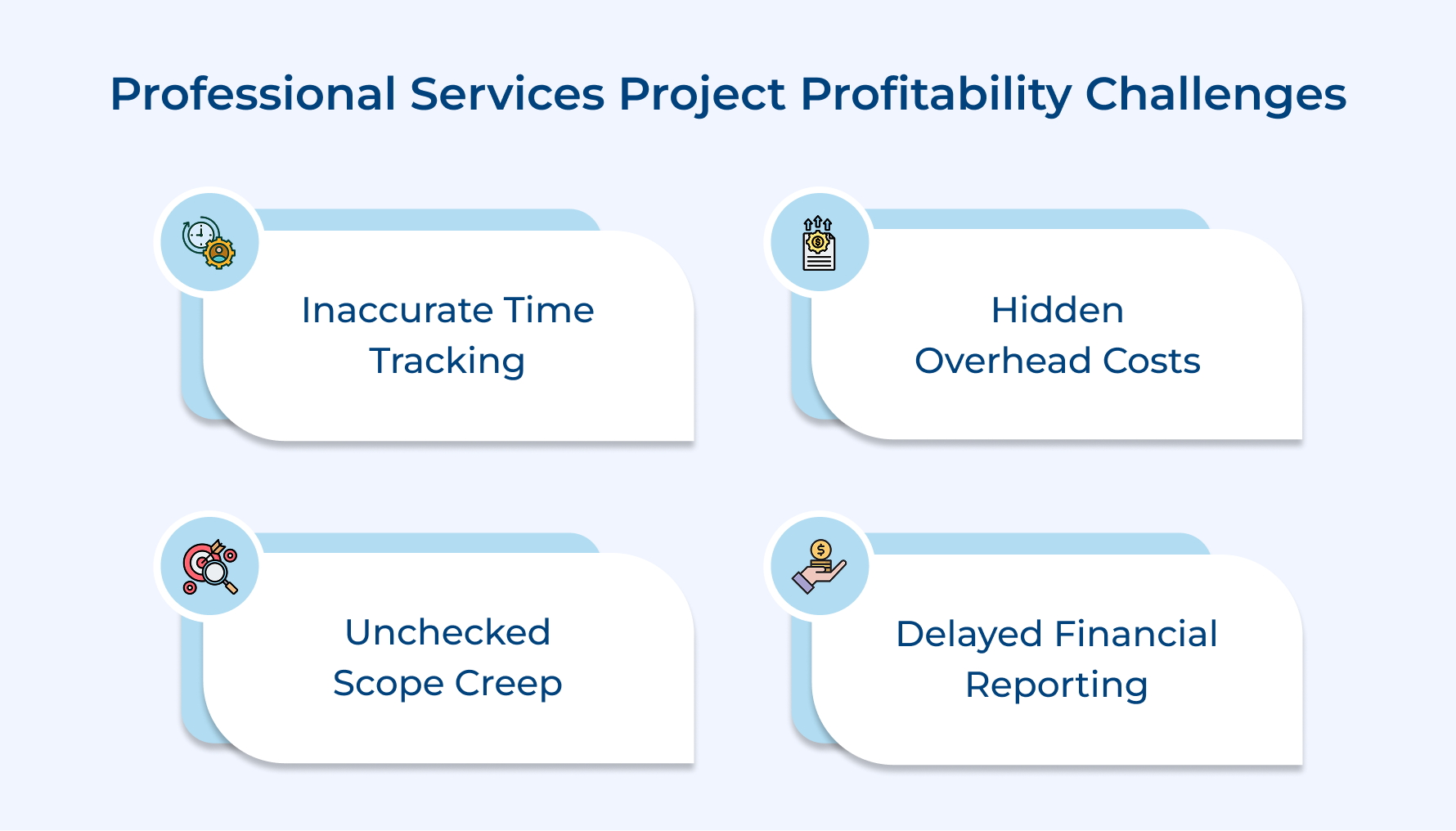
1. Inaccurate or Inconsistent Time Tracking
Time data creates a fundamental foundation error for any profitability calculation. So what causes it? Margin figures lose their credibility as decision-making is lost when hours are estimated instead of being recorded in real time.
2. Poor Visibility Into Indirect and Overhead Costs
Most budgeting models capture direct labor cost but consistently underestimate any external cost per project. This method always overestimates net margin calculations, which is true for each profitable project.
3. Scope Creep Without Financial Accountability
Scope creep transfers unbilled value to the client’s benefit in every project phase. Profitability data no longer reflects actual delivery and additional requests are absorbed without logging their cost impact.
4. Lack of Real-Time Financial Reporting
Profitability data arriving at project closure is a historical record for analysis and not a management tool. Monthly cycles instead of weekly convert the delivery decision into guesswork and recovery becomes impossible.
Consider this 4 solutions that directly address each challenge:
- Mandate daily logging with respect to specific project tasks for compliance.
- Assigns indirect costs to every project as a fixed percentage of labor cost to build a standardized overhead allocation model.
- Implement a formal scope change to capture every unplanned scope addition associated with time and cost value.
- Transform to weekly project financial reporting to maintain a current profit margin visibility at each stage of the project lifecycle.
Achieve Excellence Through Enhanced Project Performance
Project profitability is the outcome of disciplined measurement, proactive scope management and pricing strategy in real delivery data. Firms that build this discipline consistently protect margins and outperform those that measure profitability during project closure.
- Track billable and non-billable hours weekly so utilization drift never misses profit margins.
- Post-project profitability index reviews to extract real cost benchmarks that boost future pricing strategy as well as resource management decisions.
Start measuring project profitability in professional services and use that data to build a delivery model that improves margins. The data from every project is the most valuable asset for a firm to improve its profitability consistently.
Limit time — not creativity
Everything you need for customer support, marketing & sales.

Neeti Singh is a passionate content writer at Kooper, where he transforms complex concepts into clear, engaging and actionable content. With a keen eye for detail and a love for technology, Tushar Joshi crafts blog posts, guides and articles that help readers navigate the fast-evolving world of software solutions.