How to Become a Resource Manager Successfully

Key Highlights:
- A resource manager involves learning some core skills such as data analysis, workload balancing and stakeholder communication.
- How to become a resource manager starts with project coordination experience, followed by certifications such as PMP or PRINCE2.
- Resource managers optimize allocation, such as people, budgets and project timelines to drive business outcomes.
Most professionals enter a resource management career path without a structured roadmap, leaving them reactive instead of strategic.
So, why does this gap persist? The role sits at the intersection of people, data and business strategy. No one will teach you all three skills at once. The average organizational utilization rate sits at just 72%, which is quite below the standard benchmark of 80–85%, which most professional services firms target.
A good manager is responsible for planning, allocating and optimizing people, budgets, as well as time to deliver strong resource management outcomes. The guide covers how to become a resource manager, a complete career path from planning fundamentals to stakeholder strategy. It gives you a practical framework with real organizational outcomes.
What is a Resource Manager?
Resource managers are professionals who plan, allocate, and utilize an organization’s resources to make sure projects are delivered efficiently. It typically includes the following resources that need to be balanced against business priorities – people, budgets, tools and time.
They sit at the right gap between project demands and workforce capabilities to ensure the right people are working on the right tasks. The process of becoming a resource manager involves a strong understanding of operational workflows as well as human dynamics.
Main goals:
- Optimize resource utilization: Make sure proper utilization of resources is done without pushing teams toward burnout.
- Align resources with business goals: Route the right skills to projects that drive organizational priorities.
- Prevent resource conflicts: Identify and resolve scheduling issues before disrupting project timelines.
- Maintain visibility across projects: Real-time view of resource allocation and capacity across the entire project portfolio.
Why Are Resource Managers Important?
Resource managers bring structure in managing people and project demands efficiently. Let’s explore the benefits of resource management in your firm in detail:
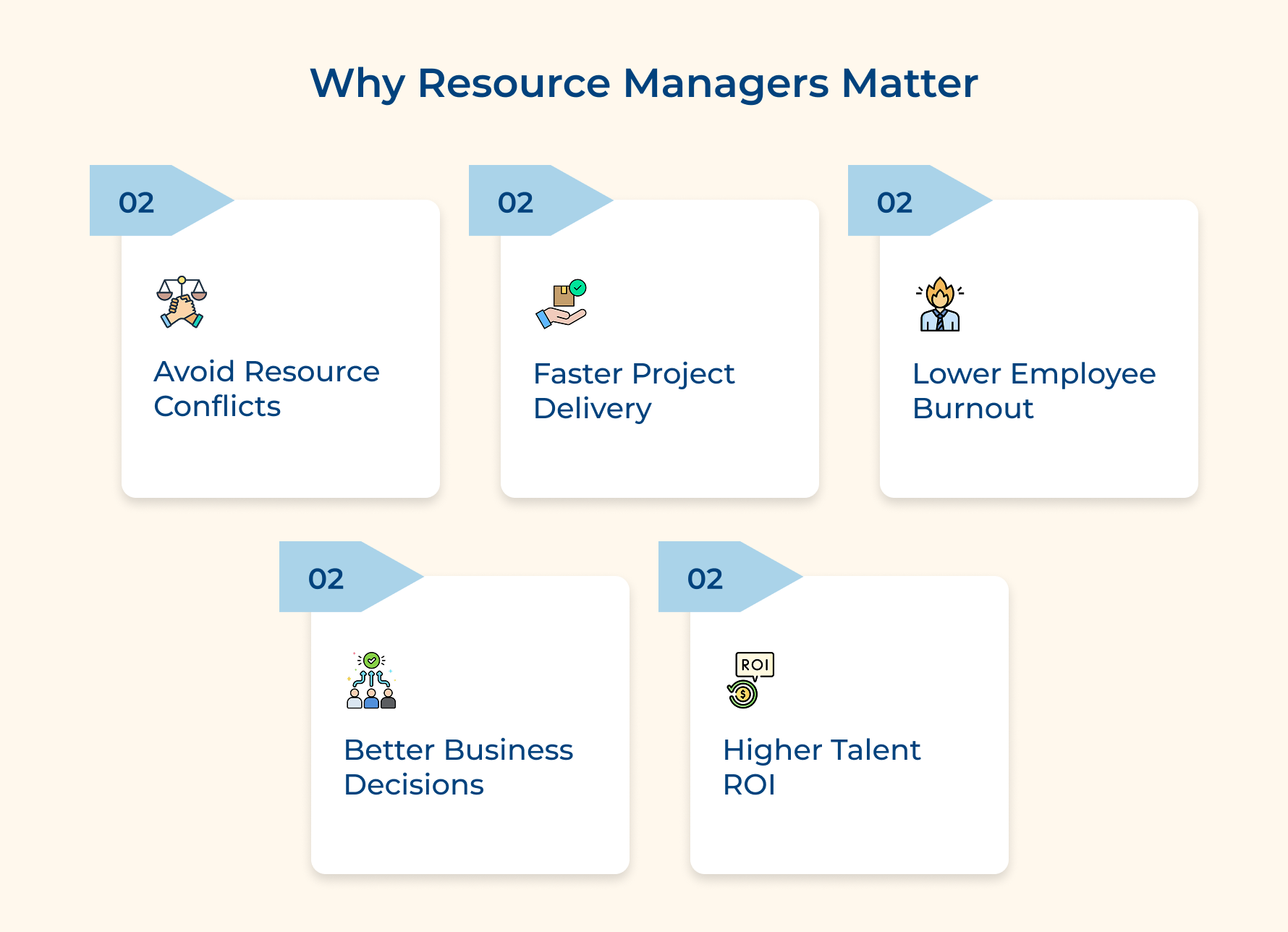
Prevent Costly Resource Conflicts
Consider an example of a situation where two projects compete for the same skilled professional. It can delay deliverables and damage client relationships. A resource manager who has followed a proper career path can spot the conflicts and resolve them before escalating..
Improve Project Delivery Rates
Projects not only fail due to poor planning but also when the right people are allocated at the right time. Resource managers help in aligning workforce availability directly with project schedules.
Reduce Employee Engagement
What is the most common cause of team burnout? Overallocation in project-driven organizations. Managers track workload distribution in real-time to make adjustments before fatigue starts affecting performance.
Enable Smarter Business Decisions
Resource managers provide real-time data in situations when firms need to take on a new project. It makes capacity planning a business decision based on reality instead of just assumptions.
They Maximize Return on Talent Investment
Every skilled resource which is on payroll represents a high cost to the organization. Managers help in effective talent management and ensure it is not wasted on low-priority work.
How to Become A Resource Manager in 7 Actionable Steps
Implement these actionable steps for becoming the best resource manager with the right skills and become a force for your organization’s success.

1. Master Resource Planning Fundamentals
Resource planning is the foundation that every resource manager builds across their entire career path before anything else. The wrong framework leads to always reacting to problems instead of preventing them. Follow these effective ways to master the fundamentals:
- Understand capacity vs. demand: Start measuring teams’ capacity for task handling against actual project demand. Resource conflicts exist because the gap was not properly measured in the initial phase.
- Learn resource forecasting techniques: Forecasting is all about real-time data visibility to make confident decisions ahead of demand. Start with simple utilization models. Shift to forecasts that include pipeline projects.
- Study workforce planning principles: Shifts your thinking toward skills and capacity your organization needs months later. This forward-looking mindset helps in becoming a strategic resource manager in the ongoing career path.
Consider the example of three projects sharing one senior developer, with tracking any overlap until deadlines. Here’s how a resource manager becomes a strong planning pillar to flag bottlenecks during the planning phase itself:
- Strong planning with leadership credibility
- Managing and tracking real weight in strategic decisions.
2. Build Deep Visibility Across Projects
What happens when there is no clear visibility across all active projects? Every resource decision made is based on assumptions. A resource manager with deep visualization skills in their career path is more confident in avoiding conflicts.
Building visibility for managers begins with learning to track all active resources precisely, becoming an important part of this management process. It goes beyond knowing who is assigned where. Requires a clear understanding of each resource’s optimization.
How to do it practically?
- Maintain a live resource register to capture resource assignments along with their allocated percentage per project.
- Follow a weekly review process to identify any shift in scope or timeline in your resource data.
Let’s consider a situation where a project manager requests a new resource for a sprint. Your calendar will show if there is any available person or already committed elsewhere.
Pro tip: Beyond tracking, also identify allocation conflicts before they surface so you can become a truly proactive manager.
3. Develop Strong Stakeholder Communication Skills
Communication makes or breaks effectiveness as a resource manager in your career path because you constantly operate at competing priorities. A good resource manager delivers during difficult capacity needs while maintaining proper relationships and trust intact.
Tips to consider to develop strong stakeholder communication skills for becoming a resource manager:
- Speak in business language: do not just use headcount numbers but also frame resource constraints in terms of project impact and business risk.
- Be proactive, not reactive: Share resource updates upfront to present you as a reliable partner, not a bottleneck.
- Document all commitments: Maintain both verbal agreements and written summaries to prevent costly misalignment.
- Practice saying no constructively: Offer alternatives instead of flat refusals when capacity is limited to keep conversations solution-focused.
Consider a situation where two project managers are demanding the same data, with a resource manager leading to a decision backed by business impact. The outcome will be achieved when the resource manager has good communication skills in their career path to turn a conflict into a structured conversation.
Stakeholders who push back on capacity limitations with pressure and urgency are the biggest challenge any resource manager faces. Overcome it by preparing utilization data early because when numbers are not ready, the conversation shifts from opinion to fact.
4. Learn to Balance Workloads Strategically
Workload balancing involves understanding resource capacity before any allocation. A resource manager with this skill in the career path protects both project outcomes and long-term health of your team.
So, how to actually implement this to become a resource manager? Build awareness first, as without understanding, your people’s balancing decision remains a guess work.
Ask these key questions before diving into workload balancing:
- Do you have real-time visualization of each team member’s workload?
- Are there any awareness processes to identify individuals that are consistently over-assigned?
- What is the real difference between someone busy and someone genuinely overloaded?
These questions surface the gaps in current visibility so that you can build the data foundation that enables strategic balancing. Below are a few processes on how to learn workload balancing to become a resource manager:
- Track utilization at individual level: Monitor team members’ allocation percentage on a weekly basis to catch overutilization before it affects performance.
- Build buffer into every AI-assisted assignment: Leave bandwidth margin to adjust unplanned work and project priorities.
- Rotate high-demand resources thoughtfully: Avoid chronic overallocation by not placing the same top performers on every critical project.
- Use historical data to improve future balancing: analyze past utilization patterns to form smarter and more realistic workload decisions.
5. Use Data to Drive Resource Decisions
Data-driven decision-making separates an exceptional resource manager from one who simply reacts to problems. Allocations that are done based on real data can be managed with confidence.
Data is the most important asset that is carried into every resource allocation. Below are the practical ways to use data as a resource manager:
- Track utilization rates consistently: Monitor the number of available capacity being consumed across all projects. It reveals people who are overloaded or underutilized before it becomes a delivery risk.
- Analyze historical resource patterns: Review how resources were allocated in previous projects for managers to reveal before they become a risk. The historical data gives your future forecasts accuracy that no assumption can match.
- Build real-time resource dashboards: use a dashboard that includes allocation, availability and project demand to transform the way you can respond to change. Decision-making speed increases across the entire organization when data is centralized and visible.
Once the data foundation is perfect, resource patterns that were hidden before are clearly visible. The level of insight gives more credible conversations. It is all about capacity gaps and hiring decisions.
6. Sharpen Conflict Resolution and Negotiation Skills
Resource conflicts are an unavoidable issue in any project-driven firm. How do you handle them to become a resource manager? They don’t just resolve conflicts but also prevent them through structured prioritization and negotiation.
Run through this readiness checklist before working on conflict resolution:
- Do I have a clear process for prioritizing resources when two projects have the same deadlines?
- Is there any scope for negotiating with project managers without affecting relationships?
- Is the conflict resolution process based on data?
The questions help to determine if the conflict resolution approach is based on data or just assumptions. Also reveals the current status of your negotiation skills that might need deliberate training and development.
So, how do you actually implement this?
- Stop treating conflicts as emergencies and think of it as a predictable process.
- It demands a structured and consistent response every single time.
7. Continuously Evolve With Industry Tools
The right tools give you an advantage over resource managers still heavily dependent on manual processes. Stay updated on the current industry tools to maintain effective resource management over time.
Most resource managers underestimate how much time they lose to become a resource tracking expert that modern tools eliminate. It improves your decision-making process and provides quality insights for leadership.
Follow these industry tools to help you continuously evolve:
- Smartsheet: streamline your dynamic resource planning templates to track workloads across multiple projects.
- Float: Resource scheduling tool with real-time visibility into team availability and project allocations.
- Runn: Resource planning tools integrated with financial forecasting, for a complete view of capacity and project profitability.
So, how to master the right technology stack for becoming a resource manager to scale their career path? Pick one tool at a time that directly solves the visibility gap and master it completely. Once you have good experience in one, build your broader technology stack based on it.
Pro tips:
- Evaluate a tool based on the team’s actual workflow instead of market popularity.
- Invest time in learning your chosen platform deeply to gain real value instead of using a surface-level tool.
5 Skills Required for Becoming a Resource Manager
Most job descriptions of Resource managers demand a specific combination of skills that go far beyond basic project management. Below are five skills that define an exceptional manager.
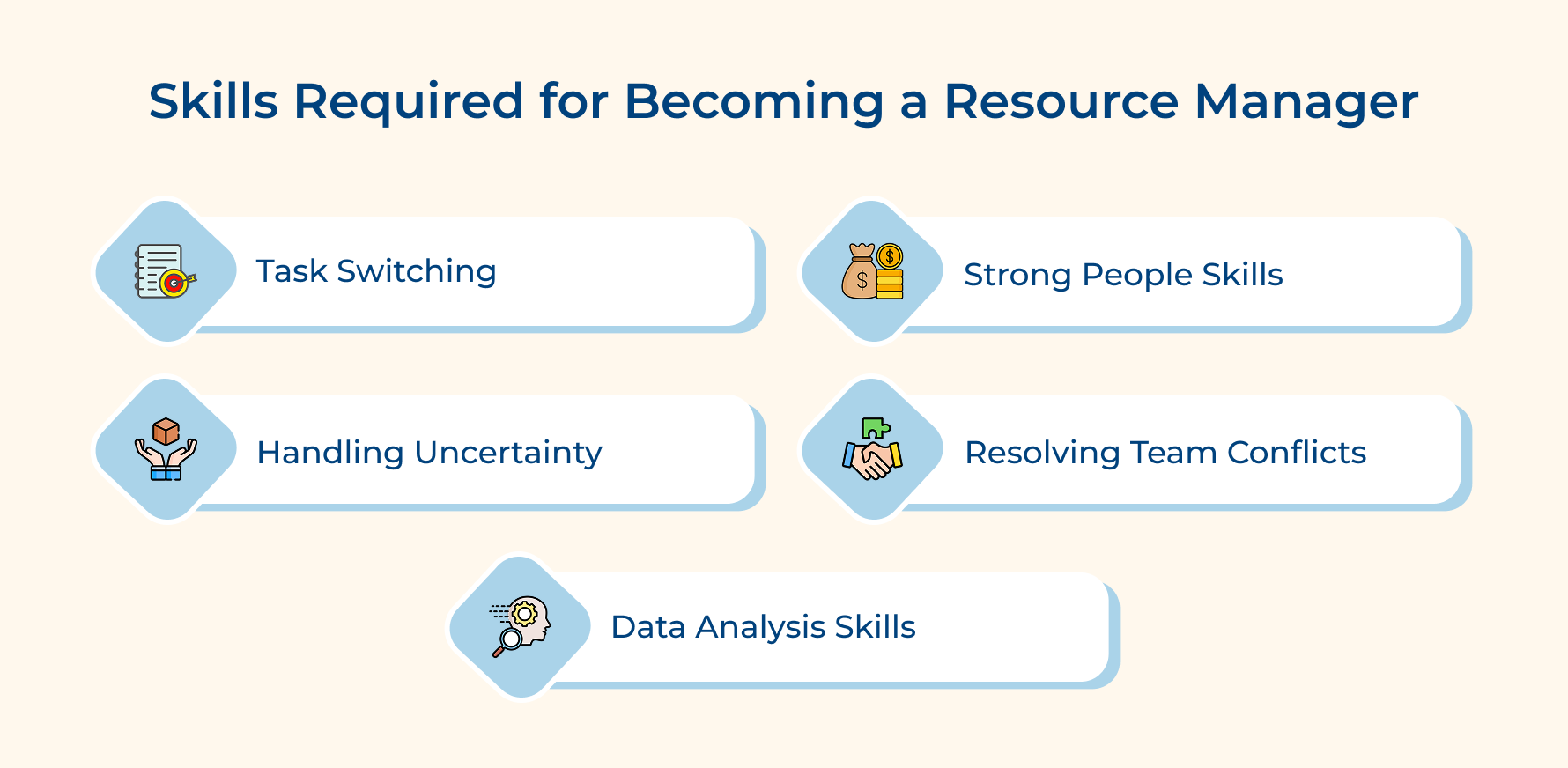
Multitasking Maven
Most resource managers need to be able to juggle multiple projects, priorities, and shifting timelines without losing sight. So, becoming a good resource manager involves quick and accurate context-switching across all fronts. It keeps operations running smoothly even under real pressure.
Comfort with Uncertainty
Resource management rarely works in predictable conditions because project scopes change, people leave, and priorities shift. The best manager always stays composed in this ambiguity to make confident decisions.
People Person Extraordinaire
Behind every successful resource manager, there is a workload limit, career path and personal bandwidth that numbers cannot capture. A genuine relationship management skill between clients and teams helps to maintain conversations that feel collaborative instead of transactional.
Conflict Resolution Expert
Consider a situation where two projects compete for the same resource. The resource manager must step in to resolve the conflict professionally. The skill is all about making priority decisions for business impact and confidence.
Data Interpretation and Analysis
Raw utilization numbers help very little in reading patterns, spotting risks and translating data into decisions. Interpreting data effectively helps in becoming one of the best resource managers who interprets data well and becomes one of the most strategically valuable resource managers in any service firm.
Step into Leadership with Resource Management Mastery
An exceptional resource manager is all about making strategic decisions that directly shape an organization’s outcomes. The fastest professionals advance by combining data fluency, soft skills and genuine people insight.
- Master capacity planning as well as workload balancing in advance
- Build client communication skills based on real-time utilization data
- Evolve your resource manager career path with the right tools and skills
Ready to put this into a live environment? Explore key resource planning tools, such as kooper can accelerate your career. The clearest path of how to become a resource manager involves mastering people, data and strategy.
Limit time — not creativity
Everything you need for customer support, marketing & sales.

Neeti Singh is a passionate content writer at Kooper, where he transforms complex concepts into clear, engaging and actionable content. With a keen eye for detail and a love for technology, Tushar Joshi crafts blog posts, guides and articles that help readers navigate the fast-evolving world of software solutions.