How to Improve Project Performance & Deliver Faster
- What is Project Performance?
- Importance of Improving Project Performance and Efficiency
- Key Elements of Project Performance
- How Do You Measure Project Performance?
- How to Improve Project Performance? 8 Crucial Tips to Success
- Roles of Project Management Skills in Project Performance
- Master the Art of Efficiency By Improving Project Performance
- FAQs about How to Improve Project Performance

Key Highlights:
- Poor visibility is the root cause behind most project performance failures across teams.
- Tracking metrics such as SPI, CPI and resource utilization to use data to improve project performance.
- Automating repetitive processes redirects the team’s focus toward high-value delivery that moves projects forward.
Why do most well-planned projects miss deadlines and blow budgets in spite of having capable teams? No, the problem is about project scope or budget; it is the absence of the right performance structures executed from the first day.
According to a recent report, only 47% of projects are completed within the original budget. Even your strongest teams lose control, which is very hard to recover without clear metrics and accountability.
The guide breaks down exactly what to track, measure and strategies that actually improve project performance towards success. Building the right project delivery system catches problems early and compounds results over time.
What is Project Performance?
Project performance is the process of measuring how effectively a project is delivered to improve its intended outcomes, such as defined scope, budget and timeline. It reflects the overall health of a project by tracking your team’s progress toward the right direction.
Project performance works by monitoring metrics like cost variance, schedule progress and resource utilization based on benchmarks. What happens when these metrics drift off track? Project leaders use that data to make real-time decisions before small issues escalate.
Improving project performance works through structured review cycles where the team compares real-time progress against planned success at intervals. It keeps everyone accountable and makes sure the project stays aligned with its original objective.
Key objectives:
- On-time delivery: Make sure every phase is completed within the schedule without quality compromise.
- Budget control: keep project costs aligned with the approved financial plan across the lifecycle.
- Scope management: Maximising performance to make sure the project delivers exactly the defined deliverables.
- Quality standards: Achieve all deliverables criteria set by stakeholders for better satisfaction.
Importance of Improving Project Performance and Efficiency
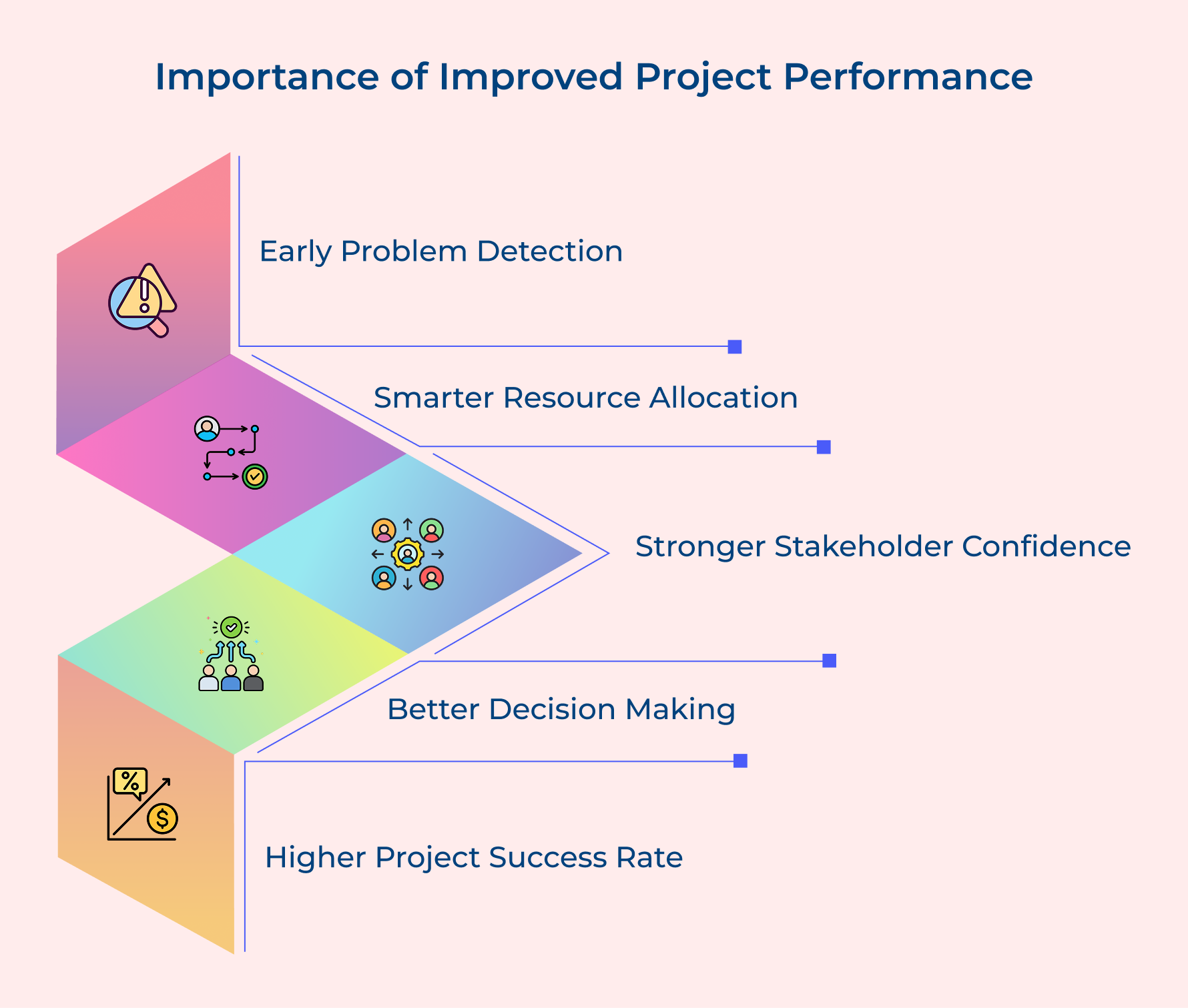
Tracking project performance is what separates projects that improve to success from the ones that fail. Let’s explore why it genuinely matters.
1. Early Problem Detection
Most projects fail to succeed due to poor performance visibility. Monitoring performance frequently helps project leaders to improve budgeting and schedule slippages early, before escalating.
2. Smarter Resource Allocation
Resource allocation and utilisation are limited in most projects, so misusing them is a risk. Performance data tells exactly where your resources, such as tools and people, are consumed to reallocate with precision.
3. Stronger Stakeholder Confidence
Stakeholders are like customers who want to trust that the project is in the right hands throughout the delivery. Consistent project performance reporting builds that trust by maximizing transparency at every phase.
4. Better Decision Making
Taking major project decisions based on assumptions instead of being data-driven can quickly break your deliverables and budget. Performance metrics help in tracking properly. They offer project leaders clarity to make faster and more accurate decisions.
5. Improve Project Success Rate
Measuring projects frequently helps to finish on time and within budget. It creates a culture of accountability where every team member understands their involvement that directly impacts the outcome.
Key Elements of Project Performance
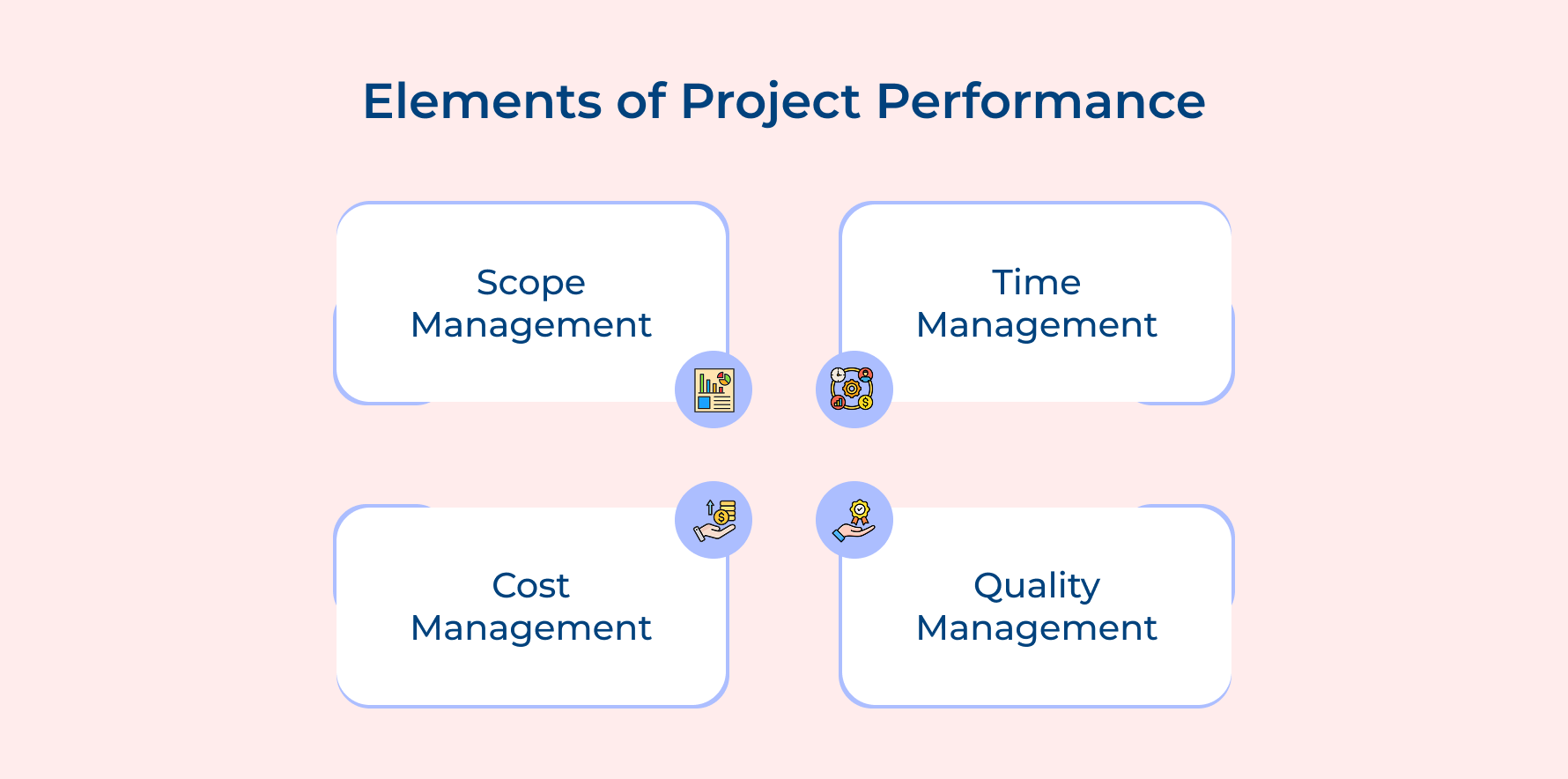
Understanding project performance goes beyond tracking and comes down to improving these core elements that drive every success.
1. Scope Management
Scope is the set of boundaries that are supposed to be delivered by keeping it under control. So what happens when there is poor scope management? Leads to endless additions of tasks from the client that drain your budget and delay delivery.
2. Time Management
Time is a resource in project management that is once lost and not recoverable. Proper time management helps in building realistic schedules to actively improve productivity and maintain performance at every phase.
What’s the key takeaway from this? It is not just about timeline management but also knowing how to protect and improve the project delivery process during unexpected delays. It is recommended to build a buffer time because real projects do not always go as planned.
3. Cost Management
The budget creeped in gradually through small, untracked expenses and poor forecasting decisions. Keep a firm grip on project costs and continuously compare with actual spending. Also, act fast when variances appear in the data.
4. Quality Management
Quality management makes sure that every project deliverable is built to the acceptance criteria, based on the stakeholders ‘ needs from the start.
The most effective way is to embed quality checks across the project lifecycle instead of waiting till review. Discovering quality in mid-project can be overcome at less cost than discovering it after the final delivery.
How Do You Measure Project Performance?
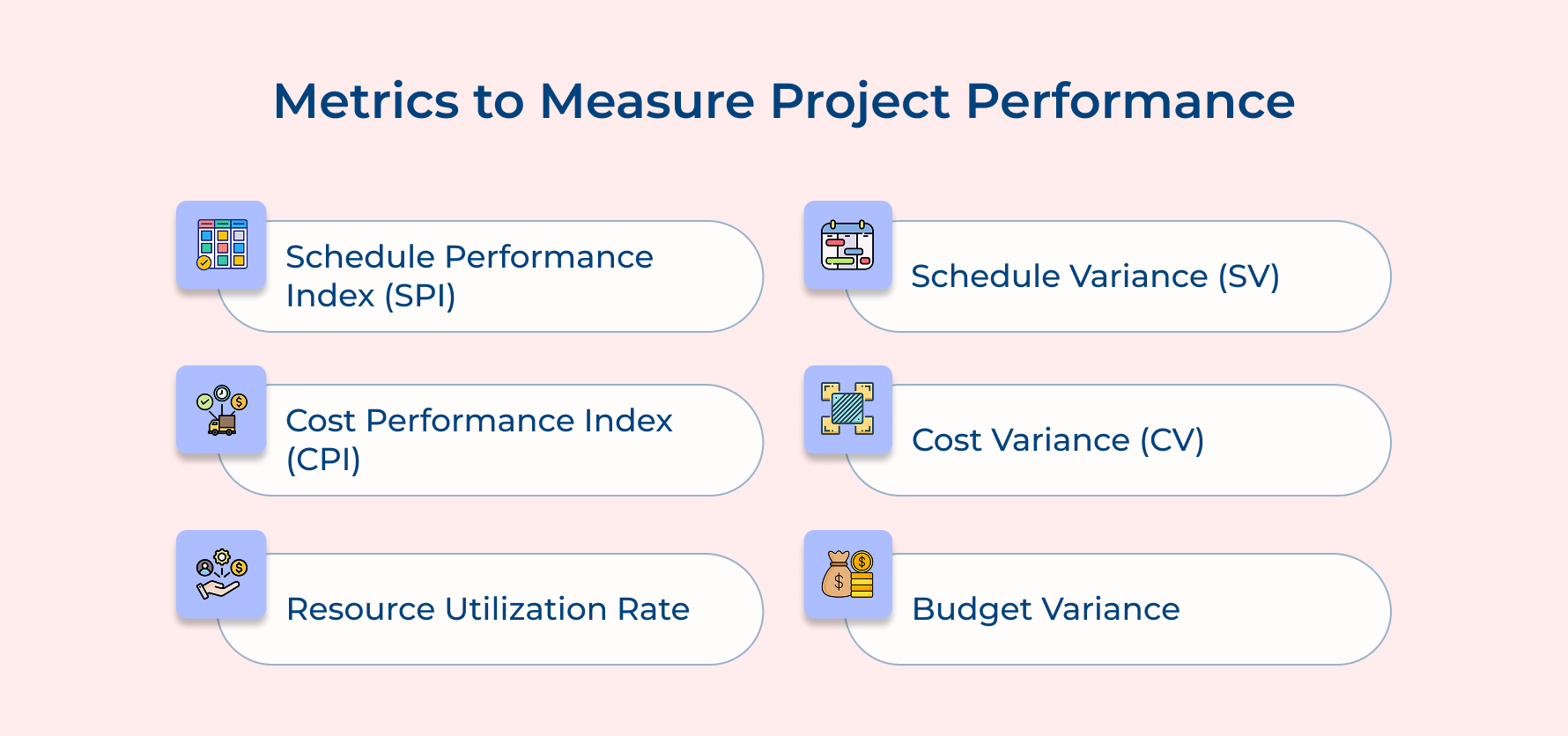
Measuring project performance is about using the right metrics that tell you the true story of the improvement and status of the project.
1. Schedule Performance Index (SPI)
SPI is the metric that any project leader checks, as it reveals whether the project is on track or not. It measures the efficiency of the team in converting planned time into actual delivery.
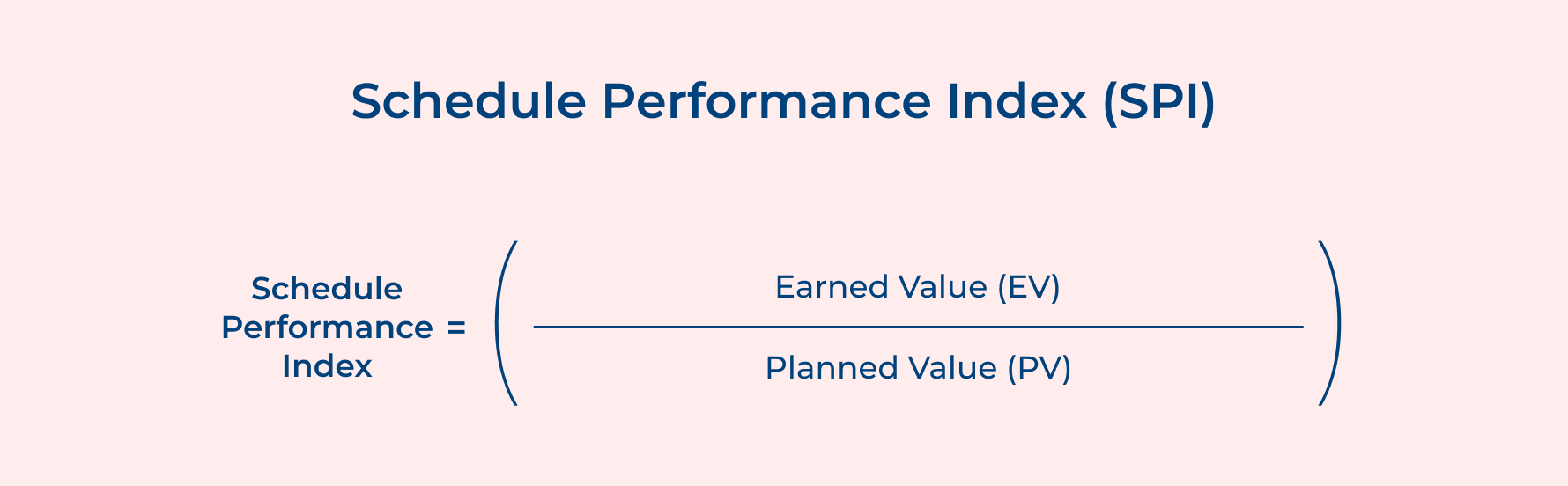
Consider these questions when reviewing SPI:
- Is the delay affecting only one phase or spreading across multiple workstreams?
- Are the right resources assigned to the right activities?
- Has the team been reporting accurate project progress?
An SPI of 1.0 does not mean everything within the project is fine. The moment it drops below 0.9 for a project, it is treated as an issue and needs direct intervention to improve the performance.
So, what is the best practice for tracking SPI? Weekly is not the right choice, as by the time a milestone arrives, the damage is already done. Break down SPI by workstream to understand areas for improvement.
2. Cost Performance Index (CPI)
CPI clear understanding of actual value being generated for every amount spent on the project. Even when everything else was going sideways, a disciplined CPI tracking has saved projects from complete budget failure.
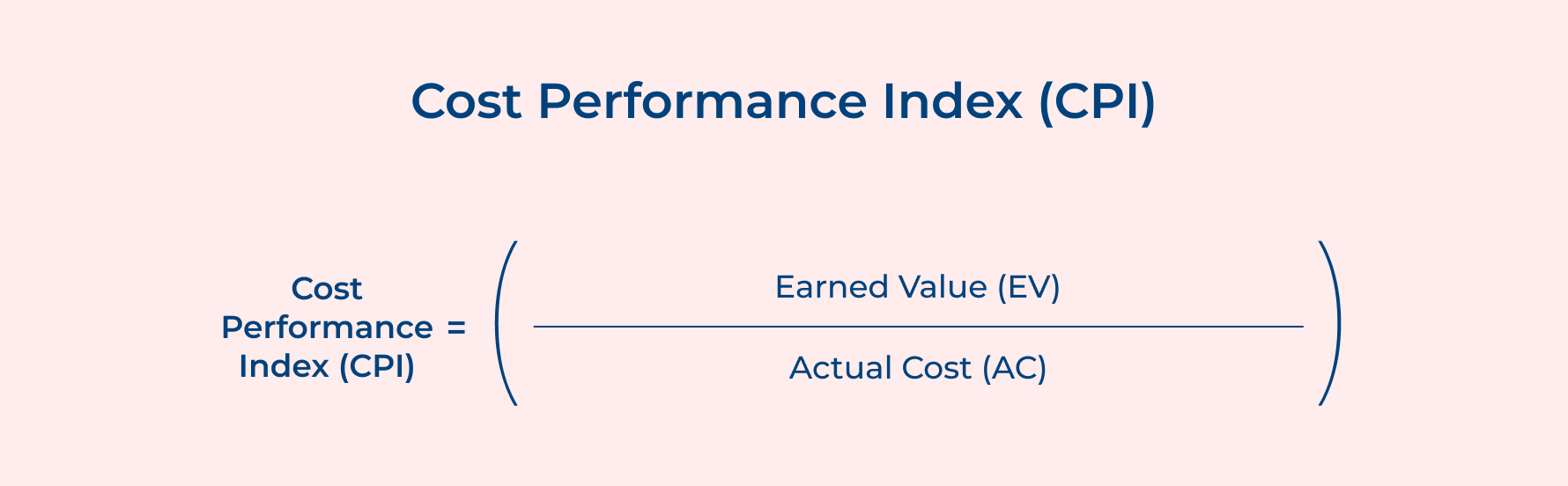
What does a falling CPI usually point to in real projects?
- Resources are taking longer to estimate because the original plan was built on assumptions
- Unplanned work quietly absorbed without any formal adjustment
- Vendor costs are running over as the scope was not defined properly.
A CPI score below 0.85 is a serious red flag for any project. It is time to collaborate on cost driver analysis when CPI trends downward for two consecutive periods.
Pro tips: Always pair CPI with SPI to understand cost overruns along with schedule delays
3. Schedule Variance (SV)
Improve your project productivity and performance by measuring schedule variance. It puts a financial weight on timeline delays. It shows the gap between the amount of work needed to complete and the work actually delivered.

Consider an example of a digital agency running a website project that tracks SV to improve the performance from 60% to 80%. SV flagged issues early enough to allow the leaders to develop the phase that was impacted.
Start investigating the reason behind the SV number instead of simply escalating it. A negative SV unaddressed always creates a project delay across every phase of the cycle.
4. Cost Variance (CV)
Cost Variance defines whether the work delivered is actually worth billing. It naturally develops a cost consciousness that makes budgeting a habit instead of an exercise.
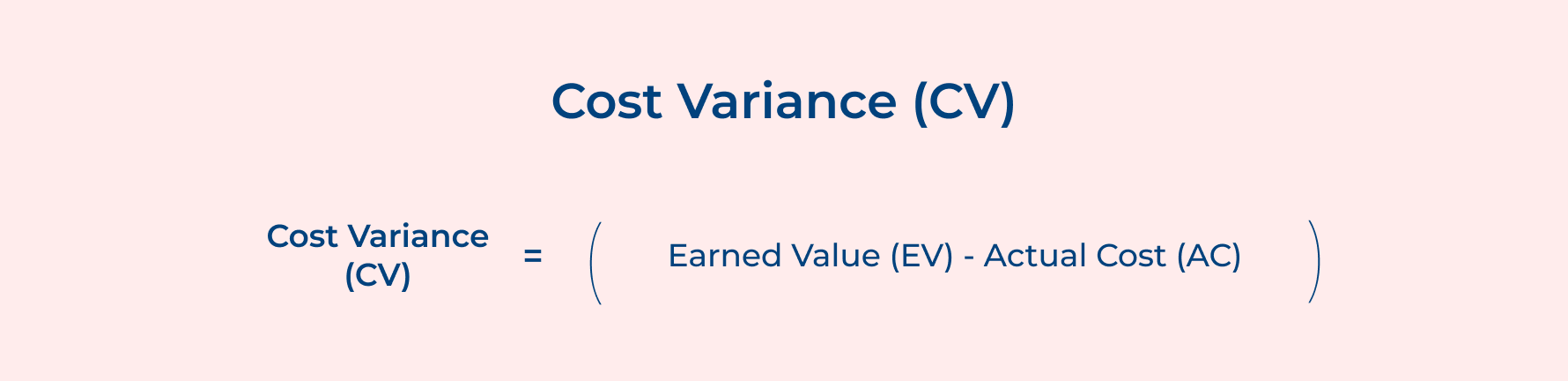
Negative CV means a structural cost problem instead of a one-time variance. It is recommended to go back to the cost baseline and define a line-by-line review to find where estimation gaps occurred.
How to improve?
- Conduct a root cause review whenever it exceeds the benchmark of 10% of the planned budget.
- Separate the CV based on deliverable category to isolate the overrun or third-party costs
5. Resource Utilization Rate
Resource utilization exposes project planning from the start to the resourcing level. Resources Overallocation can cause more project delays than any technical or scope issue.
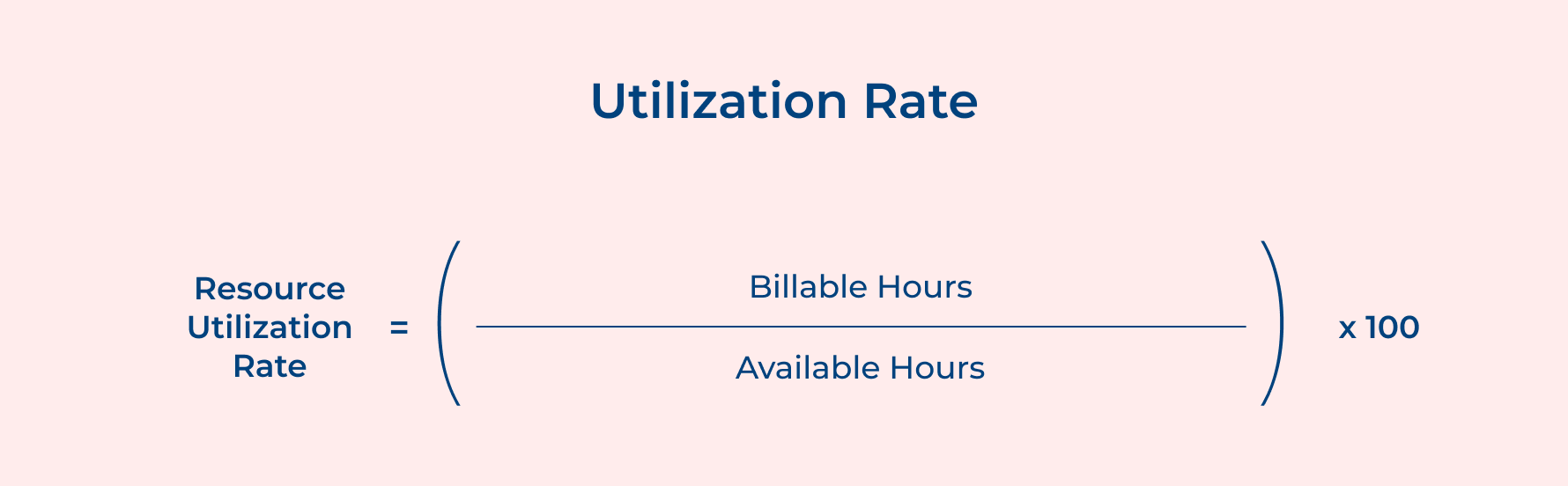
What does poor resource utilization look like in a real project?
- Situation when the same two or three people are always the bottleneck on a critical task.
- Not a proper distribution of workload across team members for most work.
The most overlooked practice that leads to project improvement is tracking resource utilization at an individual level. It helps in identifying the critical persons who are not utilised in any task, rather than the ones who are most productive.
6. Budget Variance
Budget variance gives you a clear understanding of the project’s cost spending based on the planned budget.

A positive variance means the project is under budget and no further improvement is needed. Even though it is a good result, positive variance sometimes signals that planned work is not being executed within the defined project timeline.
How to Improve Project Performance? 8 Crucial Tips to Success
Unravels eight crucial tips that can transform and improve project performance. Lets set your projects on the path to excellence and success.
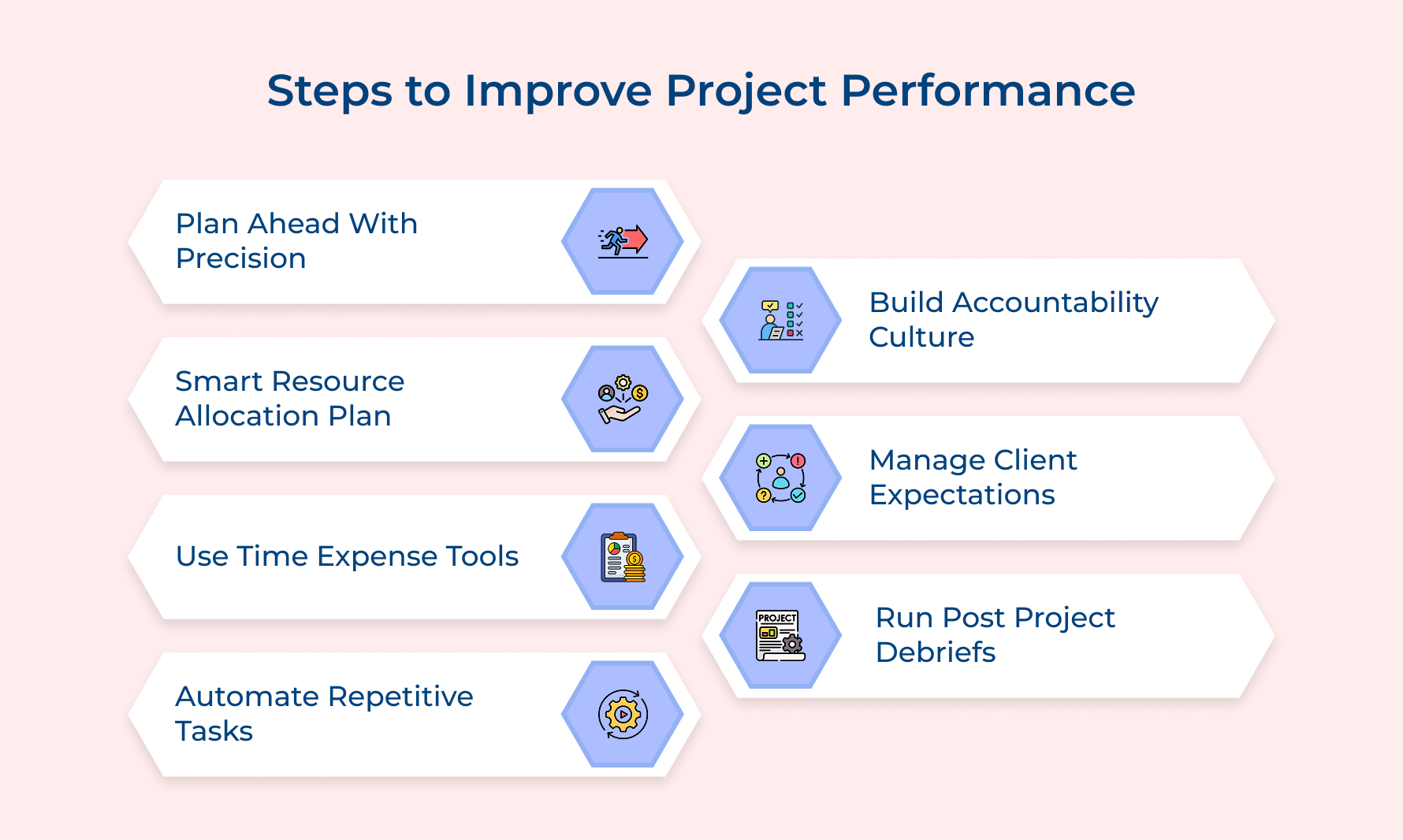
1. Plan Ahead and With Precision
Precision planning separates projects that execute cleanly from those that constantly struggle to avoid problems. It gives the team a real-time decision-making framework instead of making it just a timeline to follow.
Follow these effective ways on how precision planning translates into improving project efficiency:
- Define scope: lock down every project deliverable and exclusions before the first task is assigned.
- Build risk buffers: A plan without contingency time is like building on the assumption, so embed buffers at every phase to keep recovery options.
- Align stakeholder expectations: Get every stakeholder to a formal scope agreement and success criteria before execution to improve the budget while reducing mid-project renegotiations.
Consider an automation example, of a professional services firm that has defined scope and embedded phase buffers has improved client project performance by 20%. It eliminates budget issues that previously derailed their timelines.
2. Build a Smart Resource Allocation and Prioritization Plan
Resource allocation is all about making decisions on the team’s best capacity planning. A poor allocation wastes talent and directly damages both delivery quality.
One question to ask before finalising a resource plan is whether the highest-skilled resources are allocated to the most impactful tasks? Talent and priority misalignment are costly planning mistakes in project management.
An ideal Smart Resource Allocation Plan looks like:
- Critical path first: Before any assignment decisions, allocate the most capable resources to critical path activities.
- Workload balancing: evenly distribute your resources as it carries disproportionate responsibility.
- Buffer roles for high-risk tasks: High-complexity deliverables need a secondary resource so capacity gaps never stall.
Treat the allocation plan like a living document and not a one-time exercise for improving project efficiency. Generally speaking, rebalance assignments at every phase gate and keep the plan aligned with the project demands.
3. Leverage Intuitive Time and Expense Technology
Most project teams lose financial visibility due to disconnected time tracking and poor budgeting decisions. The right technology helps in connecting time data that directly improves project performance before margins are silently missed.
Here is an effective time and expense technology implementation looks in practice:
- Track time on the project level for accurate cost mapping
- Anomalies are flagged before they become overruns by setting automated project budget threshold alerts.
- Maintain weekly data submissions to maintain data accuracy.
When time tracking is added in your daily project work activities, it starts being a performance signal for improvement. Explore how each technology type directly strengthens execution and financial control:
- Automated time capture technology: Eliminates manual logging by automatically recording task-level time to reduce human error and make sure billing accuracy across all project activities.
- Real-time expense monitoring technology: Tracks expenditures and compares them against approved budgets to get a clear view of financial health.
- Integrated billing and invoicing technology: Connects tracked time into client invoicing to reduce billing cycle delays and make sure no billable works are missed.
4. Automate Repetitive Processes to Free Execution Bandwidth
An hour spent on repetitive tasks is similar to an hour taken away from productive execution that moves the project forward. So here comes the question: how can you improve project productivity and execution? Automation. It protects the team’s focus and redirects them toward high-value delivery work.
Explore the impactful use cases of automation for project performance improvement:
- Automated status reporting: Automation pulls live project data instantly without manual intervention. Stakeholders always get accurate updates and the project team reclaims hours lost to administrative work.
- Deadline and budget alert triggers: Automated notification for the right people the moment a task is based on a threshold. This makes your team proactive intervention before variances convert to serious problems.
- Automated handoff between dependent tasks: The moment one task is done, automation immediately triggers the next owner to begin their work. It eliminates manual handoffs and keeps project momentum intact.
Is there a risk of over-automating? Yes, poorly configured automation generates false alerts and inaccurate reports can mislead the team at critical moments.
Overcome it by starting to audit every automated workflow during setup and validating that triggers are accurately mapped in the real project.
5. Build a High Accountability Team Culture
Accountability cannot be generated on your own instead get deliberately engineered based on team operations from the start. Projects without clear ownership structures struggle with missed deadlines.
Explore why accountability directly impacts project performance:
- Ownership drives delivery: A single owner for each deliverable eliminates ambiguity without constant follow-up from leadership.
- Visible commitments reduce slippage: Individual commitments should be visible to the entire team so that people follow through because accountability becomes a shared standard.
Accountability gaps quietly accumulate until a critical deadline is missed. So, start building ownership into the team structure to stop those gaps from forming in the first place.
Pro tips: Make task ownership and deadlines visible to the entire team on a real-time dashboard.
6. Manage Client and Stakeholder Expectations
Managing stakeholder expectations is a core performance discipline that directly determines project success.
What are the causes of stakeholder disappointment? Unrealistic timelines that cause team burnout. You can overcome it by setting an honest timeline to build credibility and protect the team from unsustainable pressure. Examples of a realistic timeline that you can set:
- For a mid-sized firm, set from 6 to 8 weeks, including two revision rounds
- Projects such as website redesign for a services client set 10 to 14 weeks from launch
Absorbing a scope change silently and hoping it does not impact the timeline is the costliest mistake anyone can make. Here are key elements that make scope change effective:
- Early Flagging
- Impact Transparency
- Formal Approval Trail.
Consider a situation where stakeholders discover a project problem before the leader, which means a leadership failure. Surfacing problems early with a resolution plan keeps stakeholder trust intact.
7. Conduct Structured Post-Project Performance Debriefs
A post-project debrief is an underutilised performance improvement tool available to any team. They move to the next project, carrying the same inefficiencies without solving them.
So, how to make post-project debriefs?
- Structured stop-start-continue review: Identifies the stop and start of the project, along with what is working well. It provides honest ground-level insights that cannot be achieved through a top-down review.
- Key performance indicators variance walkthrough: The moments you track planned versus actual results on every key metric, it reveals exactly where the project stands in the cycle. The data-driven approach gives the team concrete patterns to fix in the next project plan.
Debrief insights only provided value when they were fed directly into the planning process. A lesson embedded into the next project plan helps in improving project efficiency that actually moves performance forward.
Roles of Project Management Skills in Project Performance
Strong project management skills are the direct engine behind consistent as well as reliable project performance.
- Turning ambiguity into a clear execution: Skilled project managers can convert unclear objectives into structured plans that team members can execute.
- Keeping delivery aligned with business objectives: The right skill makes sure a day-to-day execution that never drifts from the business outcome. Teams that are not aligned with this often deliver on time but completely miss the actual point.
- Making high-pressure decisions without information: Waiting for perfect data before deciding is what most projects cannot afford, but doing this keeps your project momentum intact.
- Resolving team and stakeholder conflicts before they escalate: Project managers with the right skills address tension at the source before it spreads across the entire team.
- Continuously improving performance across project cycles: Strong project management skills are the process of how to extract lessons from every project to improve. It separates teams from those that consistently raise performance.
Master the Art of Efficiency By Improving Project Performance
Improving project performance is a delivery discipline that sharpens with every project completion. Teams that are able to master it are working with better visibility and tighter execution systems.
- Track the right metrics so small variances never bulk up into unrecoverable delivery failures.
- Build accountability structures so that ownership gaps never accumulate into missed deadlines.
- Every metric tracked is combined into a team that consistently delivers beyond expectations.
Start applying these strategies to your next project and measure the difference. Real project performance improvement starts from the moment leaders stop reacting to problems and start building and focusing on preventing them.
Limit time — not creativity
Everything you need for customer support, marketing & sales.

Neeti Singh is a passionate content writer at Kooper, where he transforms complex concepts into clear, engaging and actionable content. With a keen eye for detail and a love for technology, Tushar Joshi crafts blog posts, guides and articles that help readers navigate the fast-evolving world of software solutions.