Consulting Pricing Models to Maximize Profitability & Growth
- What Are Consulting Pricing Models?
- How do the Consulting Pricing Models Help?
- Pricing Model Benefits for Consulting Firm
- 7 Most Common Pricing Models for Consulting Business
- How to Implement Consulting Pricing Models Effectively?
- How to Choose the Consulting Model That Suits Your Needs?
- Propel Your Consulting Business With Data-Driven Pricing Strategies
- FAQs about Consulting Service Pricing Models

Key Highlights:
- The wrong consulting pricing model can kill your revenue and attract client misalignment to your firm.
- When your track record clearly justifies value-based and outcome-based pricing strategies will command premium fees.
- A clear documentation of your consulting pricing model to remove inconsistency and build credibility across the client proposal.
Consulting firms are consistently undercharged despite delivering measurable client results because of how fees are structured from the start.
A recent report from the Hinge Research Institute study shows that high-growth consulting firms use value-aligned models. Flat or declining revenue-based firms are more focused on tiered pricing. When there is a misalignment in consulting pricing strategies, it quietly reduces the profit.
The complete guide will help you to understand major consulting pricing models, from hourly rates to hybrid structures. You will know the exact model that fits your business and how to implement it without losing trust.
What Are Consulting Pricing Models?
Consulting pricing models are advanced frameworks that define how a consultant or a client charges based on their expertise and value delivered. These models go beyond simple fee-setting. It directly affects the structure and management process of the entire client engagement in firms.
How do the Consulting Pricing Models Help?
The right pricing model directly shapes how clients maintain the value of consulting services. It removes ambiguity, building trust in the first conversation.
A consulting pricing model helps reflect a business philosophy for measuring and exchanging the value delivered. When you choose a suitable model, it signals that the firm is confident enough in understanding client needs.
Primary objectives:
- Clarity: The framework sets transparent expectations for both parties to understand billing in details
- Value alignment: A good pricing consulting model makes sure the fee structure reflects both the hours spent and the business impact.
- Profitability protection: Safeguards earnings by preventing scope creep from affecting project margins.
- Client trust: remove financial surprise to build long-term client relationships.
Pricing Model Benefits for Consulting Firm
The best consulting pricing strategy helps in shaping client relationships, protects margins and drives sustainable growth. Let’s explore the benefits of this model in detail:
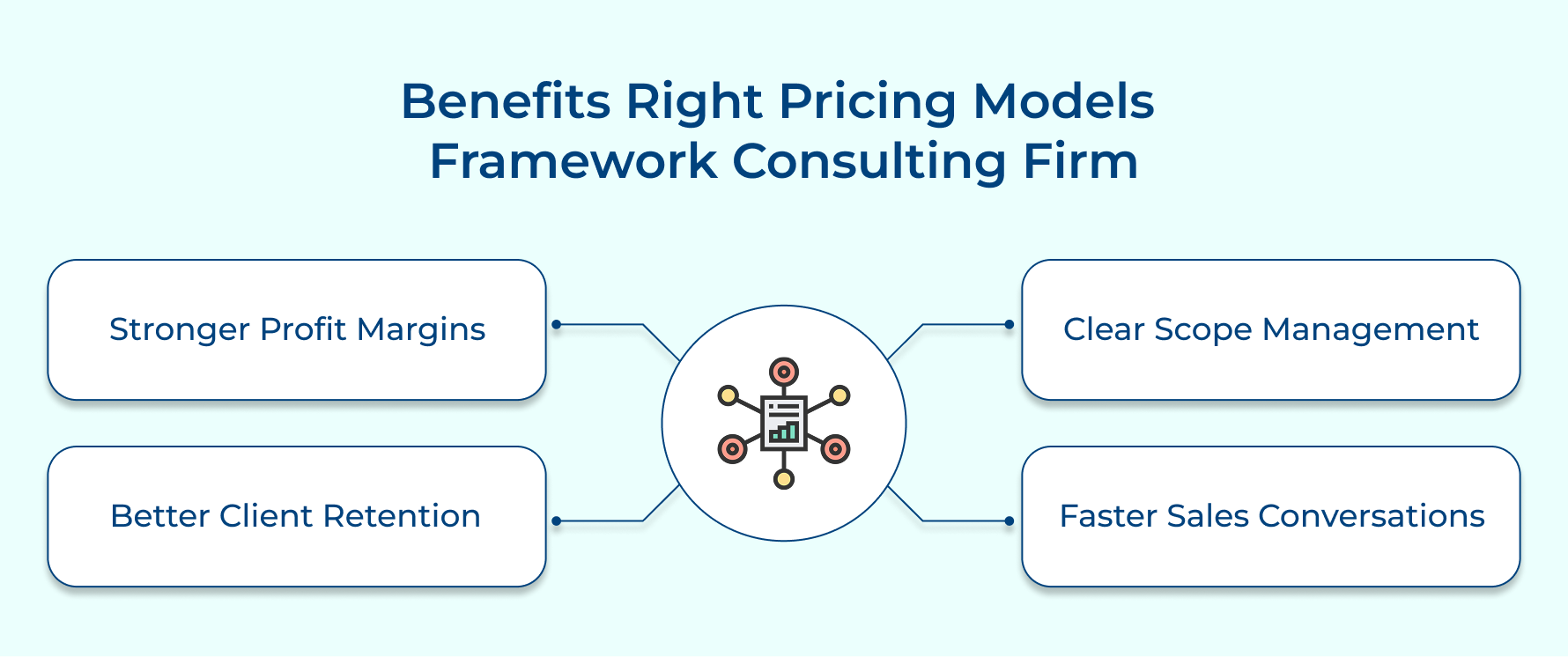
Stronger Profit Margins
A well-defined pricing framework helps your consulting firm be billed for the value delivered. It makes sure that the firms maintain a higher profit margin in comparison to those who are relying on basis billing.
Clearer Scope of Work Management
When pricing gives a defined outcomes consultant as well as client stay aligned across the engagement. It creates seamless boundaries around consulting project deliverables, which reduces any pricing risk of scope expansion.
Improved Client Retention
The moment you offer a transparent pricing structure, your clients will become loyal. A consistent model helps in maintaining financial trust. It is one of the strongest drivers for repeat business.
Faster Sales Conversations
You can remove ambiguity from proposals to shorten the decision-making cycle for each client. When clients get a transparent view of exactly what they are paying, it improves conversion rate.
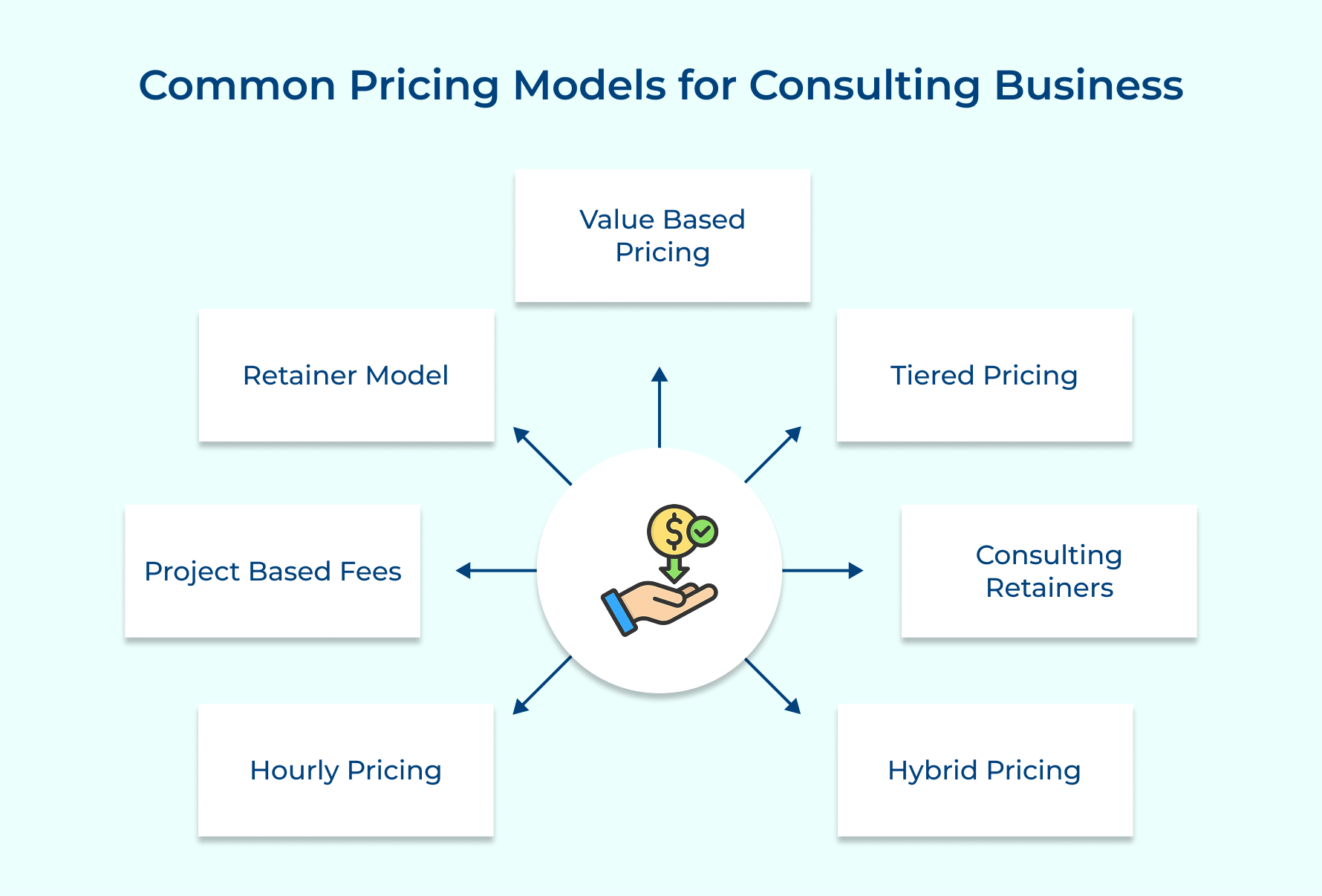
7 Most Common Pricing Models for Consulting Business
Understanding and choosing the best pricing strategy that fits your consulting practice helps in maintaining a sustainable growth and constant revenue.
1. Hourly Pricing Model
The hourly pricing model bills clients only for the amount of time spent on a project and makes sure consulting firms are paid accurately. It keeps the billing structure simple and easy for justification.
Not sure how to implement this pricing model in a real consulting service? Here is the catch.
- Define a clear consulting rate by industry, expertise level and market benchmarks before client onboarding.
- Maintain a document for every billable activity so your clients know exactly what activities will be in their invoice.
Consider an example of a consulting firm that converts client billing from $300 to $330 per hour with this pricing strategy. It helps the firms to maintain transparency and also get a correct price.
Pros:
- Easy for clients to understand without lengthy proposal negotiations
- Scalable model to make sure consultants are fully compensated based on project complexity.
The model pricing works best for early-stage firms that handle short-term project work. It also suits other business consulting industries such as IT or legal advisors, where pricing rates are varied by time spent and complexity.
2. Project-Based Fees
Project-based pricing works on a fixed price for clearly defined deliverables and both parties are transparent in pricing. Think of this model as a reward system for your consulting firm because faster project delivery increases the hourly rate.
A general question that arises is whether this pricing model is the right fit for your consulting services? Yes, if the project has a clear start point and a defined deliverable. It helps in creating a clean client relationship where expectations are locked before project work begins.
Follow this step to roll out this model in your firm effectively:
- Define scope: Make clear documentation for every deliverable before quoting to eliminate assumptions.
- Cost estimation: Calculate internal time as well as resource costs, followed by applying a profit margin.
- Milestone billing: Based on the project milestone, split the total fee into payment phases.
Consider an example, a branding consulting business quotes $12000 with this pricing strategy for an identity project. It helps to split the fee into two payments, with 50% collected upfront before the start of project work.
3. Retainer Model
The model maintains a recurring monthly fee in exchange for consulting access and delivers revenue predictability.
The retainer framework in a consulting firm works by defining a set number of hours or services the client receives each month, with respect to the pricing. It remains available within agreed parameters without renegotiating project contracts repeatedly.
Consider these questions before committing to a retainer model:
- Does the client have recurring consulting needs beyond a project?
- What is the client willing to commit to a multi-month engagement?
- Will the consulting work generate enough value to justify the monthly fee?
So, how do you actually implement without overcomplicating? Identify existing clients who are reaching for guidance. Propose a retainer fee that formalizes and defines the scope of work clearly in an agreement. Also, include a quarterly review clause to adjust terms as the project scales.
When to use the retainer model?
- Ongoing advisory roles: When clients need continuous strategic guidance instead of one-time solutions.
- Long-term transformation projects: the pricing model is Ideal for change management in the consulting business that unfolds over several months.
4. Value-Based Pricing Model
This framework anchors the consulting fee to business outcomes instead of time invested. It changes how clients evaluate consulting ROI. Consulting services that master this model consistently command premium fees as the pricing shifts from project cost to business impact.
Core variations of value-based pricing are used:
- Outcome-based pricing: The fee is tied directly to a specific result, such as revenue growth or cost reduction.
- ROI-based pricing: Charges a percentage of the financial return the client gains.
So when should a consultant use each variation? Outcome-based pricing is suitable when project results are clearly measurable and ROI-based pricing is used in financial engagements where profit is measurable.
Consultants must address it honestly before proposing this pricing model. If the refined outcomes are not achieved, the fee justification becomes difficult and can affect the relationship.
5. Tiered Pricing
Your client will receive multiple service packages at different prices and enable consulting firms to serve a broader budget range with this framework. The tier system sets project deliverables to guide clients toward higher-value packages.
Pros:
- Generate upselling opportunities within the existing client base
- Allows firms to serve both emerging clients under one pricing structure
Cons:
- The tier system can confuse clients and create delivery inconsistencies
- Lower-tier packages have a risk of attracting high-maintenance clients who consume disproportionately.
Here is the main question: Which consulting firms can benefit from this tiered pricing? firms offering repeatable project services such as SEO audits or financial health assessments.
Implement the framework with its steps:
- Define clear tier names: Use focused labels such as Starter, Growth and Scale instead of simple Bronze or Gold labels.
- Differentiate meaningfully: Make sure each tier offers a genuinely distinct level of depth or instead of just hours.
- Anchor the mid-tier: steer most clients toward your business by making the middle package the most priced.
6. Consulting Retainers
Unlike project-based work, this pricing model creates financial stability for the consulting services, giving clients consistent strategic support after month.
Wondering how this model is different from a standard retainer model? It goes beyond simple availability and includes defined advisory sessions with proactive input. It helps in keeping the client confident in moving forward on project goals without any crisis.
Pros:
- Offers a predictable monthly recurring revenue to support firm-level financial planning
- Consultants are considered trusted advisors for improved client relationships
This pricing strategy is best for experienced consulting firms with an established client base and a defined area of expertise.
Pro tips:
- Protect consultant availability with specified response times and communication channels.
- Reassess project scope and make sure retainer fee remains mutually valuable with regular check-ins.
7. Hybrid Pricing
The model is a combination of two or more pricing structures to give consulting firms the flexibility to align fees with deliverables. Powerful for complex project engagements where a single model use would create unnecessary financial risk.
The two most used hybrid combinations are:
- Retainer plus performance bonus: A monthly base fee with a combination of a results-based bonus for specific project milestones.
- Tiered retainer with outcome kicker: A fixed retainer model as a base supplemented by a success fee when project goals are achieved.
One drawback that needs to be considered is that hybrid pricing adds complexity. Overcome it by fully aligning each component so that your clients are aware. Without a detailed agreement, the model creates damaged relationships over time.
How to Implement Consulting Pricing Models Effectively?
Evaluating the right pricing strategies for your consulting services helps in building a system that reflects value and protects your business. Let’s explore the steps in more detail for better understanding:
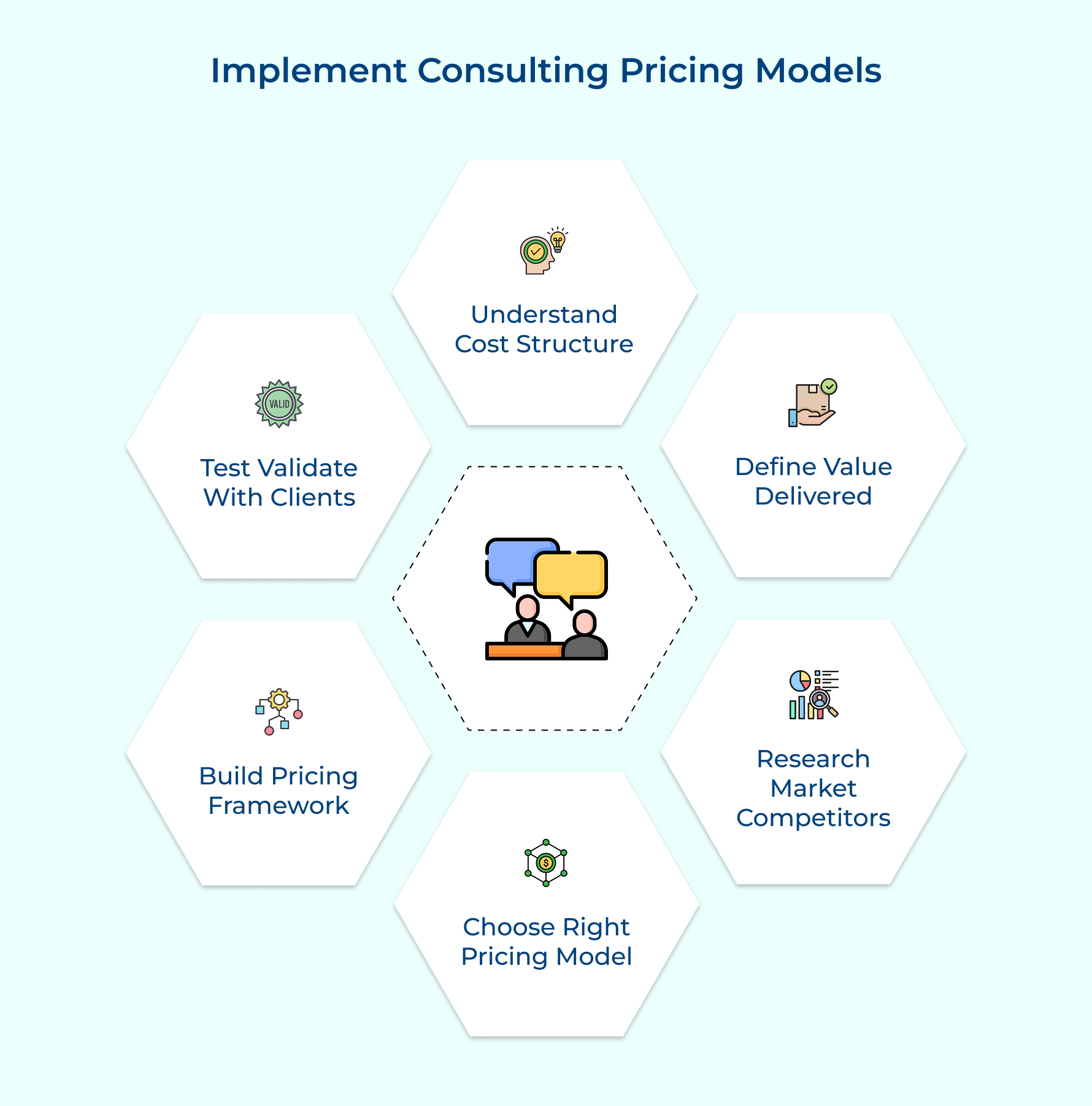
1. Understand Your Cost Structure
Before choosing and implementing this best consulting pricing strategy, get complete clarity on the total costs needed to deliver the work. Skipping this step can directly affect the business outcome.
Don’t know where to start evaluating your costs?
- What are your monthly costs of running the consulting firm?
- How many billable hours are available after admin and business development
- What is the minimum hourly rate needed to cover costs and generate a profit margin?
Getting these numbers correct helps in creating a financial baseline that no project should ever be priced. Without setting it, even from a high-paying client, you can drain profitability over time.
Pro Tips:
- Before calculating any minimum billable rate, break down costs into fixed or variable buckets.
- Perform this assessment every short span, for business costs shift over time and outdated numbers.
2. Define the Value You Deliver
Understand that the cost structure is only 50% of the work, while articulating the measurable value is the key that consulting work creates for clients. Consultants who cannot communicate their value will struggle to justify premium pricing.
The following lenses help to define and document consulting value:
- Revenue impact: Does the work directly help clients grow revenue?
- Cost savings: Does the engagement eliminate inefficiencies that are costing the client money?
- Risk reduction: Will it protect the client from costly decisions or failures?
So how do you convert it into a real pricing conversation? Quantify outcomes in the client’s own financial language before any project fee. It helps in building trust toward your business and helps increase loyalty.
A common challenge firms face during the implementation is the difficulty in quantifying concrete financial terms. How to avoid it? Collecting past client data helps in documenting case evidence, which is the most effective way to anchor value conversations.
3. Research Your Market and Competitors
Generally speaking, setting a new pricing model without knowing the market is one of the most common mistakes consulting firms face at each stage. Strong research gives a detailed reference point and price confidence.
Follow this practical research checklist before finalizing:
- Evaluate pricing ranges published by competing consulting firms
- Analyze clients in the target market to look for similar engagements
- Identify if the market works toward hourly project billing -based on structure
The goal of this step is not just to copy pricing but also to understand where your firm stands in the current market. Positioning above is entirely achievable when the value proposition is clearly defined.
Effective methods to research your market accurately:
- Direct competitor analysis: Study the service pages to identify competitors’ pricing packages and position their pricing.
- Industry rate benchmarks: Use published consulting rate reports recognized by industry sources to validate the actual fee.
4. Choose the Right Consulting Pricing Model for Each Engagement
The right framework depends on the different clients your firm handles. Using one model across all client engagements leads to real profit risk. A clear decision framework that matches the pricing model with the nature of work delivered.
Consider this question for selecting a pricing model:
- Is the scope clearly defined, or will it carry a high risk of scaling over time?
- Is the client buying a deliverable access to strategic expertise?
- Will the outcome be measured in quantifiable business terms?
Firms that have clear objectives suit fixed-fee pricing, while an ongoing advisory is better structured as a retainer. The right match of the casting pricing model from the start protects both profit margins and expectations.
Follow this quick model-matching guide:
- Short defined scope: Use a fixed fee pricing
- Strategic advisory: Use either retainer or consulting retainer model
- High-impact work: implement a value-based or outcome-based pricing model
5. Build and Document Your Pricing Framework
Pricing models only become a strategy when it is documented and consistently applied across the entire consulting practice. Without a proper framework, your firm will price inconsistently, leading to confused clients and affecting brand credibility.
So what does a consulting pricing framework include? It should cover standard rate cards for each service and clear rules for price adjustment, based on specific situations. Core elements to be included:
- Rate card: Specify fees for each service tier across the practice
- Discount policy: Set clear discount rules with a maximize threshold
- Scope change process: Proper documentation for pricing work that falls outside the original project agreement
- Review schedule: Timeline for updating pricing across all service lines
Consider an example of a mid-sized professional service or firm that documents its pricing model across three tiers. It enables the consultant to quote consistently and close engagements without escalating decisions.
6. Test and Validate Your Pricing With Real Clients
During actual project negotiation, the most accurate pricing feedback comes from a real client. Also, testing pricing reveals the fee structure correctly before it becomes a costly pattern for your client.
Key signals to look for during client pricing conversations:
- Clients accepting fees without hesitation is the key signal that pricing is too low
- Price pushback without value objections signals a communication problem
- Improving conversion rates to unbundle services often suggests a tier restructuring
Testing a new pricing model across some consecutive projects helps the consulting business to track friction. It gives evidence to refine confidence rather than reacting to client response.
How to Choose the Consulting Model That Suits Your Needs?
Choosing the right consulting pricing model to understand your business and matching it honestly with the right structure.
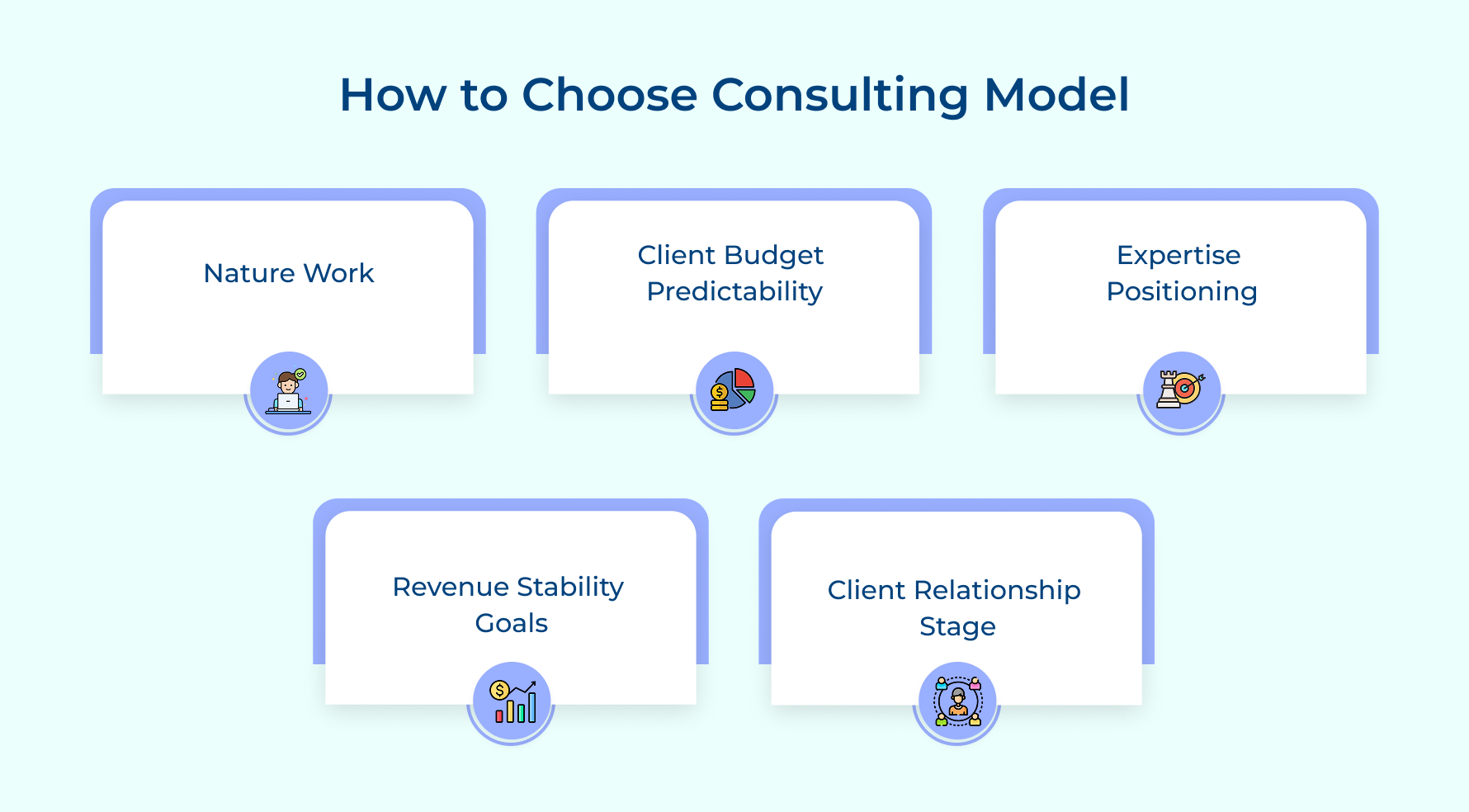
Nature of the Work
A clear business scope helps to select a model that protects both profitability as well as client trust. For example, a Project-based pricing strategy is best for well-defined deliverables, while retainer work is ideal for ongoing advisory engagements.
Client Budget Predictability
Some clients with a business need fixed costs for internal budget approvals, while others need variable costs. It helps in proposing a model that makes the billing process frictionless from the buying decision.
Your Expertise and Positioning
Consultants that are having specialized expertise are recommended to use value-based pricing over hourly models. The strong track record exists to shift away from time-based billing completely.
Revenue Stability Goals
Use retainer or tiered pricing over one-off project fees if you prioritize predictable cash flow. Choose recurring revenue models to create the financial stability for business growth and hiring confidently.
Stage of the Client Relationship
Existing clients are trusted and far more receptive to value-based pricing, while newly acquired clients need a lower-commitment project engagement. It helps to define the proper pricing structure effectively.
Propel Your Consulting Business With Data-Driven Pricing Strategies
Pricing is the key business decision for your consulting firm that directly signals the value you deserve. When done wrong, even a strong project delivery will never convert it into sustainable profitability.
- The right consulting pricing model must directly align with the value clients actually receive.
- Removes guesswork and keeps every client conversation grounded in confidence with proper documentation.
- Regularly testing and refining your model helps in turning pricing into an advantage.
Audit one active engagement against the models. Small consulting pricing strategies applied now will lead to significantly stronger margins across your entire business. Firms that treat pricing as a strategic lever are consistently scaling.
Limit time — not creativity
Everything you need for customer support, marketing & sales.

Neeti Singh is a passionate content writer at Kooper, where he transforms complex concepts into clear, engaging and actionable content. With a keen eye for detail and a love for technology, Tushar Joshi crafts blog posts, guides and articles that help readers navigate the fast-evolving world of software solutions.