A Complete Guide to Customer Onboarding for Better Retention
- What is Customer Onboarding?
- Essential Customer Onboarding Models to Consider
- Key Benefits of Customer Onboarding
- How Does AI Ensure Efficient Customer Onboarding?
- 7 Actionable Steps to Implement Customer Onboarding Process
- How to Measure Customer Onboarding Efficiency? 5 Key Metrics
- Best Practices for Onboarding New Customers
- Customer Onboarding Process Examples
- Turning First Impressions Into Lasting Connections With Customer Onboarding Process
- FAQs about Client Onboarding
Key Highlights:
- Most organizations are losing customer and are increasing customer churn rate due a broken onboarding process
- AI changes the shape of customer onboarding into a smarter process by predicting churn before customers raise a concern.
- Choosing the right model of onboarding directly shapes your client retention outcomes and loyalty.
Ever wondered why most customers leave your business? It has nothing to do with your service quality. Businesses lose customers not due to a bad offering but also due to a broken onboarding process.
Only 37.5% of new users completed onboarding and became active, while some of the best companies activated customers at a double rate.
The real question is which side of the gap your business sits on and is that affecting your customer retention?
Let’s explore a detailed guide covering customer onboarding meaning, models and steps. Also, explore the best practices built specifically for professional service businesses.
What is Customer Onboarding?
Customer onboarding is the process of guiding new clients across the entire journey to adopt and derive value. It bridges the gap in a long-term relationship between the customer and business.
What is the Importance of Customer Onboarding?
Customers that have a poor onboarding experience are most likely to shift to competitors. Before they even see the real value you offer. Is getting onboarding right the most important investment? It’s non-negotiable.
Think about when a customer used your service for three days and then left. It is where the importance of a client onboarding takes responsibility to shape their perception while directly impacting your retention and churn rate.
Things to consider:
- Mention what success looks like for each customer from the first day.
- Tailor the journey based on specific needs and use cases.
- Reach at the right moments without overwhelming to improve customer satisfaction
- Track progress so both you and the customer know what their current progress is.
Essential Customer Onboarding Models to Consider
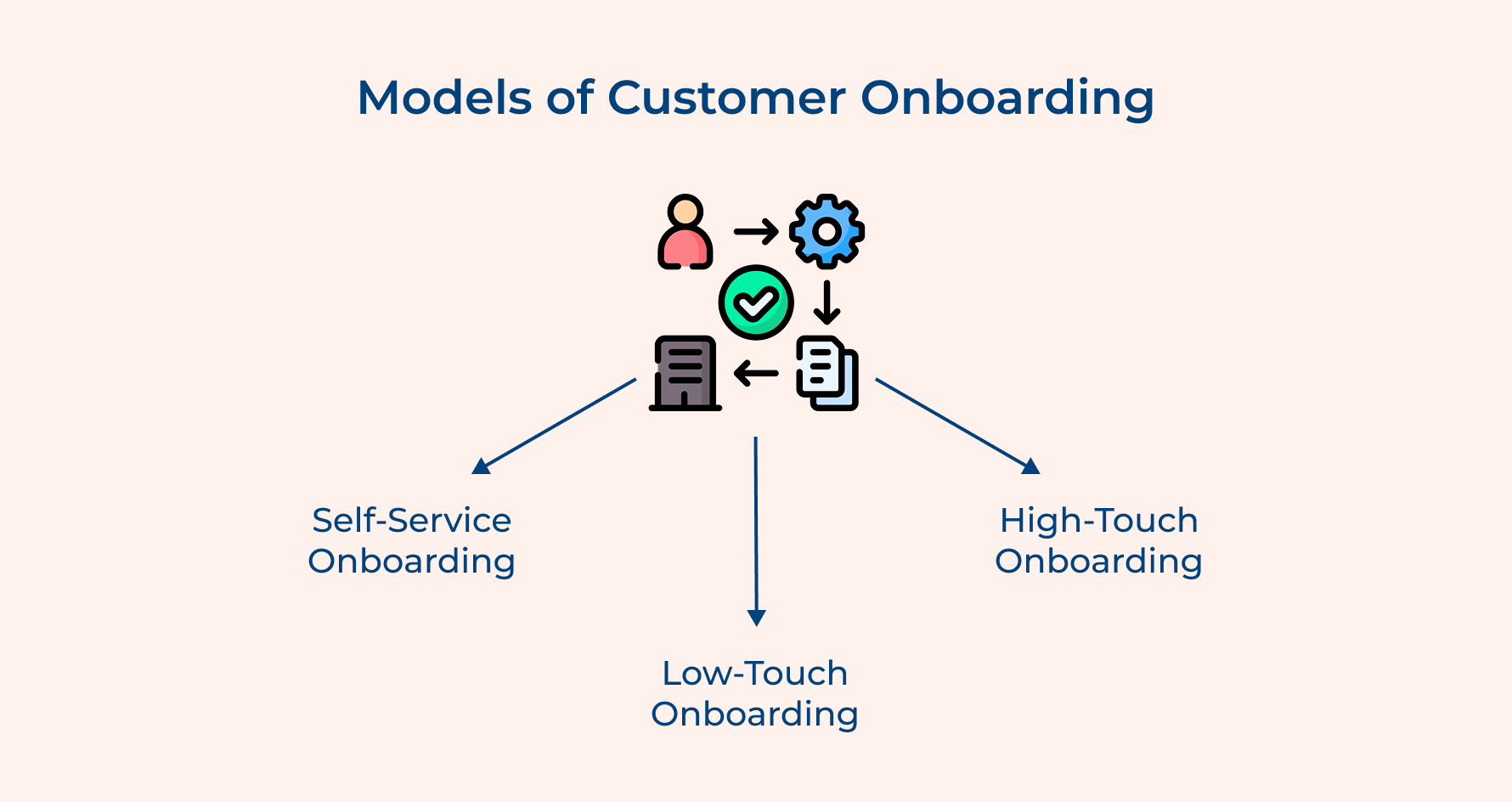
Choose the right model from the list based on your business Process to enhance the client onboarding experience.
1. Self-Service Onboarding
The model works as a self-onboarding process using pre-built resources like guides and video walkthroughs. It works best for professional services that need minimal human intervention.
Clients can move at their own pace without waiting for a scheduled call. The key is to make sure your self-service content is clear enough to answer questions before they arise.
What makes self-service onboarding work effectively?
- Resource quality: Well-structured guides and FAQs that solve customer problems.
- Intuitive flow: Tell your customers clearly that the next step in onboarding is to keep it natural.
2. Low-Touch Onboarding
Low-touch onboarding model blends automation with human support to guide customers throughout. It is best when clients need some hand-holding but not an account manager.
Automated emails and check-in calls at key milestones make the model unique without heavy resource investment.
What defines a strong low-touch onboarding experience:
- Automated touchpoints: Timely emails that respond to where the client is in the journey.
- Scheduled check-ins: Brief human interactions at important stages in customer onboarding help to streamline.
- Self-help backup: A knowledge base supports clients between touchpoints.
3. High-Touch Onboarding
High-touch onboarding is a fully personalized experience where a dedicated customer success team works closely with the client at each step. It is best suited for complex services where the values are high.
What do customers expect in this model? Your success team should provide a white-glove treatment and a deep understanding of their goals early. Act less like a vendor and more like a strategic partner.
Key Benefits of Customer Onboarding
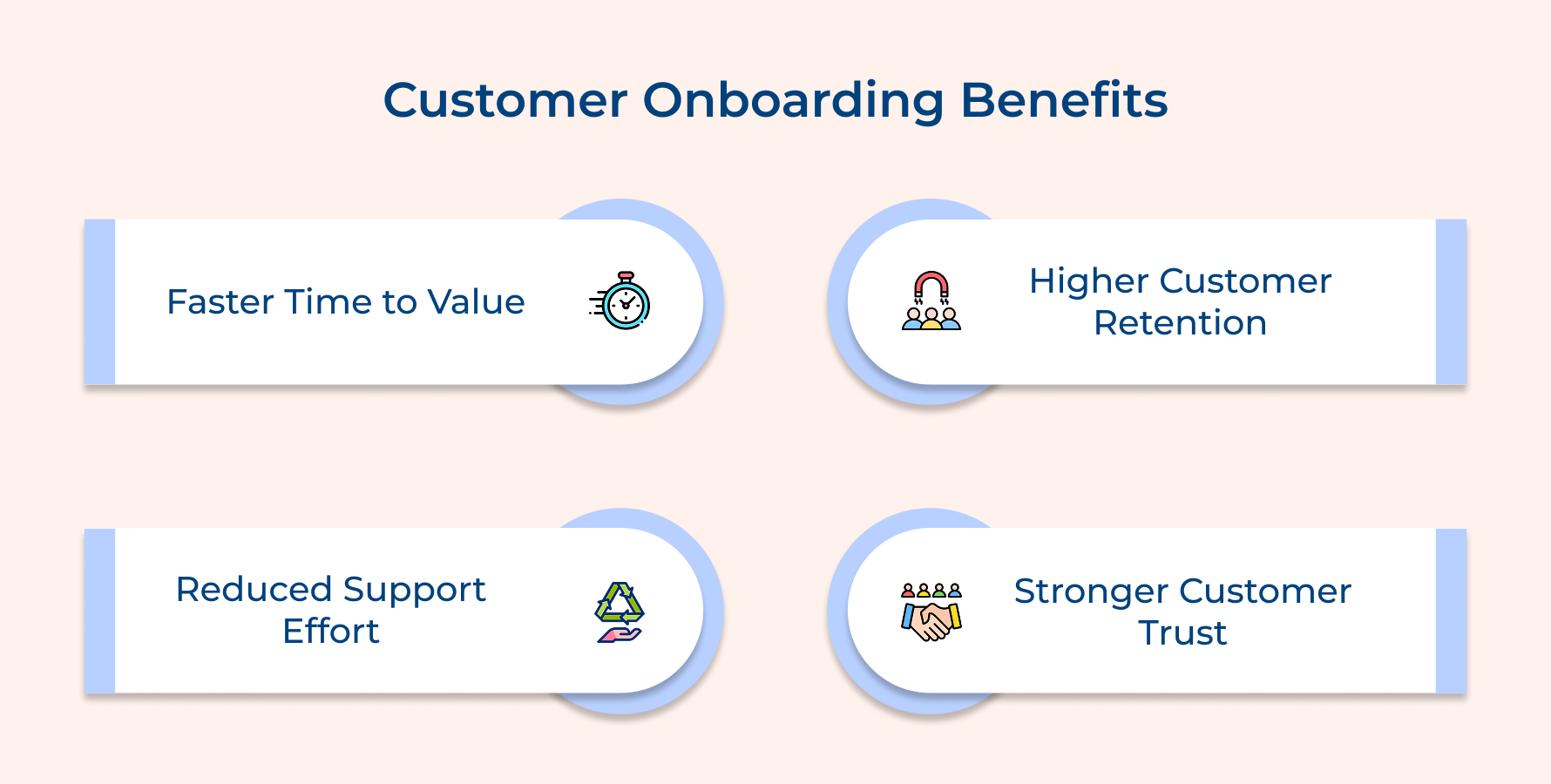
The following benefits of customer onboarding are not theoretical, but measuring it shows the importance in your business outcome.
1. Faster Time to Value for Customers
Structured onboarding means replacing the guesswork and increasing customers’ adoption process. When customers experience value, confidence solidifies before the doubt escalates.
2. Higher Customer Retention Rates
A good onboarding process improves customer retention strategy. It understands the service and knows how to extract value by thinking about retention as a win or loss within the first days of onboarding.
3. Reduced Support Burden on Your Team
A well-designed onboarding process answers client questions before they become support tickets. The support team spends more time delivering strategic value when customers are onboarded with clarity.
4. Stronger Customer Relationships and Trust
Onboarding is the customer’s first interaction with your success team that sets the tone for the entire relationship ahead. It develops a level of trust that makes them significantly more forgiving when issues arise.
How Does AI Ensure Efficient Customer Onboarding?
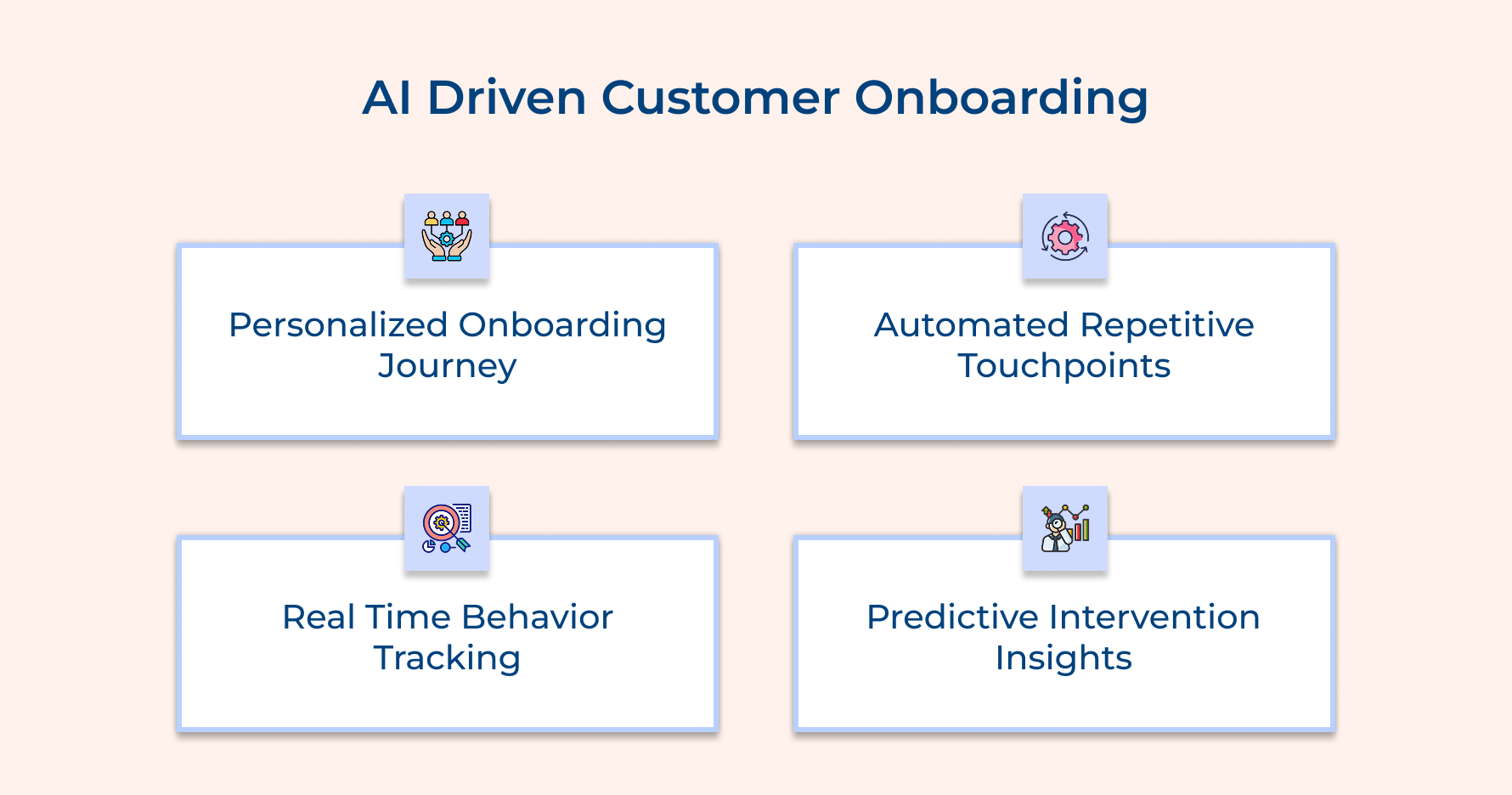
AI makes the onboarding process frictionless to reduce churn rate. Let’s explore how AI works to enhance client experience.
1. Personalized Client Onboarding Journey at Scale
When any business mentions “we treat every customer differently,” it is the biggest lie, as without AI, this is not operationally possible. AI makes personalization scalable by analyzing customer behavior and adjusting the onboarding flow chart in real time.
Consider an example, when a customer engages deeply with your service documentation, they receive a personalized next step in the onboarding process. This kind of dynamic response transforms a generic onboarding process. One that actually feels tailored to each individual.
2. Intelligent Automation of Repetitive Touchpoints
Welcome sequences, as well as milestone nudges, deliver resources based on where the customer is in the onboarding journey.
The real operational win here is efficiency as well as reliability. AI analyzes the pattern to deliver the right touchpoint to the customer at the right moment. It helps guarantee nothing gets delayed because a team member was pulled into another priority.
3. Real-Time Customer Behavior Tracking
What do most customer success teams struggle with during the onboarding processes? When customers reach out with the issue by that point, the frustration has already escalated. AI helps in overcoming by monitoring engagement signals and surfacing warning signs.
Consider an example, when a customer stops completing onboarding steps from your service portal, is sending a clear signal of leaving. AI catches this early enough for your team to intervene with context.
4. Predictive Analytics for Proactive Intervention
Can AI actually predict which customers are at risk of dropping off during onboarding? Absolutely, AI analyzes historical patterns across past customer journeys to identify the behavioral combinations that precede early churn. The data allows your customer success team to have proactive relationships.
When a customer matches a known at-risk pattern, the team with AI analysis outreach with a solution before the customer has even framed it.
7 Actionable Steps to Implement Customer Onboarding Process
Implement these key customer onboarding steps to build confidence and drive retention from beginning. Let’s explore how each works together to form a successful framework:
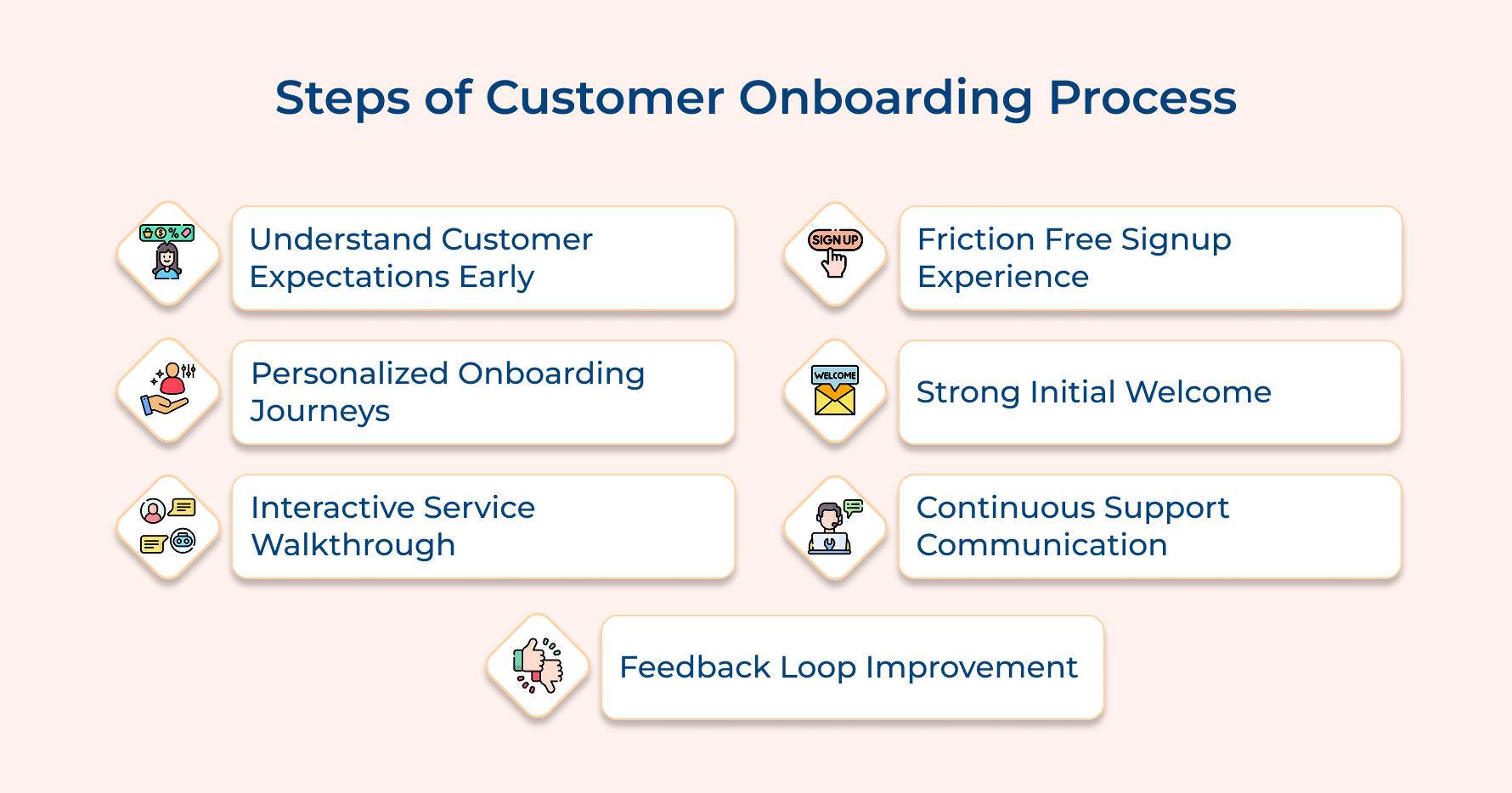
1. Understand Customer Expectations Before Day One
Onboarding failures appear in your business because expectations were never aligned with the process. Every step is built on understanding each customer’s success.
So why do professional service firms skip this step? They treat the step as a responsibility and that costs customers within the first few days. It is recommended that the onboarding team should enter with deep customer intelligence from day one, so that every interaction becomes precise as well as valuable.
Effective methods to access customer expectations before onboarding are :
- Pre-onboarding call: Conversation that uncovers customer goals and blockers before the start of onboarding.
- Mapping document: A shared documentation for both sides to define a successful onboarding outcome.
- Briefing session: A structured team handoff to transfer every insight directly to the onboarding team.
Let’s consider an example of a professional service firm where the client’s expectation of a three-day lead time is not met. The misalignment happened as no one asked the right questions from the initial stage.
2. Build a Friction-Free Signup Experience
The signup experience is your customer’s first operational moment with your service. A complicated process creates a trust deficit and your onboarding team has to recover individually. That recovery costs time and confidence is not even affordable to lose in the early stage.
Removing unnecessary steps in the customer signup flow chart is where a frictionless onboarding actually starts. Ask yourself whether every redundant screen and extra click is needed for your customer?
How to eliminate unnecessary signup steps:
- Let customers sign up using existing credentials to skip multiple account creation.
- Collect only essential customer details during signup and gather remaining details at natural touch points in the journey.
- Show customers the pressure of exactly how many steps remain for easy navigation
Frictionless signup process also includes a reduction in form fields, which is not only a UX preference but also a direct driver of signup completion. The more extra fields you add the more frustrating it becomes for customers. Form fields you can confidently eliminate at the client onboarding stages are:
- Company size
- Industry type
- Phone number
- Billing address
3. Craft Personalized Onboarding Journeys
A rigid and simple-onboarding journey showcases that your customers are just an account. Personalization is a necessity that directly defines how quickly a customer reaches their first moment of signup.
Segment Your Customers Based on Their Needs and Complexity
Customer Segmenting based on complexity enables your team to assign the right resources without over-servicing accounts. Every customer feels valued when they go through the journey designed based on segmentation and personalization.
Build Dedicated Journey Maps for Each Customer Segment
Think of your customer journey map as a living documentation that explains to your success team what the right action is for every client. The onboarding team will improvise at scale without any segmentation but consistency is missing.
Milestone Customization Based on Customer’s Goals
Generic milestones in customer onboarding, such as “account setup complete,” mean nothing to a customer who signed up to solve a business problem. Every completed step feels like real progress when milestones are connected to outcomes
4. Deliver a Strong Initial Welcome
A weak initial welcome flow makes customers feel enthusiastic. So what makes an initial welcome strong to set the right tone? It is not only warm emails but also a structured kit that shows what the next seven days will look like.
The guided feeling helps in increasing the customer’s confidence in your service immediately. Below are the examples of what an initial welcome in the customer onboarding process looks:
- Outcome-oriented welcome: “Here will help you achieve X in the next 30 days.”
- Named contact introduction: “We will route to the most dedicated onboarding specialist who owns your journey.”
- Structured next steps message: “Three things we will accomplish together within the first week of onboarding.”
What is the common mistake businesses such as SaaS or Professional service, make with their initial welcome?
They send only a generic email but customers actually need a clear signal that a real team is invested in their success from the exact moment of onboarding.
5. Guide Customers With Interactive Service Walkthrough
A service walkthrough is when a customer decides if your service is something they can own or if they have to depend on your team to operate. When the self-service walk-through is done right, it accelerates time-to-value more than any other onboarding activity.
Access the checklist for delivering service walkthrough during customer onboarding:
- Start with the customer’s goal: Start any walkthrough with an anchor that directly relates to the customer’s goal.
- Use real customer context: illustrate the walkthrough with customers’ own scenarios instead of using only generic placeholders.
- Break it into digestible stages: Sequence the walkthrough based on immediate customer priorities.
- Pause for checkpoint confirmations: Stop at every important stage in the customer onboarding and confirm confidence before moving forward.
What separates a walkthrough from one that overwhelms? It is all about sequencing. When building the walkthrough around customer needs, it creates clarity. Your customers will leave your onboarding if they don’t understand the next three actions of the process
Pro Tips:
- Give customers their own session recording so they can revisit steps independently.
- Monitor where the stage is where the churn rate increases, to identify which parts need the success team intervention.
6. Establish Continuous Support and Communication
Proactive communication is the mechanism that keeps customers moving forward when their own momentum stalls. It is recommended not to wait for customers to raise issues, as it is a silent churn accelerator.
What does a real proactive support structure look across the customer onboarding journey?
- Scheduled milestone check-ins: Your customer check-ins carry a defined agenda tied to the current stage that signals your team is not tracking their progress.
- Escalation paths for customers: A clear escalation process should start before a customer struggles. The moment of chasing occurs when customer issues lead to a breakdown in trust.
For example, a SaaS business supports customers during onboarding at every stage. It is timed and purposefully connected to where the customer is turning an onboarding process into a relationship.
What one communication gap quietly damages customer confidence during onboarding? Going silent after the initial welcome makes customers feel indifferent and alone. It will confirm that the service will not deliver what was promised.
7. Build a Feedback Loop That Drives Onboarding Excellence
Collect responses in a spreadsheet to make it a documentation exercise instead of a loop. Real onboarding is initiated once the insight for feedback directly aligns to improve customer satisfaction.
Consider asking these questions to customers that surface actionable onboarding feedback:
- “At what point of the journey do onboarding feel most confused?”
- “Was the pace aligned with your team’s capacity to absorb?”
- “What is the one thing that needs to be done to improve your customer onboarding process?”
The questions do not measure satisfaction but also expose the exact friction points your team needs to streamline in the onboarding flowchart.
Best Practices:
- Tell customers about the changes made based on their input so feedback feels like data collection.
- Recurring templates across customers reveal the onboarding gaps that any responses will never address.
How to Measure Customer Onboarding Efficiency? 5 Key Metrics
Measuring onboarding efficiency is not just about tracking activity, but also understanding the process outcome when delivering to customers.
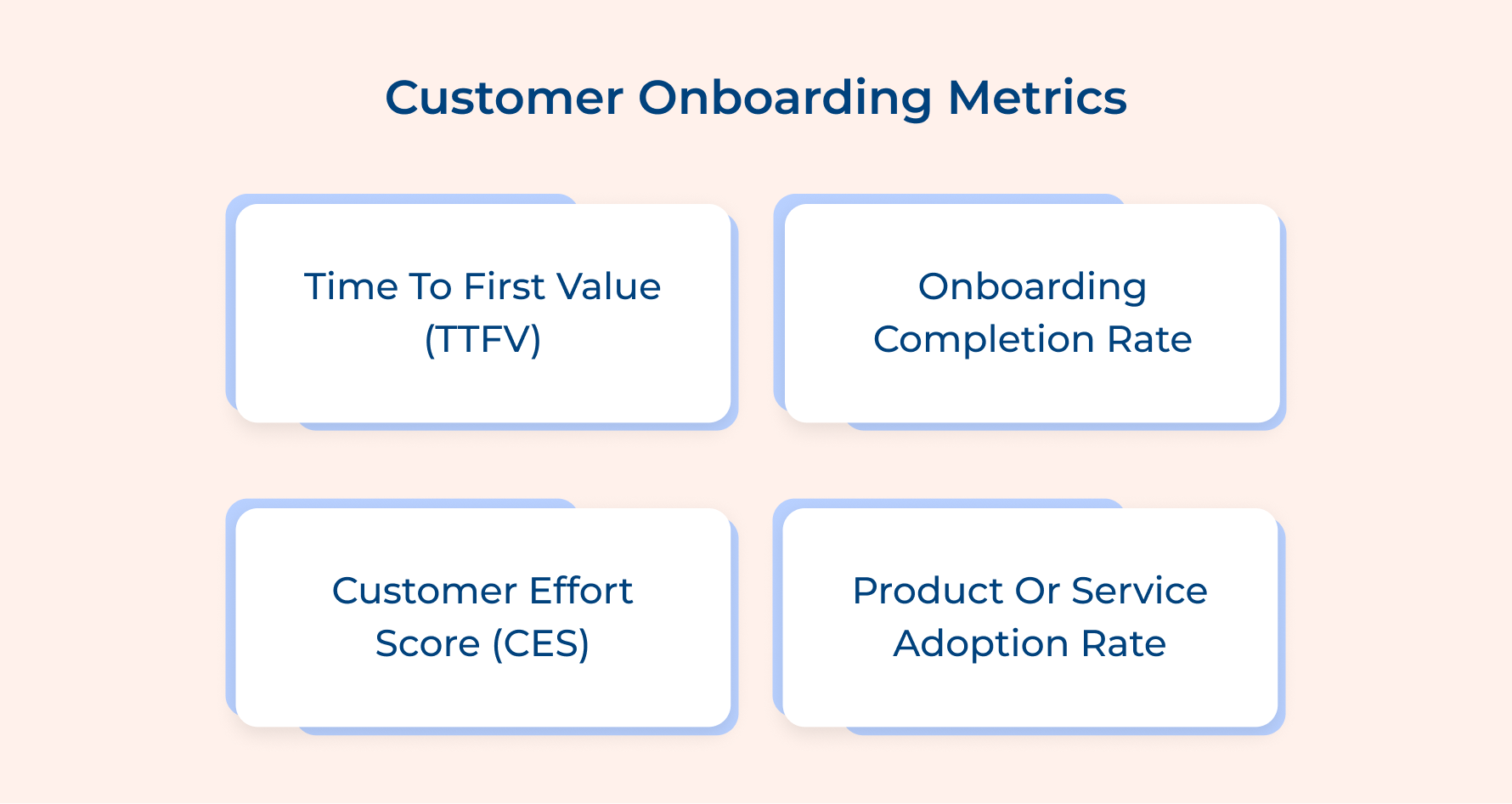
1. Time to First Value (TTFV)
The metric measures how quickly a client experiences an outcome after onboarding starts. The longer this process takes, the higher the probability of customer churn in the first place.
2. Onboarding Completion Rate
Onboarding completion rate helps in identifying the percentage of customers who actually finish the full journey without leaving in between. A low completion rate is the direct signal that your onboarding process has friction.
3. Customer Effort Score (CES)
Measures how much work a person has to put in to get through the onboarding process successfully. High effort value is the strongest indicator of early churn. Customers who are already struggling to get started rarely stay long.
4. Product or Service Adoption Rate
How deeply are customers engaging with your service features after the initial welcome? A customer who finishes from the onboarding portal but uses only 10 percent of your service means exit. They have completed a process without achieving real integration.
Best Practices for Onboarding New Customers
Explore the field-tested tips and best practices in customer onboarding that directly impact customer retention as well as churn rate.
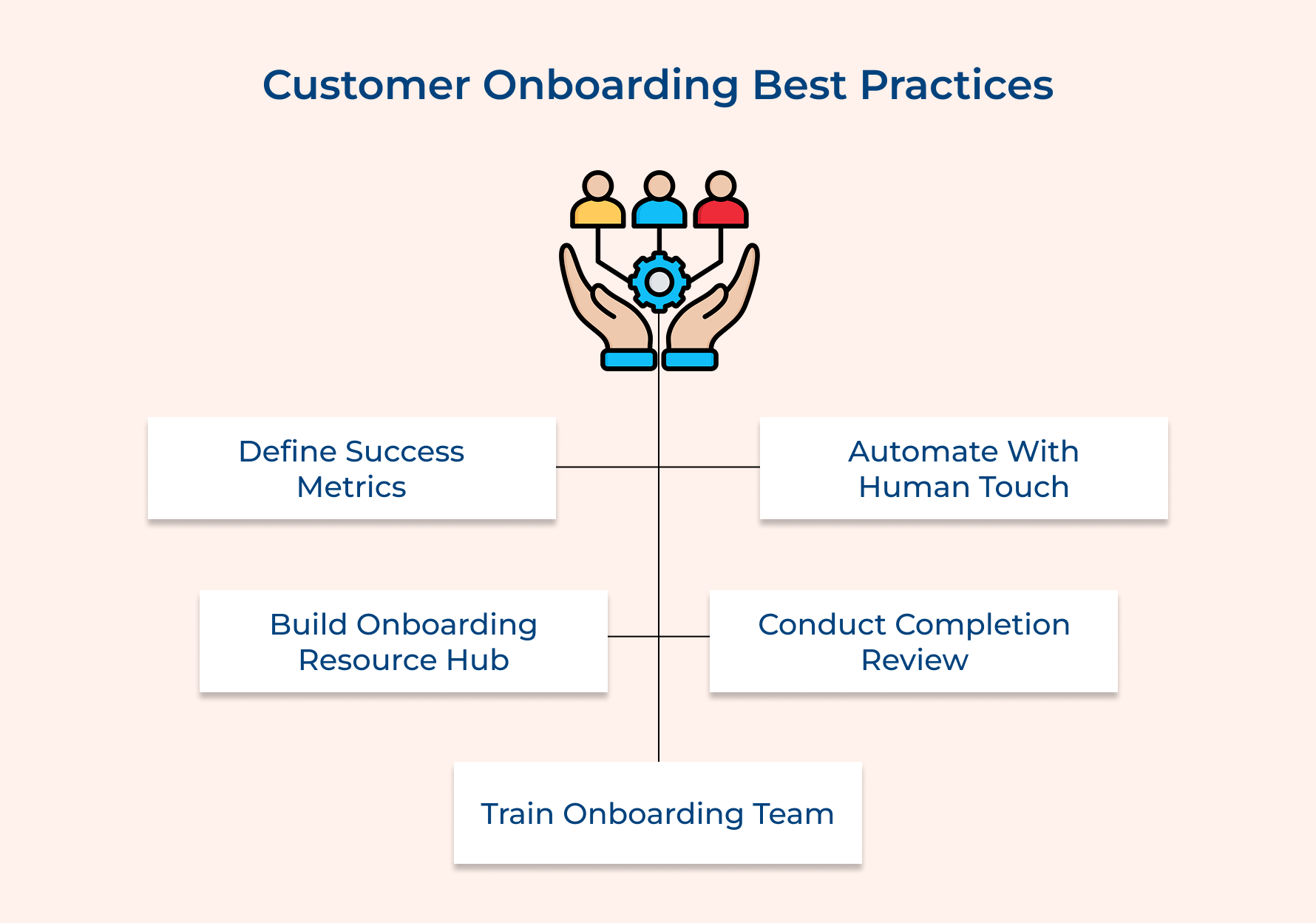
- Define success metrics upfront: before the start of the journey, align customers with the structure. Without it, the milestones your team celebrates may feel less valuable to customers.
- Leverage automation with human touch: Automate repetitive touchpoints but also make sure to keep your customer success team ready to show up at moments needed.
- Create a dedicated onboarding resource hub: Provide customers with one place to access guides and recordings without waiting. Use customer onboarding software that includes a self service portal for finding answers of basic questions and accelerates confidence.
- Conduct a formal onboarding completion review: End onboarding with a follow-up conversation that confirms the customer feels genuinely valued.
- Train your onboarding team continuously: A team that stops learning delivers a loss improvement so use regular training on customer pain points to keep your digital onboarding process sharp.
Customer Onboarding Process Examples
Explore the real-world examples and scenarios below that reflect the kind of onboarding decisions that directly impact customer retention.
1. Onboarding a New Customer for a Digital Marketing firm
A digital marketing agency conducts an onboarding discovery call to understand the client’s goals. Based on it, they build an onboarding roadmap around those outcomes. It shows that every milestone is tied directly to a deliverable that the customer can measure.
2. Onboarding a Customer for a HR Consulting Service
An HR consulting firm allocates dedicated onboarding specialists to walk through the compliance requirements. It ensures that the customer enters the engagement with full clarity on the onboarding process and makes it frictionless.
3. Onboarding a Customer for a Financial Advisory Service
A financial advisory service uses a process to map short-term as well as long-term financial goals before recommending any strategy. The customer onboarding journey is sequenced in such a way to build confidence before any major financial decisions.
Turning First Impressions Into Lasting Connections With Customer Onboarding Process
Businesses that are having the most intentional customer onboarding process wins clients in the long term. The first few weeks of a relationship are all about how your service will perform and the foundation on which retention is built or damaged.
- A structured onboarding journey directly determines if a new customer stays or walks away.
- Businesses such as SaaS, Professional services, etc that treat the onboarding as a strategic function always outperform those that think of it as an administrative task.
The quality of onboarding decides who remains with your business and who leaves. The right onboarding system not only enhances customer retention instead it also builds relationships that consistently grow. Also, turn satisfied customers into advocates for your business.
Limit time — not creativity
Everything you need for customer support, marketing & sales.

Neeti Singh is a passionate content writer at Kooper, where he transforms complex concepts into clear, engaging and actionable content. With a keen eye for detail and a love for technology, Tushar Joshi crafts blog posts, guides and articles that help readers navigate the fast-evolving world of software solutions.