Top Technology Trends in Business Transforming Operations

Key Highlights:
- The technology trends in business reshaping operations are moving faster than most leaders currently realize.
- Knowing which trends deliver real value versus which ones are noise is what separates smart adopters.
- Businesses running five disconnected tools are paying for inefficiency in ways nobody is actively tracking yet.
Most businesses are not falling behind because of bad strategy or weak teams. The technology trends in business are shifting faster than most leaders realize and the gap between early adopters as well as everyone else widens every single quarter.
The real problem is not access to technology. It is knowing which trends deliver transformational value for your specific business and which ones are just noise dressed up as innovation. Getting that wrong is expensive.
This blog breaks down the top technology trends actively reshaping how businesses operate, make decisions and serve clients. From enterprise AI to data visualizations that turn complex data into instant clarity, these are the shifts worth paying attention to right now.
What Are Business Technology Trends?
Business technology trends are patterns in how businesses start adopting new tools and systems to solve real operational problems. They reflect where industries are collectively moving and what’s becoming the new standard for staying functional as well as relevant. Ignoring them often means losing clients to competitors who figured it out faster.
When a technology trend reaches a tipping point, it stops being an advantage and becomes a necessity. Businesses that wait too long to adapt don’t just miss the upside, they spend twice the effort catching up later.
Primary objectives:
- Cut operational friction: Identify and eliminate the repetitive manual processes that quietly drain team productivity every single day.
- Raise the service bar: Meet clients where their expectations already are rather than where your current systems can reach.
- Make decisions on evidence: Build a culture where decisions are backed by actual business data rather than assumptions built over years.
- Grow without breaking: Scale operations and client load without the infrastructure cracking under pressure.
- Stay ahead of the shift: Adopt the right tools before the market forces your hand and leaves no room to do it properly.
How Do These Tech Trends Affect Resource Management?
Technology doesn’t just change what businesses do, it fundamentally changes how they allocate people, time and money to get it done
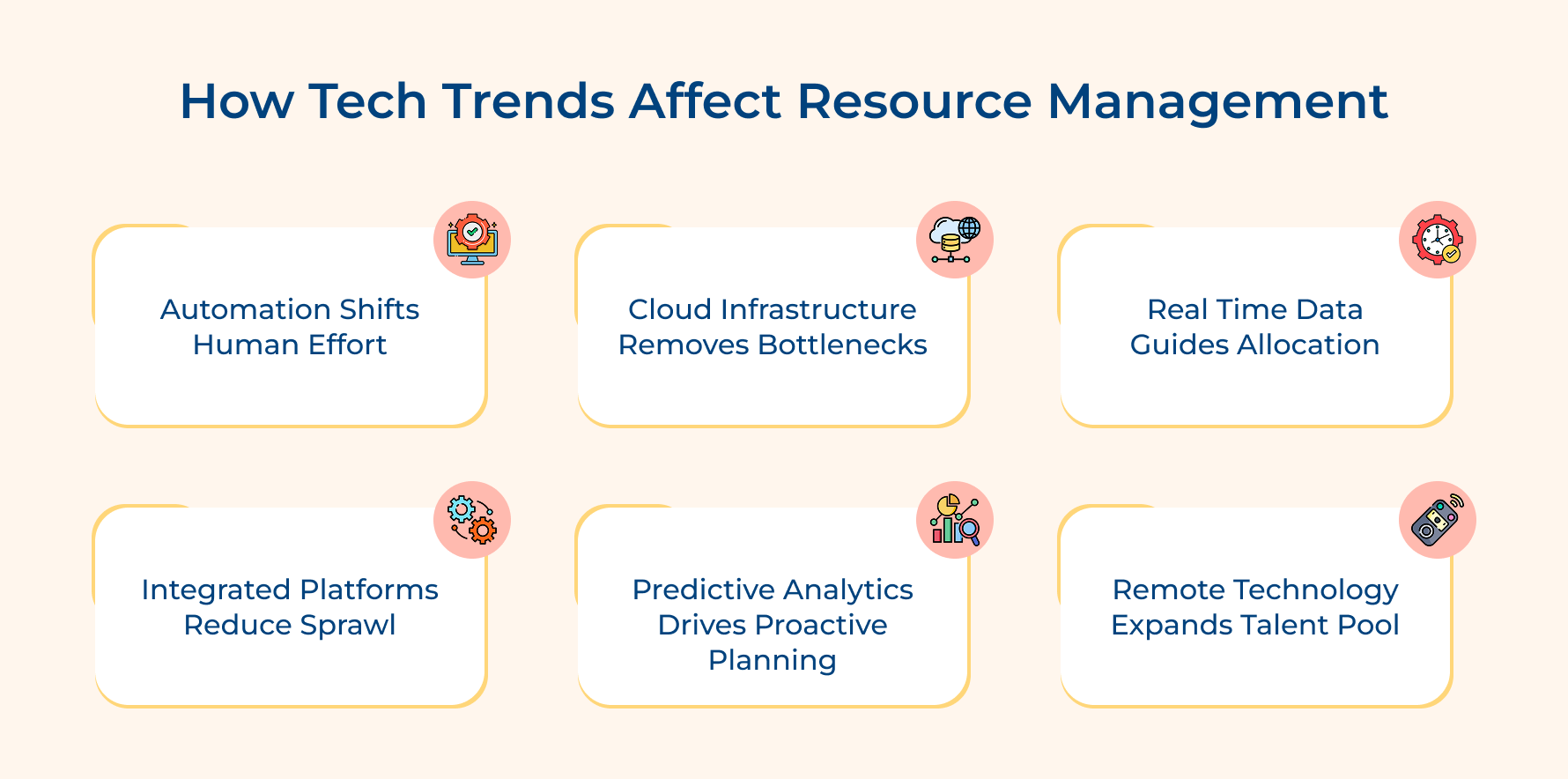
1. Automation Redistributes Human Effort
Repetitive tasks do not need human judgment. The moment artificial intelligence and automation take over that work, something valuable happens — your team’s time shifts toward work that actually requires thinking, judgment as well as client relationships.
Businesses that have implemented automation report significant drops in processing time and a noticeable improvement in output quality. Human effort does not disappear. It upgrades into work that genuinely moves the business forward.
Where this shift shows up most:
- Client-facing teams spend more time on relationships and less time on data entry that adds no real value.
- Finance teams focusing on strategic analysis rather than burning hours on manual reconciliation every month.
Business leaders who have made this shift consistently report one thing – their teams are not just more productive, they are more engaged because the work they are doing every day actually matters.
2. Cloud Infrastructure Removes Capital Bottlenecks
Large upfront infrastructure investments used to be the price of running enterprise-grade systems. Cloud infrastructure changed that entirely and the businesses that recognized this early are now reinvesting those freed-up capital budgets directly into growth.
A mid-sized firm today can run the same quality infrastructure as a large enterprise at a fraction of the cost. That levels the playing field in ways that simply were not possible a decade ago.
Here is where the real financial shift happens:
- Resources previously locked in hardware budgets now flow directly into hiring, product development and client delivery.
- Scaling up no longer requires a capital approval cycle that takes quarters to move through.
- Technology costs become predictable monthly operating expenses rather than unpredictable capital commitments.
The businesses still sitting on legacy infrastructure are not just paying more. They are moving slower than competitors who made the shift years ago.
3. Real-Time Data Changes How Managers Allocate Teams
Guessing where to deploy people is one of the most expensive habits in business operations. When managers can see workload distribution as well as project status in real time, resource decisions become faster and far more accurate without relying on instinct or outdated reports.
Where this shift shows up most:
- Spotting underutilized team members before deadlines pile up on others already at capacity.
- Reallocating budget mid-project based on actual performance data rather than original assumptions.
- Catching resource imbalances early enough to fix them before they compound into missed client deadlines.
Poor allocation is one of the most expensive silent problems any business carries. The validation process for resource decisions used to take days of back and forth across spreadsheets as well as status calls. Real-time visibility collapses that process into minutes and fixes problems before they turn into burnout or budget overruns.
4. Integrated Platforms Reduce Tool Sprawl
Running five disconnected tools does not just feel inefficient. It is measurably expensive in lost hours, duplicated data and human errors that quietly undermine every resource decision made downstream.
Integrated platforms consolidate workflows and recover time that was previously an invisible loss nobody was tracking on a balance sheet.
Here is what integration actually delivers in practice:
- Teams stop manually moving data between systems and the errors that came with that process disappear.
- Workflows that previously required three tools and two handoffs now run inside a single platform.
- Managers get a complete picture of project and resource status without chasing updates across disconnected dashboards.
5. Predictive Analytics Moves Planning From Reactive to Proactive
Hiring after demand hits is expensive. Scaling after pressure arrives is stressful. Predictive analytics gives businesses the ability to anticipate resource needs before the urgency arrives and that single shift prevents an entire cycle of costly last-minute fixes.
Where this shift shows up most:
- Forecasting seasonal staffing needs weeks before they become urgent capacity problems.
- Identifying project bottlenecks before they delay delivery timelines and damage client relationships.
- Spotting budget variance trends early enough to course correct without disrupting active projects.
Generative AI tools are accelerating this further by turning historical project data into forward-looking forecasts that update automatically as conditions change. Most businesses have historically planned resources based on last quarter’s numbers. Predictive analytics replaces that lag with signals that reflect where the business is actually heading rather than where it has already been.
6. Remote-Enabling Technology Expands the Talent Pool
Local hiring used to be a hard constraint on team quality. Remote-enabling technology removed that constraint entirely and the businesses that recognized this early built stronger specialized teams without paying premium local market salaries to do it.
The real impact here is on skill access and AI investments are amplifying it further:
- A business in a mid-tier city can now build a team with the same specialized depth as one operating out of a major tech hub.
- Roles that previously required expensive relocation packages now get filled faster with better-matched candidates from a global talent pool.
- Specialized skills that simply did not exist in local markets are now accessible without compromising on quality or paying outsized compensation to secure them.
Business leaders who have embraced remote-enabling technology consistently report one outcome above everything else. They stopped compromising on talent because geography forced their hand and their delivery quality improved as a direct result.
Top 7 Technology Trends in Business Reshaping Modern Operations
This article delves into seven pivotal technology trends that are actively reshaping the way businesses function.
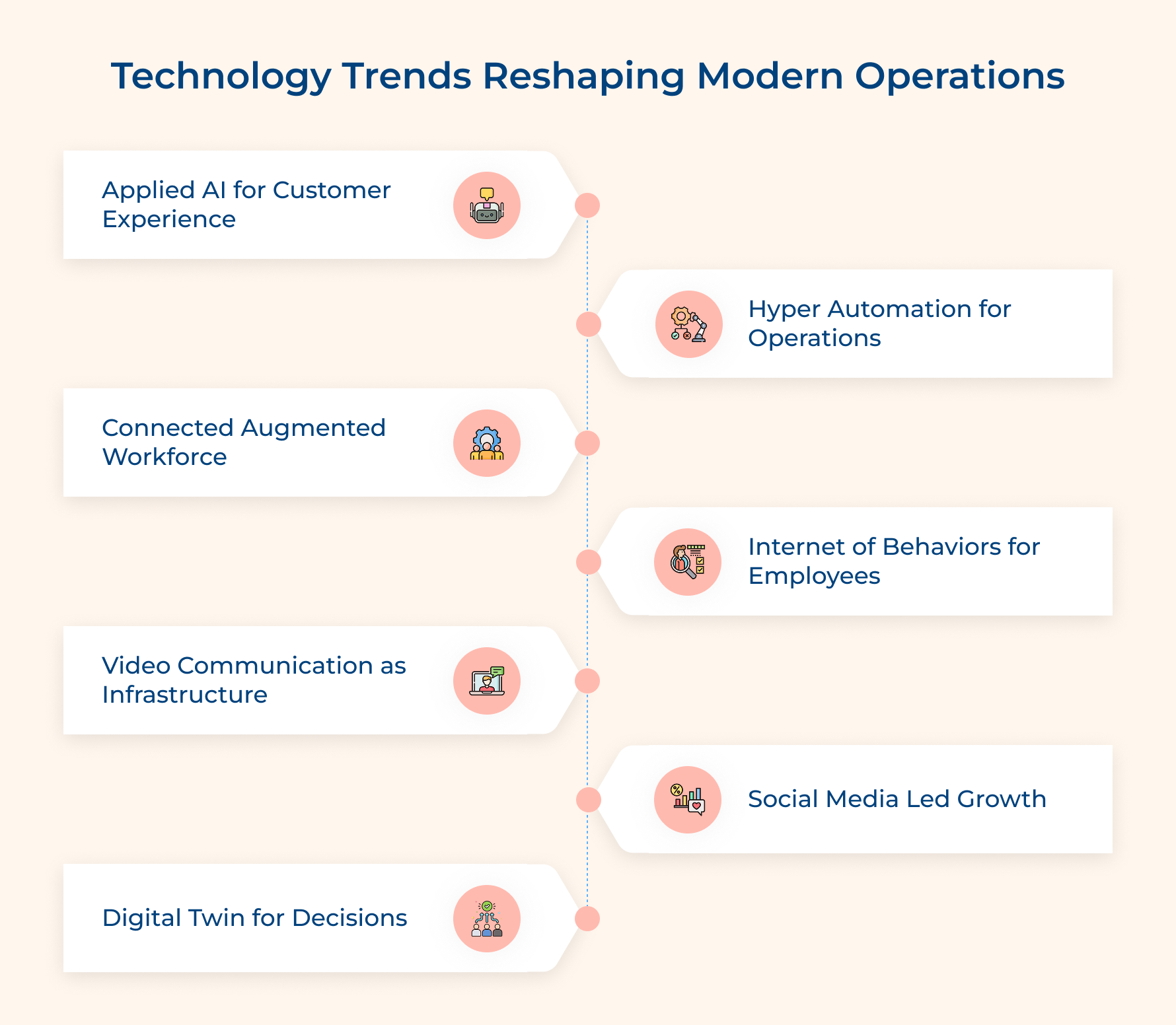
1. Applied AI to Improve Customer Experience
Most businesses think implementing AI means deploying a chatbot. The real value sits deeper. AI-driven growth happens when businesses use behavioral data to predict what a client needs before they even ask and personalize every touchpoint based on actual patterns rather than assumptions.
Service-driven businesses feel this impact most directly. Their revenue ties directly to how well they read and respond to evolving client needs before those needs turn into complaints or cancellations.
Three effective ways to implement Applied AI in your business:
- Train AI on your actual CRM data first: Generic models produce generic outputs. Feed your own historical client data into the model so it learns your specific customer behavior patterns and stops making irrelevant recommendations
- Deploy AI at the support layer before anywhere else: This is where ROI of AI shows up fastest. Automating tier-1 queries gives your human team bandwidth to focus on conversations that actually require judgment
- Use AI to trigger proactive client outreach: Let AI detect behavioral signals like a drop in product usage and trigger a personalized follow-up before dissatisfaction quietly sets in
The most damaging pitfall is rushing implementation without auditing your underlying data first. A model trained on incomplete CRM records will make confident wrong predictions and that erodes client trust faster than having no AI at all.
2. Hyper-Automation to Eliminate Repetitive Operational Load
Here, you are connecting RPA, AI and process intelligence to eliminate inefficiency across entire workflows. Businesses that implement it correctly stop paying skilled people to do work a system can handle without error, without fatigue and without follow-up chasing.
Four high-impact use cases worth prioritizing:
- Contract generation and approval routing: Automatically populate contract templates from CRM data and route them through the right approval chain without manual handoffs
- Client onboarding workflow execution: Trigger every onboarding step automatically the moment a deal is marked closed in your pipeline
- Real-time compliance monitoring: Continuously check operational activity against regulatory requirements and flag gaps before they become audit findings
- Revenue reconciliation across platforms: Automatically pull and match billing data so finance teams review exceptions rather than processing every line manually
The mistake most businesses make is automating tasks they find annoying rather than the ones actually costing them the most time and money.
Three steps to start:
- Run a process audit before touching any tool and map where time actually disappears
- Automate one complete end-to-end workflow first before scaling to others
- Build on your existing stack before introducing new software complexity
A professional services firm managing 150+ active clients can use hyper-automation to eliminate manual reporting entirely. What previously took half a day now runs overnight and lands in the client’s inbox before their morning starts.
3. Augmented Connected Workforce
An augmented connected workforce means your people have the right context, guidance and data at the exact moment they need to act. Businesses building this infrastructure now are compressing the gap between decision and execution in ways competitors running on disconnected tools simply cannot match.
This is not just realistic for large enterprises with small IT teams and dedicated technical resources. A 25-person agency connecting its project management, client communication and knowledge base into one unified workspace already operates with more workforce intelligence than a 200-person firm running on six disconnected platforms.
Five-point implementation checklist:
- Identify where decisions get delayed: The bottlenecks are almost always information gaps where someone is waiting on context before moving a task forward.
- Consolidate your tool stack first: Augmentation fails when people toggle between six platforms to complete one task.
- Build a single source of truth: Every team member should see project status, client context and next actions from one place.
- Pilot real-time decision support for your most complex role first: Give the function where bad decisions cost the most a data overlay that reduces that specific risk.
- Track time-to-competency as your primary success metric: If new team members reach full productivity faster your augmented workforce infrastructure is working.
4. Internet of Behaviors to Enhance Employee Satisfaction
Businesses making workforce decisions without behavioral data are operating on pure assumption. The cost shows up quietly in disengagement that stays invisible until a resignation letter lands on your desk and the institutional knowledge walks out with it.
Internet of Behaviours (IoB) analyzes how employees actually interact with their tools and workflows daily. Where they slow down, what they avoid and where frustration compounds silently. That behavioral data is more honest than any engagement survey because it reflects what people actually do rather than what they say they do when asked.
Current AI capabilities make this analysis faster and more actionable than ever before. Patterns that previously took months to surface now appear in weeks giving managers enough lead time to actually intervene before a problem becomes a departure.
How to implement IoB without damaging team trust:
- Frame it internally as a friction audit rather than a monitoring system or your data gets corrupted by performative behavior.
- Watch for repeated task abandonment and tool-switching patterns because they surface burnout weeks before it becomes a visible problem.
- Share findings with the team transparently and position every change as a response to what the data revealed about friction not about individual performance.
The businesses using IoB most effectively are not tracking people. They are tracking process friction and fixing it before it costs them their best performers.
5. Video Communication as a Business Infrastructure Tool
Communication through video has moved well beyond meeting software. It is now a core delivery channel for training, client communication and async collaboration that keeps distributed teams aligned without the scheduling overhead that drains productive hours every single week.
AI performance enhancements are making video communication smarter with automated transcription, sentiment detection and engagement analytics that turn every recorded interaction into actionable business intelligence.
Three ways businesses are using video as infrastructure right now:
- Asynchronous video for team documentation: B2B service firms are replacing lengthy email threads with recorded video walkthroughs for project updates and client handoffs. A consultant recording a three-minute context video saves both sides from a 45-minute meeting that could have been avoided entirely.
- Engagement tracking through built-in video analytics: Marketing agencies use video analytics to track exactly where prospects drop off in product demos or proposal walkthroughs. That data tells you more about client interest than any follow-up email response ever will.
- Video embedded directly into existing workflows: Professional service businesses embedding video inside their CRM and project management tools keep communication context attached to the work itself with no more hunting through inboxes to remember what was discussed three weeks ago.
The businesses still scheduling a call for everything that could be a recorded video are not just losing hours. They are losing the documented context that makes every future decision faster and better informed.
6. Social Media and Influencer-Led Business Growth
Social media is no longer just a brand awareness channel. It is a direct revenue driver when paired with the right influencer strategy and audience targeting. Businesses treating it as optional are actively handing pipeline opportunities to competitors who figured this out already.
This works for B2B too. A niche LinkedIn creator with 15,000 highly specific followers in your target industry will drive a more qualified pipeline than a mass campaign reaching 500,000 people who will never buy from you under any circumstances.
Five questions to validate your social and influencer strategy before committing budget:
- Are you targeting platforms where your actual buyers spend their professional time?
- Do your chosen influencers have genuine audience trust or just follower volume with no real engagement?
- Is your content addressing real pain points or just promoting services nobody asked to see?
- Are you tracking conversions from influencer activity or just reach and impressions that feel good but mean nothing?
- Do you have a content cadence that maintains presence between major campaign pushes?
Automating tasks like content scheduling, performance reporting and audience segmentation frees your team to focus on strategy / creative decisions rather than operational execution.
7. Digital Twin Technology to Optimize Business Decisions
The technology creates a virtual replica of a physical process, product, or operation letting businesses test decisions in a simulated environment before committing real resources. For client-serving businesses it de-risks delivery and for product businesses it compresses development cycles significantly.
These are not just for manufacturing anymore. Retail businesses model store layouts and inventory flow. Logistics companies simulate route disruptions.
Professional service firms are beginning to twin client delivery workflows to identify exactly where engagements typically break down before they break down in front of a paying client.
Three effective methods for implementing digital twin technology:
- Start with your highest-risk operational process: Build your first twin around the process where a wrong decision costs the most because that is where simulation delivers the clearest return.
- Integrate real-time data feeds into the twin model: A digital twin running on static data is just a diagram. Connect it to live operational data so it reflects what is actually happening right now.
- Use twin simulations for scenario planning specifically: Run disruption scenarios like supply delays, demand spikes and team capacity drops before they happen so your response is a prepared execution.
A mid-sized logistics company using digital twin simulations reduced average delivery delays by 34 percent. Not by adding more vehicles but by making smarter pre-season routing decisions based on simulated outcomes that revealed problems months before peak season arrived.
Transform Business Challenges Into Opportunities With the Latest Tech Trends
Businesses that consistently turn challenges into advantages are not the ones with the biggest budgets. They are the ones that recognize which technology trends in business actually solve real operational problems and move on them before the pressure forces their hand.
Every trend covered here addresses something most businesses are already dealing with right now. The question was never if they are relevant. It is whether you adopt them deliberately or get forced into them reactively. Deliberate adoption gives you the learning curve advantage. Reactive adoption just gives you the bill.
Limit time — not creativity
Everything you need for customer support, marketing & sales.

Neeti Singh is a passionate content writer at Kooper, where he transforms complex concepts into clear, engaging and actionable content. With a keen eye for detail and a love for technology, Tushar Joshi crafts blog posts, guides and articles that help readers navigate the fast-evolving world of software solutions.