8 Costly Resource Management Mistakes and How to Fix Them

Key Highlights:
- Resource management mistakes drain profits, cause delays and damage client relationships in service agencies.
- Poor visibility into team capacity often leads to resource planning mistakes and double-booking issues.
- Strategic planning and real-time tracking help eliminate recurring resource management errors along with improving profitability.
Your agency just lost a major client because three senior developers were accidentally double-booked on competing deadlines. Sound familiar? Resource management mistakes silently drain profits and damage relationships in agencies worldwide.
Every misallocated team member costs you money while competitors deliver projects on time with proper planning. Poor resource decisions create stressed employees and disappointed clients who question your professional capabilities as well as reliability.
Understanding the ten most common mistakes helps agencies transform chaotic operations into smooth-running machines. Let’s explore these critical errors and discover practical solutions that protect both your bottom line as well as reputation.
What are Resource Management Mistakes?
Resource management mistakes in agencies and professional services happen when you misallocate talent, time, or budget across client projects. These errors create bottlenecks where skilled team members sit idle while urgent projects lack proper staffing. Poor resource planning leads to missed deadlines and unhappy clients.
These mistakes typically start with poor visibility into team capacity and project demands. Without clear tracking systems, managers double-book employees or assign junior staff to complex tasks requiring senior expertise.
Primary objectives:
- Maintain real-time visibility into team availability and project requirements across all active accounts
- Match skill levels appropriately by assigning the right expertise level to each project phase and deliverable
- Balance workload distribution to prevent employee burnout while maximizing billable hour efficiency
- Plan for project buffers by building contingency time into schedules for unexpected scope changes
- Track utilization rates consistently to identify underused talent and overcommitted resources before problems escalate
8 Most Common Resource Management Mistakes to Avoid
Here, we delve into the eight most frequent resource management errors and provide insights on how to avoid them.
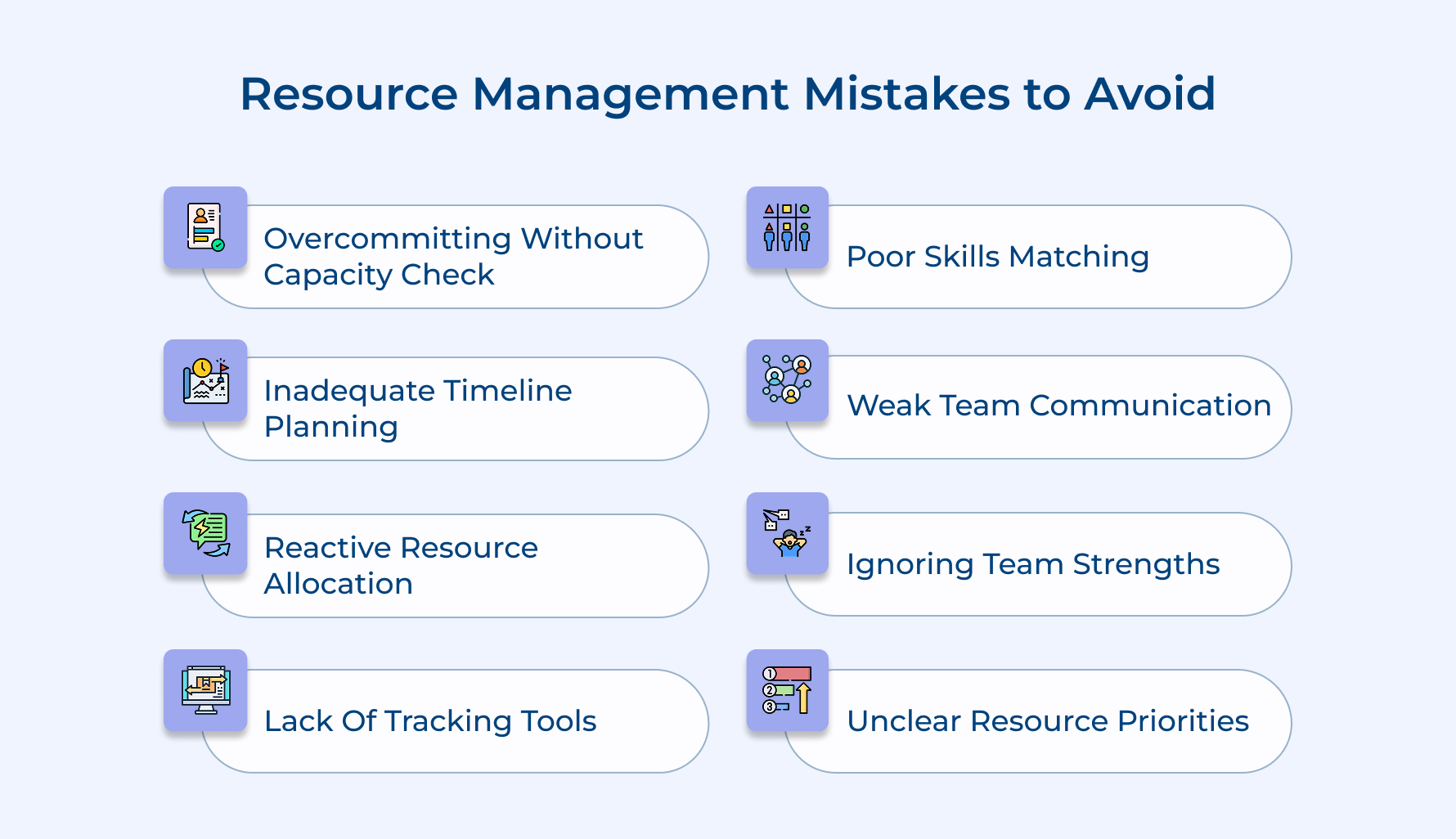
1. Overcommitting Without Checking Team Capacity
Overcommitting happens when agencies promise delivery dates without verifying if their team actually has the bandwidth to complete the work. It creates impossible situations where quality suffers and deadlines get missed because there simply aren’t enough hours in the day.
Here are the key reasons why agencies fall into this overcommitment trap:
- Sales pressure: Revenue targets push teams to say yes before checking internal capacity thoroughly.
- Poor visibility: Leaders lack real-time data about who’s working on what and when they’ll be available.
- Optimistic planning: Teams consistently underestimate how long projects actually take to complete properly.
- Fear of losing clients: Saying no feels risky so agencies promise unrealistic timelines to secure business.
The solution requires implementing capacity planning before any commitments get made. Check current workloads and build realistic timelines that account for your team’s actual availability rather than wishful thinking.
2. Poor Skills Matching to Project Requirements
Assigning people based on who’s available instead of who’s skilled leads to wasted talent and weak results. When team members are pushed into tasks outside their expertise, quality drops and clients notice.
Think about a digital marketing agency. A junior copywriter working on a Fortune 500 brand strategy, or a senior analyst stuck posting on social media, is a clear mismatch.
The problem usually comes from managers making quick decisions under deadline pressure, which later contributes to delays and Budget Overruns.
Build a skill inventory for every team member and match requirements before assigning tasks. Real-time updates on team capacity also help ensure the right people get the right jobs.
3. Inadequate Project Timeline Planning and Buffer
Poor timeline planning happens when schedules are built without allowing for delays, revisions, or client feedback loops. On paper the plan looks perfect, but in reality, projects rarely go exactly as expected.
A smarter approach is to add contingency buffers of 20–30% to each project phase. This extra time acts like insurance, giving room to manage revisions and scope changes without derailing the entire schedule.
Agencies should also track historical data. Looking at how long similar projects actually took compared to original estimates makes planning more realistic and less dependent on guesswork.
Another key step is planning revision cycles. Instead of assuming first drafts get approved, build in specific review periods and multiple rounds of feedback. Real-time updates on progress make it easier to adjust schedules as changes happen.
4. Weak Communication Between Teams and Departments
Weak communication creates information silos where teams work in isolation without knowing what resources others need or have available. This leads to double-booking conflicts and missed opportunities for collaboration that could benefit multiple projects simultaneously.
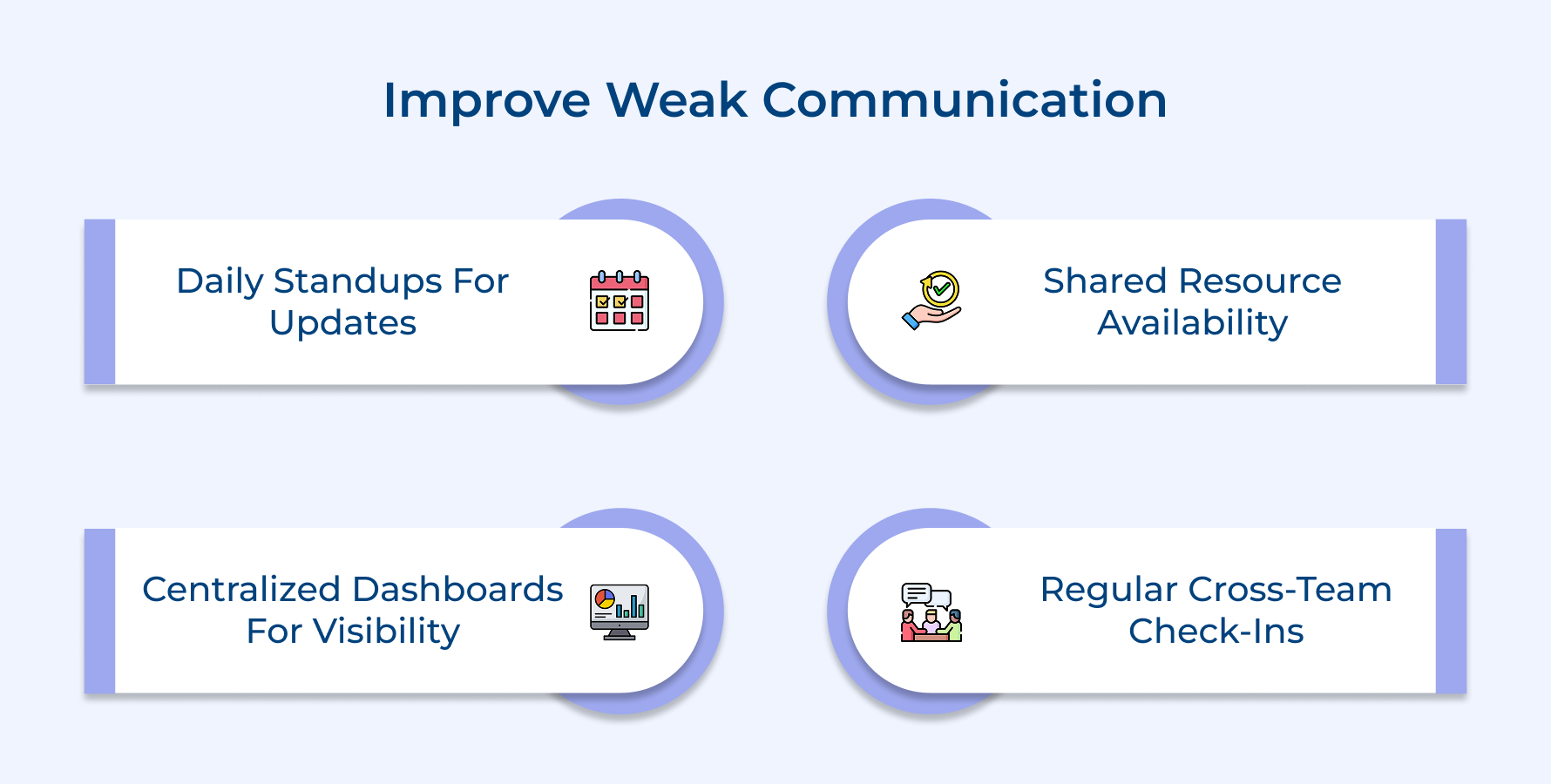
This communication breakdown typically occurs because departments develop their own processes and priorities without regular cross-team updates. Teams become focused on their immediate deadlines and forget to share critical information about capacity changes or project shifts.
How to overcome it?
- Implement daily standups: Create brief cross-departmental check-ins to share resource availability and upcoming needs.
- Use centralized dashboards: Maintain shared visibility tools where all teams can see current project status and resource allocation.
5. Reactive Rather Than Strategic Resource Allocation
Reactive resource allocation means constantly scrambling to staff projects at the last minute instead of planning assignments strategically. It creates chaos where your best people get pulled in multiple directions and important work gets assigned based on panic rather than expertise.
Here are four key questions to identify why reactive allocation happens:
- Are project timelines being communicated to resource managers weeks in advance?
- Do team leads have visibility into upcoming client demands beyond current active projects?
- Is there a formal process for requesting specific skills before projects begin?
- Are emergency requests actually emergencies or just poor planning disguised as urgency?
Start planning resource needs during the proposal stage rather than after contracts get signed. Ask yourself “who will do this work and when” before promising deliverables to clients.
6. Ignoring Individual Team Member Strengths
When team members are treated as interchangeable parts, their unique skills and preferences get overlooked. This not only wastes talent but also lowers job satisfaction, since people don’t get to shine where they perform best.
Treating Everyone as the Same Resource
Assigning tasks based only on who’s free often leads to missed opportunities. The right match between skills and responsibilities can elevate project quality as well as reduce risks. From a risk management perspective, ignoring expertise creates vulnerabilities that can derail timelines and outcomes.
Not Leveraging Personal Expertise and Preferences
Each team member builds strengths through training and experience. Smart allocation taps into those abilities instead of randomly spreading tasks. It’s about working smarter, not just filling slots.
Missing Development Opportunities
Thoughtful assignments can balance project needs with professional growth goals. This approach improves project outcomes while boosting morale. In the long run, aligning strengths with responsibilities strengthens both team performance and risk management.
7. Insufficient Tools and Technology for Tracking
When the right tools aren’t in place, managers lose visibility into how resources are being used. They can’t spot real-time utilization or see upcoming conflicts, which often leads to some team members being overloaded while others have little to do.
This issue usually arises when agencies depend on outdated spreadsheets or manual updates. Information gets scattered across different systems and leaders lose the complete picture of who’s available as well as what capacity looks like.
Modern tools can change this entirely:
- Project management platforms give a centralized view of active projects and assignments.
- Time tracking solutions show actual hours worked versus planned.
- Resource planning software forecasts availability for smarter scheduling.
- Integration dashboards sync everything, so teams always see the same accurate data.
The right setup makes resource planning measurable and tied to Key Performance Indicators, turning guesswork into data-driven decisions that prevent costly allocation mistakes.
8. No Clear Priorities When Resources Conflict
No clear priorities means lacking established criteria for deciding which projects or clients get first access to limited resources when conflicts arise. This creates confusion and inconsistent decisions that can damage client relationships while leaving team members uncertain about where to focus their efforts.
The problem emerges when agencies treat all clients equally without considering strategic value revenue potential or long-term relationship importance. Decision-making becomes emotional rather than strategic.
Consider an agency where two major clients both need their senior designer for urgent projects launching the same week. Without clear priorities the account managers argue while the designer feels torn between competing demands and deadlines slip.
Overcome:
- Establish client tier systems: Create formal rankings based on revenue strategic value and relationship potential to guide resource allocation decisions.
- Document decision frameworks: Build clear criteria that teams can reference when conflicts arise, eliminating subjective judgment calls during high-pressure situations.
Examples for Resource Planning Mistakes
These scenarios demonstrate how common resource management problems unfold in actual agencies and the practical steps teams can take to resolve them.
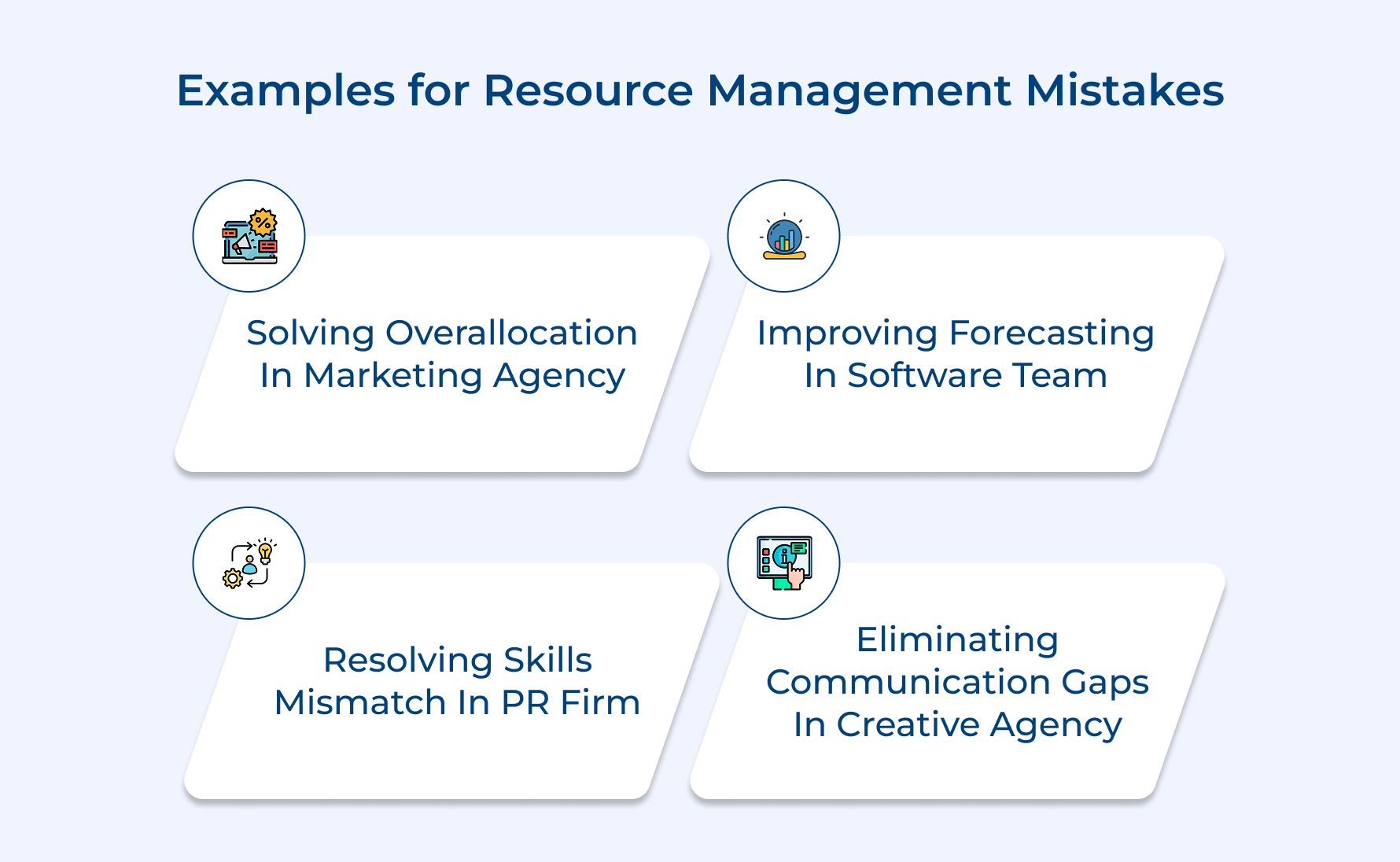
1. Solving Over-allocation in a Marketing Agency
A digital marketing agency accepted three major campaigns launching simultaneously without checking their creative team’s actual capacity. The design director discovered they needed 120 hours of work completed in just 80 available hours across the team.
The agency implemented weekly capacity reviews where project managers must verify available bandwidth before accepting new work. They also created a visual dashboard showing each team member’s workload for the next four weeks to prevent future over-allocation conflicts.
2. Improving Forecasting in a Software Development Team
A development consultancy consistently missed project deadlines because they estimated coding tasks based on best-case scenarios without accounting for testing and revision cycles. Client relationships suffered as projects regularly ran 40% longer than promised timelines suggested.
The team started tracking actual hours versus estimates for each type of development task to build historical data. They now add 30% buffer time to all estimates and use past project data to create more realistic forecasting models.
3. Resolving Skills Mismatch in a PR Firm
A public relations firm assigned their junior account coordinator to manage crisis communications for a Fortune 500 client experiencing negative media coverage. The coordinator felt overwhelmed while the client received inadequate strategic guidance during a critical reputation management situation.
The firm developed skill matrices that clearly define expertise levels required for different types of client work. They now match team members to projects based on complexity requirements rather than simple availability ensuring appropriate experience levels handle sensitive situations.
4. Eliminating Communication Gaps in a Creative Agency
A creative agency’s video production team scheduled expensive studio time without knowing the copywriting team needed three additional days to finalize scripts. This miscommunication resulted in $5,000 in wasted studio rental fees and delayed client deliverables by two weeks.
The agency implemented cross-departmental project briefings where all teams discuss dependencies and timelines before major production phases begin. They also created shared project calendars that automatically flag potential conflicts between departments requiring sequential work completion.
Overcome your Resource management Mistakes with Kooper
Resource management mistakes create cascading problems that damage client relationships and team morale while reducing profitability. Addressing these issues transforms agencies from reactive firefighting mode into strategic operations that deliver consistent results and sustainable growth.
Kooper provides integrated project management and resource tracking tools that give agencies real-time visibility into team capacity as well as workload distribution. The platform helps prevent over-allocation while ensuring the right skills match project requirements for optimal outcomes.
Limit time — not creativity
Everything you need for customer support, marketing & sales.

Shivank Kasera is part of the marketing team at Kooper, where he focuses on building content that helps agencies and service providers grow. With a keen interest in SaaS, operations, and scalability, he translates practical insights into actionable resources for business leaders.