A Complete Guide to Resource Leveling in Project Management
- What is Resource Leveling in Project Management?
- Why is Resource Leveling Important in Project Management?
- Resource Leveling vs. Resource Smoothing
- 7 Resource Leveling Techniques in Project Management You Should Know
- 5 Essential Best Practices for Successful Resource Leveling
- Resource Leveling Examples in Practice
- Achieve Seamless Project Flow with Resource Leveling
- FAQs about Resource Leveling

Key Highlights:
- Resource leveling prevents team burnout by redistributing work, ensuring balanced workloads and sustainable performance across projects.
- It improves profitability and delivery predictability by aligning team capacity with project demands, reducing overtime costs while minimizing project delays.
- Using techniques like time-shifting, resource leveling transforms chaotic schedules into smooth workflows, enhancing both team wellbeing and client satisfaction.
Picture your agency drowning in chaos as star performers burn out from impossible workloads while talented team members sit underutilized. Project deadlines slip and quality suffers because resource conflicts destroy carefully planned schedules.
This resource mismanagement costs agencies millions in lost revenue and damaged reputations. Resource leveling transforms chaos into predictable workflows that balance human capacity with project demands.
Through proven techniques like time-shifting and task redistribution, agencies create sustainable patterns that boost profitability while preserving wellbeing.
What is Resource Leveling in Project Management?
Resource leveling is the strategic process of redistributing work assignments and adjusting project timelines to balance resource demand with actual availability. For agencies and consultancies where skilled professionals are your most valuable assets, this technique prevents team burnout while ensuring no talent sits idle. It’s essentially the art of matching the right people to the right tasks at the right time.
Resource leveling analyzes your project schedule to identify periods where team members are overallocated or underutilized. The process then shifts non-critical tasks to different time periods or redistributes work among available team members. This creates a smoother workflow that respects both project deadlines and human capacity limits.
Key objectives:
- Prevent team burnout by eliminating unrealistic workload peaks that damage morale and quality.
- Maximize billable hour utilization by ensuring skilled professionals stay productively engaged throughout projects
- Reduce project costs by minimizing the need for expensive overtime or emergency contractor hiring.
- Improve delivery predictability by creating realistic timelines that account for actual resource constraints.
- Enhance client satisfaction by maintaining consistent project quality through properly managed team capacity.
Why is Resource Leveling Important in Project Management?
Managing projects with limited resources isn’t easy, but resource leveling can make a big difference. It’s a project management technique that helps you handle demand for resources more efficiently by smoothing out workloads and avoiding chaos. Here’s how:

Balances Workloads for Sustainable Performance
Resource leveling ensures your team isn’t overwhelmed one week and underutilized the next. It keeps energy levels consistent and prevents burnout.
Improves Profitability
It helps improve your margins and creates predictable cash flow by avoiding overtime while aligning your team’s capacity with revenue-generating tasks.
Builds Trust with Clients
When you manage resource dependencies properly and plan realistic delivery timelines, clients experience fewer delays as well as more confidence in your agency.
Reduces Project Risks
Over-allocating people creates bottlenecks. Resource leveling spots these early and allows you to shift timelines instead of letting one delay affect multiple projects.
Prevents Delivery Delays
Leveling eliminates the delays that happen when you have to wait around for resources to become available. You can see dependencies ahead of time and arrange them to start the next phase immediately to save weeks off the total timeline.
Example of Resource Leveling in Action
Say two campaigns need the same content writer. Instead of forcing them to multitask and rush both, you shift one deadline by a few days. Thus, maintaining quality and sanity.
Resource Leveling vs. Resource Smoothing
Managing limited resource capacity gets tricky, especially when you’re juggling deadlines and multiple projects. That’s where resource management tools help, but knowing when to use resource leveling or resource smoothing makes all the difference.
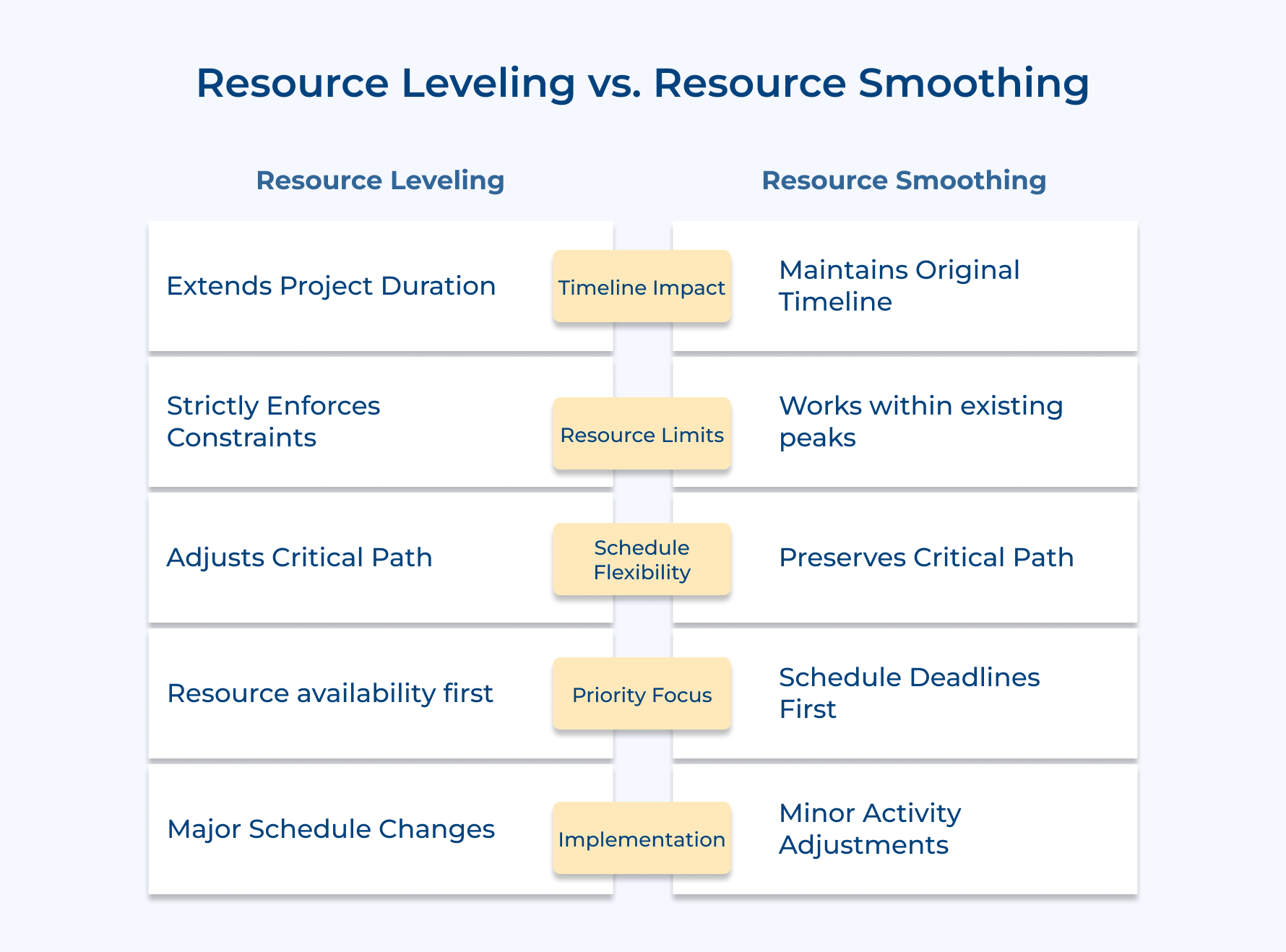
Timeline and Schedule Impact
Resource leveling extends project timelines when needed to fit actual team availability. It adjusts the sequence of tasks so no one’s overloaded.
Resource smoothing keeps the original schedule intact. It fine-tunes task allocation to reduce peaks in demand without changing the deadline.
Approach to Resource Constraints
Leveling assumes you can’t stretch beyond your available resources. If there’s a conflict, the schedule shifts, not the people or tools.
Smoothing accepts that you might hit high-demand moments but tries to ease them. It rearranges work to make things more manageable.
Implementation Complexity and Impact
Resource leveling often requires renegotiating deadlines or reworking the project plan directly with stakeholders.
Smoothing is lighter and internal. Small changes happen behind the scenes without needing formal approvals.
Strategic Purpose and Outcomes
Resource leveling supports sustainable execution. It helps your team avoid burnout and stay focused on quality.
When it comes to smoothing it is all about timely completion which is non-negotiable. It optimizes resource use without asking for extra resources or time.
7 Resource Leveling Techniques in Project Management You Should Know
In this article, we’ll explore seven essential resource leveling techniques that will help you overcome obstacles and deliver successful project outcomes.

1. Time-Based Resource Redistribution
In busy agency life, not every task needs to happen right away. Time-based resource redistribution helps you shift work around to match team availability, so no one’s drowning during peak periods and productivity stays steady.
- Move flexible tasks to off-peak times: Some activities don’t impact critical deadlines. By pushing these to quieter weeks, you give your team breathing room when things get hectic.
- Stretch intensive work over longer durations: Instead of cramming everything into a few high-stress days, you spread it out. The result? Less pressure, better quality, and a happier team.
- Add recovery gaps between major project phases: Built-in buffer zones help teams recharge and stay sharp for the next challenge.
This scheduling method respects your team’s limits and ensures consistent delivery without burning anyone out. It’s a simple yet powerful way to keep projects on track while protecting your most valuable asset – your people!
2. Resource Pool Optimization
Want to make your teams more adaptable without hiring more people? Resource pool optimization is a smart resource optimization technique that helps you get there. It allows skills to be shared across projects, improving utilization and reducing the risk of depending too much on any one person.
Here’s a quick 5-question checklist to guide you:
- Who on the team has overlapping skills that could be shared across projects?
- Can we cross-train specialists to avoid single points of failure?
- What shared resource pools can balance the workload more effectively?
- Which experts should rotate across projects to boost knowledge sharing?
- Do we have backups ready for each specialized role?
To get started, map out your team’s current skills and spot natural overlaps. Run a small pilot, have team members shadow each other to build cross-functional know-how.
This technique not only improves project delivery but also builds a stronger, more resilient team ready for shifting demands.
3. Task Decomposition and Reallocation
Feeling overwhelmed by a massive project? Task decomposition is a simple but powerful resource management technique that breaks big deliverables into smaller, manageable pieces. It lets you assign the right work to the right people without burning anyone out.
Splitting up complex tasks helps agencies avoid bottlenecks caused by overloaded specialists. It also enables parallel work, helping projects move faster and smoother.
To do it well, start by identifying natural breakpoints in your deliverables. Then, look at your team’s skills and availability to match tasks with the right people.
Pro tips:
- Map out task dependencies before you start splitting work, it prevents scheduling nightmares.
- Match task complexity with team experience to keep productivity high and stress low.
4. Critical Path Method Integration
Want to hit your finish dates without overloading your team? Try combining the critical path method with resource leveling. This blended approach helps you manage both your timeline and your team’s capacity effectively.
The critical path shows you the longest chain of dependent tasks that directly affect your project’s completion. By layering in resource constraints like availability and skill sets, you make smarter scheduling decisions that align with reality.
Here’s how it works:
- Spot non-critical tasks with some wiggle room and shift them to ease pressure.
- Focus your best people on tasks that affect the final finish date.
- Use slack time or built-in schedule buffers to redistribute work without delaying delivery.
To implement this, you’ll need detailed schedules, clear task dependencies, and realistic resource estimates. Done right, this method helps agencies stay on track, keep teams balanced, as well as deliver quality work on time and without burnout.
5. Capacity-Based Scheduling Adjustments
Capacity-based scheduling is all about matching the right work to the right people—based on their actual skills and bandwidth. Instead of overloading your team, this approach aligns project demands with what your team can realistically handle.
Before diving in, ask yourself:
- Do we really know our team’s skill levels and experience across project areas?
- Can we accurately estimate task complexity and time before assigning work?
- What systems do we have to shift tasks quickly if someone’s capacity changes?
For instance, assigning a junior designer to complex branding can delay everything. Instead, create clear workload baselines. For example, limit senior consultants to 32 billable hours per week, or ensure project managers oversee no more than 4 active projects.
This approach is one of the most practical examples of resource leveling, it reduces burnout and ensures better, more predictable project outcomes.
6. Resource Substitution and Flexibility Planning
Projects don’t always go as planned, people fall sick, priorities change or team members leave. That’s why resource substitution and flexibility planning is key to keeping work moving without a hitch.
Here’s how to make it work:
- Map Interchangeable Roles
Use cross-functional skill mapping to identify team members who can step into similar roles with minimal disruption. - Create a Substitution Matrix
Document secondary skills and build a quick-reference chart of who can cover for whom when needed. - Build Contingency Plans
Prepare for common disruptions like unplanned leave or shifting priorities by deciding ahead of time how responsibilities will be reassigned. - Use Skill-Based Resource Maps
Keep an up-to-date inventory of each team member’s capabilities and availability so you can reassign work quickly as well as confidently.
7. Technology-Assisted Resource Optimization
Tired of guessing who’s available or worried about overbooking your team? Technology-assisted resource optimization takes the guesswork out and replaces it with real-time, data-driven decisions.
Here’s what modern tools can do for you:
- Track Resources in Real Time
Project management tools let you see who’s working on what—and who’s available—at any given moment. - Get Instant Alerts On Overallocation
Automated warnings pop up when someone’s schedule is overloaded, so you can fix it before it becomes a problem. - Use Visual Dashboards
Interactive charts and dashboards show how your resources are spread out, helping you spot gaps or overloads at a glance. - Tap Into Predictive Analytics
Smart tools forecast future demand using past trends, helping you plan smarter and stay ahead of bottlenecks.
Not sure where to start? Begin by identifying your biggest resource headaches. Start simple with tracking tools, then scale up to predictive systems as your needs grow.
5 Essential Best Practices for Successful Resource Leveling
Let’s explore the fundamental practices that distinguish high-performing agencies from those struggling with resource chaos.
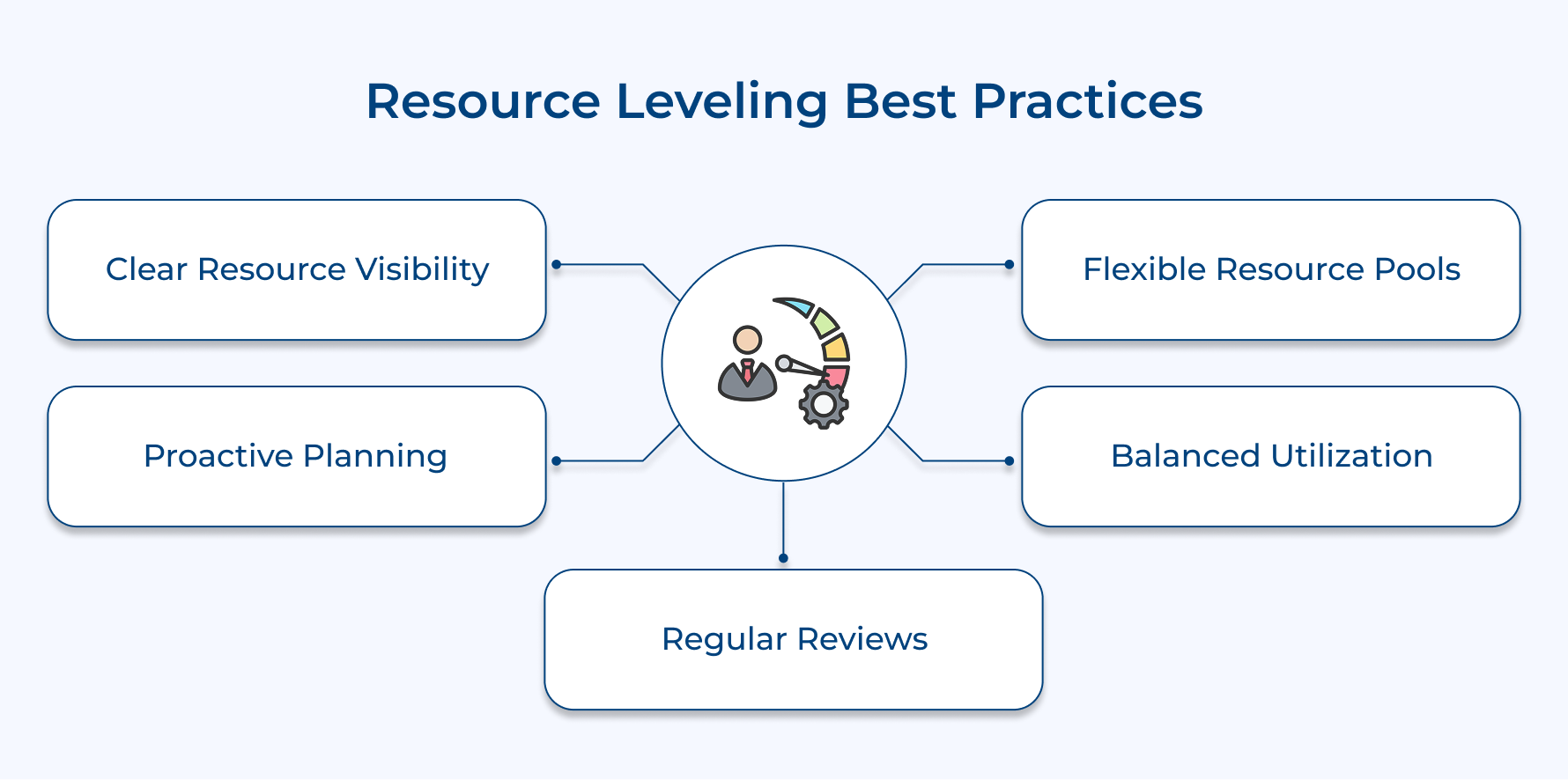
Establish Clear Resource Visibility and Tracking Systems
Think of resource visibility like having a real-time dashboard for your agency’s most valuable assets. Without clear tracking systems, you’re essentially flying blind when making critical allocation decisions that affect both project success and team wellbeing.
Modern agencies need comprehensive visibility into who’s working on what and when they’re available for new assignments. This transparency prevents the common scenario where star performers get overloaded while other capable team members remain underutilized across different project streams.
Implement Proactive Resource Planning Rather Than Reactive Allocation
Proactive resource planning means anticipating needs before they become urgent problems that disrupt ongoing projects. This forward-thinking approach allows agencies to make thoughtful decisions rather than scrambling to find available resources when deadlines loom.
Here are key questions to evaluate your planning approach:
- Can you predict resource bottlenecks three weeks before they occur?
- Do you have contingency plans ready when key team members become unavailable?
- Are you analyzing patterns from past projects to improve future resource allocation?
The difference between proactive and reactive planning often determines whether projects run smoothly or become stressful firefighting exercises. Smart agencies analyze upcoming project phases and identify resource requirements weeks or months in advance to ensure optimal team allocation.
Create Flexible Resource Pools with Cross-Trained Capabilities
Resource pools function like insurance policies for your project delivery, they provide backup options when primary resources become unavailable. Building these pools requires strategic investment in cross-training that expands your team’s collective capabilities beyond individual specializations.
Think about these pool development strategies:
- Identify which skills complement each other naturally for cross-training purposes
- Create rotation schedules that expose team members to different project types
- Build mentorship pairs between senior and junior professionals in related disciplines
Cross-trained team members create natural flexibility that prevents projects from stalling when key specialists face unexpected conflicts. This approach also provides growth opportunities for team members while reducing the agency’s dependency on individual experts for critical project functions.
Balance Utilization Targets with Sustainable Performance Standards
Utilization targets serve as important business metrics but should never come at the expense of team sustainability or work quality. The most successful agencies find the sweet spot where high productivity meets long-term employee satisfaction and retention.
Essential questions for sustainable utilization:
- What utilization rate allows your team to maintain quality while staying engaged?
- How do you measure the hidden costs of pushing utilization rates too high?
- Are you tracking leading indicators of burnout before they impact performance?
Pushing utilization rates too high creates burnout risks that ultimately harm both team morale and client relationships. Smart resource leveling maintains healthy margins that allow for creativity, learning, and the unexpected challenges that naturally arise in professional service work.
Establish Regular Resource Review and Adjustment Cycles
Regular resource reviews function like health checkups for your project portfolio—they catch problems early before they become serious complications. These systematic evaluations help agencies fine-tune their resource allocation based on actual performance data rather than initial assumptions.
Weekly or bi-weekly review cycles allow project managers to identify emerging bottlenecks and make course corrections before they impact project delivery. This rhythm creates opportunities for continuous improvement while maintaining the flexibility needed to respond to changing client requirements.
Resource Leveling Examples in Practice
Resource leveling transforms theoretical planning concepts into real-world solutions that agencies implement daily. Let’s examine specific scenarios where this technique resolves common resource conflicts and improves project outcomes.
Marketing Agency Website Redesign Project
A marketing agency discovers their lead UX designer is allocated to three concurrent website projects during the same two-week period. Resource leveling shifts two non-critical design phases to later periods while maintaining the critical path for client launches. This adjustment prevents designer burnout while ensuring all projects receive adequate attention and quality design work.
Consulting Firm Strategy Implementation Engagement
A consulting firm faces a conflict where their senior strategy consultant is needed for both client presentations and internal proposal development simultaneously. Resource leveling moves the proposal work to the following week and assigns a junior consultant to handle research preparation. This maintains client service quality while developing junior talent through increased responsibility.
Software Development Agency Mobile App Project
A development agency realizes their iOS specialist is overallocated across four mobile projects with overlapping development phases creating impossible deadlines. Resource leveling staggers the development timelines and cross-trains an Android developer in iOS fundamentals. This creates backup capacity while ensuring each project receives focused expert attention during critical development phases.
Creative Agency Brand Campaign Development
A creative agency discovers their art director is simultaneously assigned to concept development for three major brand campaigns with identical deadlines. Resource leveling extends one campaign timeline by two weeks and assigns concept refinement tasks to junior designers. This approach maintains creative quality while providing mentorship opportunities and preventing creative burnout from rushed ideation.
Achieve Seamless Project Flow with Resource Leveling
Resource leveling becomes essential because it transforms chaotic project environments into predictable workflows that respect human capacity while maintaining delivery commitments. Without this systematic approach, agencies face constant fire fighting situations that damage both team morale and client relationships.
Professional service businesses implementing resource leveling experience dramatically improved profitability through optimized utilization rates and reduced overtime costs. Operational efficiency increases through smoother project delivery while enhanced client engagement results from consistent quality and reliable timeline adherence.
Limit time — not creativity
Everything you need for customer support, marketing & sales.

Shivank Kasera is part of the marketing team at Kooper, where he focuses on building content that helps agencies and service providers grow. With a keen interest in SaaS, operations, and scalability, he translates practical insights into actionable resources for business leaders.