Project Burn Rate Tips to Track Spending and Manage Costs

Key Highlights:
- Mastering project burn rate empowers agencies to predict costs accurately and avoid budget overruns before they escalate.
- Regular burn rate tracking transforms chaotic spending into actionable insights, improving both client trust and project profitability.
- Clear scope boundaries and robust time tracking are essential to control burn rate while maintaining healthy financial outcomes.
Most agency owners watch helplessly as projects consume budgets faster than expected, leaving them scrambling to explain cost overruns to frustrated clients.
This financial uncertainty creates a vicious cycle where you either underestimate future projects to win business or pad estimates so heavily that you lose competitive bids. Meanwhile your team works harder but profitability remains elusive because you lack the data needed to identify where time and money actually disappear during project execution.
Learning to calculate and control project burn rate transforms chaotic resource management into predictable business operations. This comprehensive guide reveals the exact formulas, calculation methods and proven practices that successful agencies use to maintain healthy margins while delivering exceptional client value consistently.
What is Project Burn Rate?
Project burn rate measures how quickly your agency consumes allocated budget or hours against planned project timelines. This metric helps project managers identify when teams are either racing through budgets too quickly or moving so slowly that profitability suffers.
When burn rates spiral out of control clients lose trust in your ability to deliver on promises. Consistent budget overruns signal poor project management which damages long-term relationships. Clients value predictability and agencies that maintain steady burn rates build stronger partnerships through reliable delivery.
Understanding burn rate transforms you from a reactive project manager into a proactive business partner. When you master this metric you gain the ability to have honest conversations with clients about scope changes before they impact budgets. This transparency builds trust because clients see you’re actively protecting their investment while ensuring quality delivery.
Key objectives:
- Budget control: Track spending patterns to prevent cost overruns that eat into profit margins.
- Timeline management: Ensure project velocity aligns with client expectations and contractual deadlines.
- Resource optimization: Identify when teams are over or under-utilized to maximize efficiency.
- Early warning system: Spot potential problems before they become client-facing disasters.
- Profitability protection: Maintain healthy margins by controlling the pace of resource consumption.
Factors Affecting Project Burn Rate For Your Agency
Several interconnected elements influence how quickly your agency consumes project resources. Understanding these factors helps you predict and control spending patterns before they derail budgets.
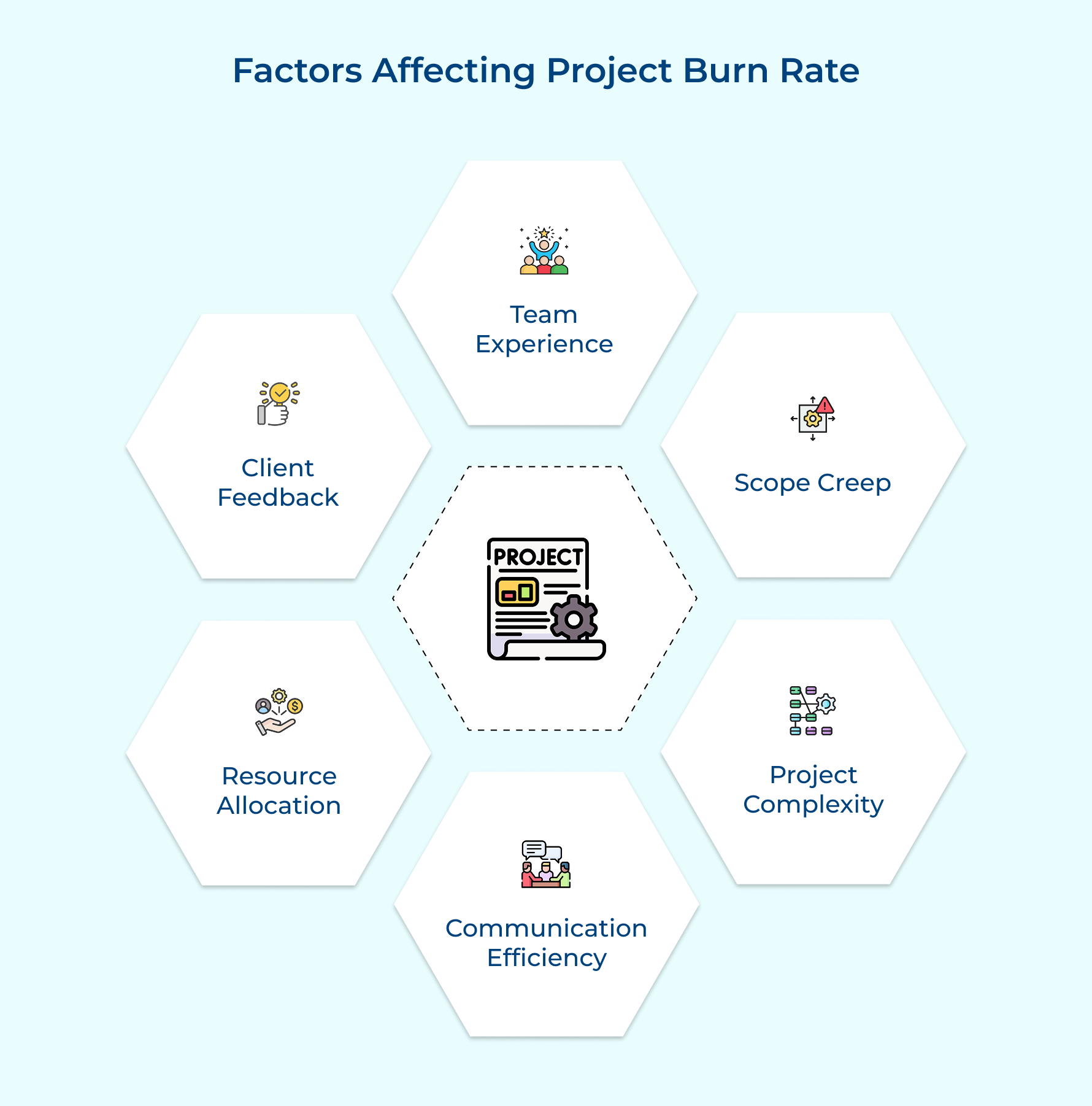
Team Experience and Skill Levels
Junior team members naturally work slower than seasoned professionals which increases hourly consumption against fixed budgets. When you assign complex tasks to inexperienced staff the learning curve directly impacts burn rate through extended completion times.
Scope Creep and Change Requests
Uncontrolled project expansion accelerates burn rate as teams tackle additional work without corresponding budget increases. Even small scope changes compound quickly when clients request “just one more feature” without adjusting timelines or resources accordingly.
Project Complexity and Technical Challenges
Highly technical projects with unknown variables create unpredictable burn patterns as teams encounter unexpected obstacles. Complex integrations or custom development work often require more hours than initially estimated leading to accelerated resource consumption.
Communication Efficiency and Clarity
Poor communication between team members and clients creates rework cycles that drain budgets through duplicated efforts. When requirements aren’t clearly defined teams spend billable hours clarifying expectations instead of delivering value.
Resource Allocation and Availability
Spreading team members across multiple projects creates context switching overhead that reduces productivity per billable hour. When key resources become unavailable unexpectedly remaining team members may lack expertise to maintain efficient progress rates.
Client Feedback and Approval Cycles
Slow client responses create project delays that extend timelines without reducing resource needs. When approval cycles drag on teams either remain idle (wasting allocated hours) or continue work based on assumptions that may require corrections later.
How to Calculate Project Burn Rate?
Calculating burn rate requires systematic tracking of resource consumption against planned budgets and timelines. This measurement process transforms abstract spending patterns into actionable data that drives better project decisions.
Regular burn rate calculations at weekly, monthly and project completion stages provide complete visibility into spending patterns. Weekly tracking catches problems early while monthly reviews reveal trends and final calculations measure overall project performance against initial projections.

Weekly Project Burn Rate Calculation
Weekly burn rate tracking provides the earliest warning system for budget deviations allowing immediate course corrections. This frequent measurement helps project managers spot emerging patterns before they impact client relationships or profit margins.

- Hours used this week: Record all billable hours consumed during the seven-day period including time spent on revisions meetings and deliverable creation. This includes both planned work and any unexpected tasks that arose during the week.
- Total budgeted hours: The complete hour allocation agreed upon in your project contract or statement of work. This figure remains constant throughout the project and serves as your baseline for all burn rate calculations.
Weekly project burn example calculation: Imagine your development team logged 52 hours this week on a website project budgeted for 900 total hours.
Your weekly burn rate calculation becomes (52 ÷ 900) × 100 = 5.8%.
This percentage tells you that in one week you consumed nearly 6% of your entire project budget which helps you project future resource needs.
Monthly Project Burn Rate Calculation
Monthly burn rate analysis reveals spending trends and seasonal patterns that weekly tracking might miss. This timeframe balances frequent monitoring with meaningful data accumulation for strategic decision making and client reporting purposes.

- Cumulative hours used: Sum of all billable hours consumed from project start through the end of the current month. This running total includes all team member contributions across all project phases and activities completed to date.
- Total budgeted hours: Your complete project hour allocation that serves as the denominator for all burn rate calculations. This baseline figure helps you understand what percentage of total resources you’ve consumed by any given point.
Example Calculation: After completing your second month your team has consumed 245 hours on a 1200-hour branding project.
Your monthly cumulative burn rate equals (245 ÷ 1200) × 100 = 20.4%.
This means you’ve used just over 20% of your total budget in two months providing insight into your project’s overall pacing.
End-of-Project Burn Rate
Final burn rate measurement compares actual resource consumption against original estimates revealing project management effectiveness. The calculation provides crucial data for improving future estimates and understanding client profitability patterns.

- Total hours used: Complete sum of all billable hours consumed throughout the entire project lifecycle including planning execution revisions and closeout activities. This final tally represents your actual resource investment in delivering the project from start to finish.
- Total budgeted hours: Original hour allocation from your project proposal or contract that served as the baseline throughout project execution. Comparing this figure against actual consumption reveals estimated accuracy and helps refine future project planning processes.
Example Calculation: Your completed marketing campaign consumed 1180 hours against a 1250-hour budget allocation.
Your final burn rate calculates to (1180 ÷ 1250) × 100 = 94.4%.
This result shows you delivered the project using 94% of allocated resources leaving a healthy 6% buffer while maintaining profitability.
Healthy agencies maintain burn rates between 85-95% of budgeted hours with consistent weekly consumption patterns. Rates below 80% suggest inefficient resource allocation while exceeding 100% indicates estimation problems or scope creep requiring immediate attention.
Track billable hours daily and compile data weekly for consistent burn rate analysis across all project phases. Below are 4 steps to calculate project burn rate:
- Step 1 – Daily time tracking: Implement consistent time tracking protocols where team members log hours immediately after task completion. Use project management tools that capture both productive work time and any rework or revision cycles that impact overall resource consumption.
- Step 2 – Weekly data compilation: Gather all recorded hours from team members and compile them into project-specific totals every Friday. This weekly ritual ensures data accuracy while providing regular opportunities to spot emerging patterns or resource allocation issues.
- Step 3 – Budget baseline verification: Confirm your total budgeted hours remain accurate by reviewing any approved scope changes or contract amendments. Adjust your baseline figure only when formal change orders modify the original project agreement to maintain calculation integrity.
- Step 4 – percentage calculation: Apply the appropriate formula based on your reporting timeframe if its weekly, monthly or cumulative totals. Double-check your math and consider using spreadsheet formulas to reduce calculation errors as well as automate the process for efficiency.
- Step 5 – Trend analysis and action planning: Compare current burn rate against previous periods and project benchmarks to identify acceleration or deceleration patterns. Use these insights to make proactive adjustments in resource allocation team assignments or client communications before problems escalate.
7 Best Practices to Control Your Project Burn Rate
Let’s delve into seven best practices to help you monitor and manage your project burn rate effectively. Hence, enabling you to steer clear of financial pitfalls and drive your project to completion on time as well as on budget.

1. Set Clear Project Scope Boundaries
Setting clear project scope boundaries is essential for protecting your project’s financial health and staying aligned with key metrics like budget burn as well as delivery timelines. Without clear boundaries, scope creep sneaks in adding unexpected work, draining resources while also delaying results.
Here’s how to keep things in check:
- Define deliverables with acceptance criteria: Clearly spell out what counts as “done” for each task, including quality standards and required approvals. This prevents endless revisions and keeps the team focused.
- Document assumptions and constraints: Note down all expectations around timelines, client inputs, and tech dependencies. Having this agreed upon upfront helps you raise change requests when things shift.
- Establish a formal change request process: Any changes to scope should go through a structured workflow with written requests, impact analysis, and approvals. No more casual “quick add-ons” that balloon costs.
Think of scope boundaries as a strong foundation, they keep your project stable and your financials on track.
2. Implement Robust Time Tracking Systems
Want to get a grip on your actual burn rate? Start by understanding exactly how your team spends their time during any given time period. Robust time tracking systems help you turn vague guesses into real, actionable data. Without it, you’re just hoping the budget holds while cash reserves quietly drain.
You think design takes 20 hours, but what if it’s really taking 35? That mismatch throws off everything, from your estimates to your delivery timelines and profits.
Here are a few questions to guide your time tracking strategy:
- How can your team log time without disrupting their workflow?
- What’s the right level of task detail to track patterns without overwhelming everyone?
- Which activities need separate tracking to truly understand profitability by client or service type?
- How will you keep time entries consistent across teams and projects?
- What reports do you need to catch burn rate issues before they hit your cash reserves?
Pro tip: Daily time entry beats weekly guesstimates because memory isn’t that reliable.
3. Monitor Resource Allocation Continuously
Keeping a close eye on how your team’s time and skills are spread across projects isn’t just good management, it’s a critical financial metric. Continuous resource allocation monitoring helps you avoid a common trap: overloading top performers while others wait around for work. That imbalance leads to inefficiencies, missed deadlines and a burn rate that creeps up before you even notice.
Here’s how to stay in control:
- Track individual utilization rates to spot when someone is nearing capacity.
- Monitor skill-specific assignments so niche expertise doesn’t become a bottleneck.
- Analyze timeline dependencies to prevent overlapping demands that delay multiple deliverables.
- Look for resource-sharing opportunities between projects without compromising quality.
Think of a digital agency managing five campaigns at once. If one strategist ends up spread across four, quality slips and budgets break. Real-time visibility into resource use is a financial necessity.
4. Establish Regular Budget Review Checkpoints
Regular budget checkpoints are your best defense against unexpected burn rate spikes that drain your cash reserves. Instead of waiting until the end of a project to find out you’re over budget, build in review moments that keep things on track from the start.
Here are four key checkpoints every agency should use:
- Kickoff budget baseline review: Align expectations and lock in targets.
- Mid-project financial health check: Catch early signs of drift before they get costly.
- Phase completion cost analysis: Assess if each stage stayed within limits.
- Final budget reconciliation: Wrap up with clear insights for future projects.
Don’t just rely on these major moments, set up weekly burn rate analysis meetings too. These short sessions act like budget health checkups.
- Compare actual hours to planned allocations.
- Flag any tasks that might spike your burn rate.
- Adjust resources early to stay on budget.
Also, use spending alerts. When 75% of your hours are used with only 60% of work done, you’ll want to act fast.
5. Optimize Team Composition and Skills
Optimizing team composition is a smart way to protect your project’s financial health. It’s all about matching the right people to the right tasks. Because, when junior team members take on work that’s too complex, or senior experts spend time on basic tasks, project expenses climb fast.
Here’s how to do it right:
- Match skills to task complexity: Let senior staff handle strategic, high-impact work while juniors manage routine tasks. This keeps productivity high and rework low.
- Offer targeted training: Equip your team with the right skills before the project starts. It shortens learning curves and avoids mistakes that eat into your budget.
- Cross-train for flexibility: Building backup skills across the team keeps projects moving even if someone’s unavailable. It’s your safety net against delays and costly revisions.
When your team is well-balanced and well-prepared, you reduce waste, increase efficiency while keeping your project expenses aligned with your financial goals.
6. Enhance Client Communication and Feedback
Strong client communication is a key strategy for controlling your burn rate. Misunderstandings often lead to work being done twice, which means double the time, effort, and cost. Keeping projects aligned with client expectations saves both time and money.
Here’s how to improve communication and reduce costly rework:
- Set response time expectations so feedback doesn’t cause unnecessary delays.
- Clarify decision authority to avoid changes from people who aren’t authorized to make them.
- Define feedback formats to get clear, actionable input instead of vague suggestions.
- Document every scope change to avoid informal requests that blow up your budget.
It’s not just about processes, structure your communication throughout the project:
- Weekly status calls
- Monthly written updates
- Milestone review meetings
- Shared portals for files and feedback
Also, train your team to ask clarifying questions early. It’s a simple habit that prevents expensive fixes down the line.
7. Build Contingency Planning Into Projects
Contingency planning is all about being ready before things go sideways, not scrambling for solutions at the last minute. When you don’t have a backup plan, even small hiccups can turn into budget-busting emergencies. That’s when rush decisions and last-minute fixes start doubling your burn rate.
Smart planning means thinking through what could go wrong during the project and building response strategies ahead of time with extra resources or time baked in just in case.
Here are a couple of pro tips to make it work:
- Include risk assessments in your kickoff meetings so you can flag potential issues early.
- Build decision trees to map out how you’ll respond to common challenges—like unexpected scope changes, tech issues, or team availability problems.
Key Benefits of Controlling Project Burn Rate
Mastering project burn rate control transforms chaotic resource management into predictable business operations. Understanding these core benefits helps agencies build sustainable growth while maintaining healthy client relationships.

Enhanced Profitability and Financial Predictability
Keeping your burn rate under control protects your profit margins and ensures project expenses don’t spiral out of control. When you manage spending carefully across projects, you create more predictable revenue, healthier cash reserves, and room to reinvest in team growth.
Improved Client Trust and Relationship Longevity
Clients notice when you consistently deliver on time and within budget. A controlled burn rate signals strong project management, which builds trust, encourages repeat work, and leads to valuable referrals that support organic growth.
Better Resource Planning and Team Utilization
When you understand how time and effort are spent, you can assign the right people to the right projects. This avoids overloading key team members and ensures junior staff get meaningful work that supports skill development.
Early Problem Detection and Course Correction
Tracking burn rates regularly gives you early insight into trouble spots. That means you can fix issues before they blow your budget or deplete cash reserves.
Reduced Stress and Improved Team Morale
When teams know their limits and aren’t scrambling to fix last-minute problems, they produce better work. Controlled burn rates prevent burnout and foster a calmer, more productive work environment.
Transform Your Spending Strategy with Project Burn Rate
Project burn rate transforms from abstract concept into powerful business tool when you implement systematic tracking and control measures. Like learning to read financial statements this skill becomes second nature with practice and transforms reactive management into strategic oversight.
Mastering burn rate control creates compound benefits that extend far beyond individual projects. Your improved estimation accuracy builds client trust while predictable resource consumption enables sustainable growth and team development investments that strengthen your competitive position.
Limit time — not creativity
Everything you need for customer support, marketing & sales.

Shivank Kasera is part of the marketing team at Kooper, where he focuses on building content that helps agencies and service providers grow. With a keen interest in SaaS, operations, and scalability, he translates practical insights into actionable resources for business leaders.