8 Best Ways to Build Resourcefulness In Project Management
- What is Resourcefulness?
- Key Benefits of Resourcefulness
- Resourceful Skills Every Team Should Have in Project Management
- 8 Steps to Develop Resourcefulness in Your Organization
- How Can Resourcefulness Influence Project Delivery?
- 4 Examples of Resourcefulness in Project Management
- Unlock Your Team’s Potential With Resourcefulness In Project Management
- FAQs about Resourcefulness in Project Management

Key Highlights:
- Creative problem-solving under constraints enables teams to maximize existing resourcefulness in project management.
- Strong adaptability and innovation improve decision-making, collaboration, as well as delivery outcomes across complex projects.
- Practical skills like communication and ownership help organizations optimize resources while delivering results despite limited budgets or shifting priorities.
Every project manager has faced moments when resources run short and deadlines stay fixed. These situations create stress and often lead to missed targets or compromised quality that damages your reputation.
The problem isn’t always the lack of resources itself but rather not knowing how to work creatively within limitations. Teams without resourcefulness skills get stuck waiting for perfect conditions that never arrive.
Resourcefulness in project management changes everything by teaching you to find solutions with whatever you have available right now. This guide explains what resourcefulness means and how to develop it effectively.
What is Resourcefulness?
Resourcefulness is the ability to find quick and clever ways to overcome difficulties using whatever tools, people, or options are available to you. It means thinking creatively when faced with constraints rather than giving up or waiting for perfect conditions. A resourceful person doesn’t let limited resources stop them from making progress.
In project management, resourcefulness helps you deliver results even when budgets shrink or timelines tighten. You learn to work smarter with what you have instead of what you wish you had.
Key objectives of resourcefulness:
- Creative problem-solving: Finding unconventional solutions when the obvious path is blocked or unavailable.
- Maximizing existing assets: Getting the most value from the people and tools already at your disposal.
- Adapting to change: Adjusting your approach quickly when circumstances shift without losing momentum.
- Building strong networks: Knowing who to call on for help and cultivating relationships before you need them.
- Reducing waste: Eliminating unnecessary steps and focusing energy only on what actually moves the project forward.
Key Benefits of Resourcefulness
Being resourceful isn’t just a nice trait to have. It directly impacts your success and the success of your projects in measurable ways. Let’s explore it one benefit at a time:
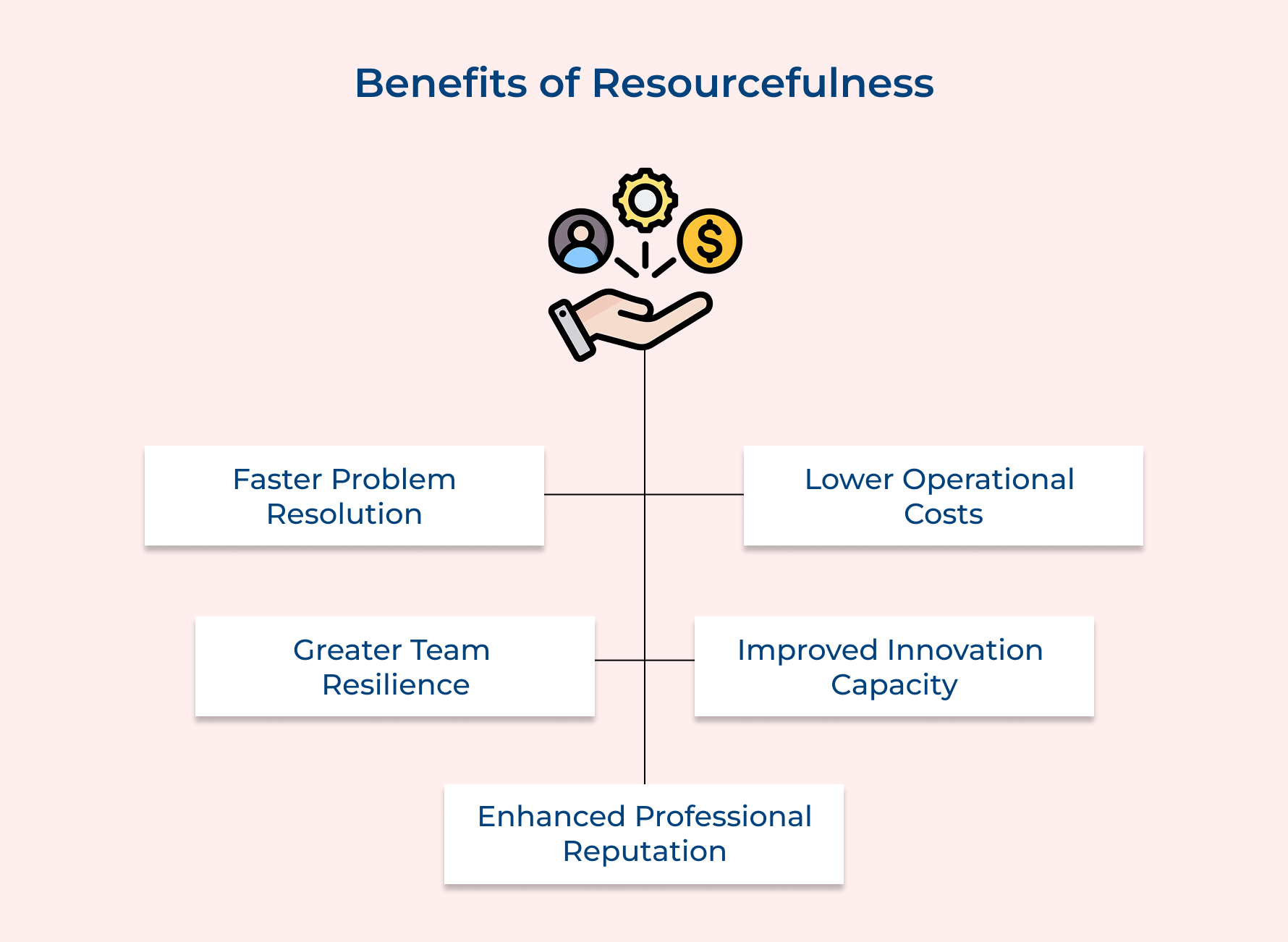
Faster Problem Resolution
When you’re resourceful you don’t wait for ideal conditions or perfect solutions. You identify what’s available and move forward immediately which saves valuable time as well as leads to project success.
Lower Operational Costs
Resourceful people find ways to accomplish goals without always requesting additional budget or resources. They repurpose existing tools and leverage current team skills which reduces spending without sacrificing quality.
Greater Team Resilience
Teams led by resourceful individuals bounce back from setbacks more quickly. They view obstacles as puzzles to solve rather than reasons to stop which keeps morale high during challenging periods.
Improved Innovation Capacity
Constraints often spark the best ideas because you’re forced to think differently. Resourceful people discover creative solutions that wouldn’t emerge if unlimited resources were always available.
Enhanced Professional Reputation
People who consistently deliver results regardless of circumstances become trusted and sought after. Colleagues and leaders remember who stepped up during a difficult situation as well as who made excuses.
Resourceful Skills Every Team Should Have in Project Management
Building a resourceful team means cultivating specific skills that help people solve problems and deliver results even when conditions aren’t perfect. Here are five essential skills every project team should develop.
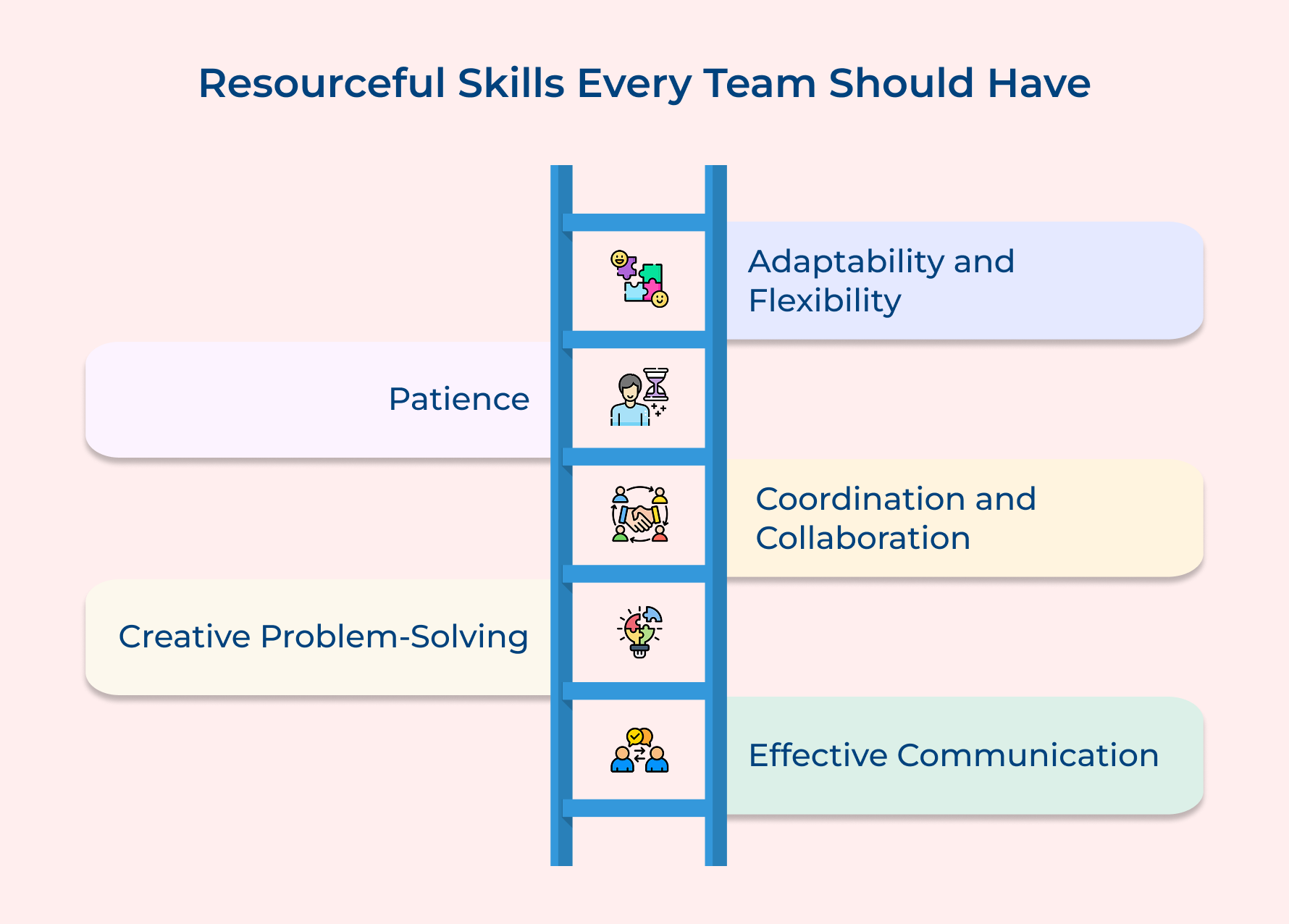
Adaptability and Flexibility
Projects rarely go exactly as planned so team members must adjust quickly when priorities shift or unexpected challenges arise. Flexible people don’t waste energy resisting change; they redirect their focus and find new paths forward.
Patience
Resourcefulness requires persistence when the first solution doesn’t work and the second one fails too. Patient team members stay calm under pressure and methodically work through problems instead of panicking or rushing toward poor decisions.
Coordination and Collaboration
No one person has all the answers which makes teamwork essential for resourceful problem-solving. Strong collaborators share information freely and leverage each other’s strengths to find solutions faster than any individual could alone.
Creative Problem-Solving
Resourceful teams think beyond obvious answers and explore unconventional approaches when traditional methods fall short. This skill involves questioning assumptions and combining innovative ideas in unique ways to overcome obstacles.
Effective Communication
Clear communication prevents wasted effort and ensures everyone understands available resources as well as current constraints. Teams that communicate well can quickly identify who has the skills or knowledge needed to address emerging challenges.
8 Steps to Develop Resourcefulness in Your Organization
Here, we’ll explore 8 practical steps that can help your organization develop a robust culture of resourcefulness. Hence, setting the stage for sustained success in an uncertain world.
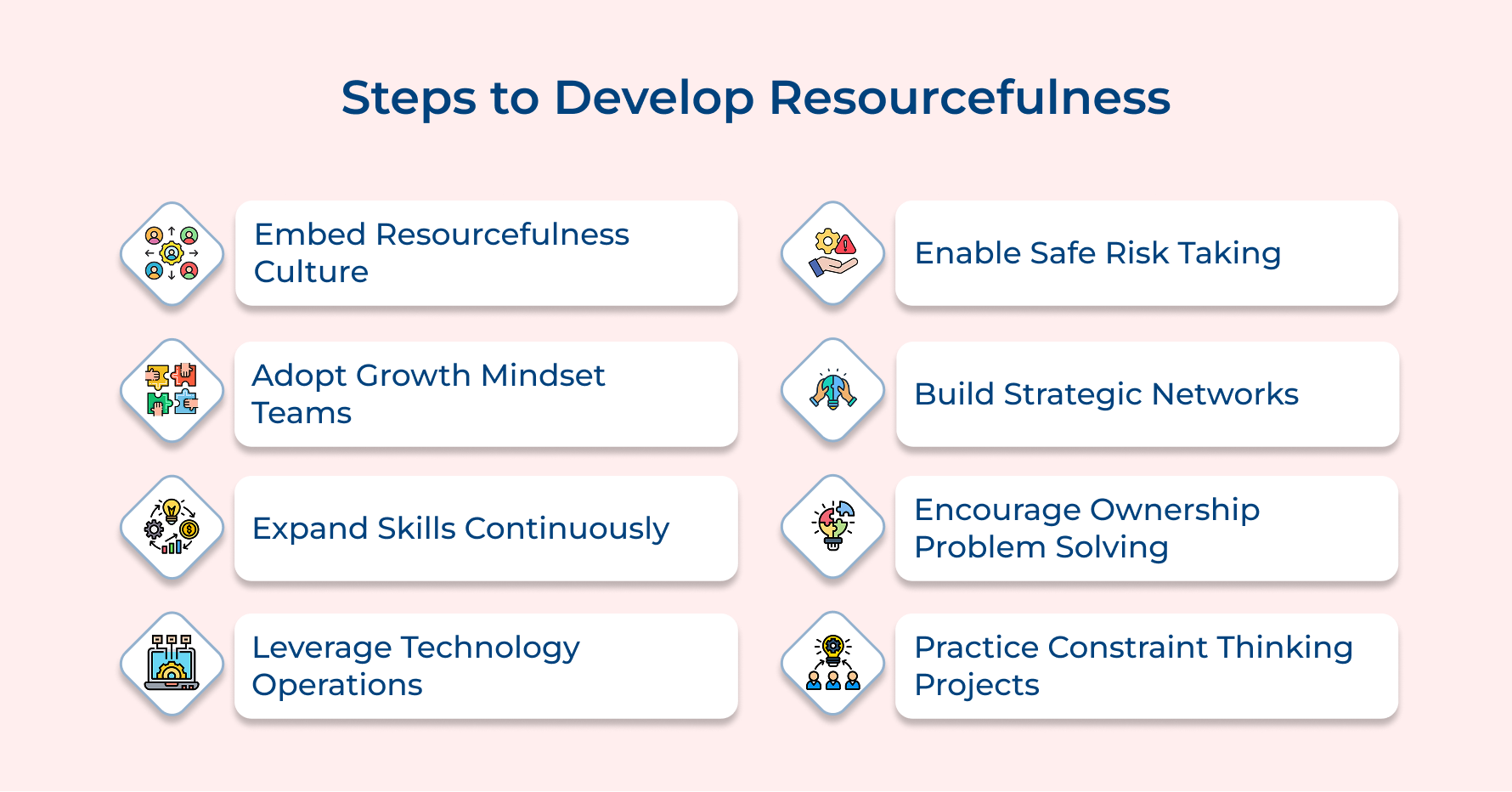
1. Embed Resourcefulness into Company Culture
Resourcefulness must become part of how your organization operates daily rather than just an occasional expectation during crises. When teams see resourcefulness valued consistently they naturally adopt it as their default approach to challenges.
Here are three effective ways to make this happen:
- Recognize and reward resourceful problem-solving behaviors: When someone finds a clever workaround or solves a problem with limited resources, call it out publicly.
- Share success stories of creative solutions: Document and circulate examples of how team members overcame obstacles creatively. These stories become reference points that inspire others facing similar situations.
- Include resourcefulness in performance evaluation criteria: Add specific metrics around problem-solving and adaptability to your review process.
For example, a project manager who delivered a client presentation using free design tools after the software budget was cut demonstrates exactly the behavior you want others to replicate.
2. Embrace a Growth Mindset Across Teams
A growth mindset means believing that abilities can be developed through effort and learning rather than being fixed traits. This perspective is essential because resourceful people see obstacles as opportunities to grow not as dead ends.
Here are four key actions to build this mindset:
- Encourage learning from failures and setbacks: Treat mistakes as valuable data points rather than reasons for blame.
- Promote curiosity over fear of mistakes: Ask questions that spark exploration instead of questions that assign fault.
- Model vulnerability as a leader: Share your own learning moments and challenges openly with your team.
- Celebrate effort and process not just outcomes: Recognize the journey of problem-solving alongside the final results.
You should also provide regular feedback focused on improvement because people need guidance to grow. Timely as well as specific feedback helps team members understand what’s working and where they can push further in their resourcefulness journey.
3. Expand Your Knowledge and Skills Continuously
Continuous learning means actively seeking new knowledge and capabilities beyond your current role or expertise. If you ignore this step your team will face problems with the same limited toolkit every time which leads to stagnation and missed opportunities.
Cross-functional training and job rotation expose team members to different perspectives as well as methods across departments. The broader understanding helps people see resources and solutions that specialists in one area might overlook completely.
Here are three ways to implement cross-functional development:
- Shadow programs between departments: Let team members spend time observing and learning from colleagues in different roles.
- Rotation assignments on diverse project types: Move people across various projects to build versatile problem-solving experience.
- Joint workshops with multiple teams participating: Bring different departments together to solve problems collaboratively and share approaches.
But why should you also support professional development and certifications? Because external learning brings fresh frameworks and industry knowledge into your organization. When employees gain new credentials they return with updated methods that benefit the entire team.
4. Leverage Technology to Streamline Operations
Technology removes manual bottlenecks and frees your team’s mental energy for creative problem-solving. Without the right tools people waste time on repetitive tasks instead of focusing on challenges that actually require resourcefulness.
Here are four key factors for choosing the right technology:
- Integration capability: Ensure new tools connect smoothly with your existing systems and workflows.
- Ease of adoption: Select technology your team can learn quickly without extensive training requirements.
- Scalability for growth: Choose solutions that can expand as your organization and project complexity increase.
- Cost versus value delivered: Evaluate whether the time saved justifies the investment required for implementation.
The right technology acts as a force multiplier that makes your team’s resourcefulness more impactful and far-reaching. Here are four essential tools to consider for streamlining operations:
- Project management tools: Centralize task tracking and deadlines for complete visibility across all projects.
- Automation tools: Handle repetitive workflows automatically so people focus on higher-value work.
- Communication and collaboration platforms: Enable quick information sharing and real-time problem-solving across teams.
- Data analytics dashboards: Provide insights for smarter resource allocation and informed decision-making.
When technology handles routine operations effectively your team gains the bandwidth and mental space to approach challenges with genuine creativity.
5. Create a Safe Environment for Risk-Taking
Psychological safety allows team members to propose unconventional ideas and attempt new approaches without fearing criticism or punishment. The environment is crucial because resourcefulness requires experimentation and people won’t experiment if failure means blame.
You can build this safety by openly discussing failed attempts as learning opportunities and separating outcomes from effort. When leaders respond to mistakes with curiosity rather than judgment, team members become more willing to try creative solutions.
Pro tips
- Set explicit “safe to fail” boundaries so people know which risks are encouraged and which require approval.
- Leaders should share their own failures first to normalize imperfection and encourage openness across the team.
6. Build Strong Networks and Strategic Relationships
Strong networks give your team access to knowledge and resources beyond their immediate capabilities through trusted connections. This step matters because no single team has all the answers and relationships unlock solutions you couldn’t find alone.
Here are three effective methods to build these connections:
- Build connections across departments and teams: Break down silos by creating opportunities for different groups to work together on shared challenges.
- Develop external partnerships with industry peers: Build relationships with professionals outside your company who face similar challenges.
- Create mentorship programs for knowledge transfer: Pair experienced employees with newer team members to share institutional knowledge and problem-solving wisdom.
For example, a marketing agency struggling with a technical client request could tap their network to borrow expertise from a partner firm rather than turning down the project entirely.
7. Encourage Ownership and Independent Problem-Solving
Ownership means team members take personal responsibility for outcomes and feel empowered to act without constant approval. If you ignore this step your organization creates bottlenecks where every decision waits for management and resourcefulness dies in endless approval chains.
Delegate Authority Along with Responsibility Clearly
When you assign someone a task, give them the power to make decisions about how to accomplish it. Responsibility without authority frustrates people and prevents them from applying their own resourceful thinking to challenges.
Reduce Micromanagement and Trust Team Judgment
Step back and let your team figure things out even when their approach differs from yours. Constant oversight signals distrust and discourages the independent thinking that resourcefulness requires to flourish.
Empower Employees to Make Decisions Autonomously
Define clear decision-making boundaries so people know exactly what they can handle independently versus what needs escalation. This clarity removes hesitation and lets resourceful action happen quickly when opportunities arise.
8. Practice Constraint-Based Thinking in Projects
Constraint-based thinking means intentionally working within limitations to force creative problem-solving rather than defaulting to more resources. It is essential because real projects always have constraints and teams trained this way handle them naturally.
How can you actually use this approach? Run practice exercises where teams must deliver results with deliberately reduced budgets or tighter timelines. These simulations build the creative muscles your team needs when real constraints inevitably appear.
Best practice
- After each project, conduct a review specifically focused on identifying moments where resourcefulness made a difference.
- Challenge teams to find at least two alternative solutions before approving additional resources for any problem.
How Can Resourcefulness Influence Project Delivery?
Resourcefulness transforms how teams approach challenges and directly impacts whether projects succeed or struggle. When team members think creatively under pressure they consistently deliver better outcomes even when conditions aren’t ideal.
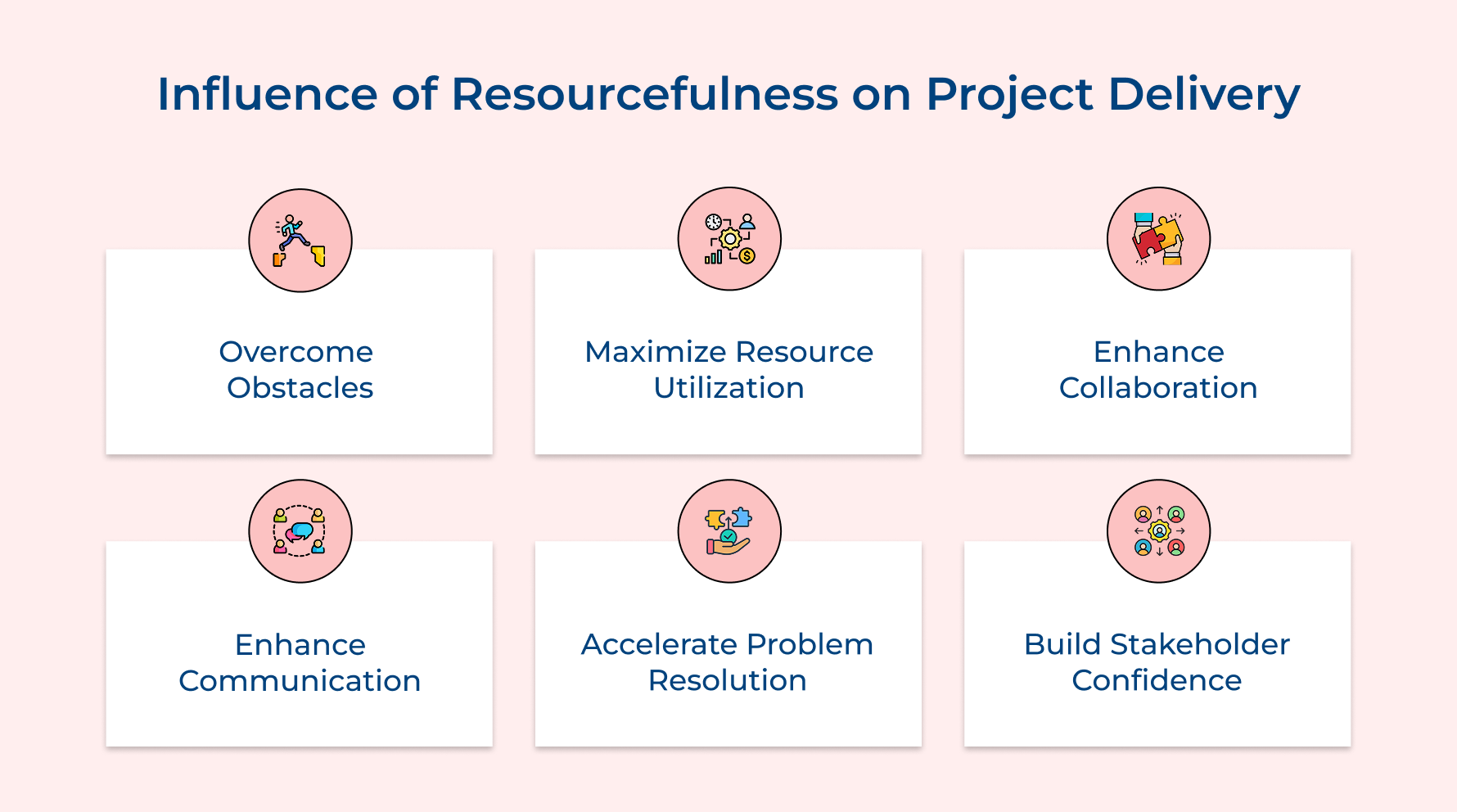
1. Overcome Obstacles
Every project encounters unexpected problems that threaten timelines and budgets regardless of how well you plan initially. Resourceful teams treat these obstacles as puzzles to solve rather than reasons to stop which keeps momentum alive.
Here are key ways resourcefulness helps teams overcome obstacles:
- Quick pivot capability: Teams can change direction rapidly when the original plan hits a wall without losing significant progress.
- Alternative path identification: Resourceful thinkers naturally see multiple routes to the same destination when one path closes.
- Reduced dependency on perfect conditions: Teams learn to work with what they have instead of waiting for ideal circumstances.
The ability to push through challenges without requesting additional resources or timeline extensions builds trust with stakeholders. Clients and executives remember teams that found ways forward when others would have escalated problems upward.
2. Maximize Resource Utilization
Resourceful teams extract maximum value from every person and tool available to them instead of constantly requesting more. This way, budgets are always limited and smart allocation separates successful projects from failed ones.
Consider these questions when evaluating resource utilization:
- Are team members working on tasks that match their strongest skills and experience?
- Could existing tools handle additional functions that you’re currently doing manually?
- Are there underutilized resources in other departments that could support your project?
For example, a software development team realized their QA specialist had strong documentation skills from a previous role. By having her lead the user guide creation alongside testing they eliminated the need to hire a technical writer and delivered both outputs faster.
When teams maximize what they already have they demonstrate fiscal responsibility that earns future project approvals. Leaders naturally trust resourceful teams with bigger budgets because they know nothing will be wasted.
3. Enhance Collaboration
Resourcefulness thrives when people combine their different perspectives and skills to solve problems together. Individual brilliance has limits but collaborative resourcefulness multiplies the creative solutions available to any challenge.
Here are ways resourcefulness strengthens collaboration:
- Cross-functional problem-solving: Teams pull in expertise from unexpected areas to tackle challenges from fresh angles.
- Knowledge sharing acceleration: Resourceful cultures encourage people to share shortcuts and lessons learned openly with colleagues.
- Collective ownership of solutions: When teams solve problems together everyone feels invested in making the solution work.
Strong collaboration also prevents knowledge from becoming trapped with single individuals who might leave or become unavailable. Resourceful teams build redundancy naturally because sharing information and approaches becomes habitual behavior.
4. Enhance Communication
Clear communication ensures everyone understands available resources and current constraints which prevents wasted effort as well as duplicated work. Resourceful communicators share information proactively rather than waiting to be asked directly.
Think about these questions regarding your project communication:
- Do team members know what resources colleagues have access to that might help them?
- Are constraints and limitations communicated early enough for people to plan around them?
- Does information flow freely across the team or get stuck in departmental silos?
For example, a project manager started each weekly meeting by asking team members to share one resource or skill they had available that week. This simple practice led to a designer helping with a presentation and an analyst assisting with data cleanup which saved hours.
When communication flows well resourcefulness spreads across the entire team instead of staying isolated with individuals. Good information sharing means one person’s clever solution becomes everyone’s tool.
5. Accelerate Problem Resolution
Speed matters in project delivery because delayed problem-solving creates cascading impacts on timelines and dependent tasks. Resourceful teams resolve issues faster because they don’t wait for perfect information or ideal solutions before acting.
Here are factors that accelerate problem resolution:
- Bias toward action: Resourceful teams prefer imperfect progress over perfect paralysis when facing challenges.
- Rapid experimentation: Teams test quick solutions immediately rather than debating theoretical approaches endlessly.
- Learning integration: Past solutions get catalogued and referenced which speeds up resolution of similar future problems.
Quick resolution also reduces the stress and uncertainty that problems create for team members as well as stakeholders. When issues get handled promptly everyone maintains confidence that the project remains on track.
6. Build Stakeholder Confidence
Stakeholders trust teams that consistently deliver despite challenges because they’ve proven their reliability under pressure. This confidence translates into more autonomy and fewer micromanagement interventions during future projects.
Ask yourself these questions about stakeholder relationships:
- Have you demonstrated creative problem-solving that stakeholders witnessed and appreciated?
- Do stakeholders see your team as one that finds solutions or one that escalates problems?
- Are you building a track record that earns trust for larger future projects?
For example, a marketing team lost access to their primary vendor two weeks before a product launch deadline. They resourcefully assembled a solution using three smaller vendors and delivered on time which earned them the lead role on the company’s biggest campaign the following year.
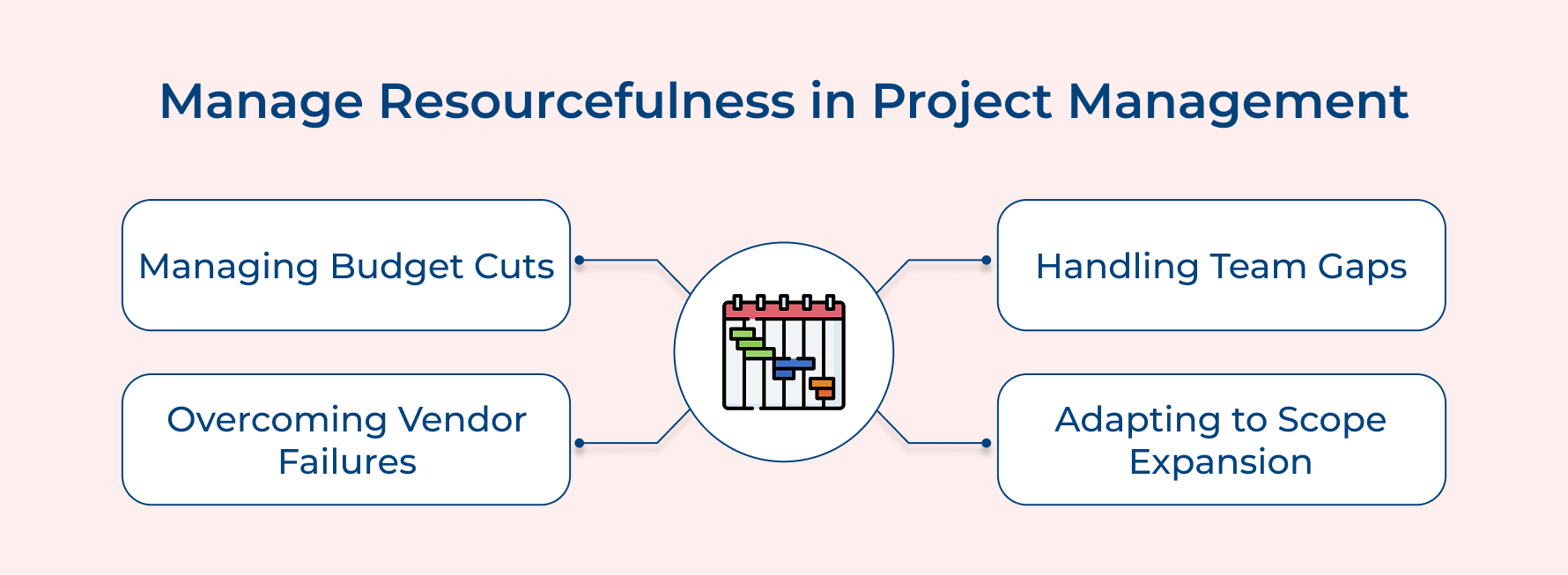
4 Examples of Resourcefulness in Project Management
Here are a few examples that show how resourcefulness turns challenging situations into successful outcomes. These scenarios in the business landscape demonstrate how creative thinking helps teams deliver results when standard approaches fall short.
Budget Cuts Mid-Project
A construction project manager faced a 20% budget reduction halfway through the timeline. She renegotiated vendor contracts and reassigned internal staff to handle tasks originally planned for contractors which kept the project moving forward without sacrificing quality.
Key Team Member Departure
A software team lost their lead developer two months before launch with no budget for replacement. The project manager distributed responsibilities across remaining team members based on hidden strengths and brought in a part-time consultant for critical tasks only.
Vendor Failure Before Deadline
An event planning team learned their catering vendor cancelled one week before a major corporate conference. They quickly partnered with three local restaurants to create a collaborative menu that actually received better feedback than traditional catering would have.
Scope Expansion Without Additional Resources
A marketing team received requests to add two new deliverables without timeline extension or extra budget. They repurposed existing content and automated reporting tasks to free up enough capacity to handle the expanded scope successfully.
Unlock Your Team’s Potential With Resourcefulness In Project Management
Resourcefulness in project management transforms how your cross-functional team handles challenges and delivers projects successfully under any circumstances. When you build this skill into your organization’s culture you create teams that find solutions leading to innovative digital transformation.
Start developing resourcefulness today by embracing the steps outlined above and watching your project outcomes improve. The investment you make in building resourceful teams pays dividends across every future project you undertake.
Limit time — not creativity
Everything you need for customer support, marketing & sales.

Neeti Singh is a passionate content writer at Kooper, where he transforms complex concepts into clear, engaging and actionable content. With a keen eye for detail and a love for technology, Tushar Joshi crafts blog posts, guides and articles that help readers navigate the fast-evolving world of software solutions.