Project Management Dependencies: Types, Examples & Tips
- What are Dependencies in Project Management?
- Key Benefits of Managing Project Dependencies Effectively
- Types of Dependencies in Project Management
- How to Identify & Manage Dependencies in a Project?
- Practical Tips for Project Dependency Management
- Examples of Project Management Dependency by Industry
- Challenges in Project Dependencies
- Streamline Your Workflow with Project Management Dependencies
- FAQs about Dependencies in Project Management

Key Highlights:
- Understanding dependencies in project management helps teams avoid idle time and missed deadlines.
- Project management dependencies reveal critical paths, bottlenecks and where schedules are most fragile.
- Clear dependency mapping improves resource allocation and prevents specialists from sitting idle unnecessarily.
Your project timeline looks perfect on paper but tasks keep stalling because someone’s waiting on someone else. Deadlines slip constantly and nobody knows why delays keep cascading through your schedule.
Without understanding dependencies, you’re scheduling blind. Teams sit idle while critical work waits. Stakeholders lose confidence as delivery dates become meaningless guesses instead of reliable commitments.
Mastering project management dependencies gives you control over timing and outcomes. This guide shows you how to identify, classify as well as manage task relationships. You’ll learn to build schedules that reflect reality and prevent delays before they spread.
What are Dependencies in Project Management?
Dependencies are the relationships between tasks where one activity relies on another to start or finish. When Task A must complete before Task B can begin, you’ve got a dependency that shapes how your entire project flows forward.
These connections determine your project’s critical path and overall duration. They help you spot bottlenecks before they become problems. Understanding dependencies means you can plan realistic schedules and allocate resources where they’re actually needed instead of where you think they should go.
Main objectives:
- Sequence clarity: Establish the correct order of tasks so team members know exactly what comes next.
- Risk reduction: Identify potential delays early by understanding which tasks could create domino effects across your timeline.
- Resource optimization: Allocate team members and materials efficiently by knowing when they’ll actually be needed.
- Timeline accuracy: Create realistic schedules that account for how tasks genuinely connect rather than wishful thinking.
- Client communication: Show clients and team members why certain delays happen and how tasks interconnect throughout the project.
Key Benefits of Managing Project Dependencies Effectively
Managing dependencies well separates successful projects from chaotic ones. When you understand how tasks connect, you control your project instead of reacting to surprises.
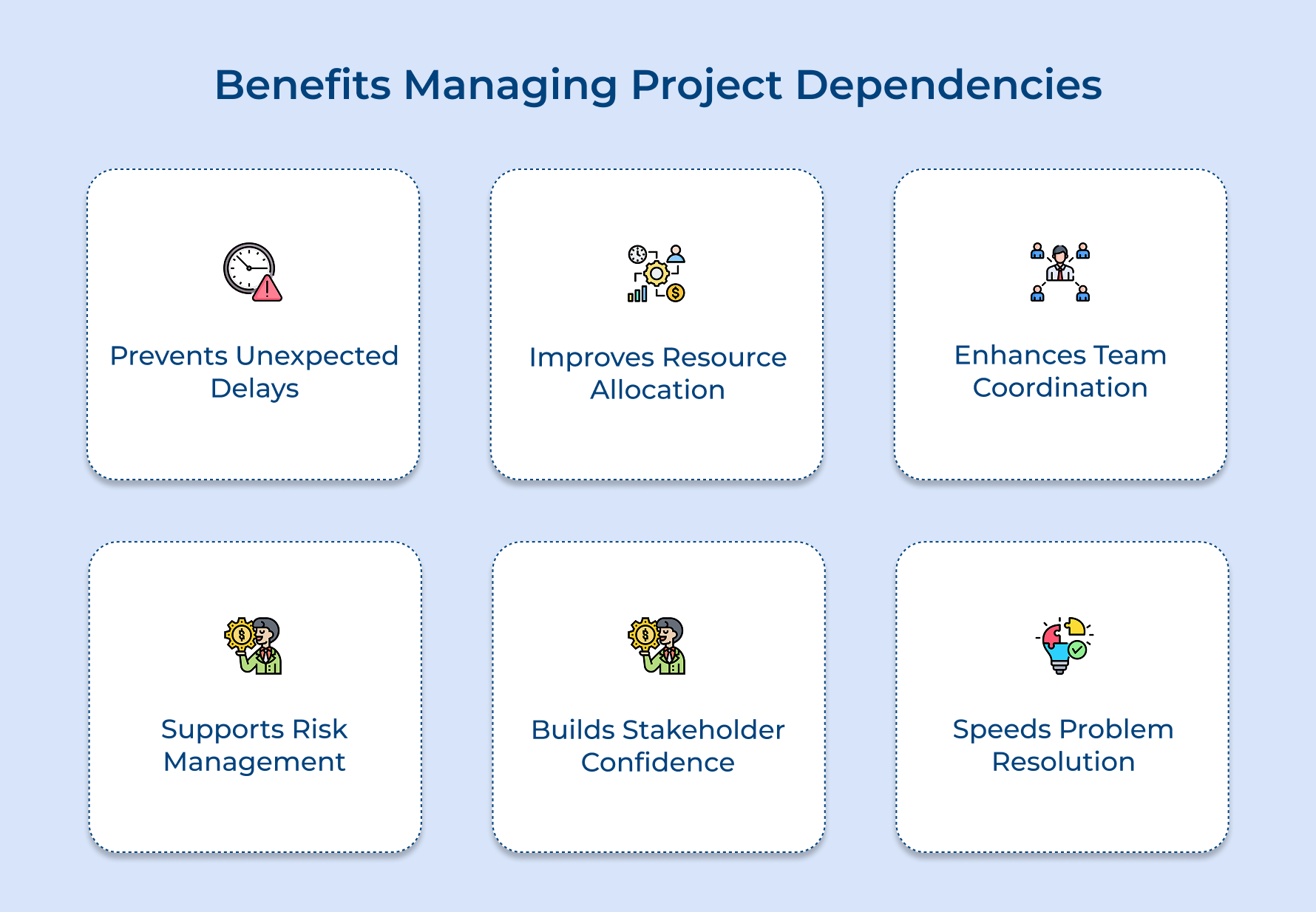
Prevents Unexpected Delays
You spot potential roadblocks before they derail your timeline. When dependencies are mapped out, surprises become rare events instead of daily crises that drain team morale.
Improves Resource Allocation
Team members work on the right tasks at the right time. No more having expensive specialists sitting idle or critical skills stretched too thin across conflicting priorities.
Enhances Team Coordination
Everyone understands how their work affects others downstream. This clarity reduces friction and creates accountability because people see their role in the bigger picture clearly.
Enables Better Risk Management
You identify vulnerable points where single delays could cascade. The foresight lets you build buffers or create backup plans for your most fragile dependency chains.
Increases Stakeholder Confidence
Clients trust you more when you explain realistic timelines backed by dependency logic. They appreciate transparency about why certain sequences matter instead of arbitrary-seeming deadlines.
Facilitates Faster Problem-Solving
When issues arise, you quickly trace impacts through your dependency map. This speed means you can adjust plans and communicate changes before small problems become major setbacks.
Types of Dependencies in Project Management
Dependencies come in various forms that shape how your project unfolds. Understanding each type helps you build schedules that reflect reality instead of wishful thinking. Let’s explore them:
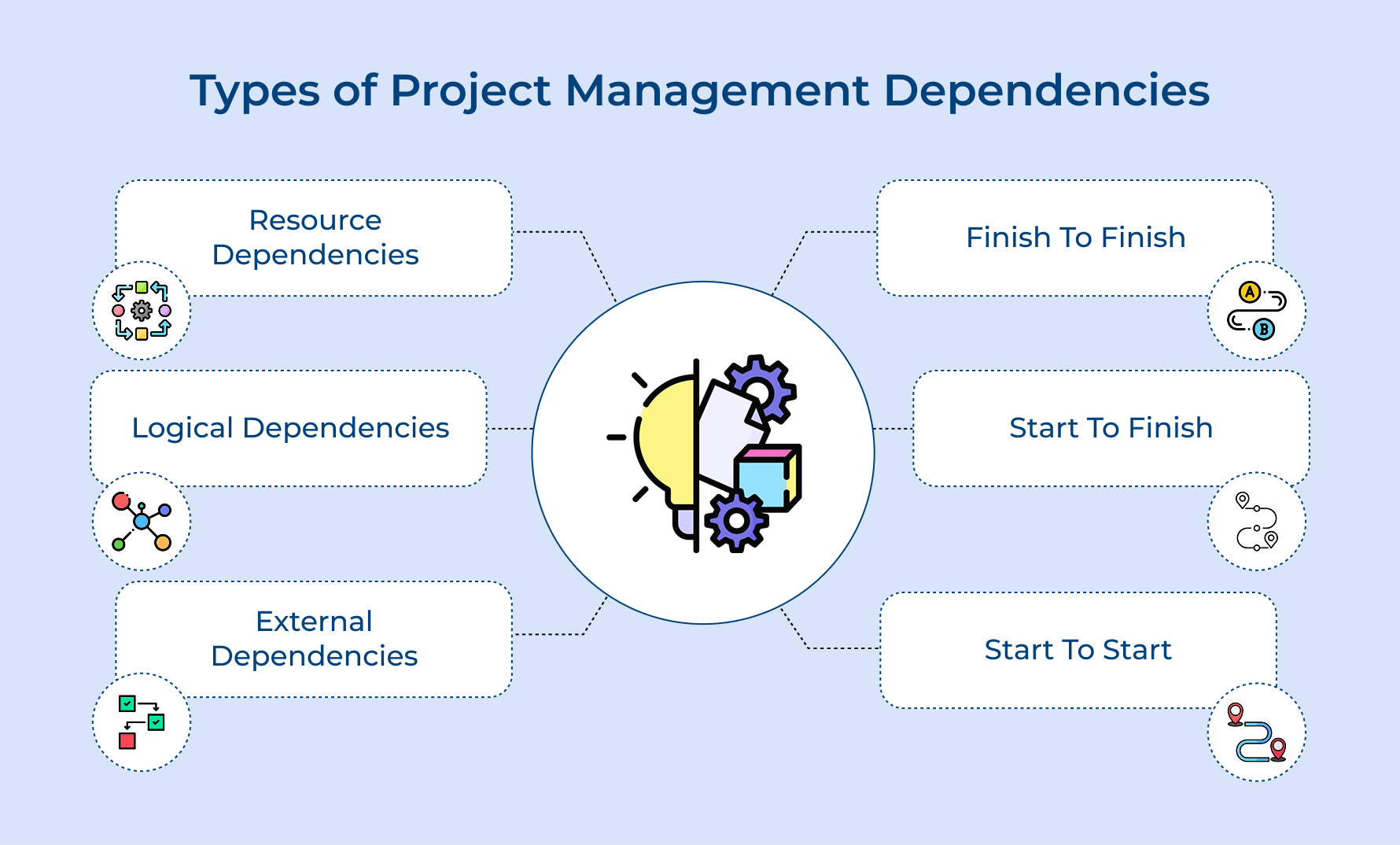
Resource Dependencies
Resource dependencies occur when multiple tasks compete for the same people or equipment. You can’t have your graphic designer working on two presentations simultaneously. This constraint forces you to sequence tasks based on who’s available rather than just logical workflow preferences.
Here’s what typically creates resource dependency bottlenecks in projects:
- Specialized team members with unique skills that multiple tasks require
- Expensive equipment or software licenses that teams must share
- Budget constraints that limit how many resources you can deploy at once
These dependencies often catch project managers off guard. Unlike logical dependencies that follow clear cause-and-effect patterns, resource conflicts emerge from practical limitations. Smart scheduling around resource dependencies prevents burnout and keeps your most valuable assets productive throughout the project lifecycle.
Logical Dependencies
Logical dependencies follow natural cause-and-effect relationships between tasks. You must write the code before you can test it. These connections exist regardless of resources or external factors because the work itself demands a specific sequence.
Consider these questions when mapping your logical dependencies:
- Does Task B require deliverables or outputs from Task A to proceed?
- Would starting Task B before Task A create rework or quality issues?
- Can these tasks truly run parallel or does physics demand sequencing?
Also called technical dependencies, these are the most straightforward to identify. The work creates its own order based on what must physically or logically come first. Teams sometimes mistake preference for necessity and create false logical dependencies that unnecessarily constrain their schedule flexibility.
External Dependencies
External dependencies involve factors outside your direct control. Waiting for vendor deliveries or regulatory approvals creates scheduling constraints you can’t simply speed up. These require buffer time and backup plans because you’re at someone else’s mercy.
Common external dependencies that project managers wrestle with daily include:
- Third-party vendor deliveries that arrive on their schedule
- Government permits and regulatory approvals with fixed processing times
- Client feedback cycles where you’re waiting for stakeholder availability
External dependencies demand different management strategies than internal ones. You need stronger communication channels and contingency plans. The key is identifying them early so you can work around constraints or apply pressure where it might actually help. Managing external dependencies requires proactive communication and realistic expectations.
Finish-to-Finish
Finish-to-finish dependencies mean two tasks must complete at the same time. Quality testing can’t finish until development finishes. Both activities run in parallel but their endpoints are synchronized for logical reasons or efficiency.
This dependency type often appears in inspection and approval workflows. Your content creation as well as legal review might progress together but both must conclude simultaneously. The reviewer needs to see the final version before signing off completely.
Documentation and software releases often use this pattern because the manual must reflect the actual product at launch time. Real-world scenarios where finish-to-finish dependencies make sense:
Quality assurance testing that runs alongside final development tweaks
Documentation updates that mirror feature development progress
Training material creation that matches product finalization timelines
Start-to-Finish
Start-to-finish dependencies are the rarest and most confusing type. The successor task can’t finish until the predecessor task starts. The backward-seeming relationship appears in scenarios like shift handovers or transitional phases.
Consider a security guard shift change where the night guard can’t finish their shift until the day guard starts. The ending of one task depends on the beginning of another. This creates a unique scheduling challenge that most project management software struggles to represent clearly.
These dependencies feel counterintuitive because we typically think forward in time. Just-in-time manufacturing uses start-to-finish relationships where inventory can’t be depleted until new supplies begin arriving.
Understanding when start-to-finish dependencies apply in your projects requires careful thinking:
- Shift transitions where outgoing staff can’t leave until replacements arrive
- System migrations where the old system stays active until new one goes live
- Inventory management where stock depletion waits for replenishment to begin
Start-to-Start
Start-to-start dependencies allow two tasks to begin simultaneously or nearly so. Your design work and prototype ordering can start together once requirements are clear. Neither task must finish for the other to commence work.
This dependency creates efficiency by enabling parallel workflows. When tasks share common inputs but produce different outputs, start-to-start relationships maximize your team’s productivity. Your social media campaign and email marketing can both launch when the creative brief is approved.
The beauty of start-to-start dependencies lies in compression opportunities. They let you shorten project timelines without sacrificing quality or creating chaos. You need adequate resources to support simultaneous work or you’ll just create resource dependencies that negate the scheduling benefit.
How to Identify & Manage Dependencies in a Project?
Dive into these seven essential steps to ensure your project flows smoothly from inception to completion.
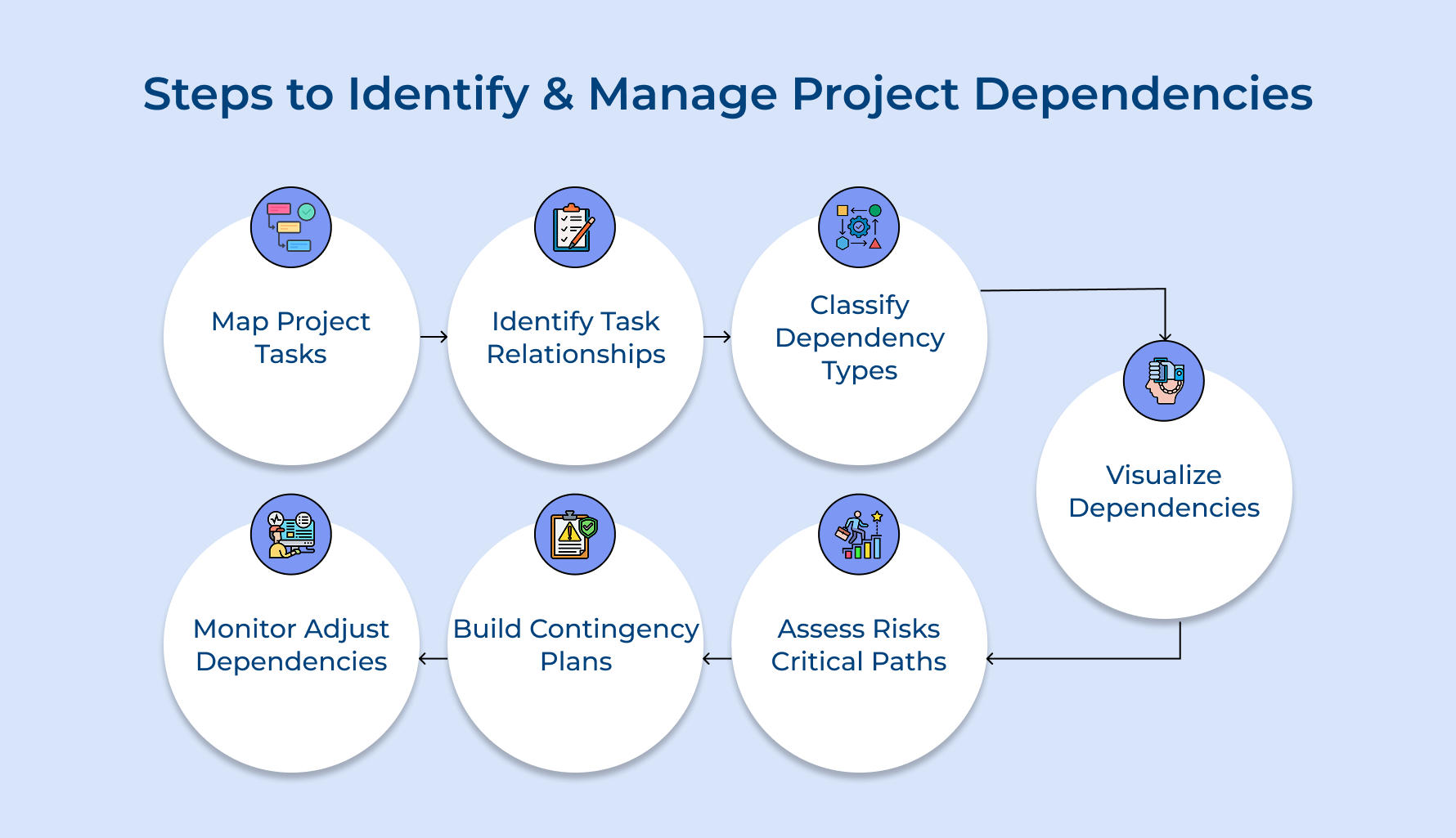
1. Map All Project Tasks Clearly
Mapping tasks is your foundation for understanding what needs to happen and when. Without a clear task inventory, you’re flying blind. This step transforms vague project goals into concrete actionable items that your team can actually execute and track.
Here are four key strategies for mapping project tasks effectively:
- Start with deliverables: Work backwards from final outputs to identify every task needed to produce them.
- Involve your team: Gather input from people doing the actual work because they spot details you’ll miss.
- Use consistent granularity: Keep tasks at similar detail levels so nothing gets lost in abstraction or overwhelmed by minutiae.
- Review and refine: Revisit your task list as you learn more because initial assumptions rarely survive contact with reality.
Consider a digital marketing agency launching a client’s rebrand campaign. They break down the project into distinct tasks like audience research, logo design iterations, website wireframing, content creation and launch coordination. Each task gets documented with clear deliverables so everyone knows what “done” actually means for their piece.
2. Identify Relationships Between Tasks
Identifying task relationships reveals the invisible threads connecting your project activities together. It uncovers which tasks must wait for others and where resource conflicts will emerge. Understanding these connections prevents you from creating impossible schedules that look good on paper but fail in reality.
Start by asking which tasks produce outputs that other tasks need as inputs. Look for shared resources where team members or equipment must serve multiple tasks. Question if tasks can truly run parallel or if hidden dependencies lurk beneath the surface.
Pro tips:
- Interview task owners directly because they often know dependencies that don’t appear in documentation or planning sessions.
- Watch for assumed dependencies that stem from habit rather than necessity since these artificial constraints unnecessarily limit your scheduling flexibility.
3. Classify Dependencies by Type
Classification transforms a messy web of task relationships into an organized system you can actually manage. Knowing whether you’re dealing with logical, resource, or external dependencies changes how you schedule and mitigate risks.
Consider these four key factors when classifying your project dependencies:
- Nature of constraint: Determine if the dependency stems from work logic, resource availability, or external factors beyond control.
- Flexibility level: Assess if the dependency is fixed by physics or just current assumptions about workflow.
- Control span: Identify if you can influence the dependency or must simply plan around it.
- Impact severity: Evaluate how much schedule disruption would occur if this dependency breaks or delays.
Learn these factors to prioritize which dependencies need the most attention and planning. Not all dependencies carry equal weight in determining your project’s success or failure trajectory.
Here’s how project dependencies typically get classified in practice:
- By timing: Finish-to-start, start-to-start, finish-to-finish, or the rare start-to-finish relationships that define task sequencing.
- By necessity: Mandatory dependencies that can’t be avoided versus discretionary ones that reflect preferred workflows or best practices.
- By origin: Internal dependencies you control versus external ones where you’re at another party’s mercy.
Proper classification lets you apply the right management approach to each dependency. External dependencies need buffer time while resource dependencies might need additional staffing to resolve scheduling conflicts properly.
4. Visualize Dependencies Using Tools
Visual tools make task dependencies easier to understand. Lists and spreadsheets overload your memory while hiding risks. Diagrams show the full picture and reveal problems early.
Use network diagrams or Gantt charts
Network diagrams show how tasks connect. Gantt charts show task order and overlaps on a timeline. Both help spot bottlenecks quickly.
Leverage project management software
Tools like Kooper, Asana or Microsoft Project track dependencies automatically. Alerts show how changes affect other tasks and reduce manual errors.
Create simple dependency maps
Focused maps show only task relationships. Color coding highlights different dependency types and makes patterns easy to see.
5. Assess Risks and Critical Paths
Risk assessment identifies which dependencies could derail your project if they fail or delay. Skipping this step means discovering vulnerabilities only when disasters strike. You lose the chance to protect your schedule before problems cascade through dependent tasks.
This reveals your project’s critical path – the longest sequence of dependent tasks determining minimum completion time. Understanding which tasks have zero flexibility versus comfortable buffers lets you focus attention strategically. You allocate resources where they matter instead of spreading efforts thin.
Ask yourself these four key questions when assessing dependency risks:
- Which single task failure would create the longest project delay?
- Where do multiple dependencies converge on one task or resource?
- What external dependencies have the highest likelihood of causing problems?
- Which tasks sit on the critical path with no schedule buffer?
These questions force you to think like a detective hunting for weak points. They shift your mindset from optimistic planning to realistic risk evaluation. Your answers reveal where contingency plans will deliver the biggest protective value.
6. Build Contingency Plans Strategically
Contingency planning creates your safety net for when dependencies break or delay unexpectedly. Without backup plans, you’re gambling everything will go perfectly in a world where perfection rarely happens. Strategic contingencies give you options instead of forcing crisis mode.
Here are three effective ways to build contingency plans strategically:
- Time buffers for critical dependencies: Add padding to tasks on your critical path and external dependencies where delays hurt most.
- Alternative resource arrangements: Line up backup vendors or cross-trained team members who can step in when primary resources become unavailable.
- Parallel path options: Develop alternative workflows that achieve outcomes through different task sequences when possible.
Wait, won’t all this contingency planning slow us down and waste resources? Smart contingencies don’t slow you down – they prevent massive delays when you have no backup options. The small upfront investment pays off enormously when a vendor misses deadlines or your specialist calls in sick.
7. Monitor and Adjust Dependencies Continuously
Continuous monitoring keeps your dependency map aligned with reality as your project evolves. Dependencies shift when tasks finish early or late and external factors change. Regular tracking catches problems while they’re small instead of after they’ve spread.
Check dependency status during every review meeting and update schedules when changes occur. Watch for new dependencies that emerge as work progresses. Communicate any shifts to affected stakeholders immediately so they can adjust plans.
Pro tips:
- Assign dependency monitoring to specific team members because diffused responsibility means nobody actually tracks.
- Build dependency review into regular standup meetings so it becomes an automatic habit instead of something remembered only during crises.
Practical Tips for Project Dependency Management
Effective dependency management separates smooth projects from chaotic ones. These practical tips help you stay ahead of complications.
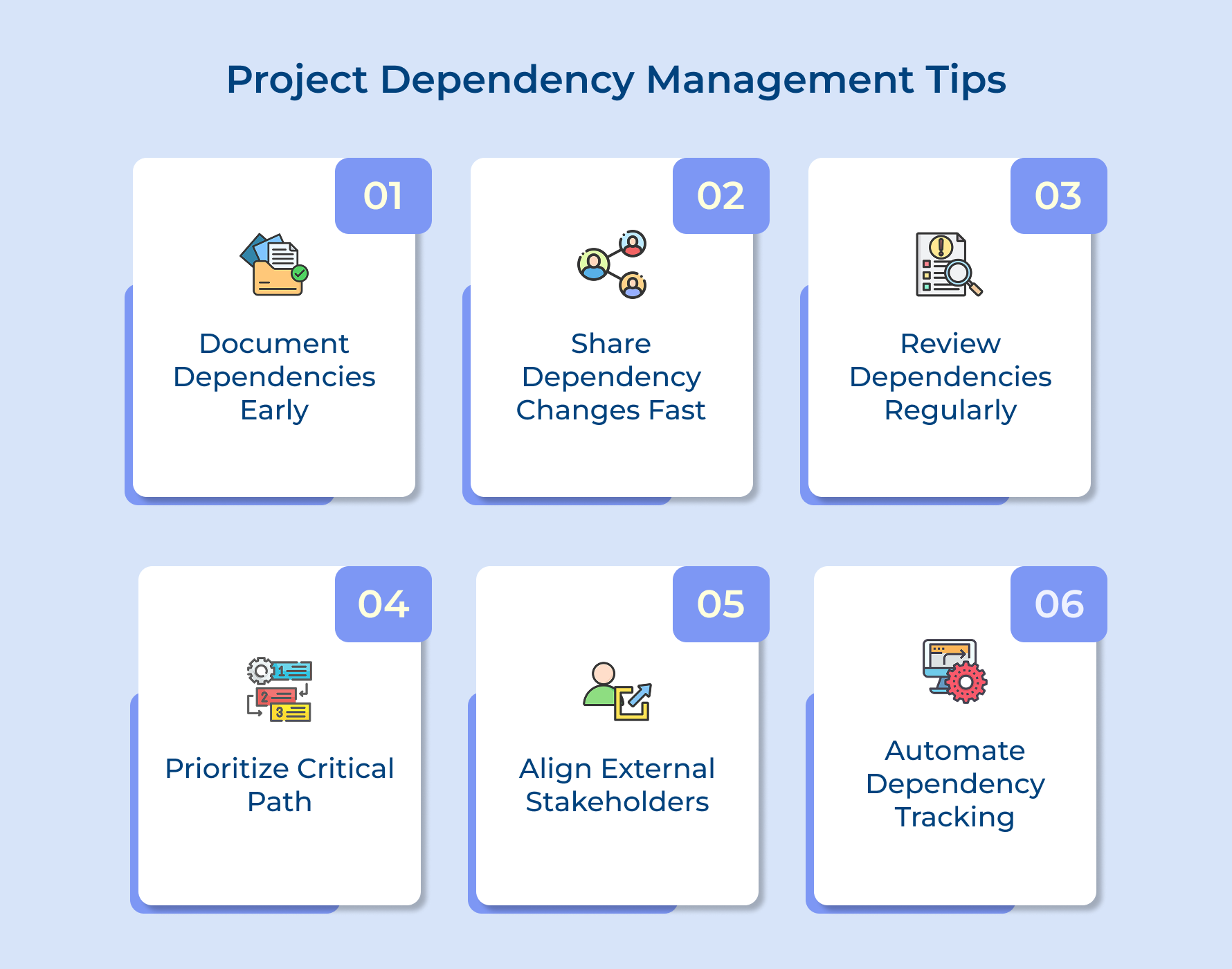
- Document dependencies from day one: Start tracking dependencies during initial planning instead of discovering them mid-project. Early documentation prevents surprises and helps stakeholders understand realistic timelines before commitments are made.
- Communicate dependency changes immediately: Alert affected team members the moment a dependency shifts or breaks. Quick communication prevents wasted effort on tasks that can’t proceed while maintaining trust across your project team.
- Review dependencies in every status meeting: Make dependency checks a standard agenda item in project reviews. Regular examination catches emerging problems early and keeps everyone aware of how their work affects others downstream.
- Prioritize critical path dependencies: Focus your energy on dependencies that directly impact project completion dates. Not every dependency deserves equal attention so concentrate resources where delays would hurt most significantly.
- Build relationships with external stakeholders: Cultivate strong connections with vendors and external partners your project depends on. Good relationships give you leverage when you need priority treatment or faster responses during crunch times.
- Use automation to track dependency status: Let project management software automatically flag when predecessor tasks complete or delay. Automation reduces manual tracking burden and ensures nothing slips through the cracks during busy project phases.
Examples of Project Management Dependency by Industry
Dependencies manifest differently across industries based on unique workflows and constraints. These real-world examples show how various sectors handle task interdependencies.
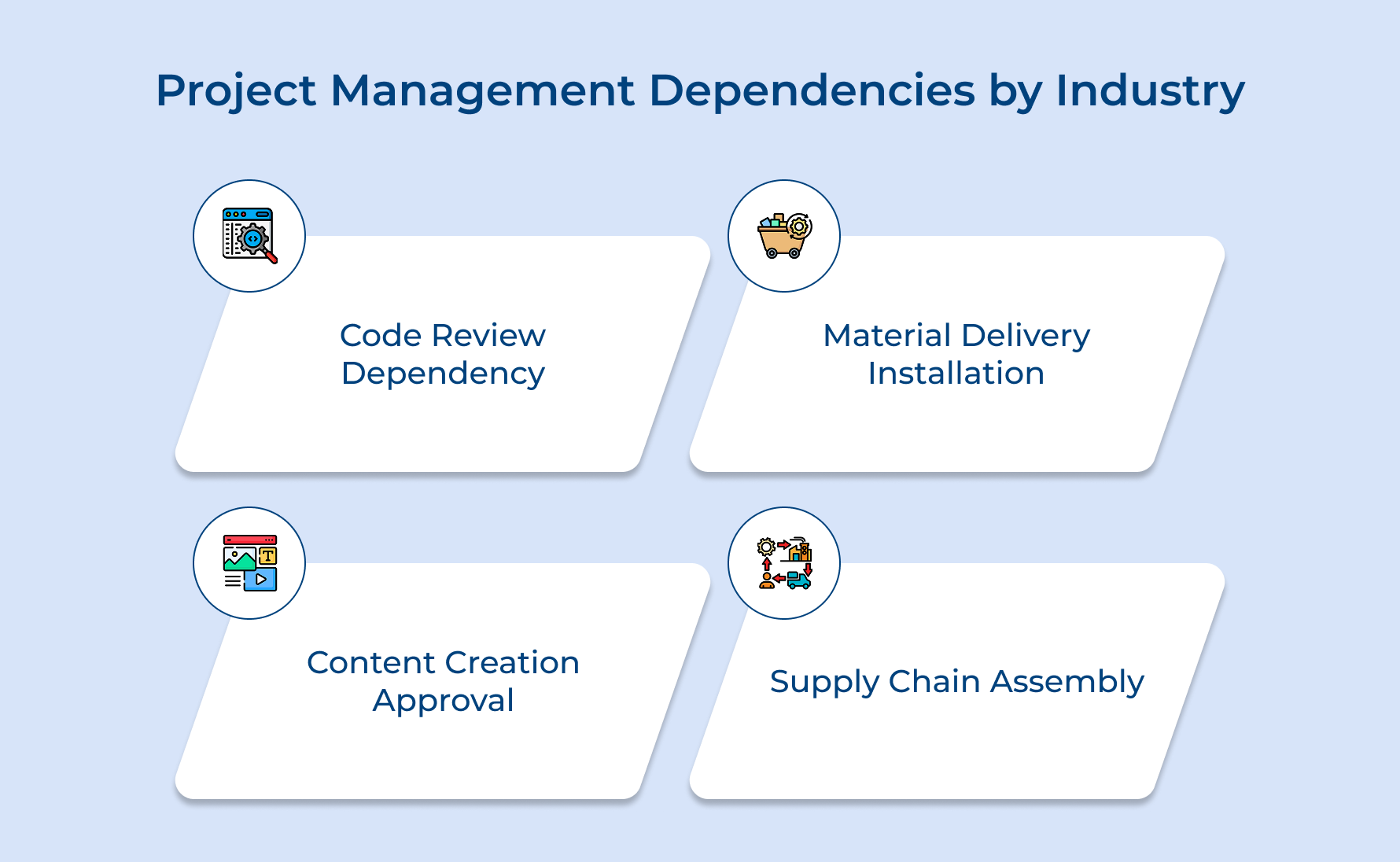
Software Development: Code Review Dependencies
Developers can’t deploy new features until code passes peer review and automated testing completes successfully. The development task feeds into testing which then enables deployment. This finish-to-start dependency ensures quality standards are met before production release happens.
Construction: Material Delivery and Installation
Foundation pouring can’t begin until concrete suppliers deliver materials to the construction site. Weather conditions create external dependencies that affect both delivery schedules and curing times. Multiple trades depend on foundation completion before starting their specialized work phases.
Marketing: Content Creation and Approval Workflow
Graphic designers need approved copy before creating visual assets for campaign materials. Legal review must finish before any content goes live across channels. These logical dependencies ensure brand consistency and regulatory compliance throughout the entire marketing launch process.
Manufacturing: Supply Chain and Assembly Line
Assembly can’t start until raw materials arrive from suppliers and pass quality inspection checkpoints. Each assembly station depends on the previous station completing its work correctly. Resource dependencies emerge when specialized equipment or skilled technicians must serve multiple production lines simultaneously.
Challenges in Project Dependencies
Managing dependencies isn’t always straightforward. These common challenges can derail even well-planned projects if you’re not prepared.
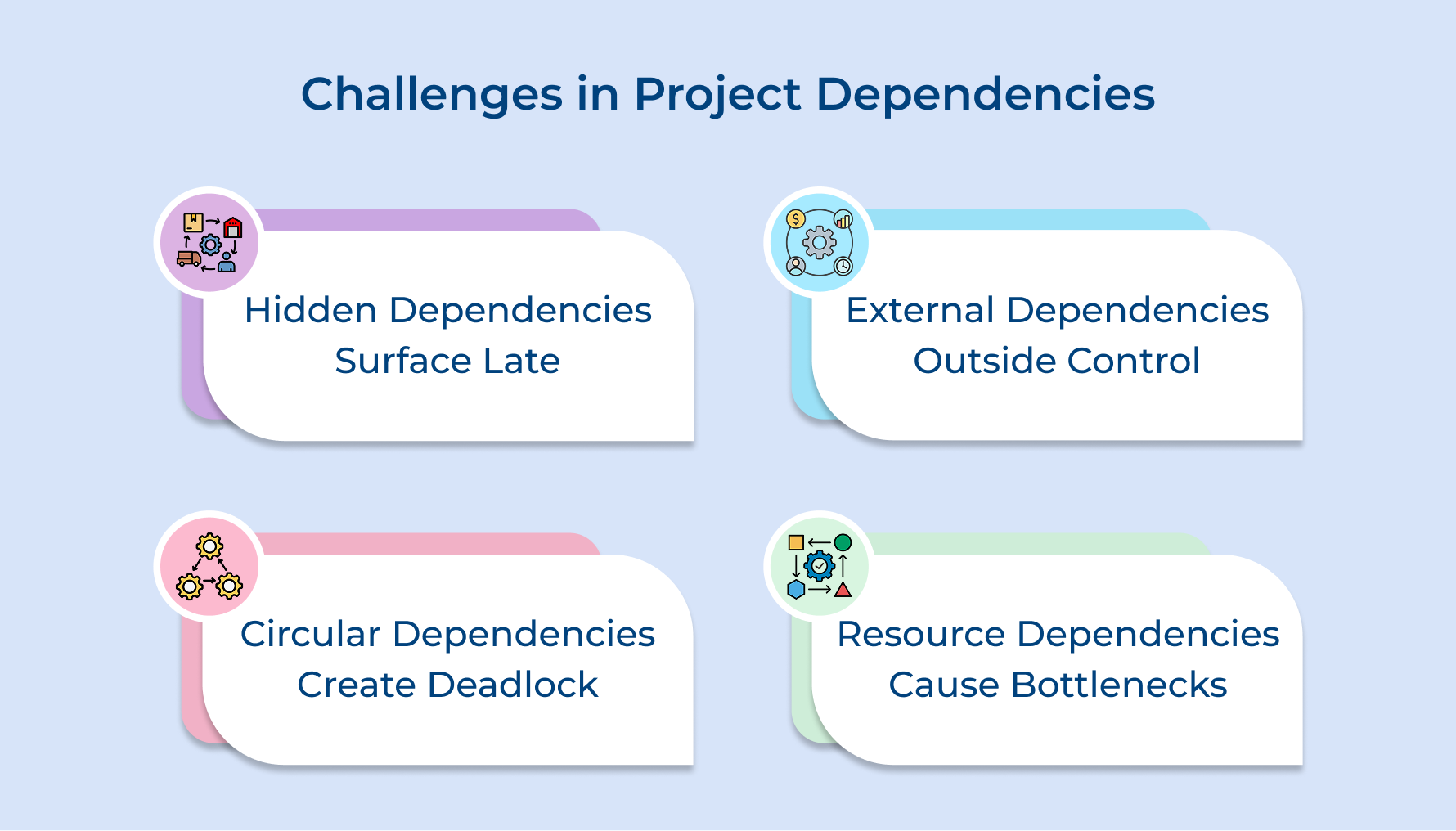
Hidden Dependencies That Surface Late
Teams often uncover important dependencies halfway through a project that were missed during planning. These surprises slow progress and trigger costly rework when tasks suddenly can’t move forward. Most of the time, unclear communication and incomplete requirements are the real reasons these hidden dependencies surface late.
External Dependencies Beyond Your Control
Vendors miss delivery dates, regulators delay approvals and clients provide feedback slower than promised. You can’t force external parties to prioritize your timeline. This lack of control makes accurate scheduling nearly impossible without significant buffer time.
Circular Dependencies Creating Deadlock
Sometimes Task A needs Task B to finish while Task B simultaneously needs Task A’s output. These circular dependencies create impossible situations where nothing moves forward. They result from poor design or unclear requirements not caught early.
Resource Dependencies Causing Bottlenecks
When multiple tasks need the same specialist or equipment, bottlenecks form quickly. Your expert gets overloaded while other tasks sit idle waiting. Resource constraints often create more scheduling problems than logical task dependencies.
While dependency challenges are frustrating, practical solutions exist to minimize their impact. Here’s how to tackle these obstacles:
- Conduct thorough dependency discovery workshops with all stakeholders before kickoff to surface hidden connections early.
- Build substantial buffer time into external dependencies and maintain backup vendor relationships for critical deliverables.
- Break circular dependencies by identifying which task can be partially completed or which requirement can be relaxed.
- Cross-train team members on critical skills and consider hiring contractors to eliminate resource failure points.
- Use dependency mapping tools to visualize relationships and spot potential conflicts before they impact schedules.
Streamline Your Workflow with Project Management Dependencies
Understanding and managing dependencies transforms chaotic projects into smooth operations. When you map task relationships clearly and monitor them continuously, scheduling becomes predictable instead of reactive guesswork.
Start implementing these dependency management practices in your next project. Track what works for your team while refining your approach. Better dependency management means fewer surprises, happier stakeholders and projects that actually finish on time without constant firefighting.
Limit time — not creativity
Everything you need for customer support, marketing & sales.

Neeti Singh is a passionate content writer at Kooper, where he transforms complex concepts into clear, engaging and actionable content. With a keen eye for detail and a love for technology, Tushar Joshi crafts blog posts, guides and articles that help readers navigate the fast-evolving world of software solutions.