Project Cost Optimization: Tips to Reduce Budget Overruns
- What is Cost Optimization in Project Management?
- Why is Cost Optimization Important in Project Management?
- 6 Actionable Project Cost Optimization Techniques
- 8 Project Cost Optimization Best Practices
- Project Cost Optimization Challenges
- Turn Financial Challenges Into Opportunities With Optimized Project Cost
- FAQs about Project Cost Optimization

Key Highlights:
- Effective cost optimization in project management builds client trust and loyalty.
- Align resources intelligently to maximize efficiency and minimize unnecessary expenses.
- Automation and process improvement reduce labor costs while boosting project productivity.
Even with solid planning, your projects still seem to go over budget. Meanwhile, competitors are winning bids and staying profitable, leaving you wondering how they’re managing project cost optimization so well.
Every budget overrun hurts client trust and cuts into money you could reinvest in growing your business. Explaining unexpected costs to frustrated clients gets draining and your team ends up stuck between delivering great work while meeting unrealistic financial targets.
This guide breaks down eight practical project cost optimization techniques used by successful project managers. You’ll learn how to eliminate waste, control costs smarter and manage project budgets in a way that protects profitability without compromising client satisfaction.
What is Cost Optimization in Project Management?
Cost optimization means finding ways to deliver project outcomes while spending less money without hurting quality. It involves analyzing where funds go and making smart choices about resource allocation. The goal is maximizing value from every dollar spent rather than simply cutting costs everywhere.
How It Drives Growth While Keeping Clients Happy?
When you optimize costs effectively, you can offer competitive pricing that attracts new clients while maintaining healthy profit margins. This approach lets you reinvest savings into better service delivery or innovation. Clients stay satisfied because they receive quality work at fair prices, which builds trust and leads to repeat business.
Key objectives:
- Eliminate waste: Remove activities and expenses that don’t contribute to project value or client outcomes.
- Improve resource efficiency: Ensure team members and tools are used at their full potential without overallocation or idle time.
- Negotiate better terms: Secure favorable rates with vendors and suppliers through strategic partnerships as well as volume agreements.
- Prevent budget overruns: Identify financial risks early and implement controls that keep spending within approved limits.
- Increase profit margins: Create room for higher returns by reducing unnecessary expenses while maintaining deliverable quality.
Why is Cost Optimization Important in Project Management?
Cost optimization isn’t just about saving money. It’s about building operational efficiency and sustainable project practices that help organizations thrive in competitive markets.
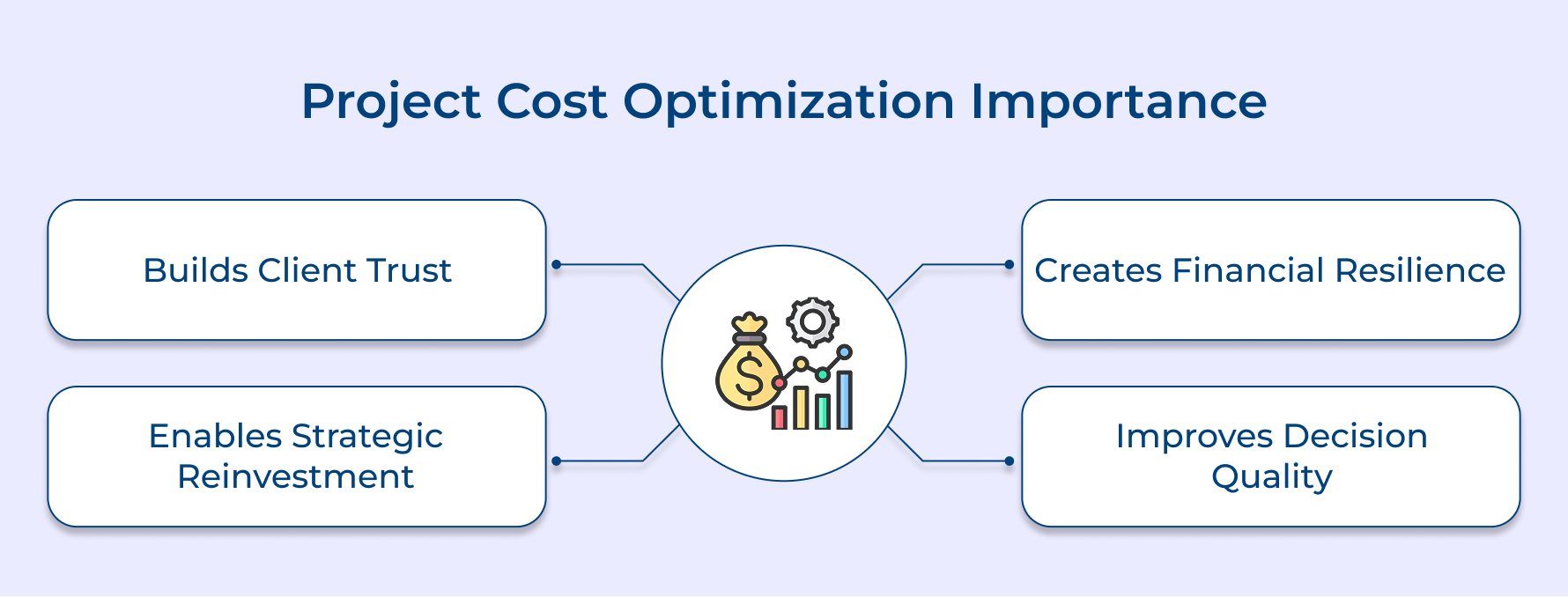
Builds Client Trust and Loyalty
Clients notice when you respect their budgets and still find smart ways to deliver more value. Strong resource management shows you’re focused on outcomes, not just billable hours and positions you as a partner invested in their long-term success.
Creates Financial Resilience
Optimized projects are backed by thoughtful cost analysis, giving you breathing room when unexpected challenges arise. Instead of scrambling or having uncomfortable budget conversations, you’re able to adapt while protecting timelines and client confidence.
Enables Strategic Reinvestment
Savings unlocked through automation tools don’t just reduce costs—they free up budget to upskill your team, improve processes, or experiment with new ideas. Over time, these reinvestments build capabilities that set you apart from competitors.
Improves Decision-Making Quality
Focusing on performance metrics encourages project managers to question assumptions and align spending with real project goals. This sharper, data-driven mindset leads to better decisions across planning, execution and delivery—not just finances.
6 Actionable Project Cost Optimization Techniques
Smart cost optimization requires proven techniques that balance financial discipline with project quality. Let’s explore six practical approaches that project managers use to keep budgets healthy while delivering excellent results.
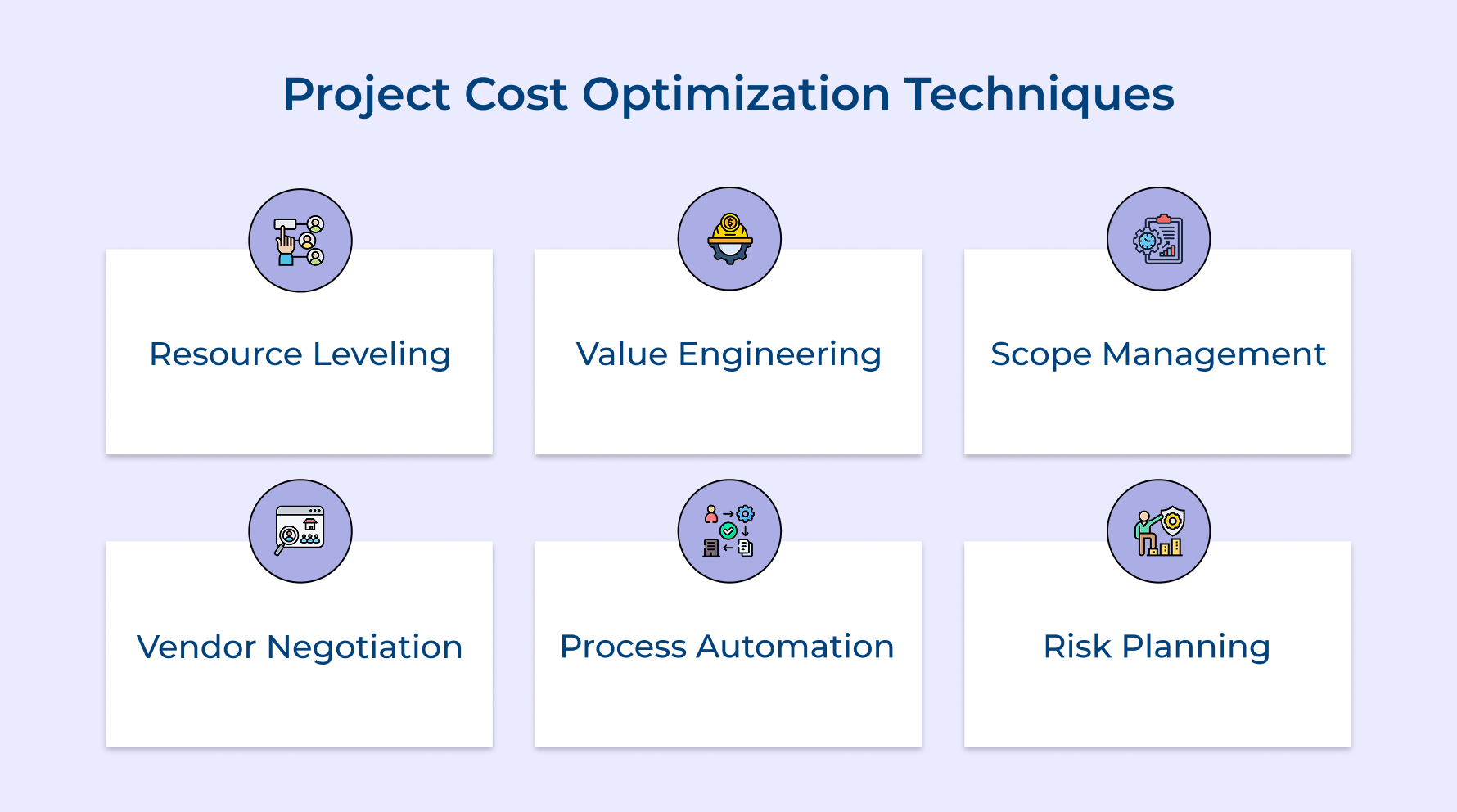
1. Resource Leveling and Allocation
Resource leveling helps you distribute team workload evenly across project timelines to avoid expensive overtime and burnout. By smoothing out peaks and valleys in resource demand, you eliminate the costly cycle of hiring temporary staff during rush periods.
Consider how resource optimization creates value across different scenarios:
- A software team shifts developers from waiting phases to documentation tasks instead of paying them to sit idle.
- Construction crews move between complementary projects during weather delays rather than staying on payroll unproductively.
- Marketing teams batch similar creative work together to reduce context-switching costs and improve output quality.
When team members work at sustainable capacity without constant fire-drills, they produce higher quality work that requires fewer expensive revisions. This creates a virtuous cycle where better planning leads to better outcomes which leads to more predictable projects.
2. Value Engineering
Value engineering systematically examines every project component to determine if there’s a cheaper way to achieve the same result. The focus remains on preserving functionality and quality while finding cost-saving opportunities that clients might not even notice.
Think about value engineering opportunities in typical project scenarios:
- Replacing custom-built software features with proven third-party integrations that cost significantly less to implement.
- Using prefabricated components in construction instead of building everything from scratch on-site.
Project managers who master this technique often discover that expensive solutions became standard practice simply because nobody questioned them. Sometimes the most significant savings come from eliminating unnecessary complexity rather than finding cheaper versions of complicated solutions.
3. Scope Management and Change Control
Scope creep silently destroys project budgets by adding unplanned work that consumes resources without corresponding budget increases. Effective scope management establishes clear boundaries about what’s included and creates formal processes for evaluating requested changes.
Watch for these common scope creep patterns that drain budgets:
- Clients requesting “quick fixes” that accumulate into significant unbilled work over time.
- Team members adding features they think would be nice without checking if they align with approved scope.
Strong change control creates transparency about trade-offs so everyone understands that adding new requirements means adjusting timeline, budget, or removing other features. This clarity prevents frustrating end-of-project conversations where clients are shocked by overages.
4. Vendor Negotiation and Consolidation
Strategic vendor management reduces costs through better pricing agreements and streamlined relationships that eliminate redundant services. Consolidating purchases with fewer vendors gives you leverage to negotiate volume discounts while reducing administrative overhead.
Explore these vendor optimization strategies that deliver measurable savings:
- Negotiating annual contracts with committed volumes instead of paying premium rates for ad-hoc purchases
- Establishing preferred supplier programs where vendors offer better rates in exchange for consistent business
Vendors who view you as a valued long-term partner are more likely to accommodate urgent requests and proactively suggest cost-saving alternatives. Building these partnerships requires treating vendors fairly while still negotiating firmly for reasonable rates.
5. Automation and Process Improvement
Automating repetitive tasks eliminates labor costs while reducing errors that lead to expensive rework. Process improvement identifies bottlenecks where time and money leak out without adding value.
Consider automation opportunities that deliver rapid return on investment:
- Using project management software to automatically generate status reports instead of manually compiling updates
- Implementing automated testing in software development to catch bugs early when they’re cheapest to fix
Project managers who carve out time for these improvements find that efficiency gains free up capacity for taking on more profitable work. The key is starting with high-frequency activities where even small time savings multiply across dozens of repetitions.
6. Risk Management and Contingency Planning
Proactive risk management prevents costly surprises by identifying potential problems early when solutions are still affordable. Building appropriate contingency reserves ensures you can handle unexpected issues without panic spending.
Address these critical risk categories that threaten project budgets:
- Technical risks where new technologies might not work as expected and require expensive alternative solutions
- Schedule risks where dependencies create vulnerability to delays that trigger penalty clauses
- External risks like regulatory changes that force mid-project adjustments to deliverables
Effective risk management isn’t about creating perfect plans that account for every possibility. Instead it’s about maintaining visibility into what could go wrong and having response strategies ready before problems escalate.
8 Project Cost Optimization Best Practices
Let’s walk you through the top eight cost optimization best practices that can transform the way your projects operate, ensuring financial efficiency without sacrificing quality.
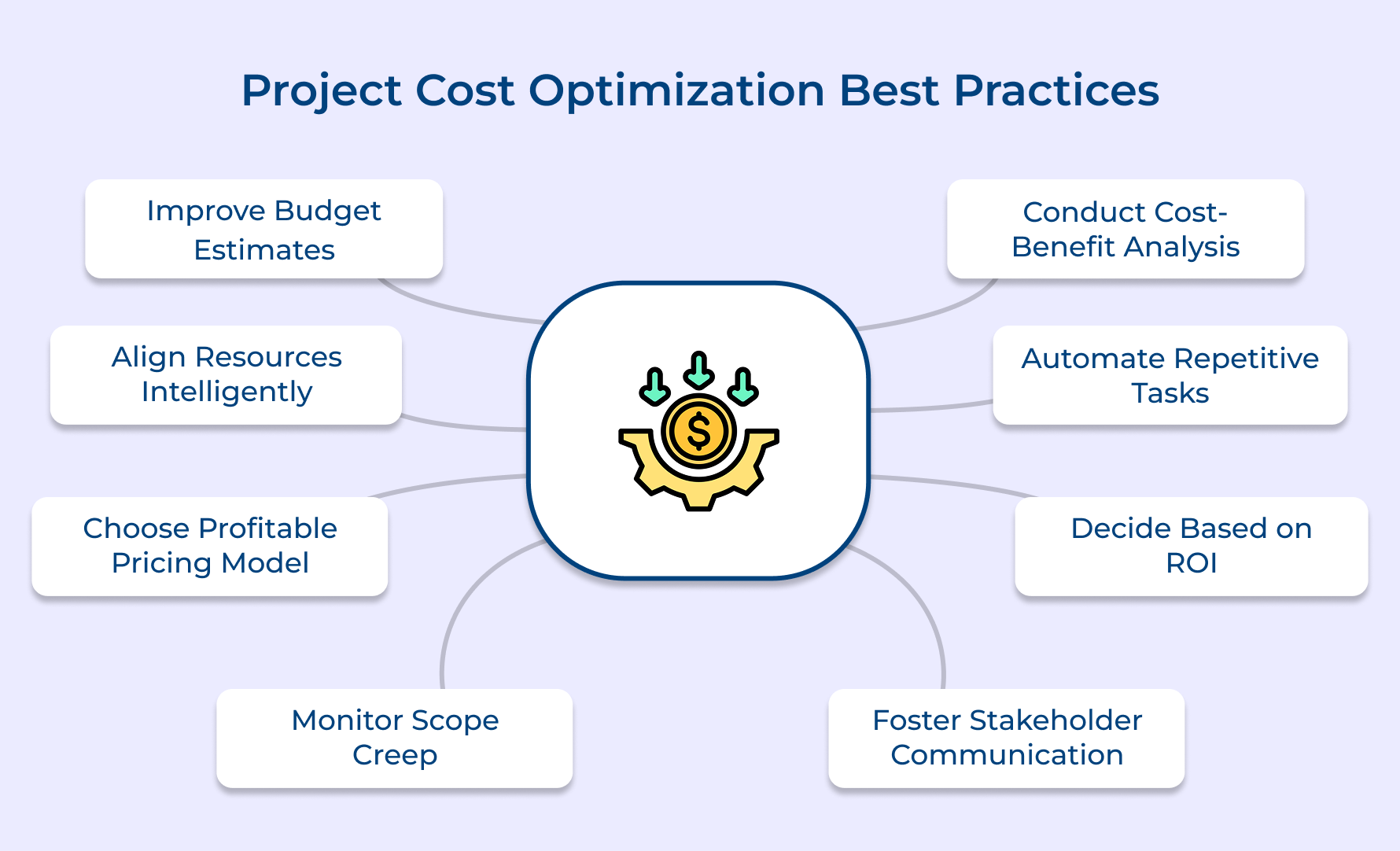
1. Improve Project Budget and Estimates
Creating accurate project budgets means analyzing past performance and building realistic financial projections that account for complexity. This practice forms the foundation of cost optimization because poor estimates lead to either overspending or underbidding that hurts profitability.
Here’s what makes strong budgets and estimates valuable:
- Client trust: Realistic budgets demonstrate professionalism and reduce awkward conversations about unexpected cost increases during project execution.
- Resource planning: Precise estimates enable better staffing decisions because you know exactly what skills and capacity you’ll need.
Costs:
- Time investment: Thorough estimation requires hours of analysis that could be spent on billable client work initially.
- Data collection effort: Building historical databases means tracking time and expenses meticulously across all projects.
So how do you actually implement better budgeting in your daily project work? Start by creating a simple spreadsheet that captures actual costs versus estimates for every project you complete. Review this data quarterly to identify patterns and use these insights to adjust your estimation formulas for improved accuracy.
2. Conduct Regular Cost-Benefit Analysis
Cost-benefit analysis is simply about pausing to ask, “Is this really worth it?” before approving spend or making project decisions. Using cost management tools helps you compare expected value against actual costs, so every choice aligns with your project goals and cost structures.
When agencies apply this mindset, they stop delivering expensive solutions just because clients ask for them. Instead, they recommend smarter alternatives that achieve the same results, control costs and protect healthy profit margins.
Here are three practical approaches to integrate cost-benefit analysis. Smart agencies build cost-benefit thinking into their standard workflows:
- Feature prioritization matrix: Create a scoring system that rates each requested feature on implementation cost versus business value to identify quick wins and expensive low-impact items.
- Quarterly expense review: Schedule meetings where you examine ongoing costs like software subscriptions to eliminate services that no longer justify their expense.
- Alternative solution comparison: When facing significant project decisions, document at least three different approaches with their costs and benefits before choosing the best path.
For example, a digital agency was asked to build a custom analytics dashboard but first conducted cost-benefit analysis. They discovered an existing tool could be customized for one-third the cost while delivering equivalent functionality and the client saved money while the agency maintained its margin.
3. Align Resources to Projects Intelligently
Resource alignment means matching the right people with appropriate skills to specific project tasks without wasting expensive talent on work below their level. When you miss this practice, you end up paying senior developers to write documentation or having junior staff struggle with complex problems that drain time.
You implement smart resource alignment by creating a skills matrix that shows each team member’s capabilities and hourly cost. Before assigning work, compare task requirements against this matrix to find the most cost-effective person who can complete it successfully.
Pro tips:
- Never assign your highest-paid resources to routine tasks that junior team members could handle with brief guidance.
- Always consider training costs as an investment because developing internal capabilities is cheaper than hiring specialists for every unique requirement.
4. Automate Repetitive Tasks Wherever Possible
Automation means using software and tools to handle repetitive project tasks that humans currently perform manually as well as consistently. This practice eliminates the labor costs of routine work while reducing errors that lead to expensive rework or client dissatisfaction.
How exactly does automation improve your project cost structure? Every automated task removes ongoing labor expenses that would otherwise recur across multiple projects and clients. A task that takes 30 minutes weekly costs roughly 26 hours annually per person which automation converts into a one-time setup investment.
Here are three high-impact automation opportunities for client-based organizations. The right automation choices deliver immediate and measurable savings:
- Status report generation: Tools auto-compile progress and timeline updates into client-ready reports, saving managers hours of manual follow-ups.
- Invoice processing: Automated systems track billable hours and generate accurate invoices, reducing errors as well as client disputes.
- Testing and quality checks: Automated tests instantly catch bugs or errors, minimizing manual QA effort and rework.
But doesn’t automation require significant upfront investment that might not pay off? The key is starting small with tools that offer quick wins rather than attempting enterprise-wide transformation immediately. Focus first on automating your highest-frequency tasks because even modest time savings multiply rapidly when a process repeats daily across multiple projects.
5. Choose the Most Profitable Pricing Model
Selecting the right pricing model means aligning how you charge clients with the risk profile and value delivery of each project. Client-based agencies must follow this practice because the wrong pricing approach can turn profitable work into money-losing engagements.
Ask yourself these critical questions before committing to a pricing structure. The right questions help you identify which pricing model fits best:
- What level of scope certainty exists: Can you define all deliverables upfront or will requirements evolve as the project progresses?
- Where does project risk primarily sit: Are uncertainties mainly around execution complexity or around whether the client knows what they need?
- How measurable is the business value: Can you quantify the financial impact your work creates or is the value more subjective?
The pricing model you select fundamentally shapes your relationship with risk and profitability throughout the project lifecycle. A mismatch between your model and project characteristics creates friction where either you absorb unexpected costs or clients feel overcharged.
Consider these proven pricing models based on your project characteristics:
- Fixed-price projects: Best for well-defined scope where your experience lets you estimate accurately and control costs effectively.
- Time-and-materials: Ideal when requirements will evolve or when client needs flexibility to adjust direction based on early results.
- Value-based pricing: Works when you can demonstrate clear ROI which lets you capture a portion of the value created.
Your pricing model choice directly impacts whether you optimize costs or just shift who bears the financial burden. The best agencies match their model to project reality.
6. Make Decisions Based on ROI
ROI-based decision making means evaluating every significant expenditure by calculating the return it will generate rather than simply choosing the cheapest option. This practice is needed because low-cost choices often create hidden expenses that ultimately cost more.
You implement ROI thinking by establishing an approval threshold where expenses over a certain amount require documented expected returns. Calculate how much time the investment will save or revenue it could generate and compare this benefit against the cost.
Best practice:
- Always include the cost of your team’s time when evaluating options because cheap tools requiring extensive manual work often cost more.
- Remember that the fastest payback isn’t always best if a longer-term investment delivers significantly greater total value.
7. Monitor and Control Scope Creep
Scope creep refers to the gradual expansion of project requirements beyond what was originally agreed upon without corresponding budget adjustments. The significance of controlling scope creep cannot be overstated because these small additions accumulate into major financial losses.
Set Clear Change Approval Rules
Put a formal change request process in place so every scope change is reviewed before work starts. It helps everyone pause and consider the cost impact instead of agreeing casually.
Lock Baselines with Stakeholder Sign-off
Document scope clearly and get written approval upfront. This gives you a solid reference when expectations shift later and keeps everyone aligned on what’s included.
Share Cost Impact Upfront
Always explain the cost before accepting changes. When stakeholders see the financial impact, many requests are reconsidered or dropped altogether.
8. Create Transparent Client Communication
Transparent client communication means sharing project financial information openly rather than waiting until problems force difficult conversations. This practice is important because clients who understand spending patterns become partners in controlling costs.
Sharing budget status in regular updates creates a rhythm where financial discussions become routine. You integrate budget reporting into standard meetings by showing actual spending versus planned spending with simple visuals.
Make budget transparency work with these practical approaches:
Regular financial visibility helps clients stay informed:
- Include a budget summary in every status report showing percentage of budget consumed versus project completion
- Use traffic light indicators where green means on track and red flags issues requiring attention
- Provide context for variances by explaining what drove different costs
Involving key stakeholders in cost-impacting decisions early creates shared ownership of project outcomes. When you face decisions about expensive features or different approaches, bring these trade-offs to stakeholders before committing.
Creating visibility into spending trends requires these essential elements.
Help stakeholders understand trajectory and patterns:
- Trend charts showing how weekly spending compares to plan help identify issues before they become problematic
- Variance explanations that describe why costs differ from estimates build trust
- Forecast updates that project final costs give stakeholders time to secure additional budget if needed
Project Cost Optimization Challenges
Even with the best intentions, project managers face real obstacles when trying to optimize costs. Understanding these challenges helps you anticipate and overcome them.
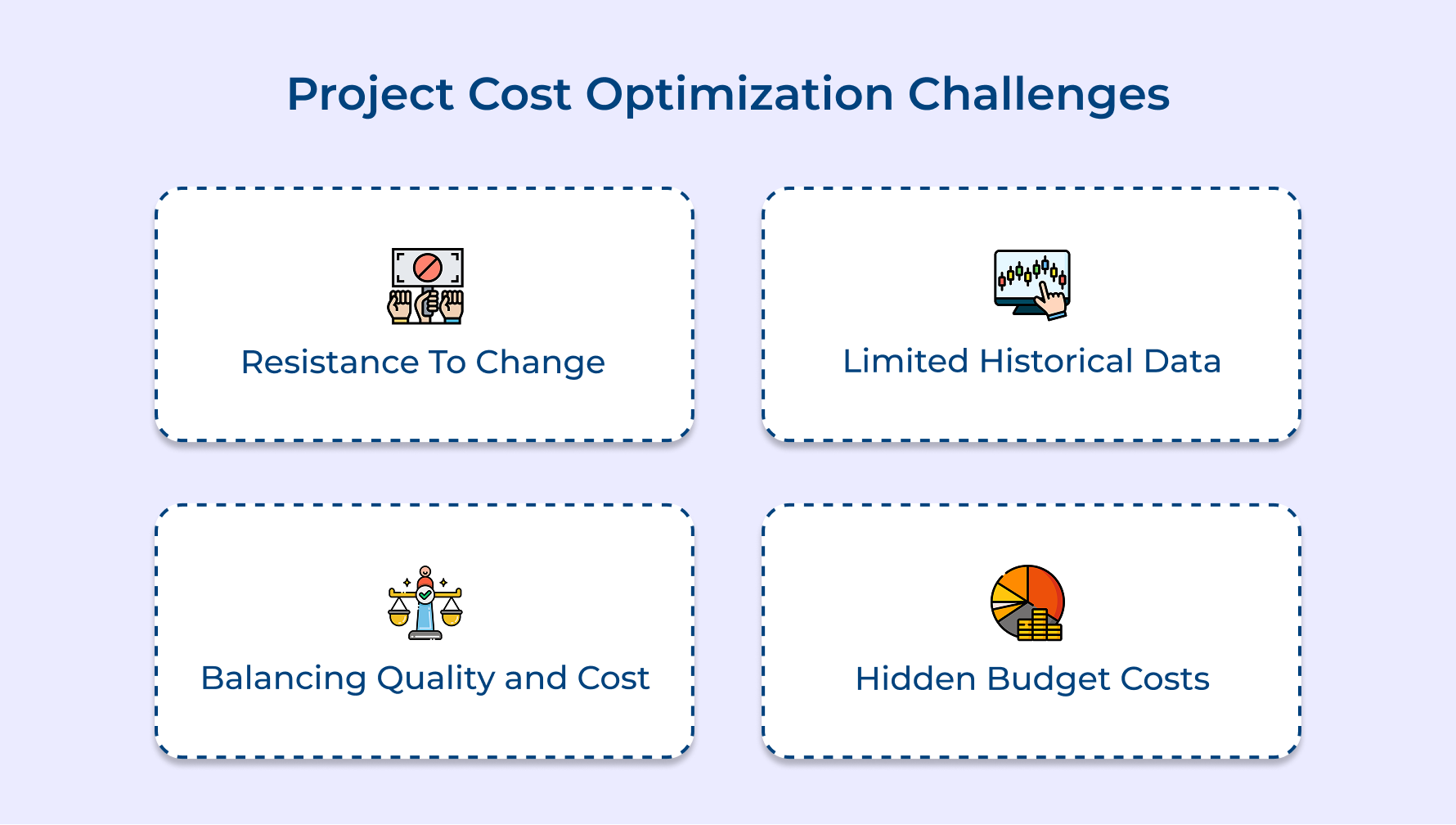
Resistance to Change from Team Members
People naturally resist new processes that disrupt their established workflows even when changes would improve efficiency. Team members may fear optimization means more work or threatens job security.
Lack of Historical Data for Forecasting
Organizations often lack reliable data from past projects to inform current estimates. Without this foundation, you’re guessing about which initiatives will actually save money.
Balancing Quality with Cost Reduction
Pressure to cut expenses can tempt teams to compromise quality standards which ultimately costs more through rework. Finding the balance between excellence and waste elimination requires careful judgment.
Hidden Costs That Don’t Appear in Budgets
Indirect expenses like communication overhead or context switching often go untracked but significantly impact profitability. These invisible costs erode margins while appearing nowhere in accounting.
Each obstacle has practical solutions you can implement:
- Involve team members early in planning and communicate how changes benefit them through reduced stress or improved workflows.
- Start tracking actuals versus estimates immediately because even imperfect data provides more insight than continued guessing.
- Establish non-negotiable quality standards and focus optimization on eliminating waste rather than cutting corners.
- Conduct post-project reviews identifying hidden costs so future estimates account for previously invisible expenses.
Turn Financial Challenges Into Opportunities With Optimized Project Cost
Project cost optimization transforms financial pressure into strategic advantage when you approach it systematically rather than through random cost-cutting. The techniques and best practices covered here give you a framework for making smarter decisions that protect both profitability as well as quality.
Start small by implementing one or two practices that address your most pressing challenges today. As you build momentum and see results, expand your optimization efforts across more projects while watching how improved financial discipline creates opportunities for growth that seemed impossible before.
Limit time — not creativity
Everything you need for customer support, marketing & sales.

Neeti Singh is a passionate content writer at Kooper, where he transforms complex concepts into clear, engaging and actionable content. With a keen eye for detail and a love for technology, Tushar Joshi crafts blog posts, guides and articles that help readers navigate the fast-evolving world of software solutions.