Time and Resource Management Strategies for Profitability
- What is Time Tracking in Resource Management?
- Benefits of Time Tracking in Resource Management
- Track Time in Resource Management with 8 Effective Strategies
- Common Challenges of Time Tracking in Resource Management
- Precision Time Tracking for Smarter Resource Management
- FAQs about Time Tracking in Resource Management

Key Highlights:
- Accurate time tracking in resource management transforms guesswork into strategic decision-making that directly impacts growth potential.
- Integrated time tracking and resource management systems provide complete project visibility that improves both internal operations as well as client relationships.
- Consistent time tracking habits supported by proper tools and protocols create sustainable competitive advantages for professional services businesses.
Many agencies work in constant confusion where priorities keep shifting and managers lack clear visibility into how resources are used. This often causes deadlines to be missed, budgets to overrun and clients to question both costs as well as value.
When time tracking is inaccurate, decisions are based on guesswork instead of facts. Teams may spend hours on low impact tasks while critical projects do not get enough attention. Invoices that do not match client expectations erode trust.
Strategic time tracking in resource management brings structure by showing exactly how every hour is spent. It helps agencies make informed resource decisions, improve client relationships and ensure team efforts deliver measurable business results.
What is Time Tracking in Resource Management?
Time tracking in resource management is the systematic process of recording how team members spend their working hours across different client projects and internal tasks. It captures the actual effort invested in specific deliverables while providing visibility into resource allocation patterns.
Time tracking and resource management traditionally operate as separate functions in most agencies. However, when these two areas merge into a unified system, agencies unlock comprehensive project intelligence. This integration reveals the complete story of how projects unfold from initial planning through final delivery.
Prime objectives:
- Project profitability analysis: Track actual time against budgets to identify which projects generate the highest returns and which ones drain resources.
- Resource utilization optimization: Monitor how effectively team members are deployed across projects to eliminate bottlenecks and maximize productive capacity.
- Accurate client billing: Capture precise billable hours with detailed project breakdowns to ensure transparent and justified invoicing.
- Capacity planning: Use historical time data to make informed decisions about taking on new projects and hiring additional team members.
- Performance benchmarking: Establish baseline metrics for similar project types to improve future estimates and identify areas for process improvement.
Benefits of Time Tracking in Resource Management
Smart agencies know the importance of time tracking in resource management. It creates powerful insights that transform how teams operate and deliver client work.
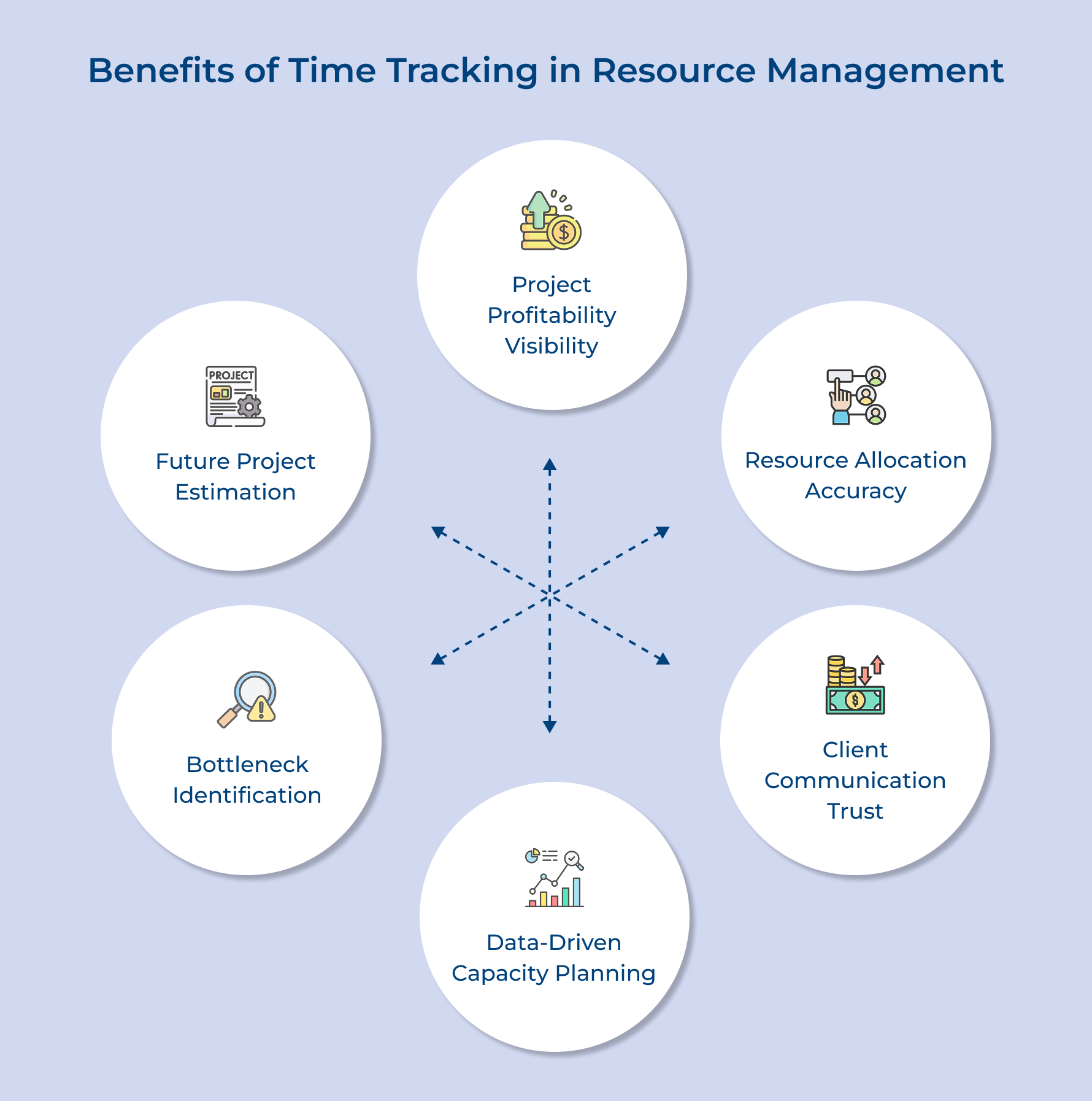
Enhanced Project Profitability Visibility
A clear utilization report shows the true cost of delivering each project by comparing actual hours to the original project schedule, estimates and budgets. This insight helps agencies see which projects bring the best margins and which clients often need more resources than planned.
Improved Resource Allocation Accuracy
Historical time data shows exactly how long certain tasks take for different team members. It allows more accurate resource planning by assigning work based on proven performance instead of rough guesses.
Streamlined Client Communication and Trust
Detailed time records make it easier to have open conversations with clients about scope and deliverables. When agencies can show exactly where hours went, clients trust billing accuracy and project value.
Data-Driven Capacity Planning
A utilization report highlights team workload patterns and signals when extra resources are needed before the project schedule is at risk. Agencies get to hire smart and take on new work confidently.
Operational Bottleneck Identification
Consistent time tracking reveals where processes slow down. Teams can pinpoint recurring delays and improve workflows to remove friction points.
Accurate Future Project Estimation
A database of actual completion times creates a strong reference for future proposals. Agencies can make realistic estimates, win more work and protect profitability.
Track Time in Resource Management with 8 Effective Strategies
The article shares eight smart strategies to help you track time more accurately in resource management. Each tip is designed to make sure every hour you spend moves you closer to your goals.
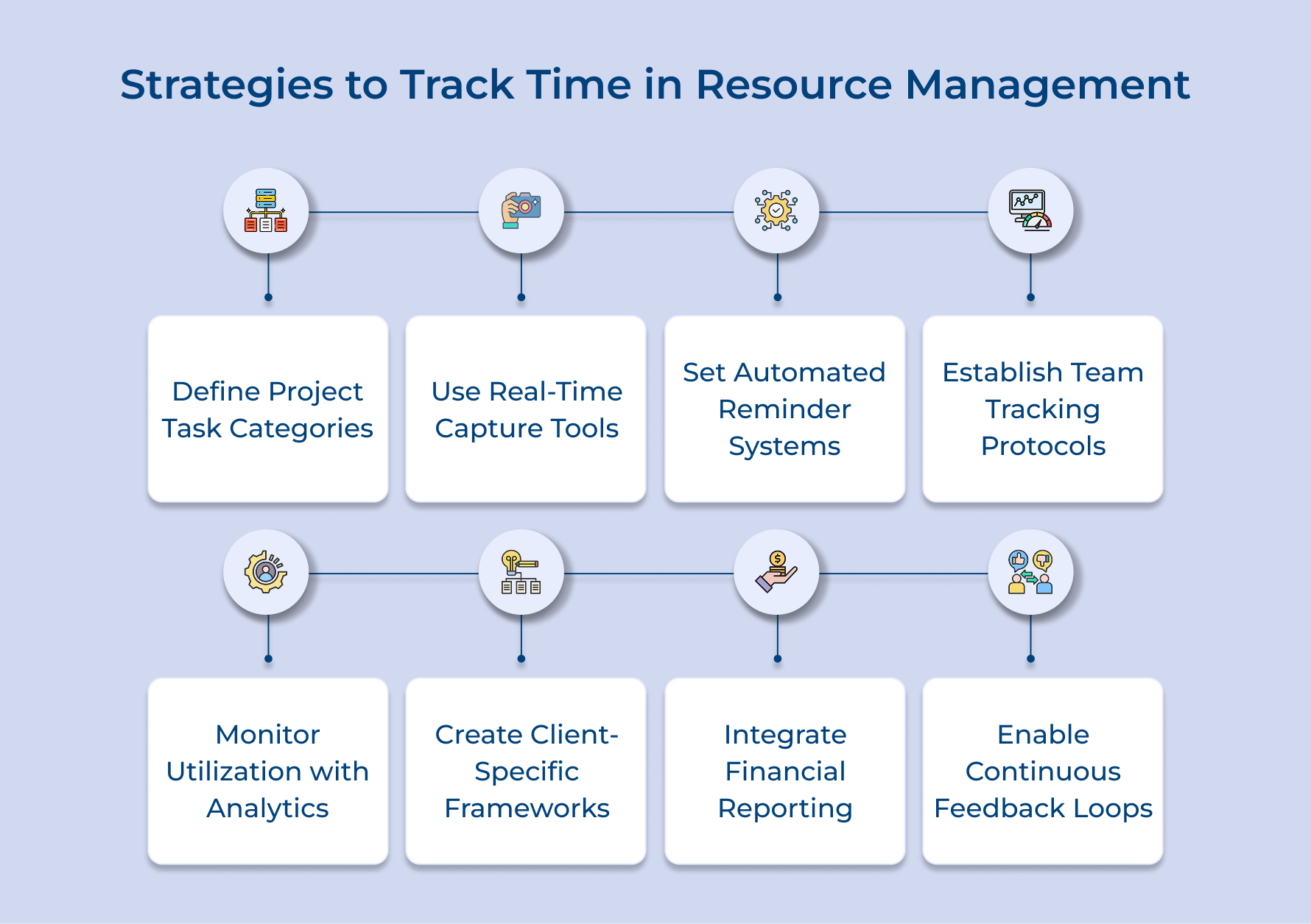
1. Define Clear Project Task Categories
If you want accurate time tracking, you need a solid structure from the start. Task categories give your team clear lanes to work in so they know exactly where to log their hours. Without them, entries get inconsistent and your reports lose value.
Here’s how to do it right:
- Create standardized activity codes for billing: Think universal codes like “Strategy Development,” “Research & Execution,” and “Client Communication.” They should match your services and make invoicing quick.
- Separate billable vs. non-billable work: Billable hours might be client meetings or deliverable creation, while non-billable hours include admin work or team training. This clarity helps with both invoicing and internal tracking.
- Customize by client: Some clients need unique phases, like “Campaign Setup” or “Performance Optimization.”
Your time data becomes meaningful with this structure. It feeds into better resource forecasting and other management techniques, helping you plan projects with confidence as well as spots where your profitability is strongest.
2. Implement Real-Time Time Capture Tools
Guesswork has no place in time tracking. The more accurate your estimates, the easier it is to keep projects on track and resources well-balanced.
Here’s how to nail it:
- Use historical data: Look back at similar projects to see how long tasks really took.
- Consult your team: They know the day-to-day realities better than anyone.
- Factor in buffers: Build in extra time for delays or revisions.
When you set practical time frames, your team avoids burnout, deadlines become realistic and resource forecasting becomes far more accurate. You also get a clearer picture of where your management techniques can improve.
3. Set Up Automated Reminder Systems
Switching between multiple apps or methods is a recipe for confusion. One unified system makes everything smoother.
Try this approach:
- Pick a single tool for all teams: This ensures consistent tracking across projects.
- Train everyone: Don’t assume they’ll “figure it out”; give a quick walk-through.
- Integrate with other systems: Link it to your CRM or project management tool for richer insights.
One reliable platform will help you have cleaner data, easier reporting and fewer headaches during invoicing.
4. Establish Team Time Tracking Protocols
Using utilization reports for capacity planning helps you make smarter, more confident project decisions. Here’s how to use them effectively:
- Spot workload peaks early: Identify when team members are reaching their limits before burnout sets in.
- Redistribute tasks: Shift work between team members to balance the load and keep timelines intact.
- Plan ahead for hiring: Use historical data to see seasonal trends and prepare for busy periods in advance.
- Accept projects with confidence: Say yes to new work knowing you have the resources available.
- Track over time: Monitor how workloads evolve so you can make gradual improvements instead of last-minute changes.
- Support sustainable growth: Ensure your agency can scale without overworking staff or compromising quality.
Accurate data makes capacity planning easier and more reliable. It turns the process from guessing into clear, informed decisions. This helps projects stay on schedule. It also protects your team’s workload and well-being.
5. Monitor Resource Utilization Through Analytics
Turning time-tracking data into actionable insights helps you optimize team performance and project efficiency. Without it, you risk missed opportunities for better resource allocation and profitability.
- Track individual capacity:
- Senior team members: 75–85% billable utilization (allows for mentoring & business development)
- Mid-level professionals: 80–90% (primarily on client delivery)
- Junior team members: 60–75% (balancing work & learning)
- Analyze portfolio patterns: Look at project complexity, skill set allocation and client time concentration to see where resources are going.
- Compare planned vs. actual efforts: This reveals estimation accuracy and highlights work that consistently takes more or less time than expected.
Spot over/underutilization, refine your project scopes and ensure your team’s structure matches client demands.
6. Create Client-Specific Tracking Frameworks
Every client works differently. With unique billing rules, project setups and approval processes. A one-size-fits-all approach just won’t cut it.
- Customize billing categories: Match each client’s project types, services and approval workflows for accurate time entries as well as transparent invoices.
- Set milestone checkpoints: Create review points to track progress, flag budget risks early and adjust scope if needed.
- Capture approval workflow time: Track the hours spent waiting on or managing client approvals, they impact timelines and billing accuracy.
7. Integrate Financial and Operational Reporting
Time tracking becomes far more powerful when it’s tied directly to budgets and profitability metrics. Without this link, you’re working with an incomplete view of project health.
- Connect every hour to budget categories & cost centers: It shows real-time profitability margins and flags overspending before it snowballs.
- Automate alerts at 75% budget usage: Trigger timely conversations with clients to adjust scope or timelines proactively.
- Run weekly profitability reports: Combine time logs with expenses so decision-makers can see the complete financial picture and act fast.
The integration ensures you’re not just tracking hours but actively managing project profitability and making smarter resource allocation decisions.
8. Build Continuous Improvement Feedback Loops
Time tracking shouldn’t be a “log it and forget it” task. It’s a living system that should improve over time. A well-designed feedback loop helps you spot recurring issues, refine processes and keep your data accurate.
- Weekly accuracy audits: Review a sample of entries to catch errors and give targeted coaching where needed.
- Monthly variance analysis: Compare planned vs. actual hours to sharpen future estimates and avoid budget surprises.
- Quarterly process reviews: Invite your team to share what’s working, what’s slowing them down and where the system can improve.
- Annual strategy check: Assess whether your time tracking still aligns with evolving business goals and client expectations.
For example, one agency discovered their designers consistently underestimated revision time by 40%. Updating templates and setting clearer client expectations not only boosted profitability but also improved client satisfaction.
Common Challenges of Time Tracking in Resource Management
Time tracking resource management presents unique obstacles that can undermine even the most well-intentioned systems and create frustration across teams.
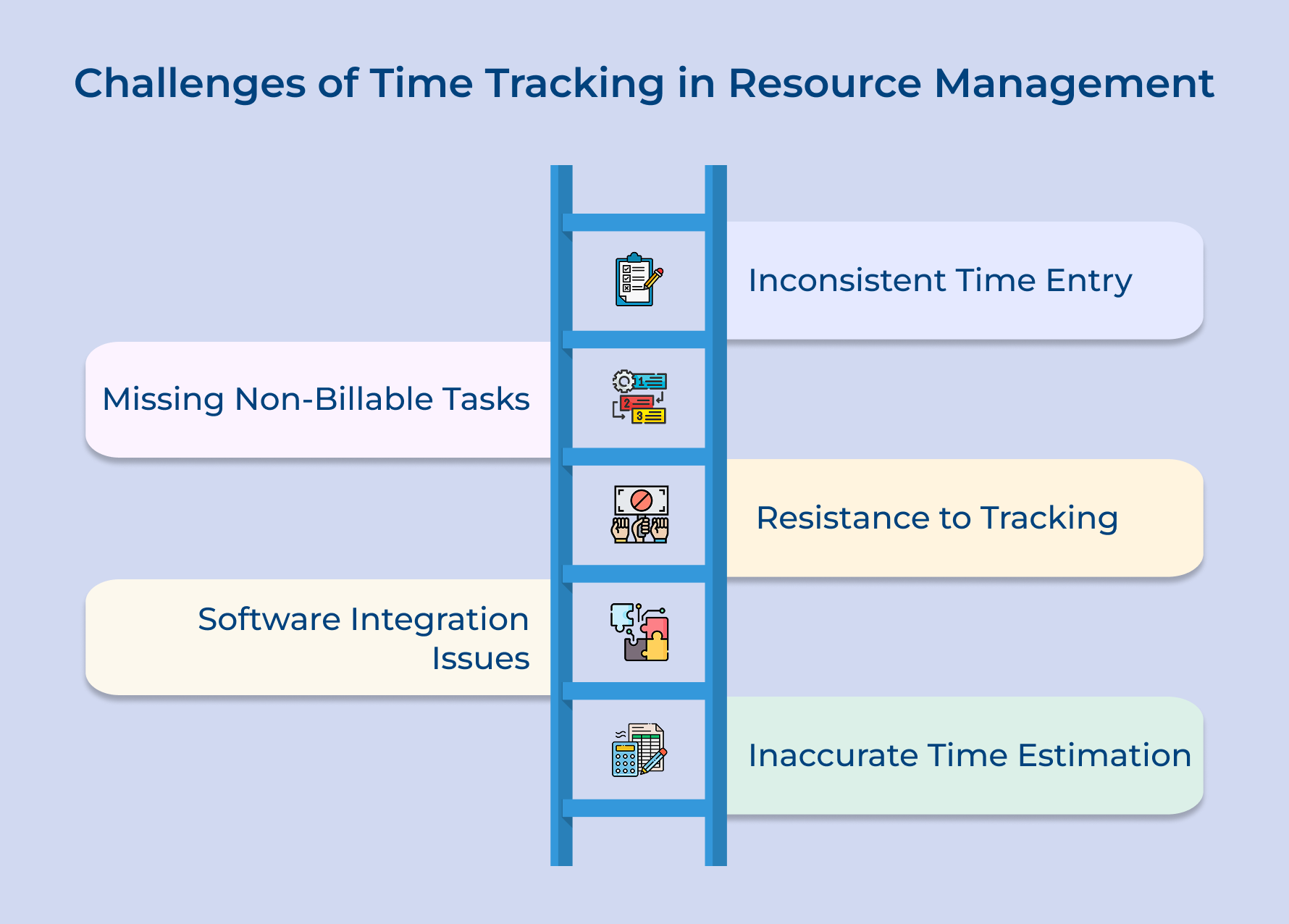
Inconsistent Time Entry Habits Across Team Members
Not everyone logs time the same way and that’s a problem. Some team members are diligent, updating their hours daily, while others wait until the end of the week and try to recall what they worked on. This “rely on memory” approach creates unreliable data and makes it harder to get a clear picture of project involvement.
Difficulty Capturing Non-Billable Administrative Tasks
Internal meetings, emails, training – these tasks often slip through the cracks because they don’t fit neatly into a client project category. An incomplete view of resource utilization and an underestimated picture of what it really costs to run the agency.
Resistance to Detailed Time Tracking Requirements
Creative teams sometimes see time tracking as micromanagement, not a strategic tool. That mindset leads to incomplete logs, delays in updates and general pushback against consistent tracking.
Integration Problems Between Multiple Software Systems
Using separate tools for projects, accounting and time tracking creates data silos as well as duplicate entry work. The lack of integration means inconsistent information and more admin load for the team.
Inaccurate Project Time Estimation and Budget Planning
Estimates are little more than guesswork without solid historical data. This leads to budget overruns, poor resource allocation and timelines that force teams to either rush or work unpaid hours.
These targeted solutions address each challenge directly while building sustainable habits that improve data quality and team adoption over time.
- Implement standardized daily time entry protocols with automated reminders and team accountability check-ins to establish consistent tracking habits.
- Create specific categories for administrative work and internal projects to ensure complete resource utilization visibility across all agency activities.
- Focus on the business benefits of time tracking through training sessions that demonstrate how accurate data improves project outcomes and team planning.
- Invest in integrated software solutions that automatically sync time data across project management accounting and reporting systems to eliminate duplicate entry work.
- Use historical time tracking data to build realistic project templates and estimation models that account for the actual effort required for similar work.
Precision Time Tracking for Smarter Resource Management
Time tracking in resource management becomes absolutely necessary because agencies need accurate data to make informed decisions about resource allocation, project profitability and team capacity planning. Without reliable time data businesses operate on assumptions rather than facts which leads to poor outcomes.
When agencies use comprehensive time tracking systems, they see big gains in profitability. Accurate tracking improves project estimation and strengthens time and resource management. It also boosts operational efficiency through better resource use. Clear communication and accurate billing improve client satisfaction and trust.
Limit time — not creativity
Everything you need for customer support, marketing & sales.

Pooja Deshpande is a content contributor at Kooper, focused on creating insightful resources that help agencies and service providers scale efficiently. Passionate about SaaS trends, content strategy, and operational excellence, she delivers practical, easy-to-implement guidance for modern business leaders.