What is Workforce Planning & How To Build a Winning Strategy
- What is Workforce Planning?
- Why is Workforce Planning Important?
- What are the Benefits of Workforce Planning for Organizations?
- 4 Core Principles of Workforce Planning
- Types of Workforce Planning in Organizations
- How to Implement Workforce Planning in 6 Quick Steps?
- 6 Essential Workforce Planning Strategies for Businesses
- Practical Examples of Workforce Planning
- Workforce Planning Challenges and Ways to Avoid Them
- Align Talent with Strategy Using Effective Workforce Planning
- FAQs about Workforce Planning

Key Highlights:
- Workforce planning bridges the gap between your current team and what the business actually needs tomorrow.
- Strategic talent decisions stop being reactive when leaders connect hiring directly to real business objectives and goals.
- Balancing permanent staff, fractional talent and contractors gives your business the flexibility to scale without breaking under pressure.
Most businesses don’t realize they have a workforce problem until it’s already costing them – a critical project stalls, a key person leaves and suddenly everything feels reactive.
The gap between where your team is today and what your business actually needs to deliver tomorrow is exactly where workforce planning lives. That gap quietly widens when there’s no proper planning.
This guide breaks down what workforce planning really means, how to build a process that works and the strategies that keep your talent decisions ahead of your business demands.
What is Workforce Planning?
Workforce planning is the process of analyzing your current workforce while identifying future talent needs. It builds a clear strategy to close the gap between where you are and where your business is heading.
Most organizations realize they have a workforce problem only when it’s already hurting them – a critical role sits vacant for months, a key project stalls because the right skills aren’t available.
Workforce planning flips that reactive pattern on its head by helping you anticipate those gaps before they become expensive problems.
Planning objectives:
- Align talent with business goals: Ensures the right people are in the right roles at the right time to support where the company is headed.
- Reduce hiring costs: Proactive planning cuts down on emergency hiring, over-reliance on contractors and the hidden costs of prolonged vacancies.
- Identify skill gaps early: Surfaces the difference between the capabilities your workforce has currently and what the business will demand tomorrow.
- Improve retention strategy: Helps leaders understand turnover patterns and build career paths that give employees a reason to stay.
Why is Workforce Planning Important?
You’re essentially running your business blind without a clear view of your future talent needs, reacting to problems that good planning could have prevented entirely.
The numbers make the case better than anything else:
- 63% of employers identify skill gaps as the single biggest barrier to business transformation over the 2025–2030 period, according to the World Economic Forum’s Future of Jobs Report 2025.
- Internal mobility use in the U.S. grew from 25% in 2024 to 35% in 2025 and LinkedIn data shows employees at companies with strong internal mobility stay nearly twice as long.
- Demand for fractional leadership roles jumped 26% in 2024, as organizations recognized that accessing high-impact talent flexibly beats losing access to it entirely.
Businesses that treat workforce planning as a core strategic function not just a resource checkbox are the ones consistently outperforming their competitors on retention, productivity and growth.
What are the Benefits of Workforce Planning for Organizations?
Workforce planning is about building an organization that can perform under pressure, adapt to change and grow without constantly firefighting talent problems.
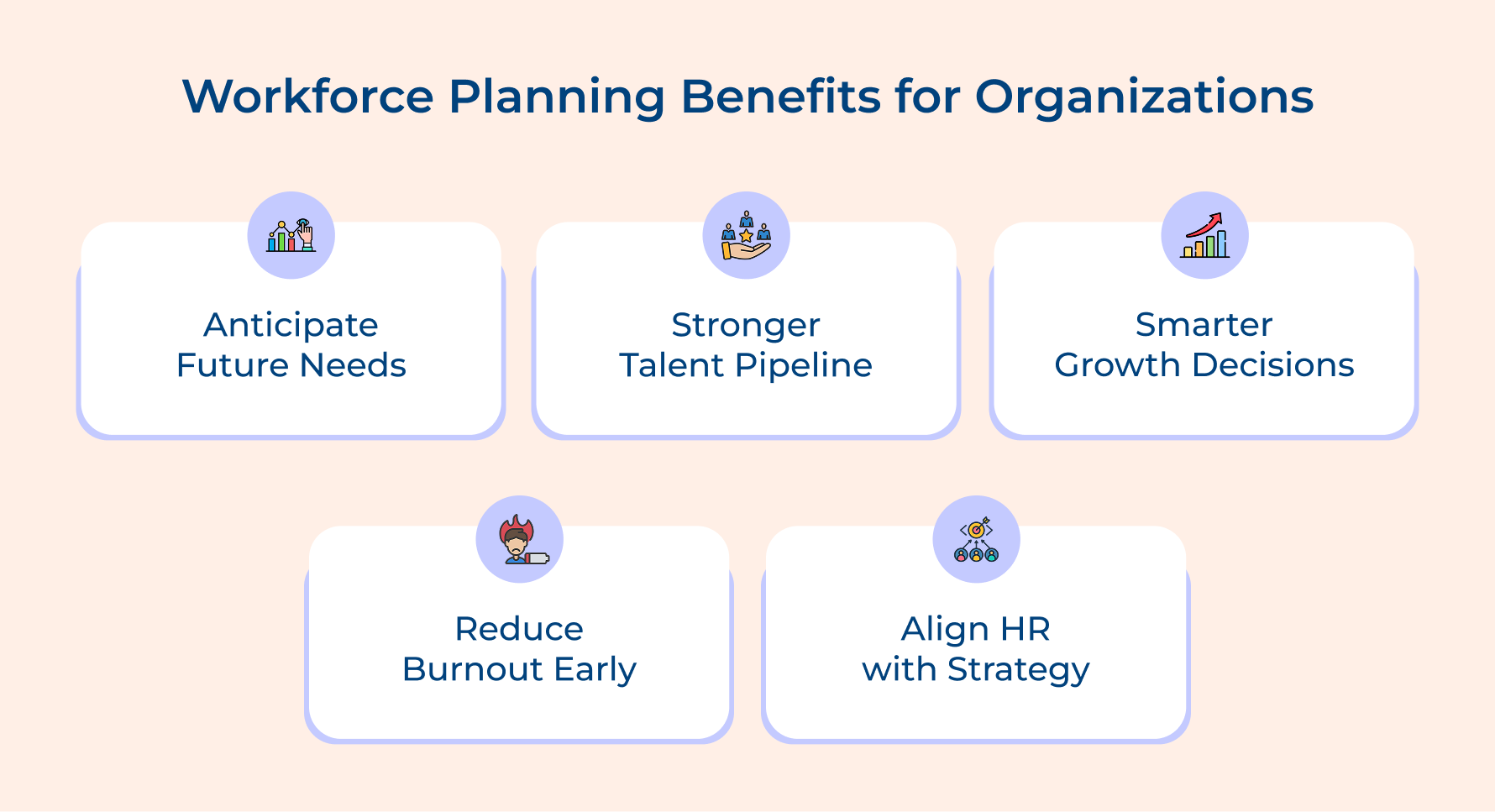
Anticipate Future Needs
Most organizations only realize they’re understaffed when a project is already slipping. Workforce planning shifts your thinking from “who do we hire now?” to “what will we need in 6 months?” – and that shift alone changes everything.
Stronger Talent Pipeline
When you know where your business is headed, you can start developing people internally before the need becomes urgent. That means fewer expensive external searches and more promotions that actually stick because the person was genuinely prepared for the role.
Smarter Growth Decisions
Workforce planning gives leaders real data, whether they are growing a new service or cutting costs after a tough quarter. You’re not guessing which roles are critical – you already know, because you mapped it out in advance.
Reduce Burnout Early
Overloaded teams don’t always speak up – they quietly disengage, then leave. Workforce planning surfaces capacity issues early, so you can redistribute workload or bring in support before your best people start looking elsewhere.
Align HR with Strategy
This is where workforce planning earns its seat at the leadership table. When HR can show exactly how talent decisions connect to revenue targets, client delivery, or market expansion — it stops being a support function and becomes a core driver of business outcomes.
4 Core Principles of Workforce Planning
In a professional services firm, workforce planning only works when it’s built on solid principles (not just processes) that guide every talent decision from the top down.
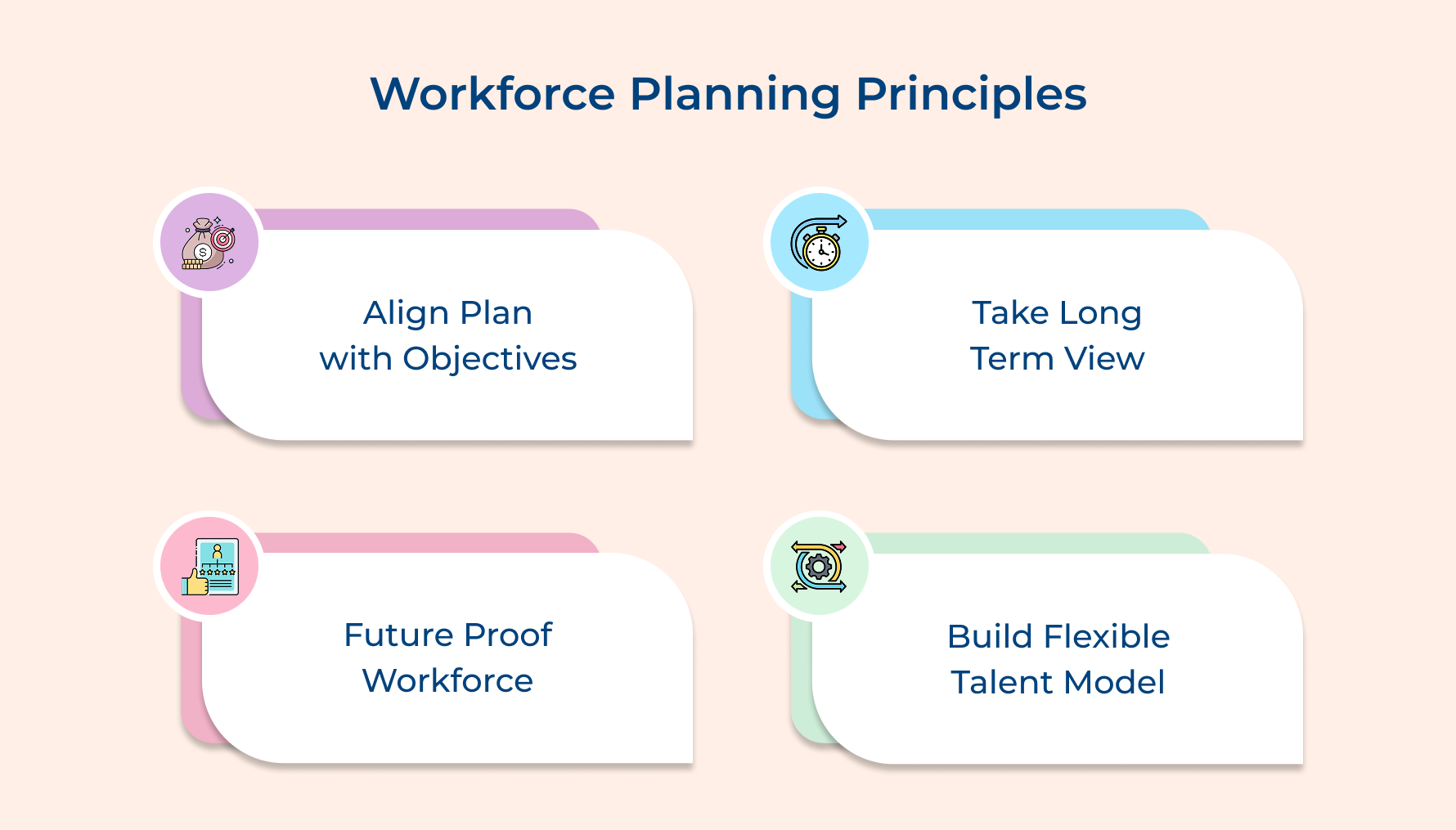
1. Align Plan With Objectives
Workforce planning should mirror where your firm is actually headed, not sit in an HR folder collecting dust. Expanding into a new practice area? Targeting enterprise clients? Your hiring and talent management strategy needs to move in lockstep with those strategic goals.
The moment workforce planning disconnects from business direction, the wrong people end up in the wrong seats. Every role you plan for should trace back to a specific business outcome.
2. Take Long Term View
Firms planning only one quarter ahead are always playing catch-up. The talent you need tomorrow takes months to hire, onboard and develop into full productivity. Building a 12 to 24-month outlook gives you room to make smarter, less reactive decisions.
Short-term thinking creates a chronic cycle of emergency hiring and expensive contractor dependency. Performance management becomes harder when people are rushed into roles. A longer lens lets you build capability gradually, far less disruptive and significantly more cost-effective than scrambling when the need turns critical.
3. Future Proof Workforce
Skills that made your firm competitive three years ago may not win clients three years from now. Future-proofing means continuously mapping emerging capability requirements against what your current team actually delivers. Strong employee retention becomes easier when people see deliberate investment in their growth and relevance.
This isn’t about chasing every industry trend, it’s about identifying two or three capability shifts most relevant to your firm and building toward them intentionally. Firms that do this consistently are rarely caught off guard when markets move.
4. Build Flexible Talent Model
Rigid workforce structures crack under pressure fast. A sudden client win, an unexpected departure, or a project demand shift can expose gaps almost immediately. Professional services firms need a deliberate blend of permanent staff, fractional talent and contractor capacity that genuinely flexes with the business.
Prioritizing work-life balance within that model also matters – flexible structures that respect people’s boundaries attract stronger talent and reduce burnout. Build a talent model that holds steady under pressure while staying agile enough to pivot when circumstances change unexpectedly.
Types of Workforce Planning in Organizations
Workforce planning isn’t one-size-fits-all — confusing the three types creates plans that look great on paper but fall apart in practice. Understanding the difference is exactly what separates reactive organizations from truly prepared ones.
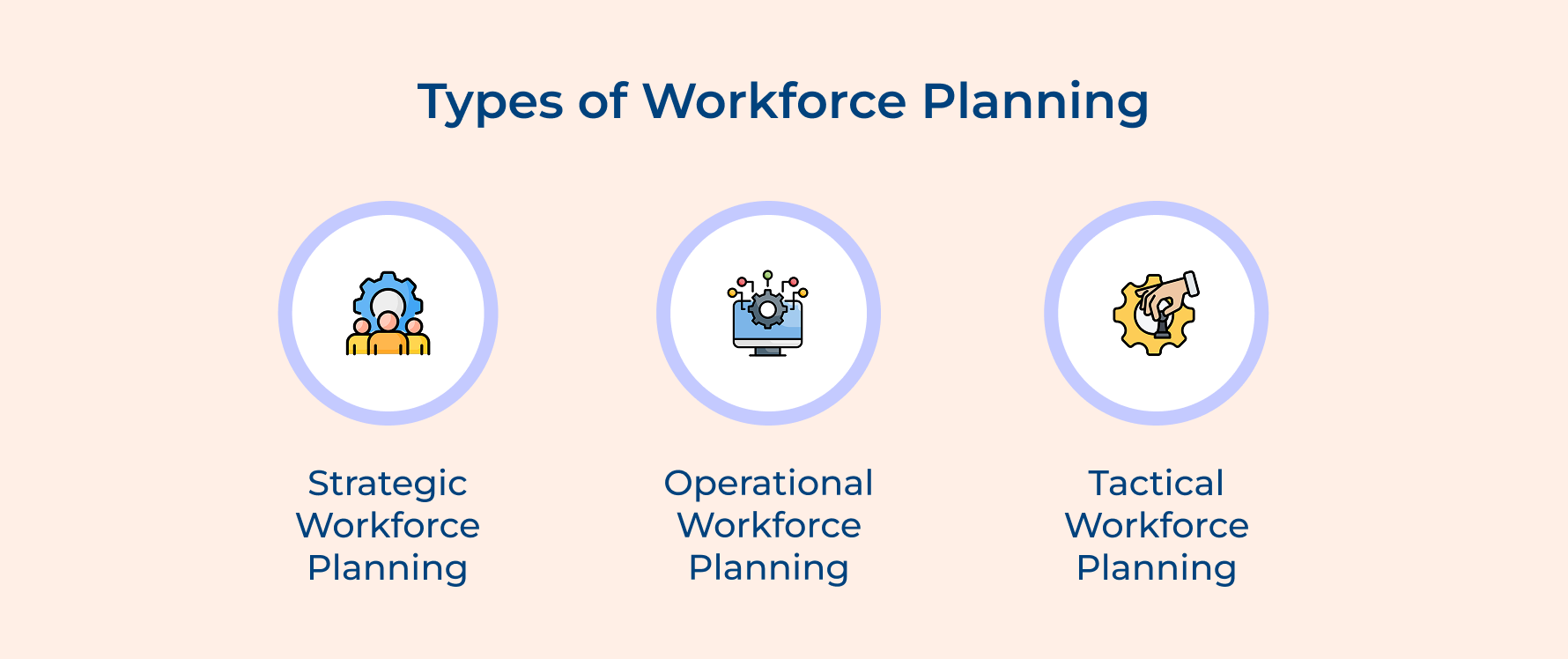
1. Strategic Workforce Planning
Strategic workforce planning is where leadership steps back from daily noise and asks the harder question: “what kind of organization do we need to become?” It connects business ambition directly to talent decisions, ensuring you’re building toward something deliberate rather than constantly reacting.
Here’s what it actually covers:
- Future capability mapping: Identifying skills and roles the organization will need as market conditions shift – before the gap becomes too costly to fix quickly.
- Workforce composition: Determining the right long-term mix of talent levels to sustain delivery quality without unnecessarily inflating your cost structure.
2. Operational Workforce Planning
Operational workforce planning is the ongoing management of who is available, what they’re working on and if capacity matches demand right now. Most organizations feel poor operational planning first – through missed deadlines, overloaded teams and last-minute scrambles that should have been anticipated weeks earlier.
Here’s what it actively manages:
- Resource allocation: Making sure the right people are on the right work and that no one is idle or stretched so thin that quality suffers.
- Attrition management: Tracking turnover and hiring timelines so delivery doesn’t stall when someone leaves unexpectedly.
- Workload balancing: Catching over-capacity issues before burnout sets in and performance quietly declines.
3. Tactical Workforce Planning
Tactical workforce planning sits between long-term vision and daily operations — it’s the medium-term execution layer where strategy gets tested against reality. This is where organizations move from intention to action – with specific decisions, clear owners and honest timelines attached.
Here’s where tactical planning earns its value:
- Skills gap interventions: Deciding if a capability need is best solved through training, a new hire, or a contractor – before the work actually arrives.
- Budget and headcount alignment: Reconciling talent needs with approved budgets so there are no surprises when a new project kicks off.
How to Implement Workforce Planning in 6 Quick Steps?
Getting workforce planning right is about building a repeatable process that connects your talent reality to your business direction at every stage.
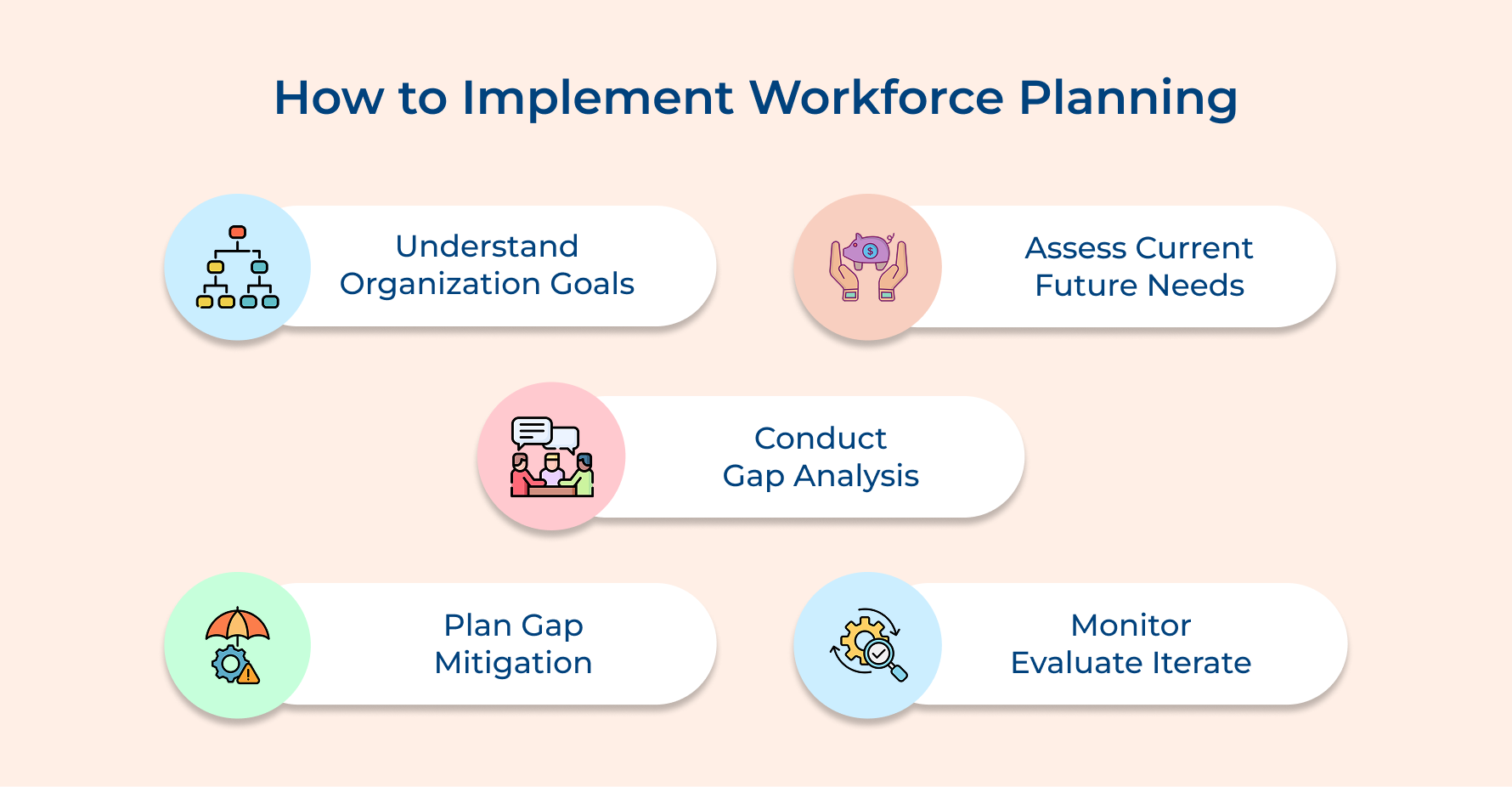
1. Understand the Organization’s Overall Goals
Workforce planning without a clear view of business direction is just headcount management. Before analyzing people, skills, or capacity, you need an honest understanding of where the organization is heading and what it will take to get there.
This step requires active alignment with leadership on growth targets, new service areas and operational changes on the horizon. The clearer the business direction, the more precise your workforce plan becomes.
To build this foundation effectively:
- Map key business objectives and identify which ones are most dependent on having the right talent in place.
- Understand where the business plans to grow, contract, or pivot – each scenario carries different workforce implications.
- Get explicit alignment from leadership on priorities, when everything is a priority, workforce planning loses its focus.
Skipping this step means every decision that follows is built on assumption rather than direction. In workforce planning, assumptions don’t just slow you down, they cost you!
2. Understand the Current and Future Workforce Needs
Once you know where the business is going, build an honest picture of what your workforce looks like currently and what it needs to look like to deliver on those goals.
Most organizations underinvest here, they count heads but don’t assess capability, capacity, or readiness. A thorough current-state analysis goes beyond org charts – it examines who can do what, who is at risk of leaving and where delivery depends on one or two people more than it should.
A thorough current-state analysis should surface:
- Which roles/skills are critical to current and upcoming work as well as how exposed the business is if those positions become vacant.
- Where capacity is stretched to a point already affecting quality or requiring reactive contractor spend.
Future workforce needs should then be mapped against your business goals from Step 1.
3. Perform a Gap Analysis
A clear gap analysis is where workforce planning gets specific, identifying the delta between your current capabilities and what the business will actually need. This step goes far beyond counting vacancies.
A meaningful gap analysis examines skill depth, succession risk, capacity shortfalls and structural gaps that could prevent the business from executing its plan. Done properly, it becomes the most actionable output of the entire process – telling leadership exactly where the risk sits and how significant it really is.
4. Formulate a Plan to Mitigate the Gap
Identifying gaps without a plan to close them is analysis without value. This step is where workforce planning moves from diagnosis to action and where the quality of your earlier work directly determines the quality of your decisions.
A strong mitigation plan doesn’t default to hiring as the only answer. For each gap, the right response might be hiring, developing internal talent, restructuring work allocation, or bringing in fractional expertise.
A strong gap mitigation plan should address:
- if each gap is best closed through hiring, internal development, or restructuring based on timeline, cost and business impact.
- Which gaps carry the highest delivery risk and need to be prioritized regardless of budget pressure.
- How the plan will be sequenced, some gaps need immediate action while others can be addressed over a longer timeline.
The plan also needs a budget attached to it. A gap plan without funding is a document, it only becomes a strategy when resources are committed and ownership is assigned.
5. Monitor, Evaluate and Iterate
Workforce planning is not a set-and-forget process. Business conditions change, project pipelines shift and the assumptions you made six months ago may no longer reflect what the business needs.
To make monitoring genuinely useful:
- Track leading indicators – capacity risk, bench strength and time-to-productivity – not just lagging metrics that confirm problems already in progress.
- Review the plan against actual business performance each quarter, if revenue or project pipeline has shifted, the workforce plan needs to shift with it.
- Treat each iteration as an opportunity to improve planning assumptions, the firms that get best at workforce planning learn systematically from where their previous plan missed.
Building a regular review rhythm is what separates organizations that stay ahead of workforce challenges from those that keep reacting to them. A monthly check on leading indicators and a quarterly review of the full plan gives leadership visibility to make adjustments before gaps become crises.
6 Essential Workforce Planning Strategies for Businesses
Having the right people in the right roles at the right time doesn’t happen by accident, it takes deliberate strategy. Here are six workforce planning strategies that help businesses.
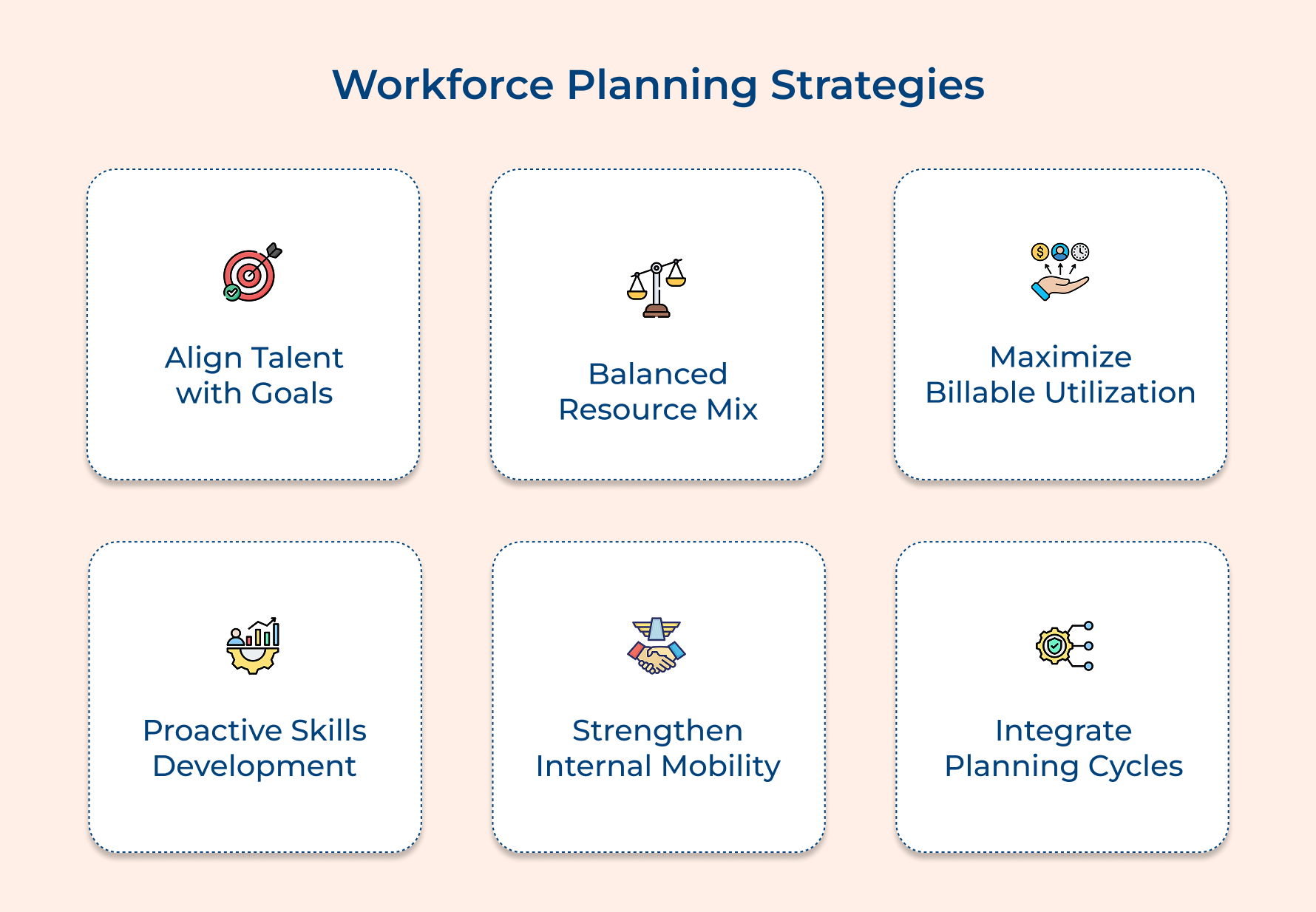
1. Align Talent Acquisition Strategy with Business Goals
One of the most foundational workforce planning strategies is making sure every hiring decision traces back to a clear business objective. Most firms hire when the pain becomes unbearable. A team is stretched, a deadline is slipping and suddenly there’s pressure to fill fast.
A project-based firm that wins a large engagement without planning for the right talent will either over-promise on delivery or scramble under pressure. Strong human resource management means getting ahead of that cycle entirely.
Before opening any role, ask yourself:
- Is this role tied to a specific project or objective or just replacing a vacancy without questioning whether it still makes sense?
- Does the hiring timeline match when the business actually needs this person productive and billable?
- Have delivery leads agreed on what success looks like before the search even begins?
Organizations that handle shifting priorities well don’t restart their workforce planning strategy from scratch every time conditions change. They build flexibility into their hiring roadmap to absorb disruption without losing momentum. When alignment is consistent, hiring stops feeling like a reactive cost and starts functioning like a genuine growth lever.
2. Create a Balanced Mix of Resources
A well-executed workforce planning strategy is all about having the right combination of talent types that flex with your business without breaking under pressure.
Most project-based firms discover their workforce mix is broken at the worst possible time, when a project win exposes a capacity gap or departures reveal how much depended on just a few key people. Agile workforce planning helps you spot these vulnerabilities early rather than mid-crisis.
Here’s how to think about each resource type:
- Permanent employees: Core delivery and culture carriers who hold institutional knowledge contractors never will while costing far more to replace than retain.
- Contract workers: Best for specific skill needs or peak demand periods where a permanent hire doesn’t make financial sense yet.
- Fractional talent: Senior expertise at a fraction of full-time cost, valuable for strategic roles that don’t need daily presence.
Ask one honest question: if your most critical contractors walked away tomorrow, would delivery hold? If not, your mix is carrying more risk than you realize. Rebalancing means ensuring no single resource type holds the business hostage while keeping cost-per-delivery predictable even when project volumes fluctuate.
3. Maximize Billable and Strategic Workforce Utilization
This workforce planning strategy shifts focus from simply tracking hours to understanding whether your people are deployed in ways that genuinely drive value.
Underutilization bleeds revenue. Talented people waiting for the next project while the business absorbs the cost is a quiet but expensive problem. Overutilization burns out your best people until they leave, driving up employee turnover and disrupting delivery continuity.
Run these utilization checks regularly:
- Are your highest-skilled people doing work that matches their level or buried in tasks a junior could handle?
- Is there a pattern of the same people consistently over-allocated while others stay underdeployed?
- Is non-billable work being tracked or silently consuming capacity planned for revenue-generating projects?
HR analytics can make these patterns visible far earlier than manual reviews ever could. A weekly resource check with real authority to reallocate is worth more than any dashboard that simply reports what went wrong after the fact.
4. Build a Proactive Skills Development Program
Treating skills development as a core workforce planning strategy separates firms that stay ahead of capability gaps from those constantly playing catch-up.
Reactive training is expensive, you pay twice. Once for the damage the gap caused and again for the rushed solution. Start by auditing what skills your current team holds against what upcoming projects will actually demand.
Ask these questions to test whether your program is genuinely future-focused:
- Are the skills being developed tied to work the business will actually need or to what was relevant two years ago?
- Do people have a clear line of sight between current development and where it takes them within the firm?
- Are sales staff and operational teams being developed in parallel or only technical roles getting attention?
One mid-size agency identified growing client demand for data-led strategy but lacked the internal skills to lead those engagements. Rather than hiring externally, the firm built a structured development track over two quarters, retaining talent that would have otherwise left.
5. Strengthen Internal Mobility Before Looking Externally
Making internal mobility a deliberate part of your workforce planning strategy means growth opportunities reach your existing team first, before they become reasons to look elsewhere.
Internal mobility fails not because talent isn’t there but because visibility and process break down. Think of it like a supply chain. If the pipeline between available talent and open opportunities isn’t visible and well-managed, nothing flows efficiently.
Start by building a simple internal talent register updated regularly with each person’s skills, interests and readiness level so opportunities get matched intentionally rather than by whoever a delivery lead happens to think of first.
Every time a firm overlooks an internal candidate it sends a clear signal that growth has a ceiling here. That signal spreads fast.
6. Integrate Workforce Planning Into Financial and Operational Planning Cycles
This workforce planning strategy ensures talent decisions aren’t made in isolation, connecting them directly to budget cycles and operational realities so they actually get funded and executed properly.
When workforce planning sits outside the financial cycle it becomes a wish list. The fix is straightforward – establish a shared planning rhythm where delivery, finance and operations review workforce needs together at regular intervals rather.
Three critical sync points every firm should establish:
- Quarterly workforce and budget alignment: Review headcount plans every quarter so hiring decisions reflect current business reality rather than outdated projections.
- Operational capacity planning: Delivery leads need a shared view of upcoming project demands and required talent.
- Scenario planning reviews: Stress-test the workforce plan against both growth and contraction scenarios so decisions don’t stall when conditions shift unexpectedly.
When embedded in financial and operational rhythm, this workforce planning strategy stops being a reactive conversation as well as becomes a proactive discussion.
Practical Examples of Workforce Planning
Workforce planning looks different depending on the business, here are four real-world scenarios across service-based organizations.
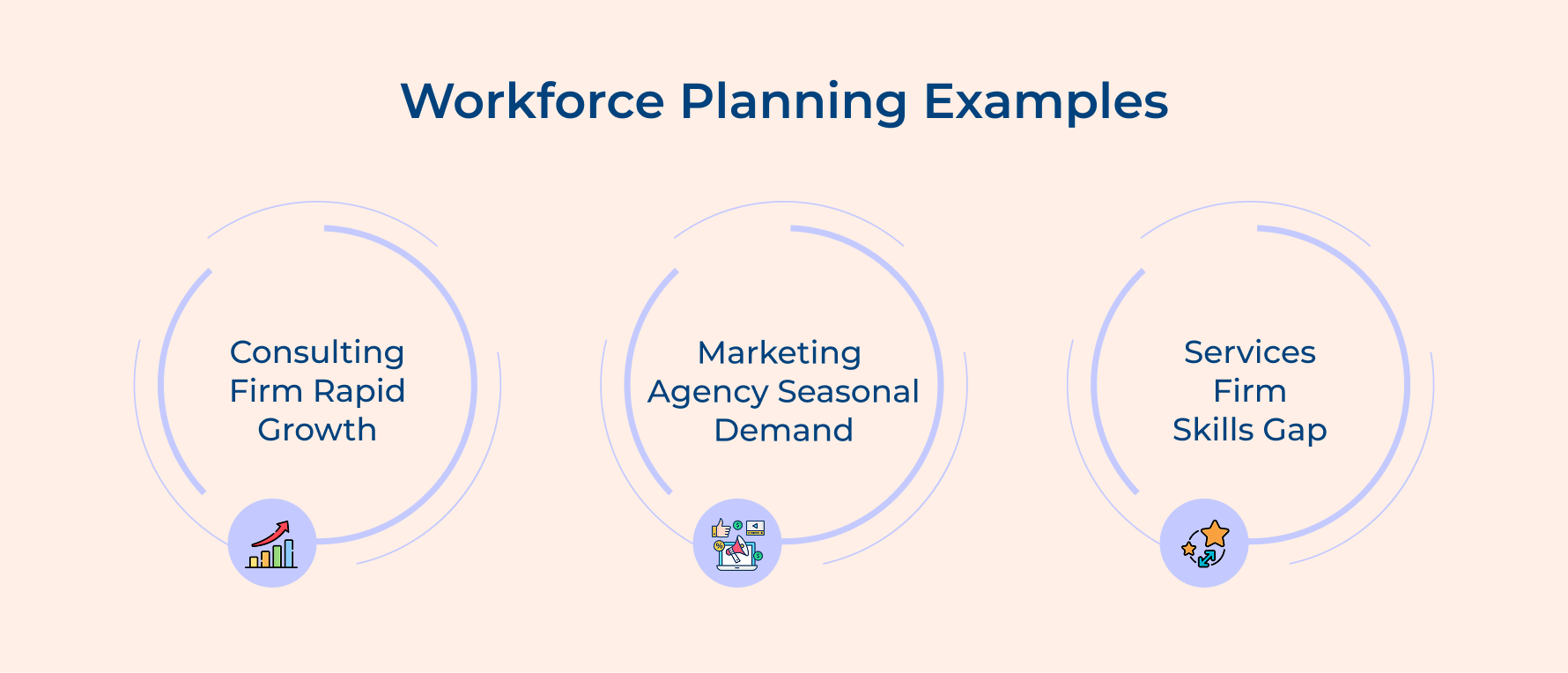
A Consulting Firm Managing Rapid Client Growth
A consulting firm wins three large projects but lacks senior consultants to staff them without overloading the team. The workforce plan identifies internal stretch candidates, fractional experts and one targeted permanent hire – keeping delivery on track without burning out existing staff.
A Marketing Agency Navigating Seasonal Demand
A digital agency historically scrambled for contractors at peak rates, overworking its permanent team in the process. Workforce planning builds a pre-vetted contractor bench for peak periods, letting permanent staff focus on strategic work year-round without the cost spike.
A Professional Services Firm Addressing a Skills Gap
A financial advisory firm sees demand shifting toward technology-led solutions but lacks the internal skills to deliver. A structured gap analysis identifies senior advisors for a targeted upskilling program – closing the capability gap without the disruption of external hiring.
Workforce Planning Challenges and Ways to Avoid Them
Even the best workforce planning process runs into obstacles, here are the four most common challenges organizations face and how to address them.
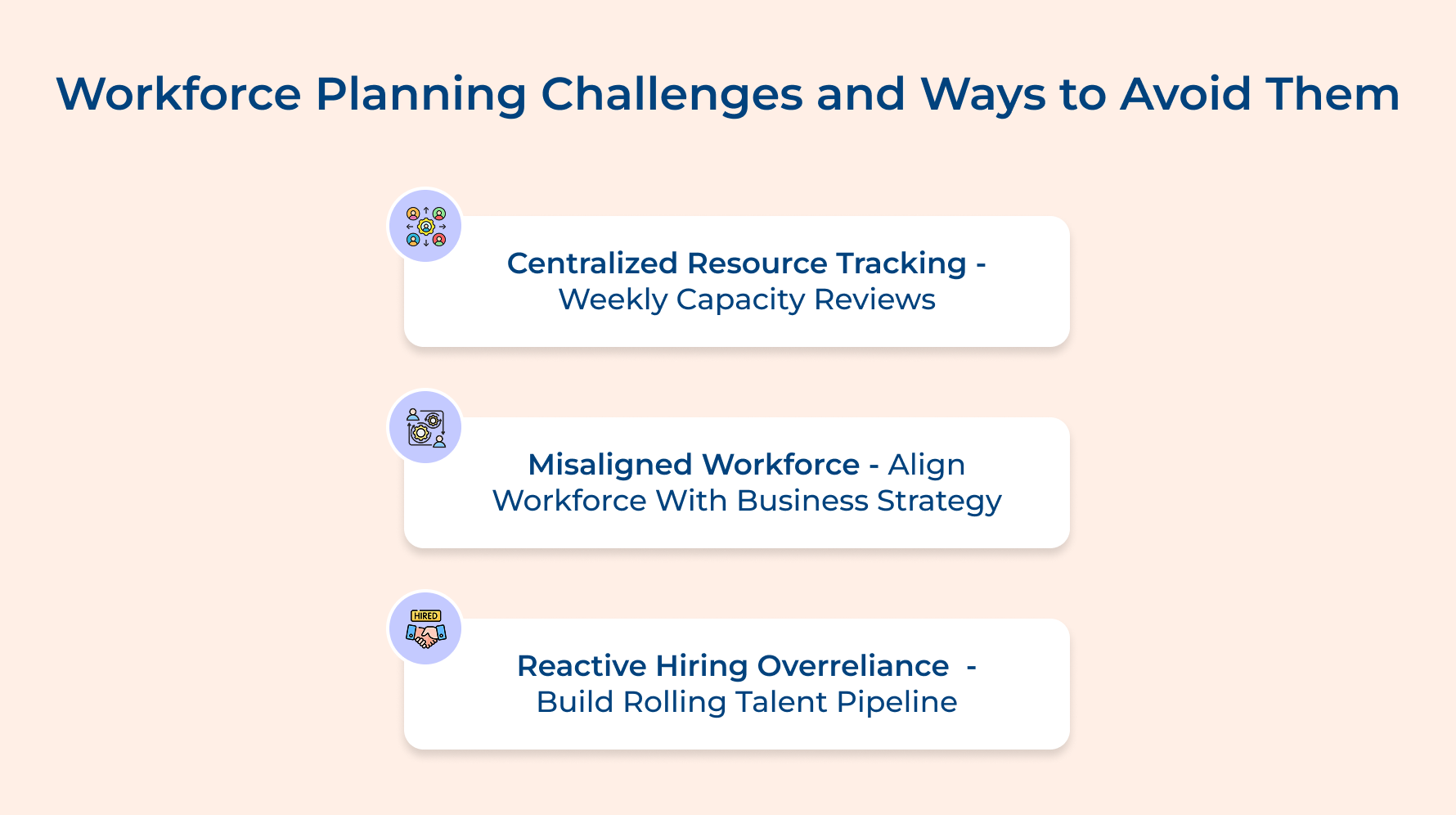
1. Lack of Visibility Into Current Workforce Capacity
Most organizations don’t have a clear real-time picture of who is available, what they’re working on and where capacity is actually sitting. Planning on top of incomplete data produces incomplete decisions.
The fix starts with:
- Implement a centralized resource tracking tool that captures availability, utilization and skills in one place.
- Establish a weekly capacity review rhythm so visibility is maintained consistently.
2. Misalignment Between Business Strategy and Talent Planning
Workforce plans that are built in isolation from business strategy always end up solving yesterday’s problem. When delivery, finance and leadership aren’t working from the same direction, talent decisions consistently miss the mark.
Closing this gap requires structured alignment touchpoints:
- Involve delivery leads in workforce planning conversations from the start, not after decisions are already made.
- Sync workforce planning reviews with business planning cycles so talent decisions reflect current priorities.
3. Overreliance on Reactive Hiring
When hiring only happens in response to an immediate gap, the business is always behind. Reactive hiring is slower, more expensive and produces worse outcomes than planned talent acquisition built around a forward-looking pipeline.
How to overcome it?
- Build a rolling talent pipeline for high-frequency roles so the business isn’t starting from zero every time a seat opens.
- Track project pipeline alongside workforce capacity so hiring needs are visible weeks before they become urgent.
Align Talent with Strategy Using Effective Workforce Planning
Workforce planning isn’t a one-time exercise, it’s an ongoing discipline that keeps your talent decisions connected to where the business is genuinely heading. The firms that do it well aren’t just better at hiring, they’re better at delivering.
Getting started doesn’t require a perfect process. Start with visibility, build alignment with your business goals and treat every planning cycle as an opportunity to get sharper than the last one.
Limit time — not creativity
Everything you need for customer support, marketing & sales.

Neeti Singh is a passionate content writer at Kooper, where he transforms complex concepts into clear, engaging and actionable content. With a keen eye for detail and a love for technology, Tushar Joshi crafts blog posts, guides and articles that help readers navigate the fast-evolving world of software solutions.