A Detailed Guide To Task Dependencies in Project Management
- What is Task Dependency in Project Management?
- Benefits of Finding Task Dependencies in Project Management
- Types of Task Dependencies in Project Management
- How to Identify Task Dependencies in your Project in 8 Clear Steps
- Different Examples of Project Dependency
- Best Practices for Managing Task Dependencies in a Project
- Popular Terminologies Used in Project Dependencies
- Master your Projects With Seamless Task Dependencies
- FAQs about Task Dependencies in Project Management

Key Highlights:
- Accurately mapping all project tasks and their dependencies transforms uncertain timelines into milestone-driven project roadmaps.
- Understanding the four main types of task dependencies helps teams optimize workflows and proactively avoid resource bottlenecks.
- Managing project dependencies visually with Gantt charts improves communication, risk management and alignment on complex deliverables.
Most agencies struggle with project chaos because they fail to recognize how tasks connect and depend on each other throughout complex workflows.
When you cannot identify task dependencies, your carefully planned timelines become worthless as delays cascade through interconnected activities like falling dominoes.
Mastering task dependency identification and management transforms unpredictable project execution into systematic workflows that deliver consistent results. Understanding these relationships helps you build realistic timelines, optimize resource allocation and communicate transparently with clients about project progress as well as potential challenges.
What is Task Dependency in Project Management?
Task dependency represents the logical relationship between different project activities where one task cannot begin or finish until another task reaches a specific milestone. These dependencies create a structured workflow that ensures deliverables are completed in the correct sequence.
Understanding and managing task dependencies allows agencies to provide clients with realistic timelines as well as transparent progress updates. When you can clearly explain why certain deliverables must wait for others to complete, clients appreciate the honesty rather than being surprised by delays.
Prime objectives:
- Resource optimization: Ensures team members are assigned to tasks at the right time without creating bottlenecks or idle periods.
- Risk mitigation: Identifies potential delays early so you can adjust timelines or reallocate resources before problems impact client deliverables.
- Quality assurance: Prevents rushing through foundational work that could compromise the quality of dependent tasks later in the project.
- Communication clarity: Provides a clear framework for explaining project progress and timeline changes to both internal teams as well as clients.
- Workflow efficiency: Eliminates unnecessary waiting periods by identifying which tasks can run simultaneously versus those requiring sequential completion.
Benefits of Finding Task Dependencies in Project Management
Understanding task dependencies transforms project chaos into structured workflows. Let’s explore the fundamental questions and benefits that make dependency mapping essential.
Four essential questions about task dependencies every project manager should consider:
- What tasks must be completed before others can begin?
- Which activities can run simultaneously without creating conflicts?
- Where are the potential bottlenecks that could delay entire project timelines?
- How will changes to one task ripple through the rest of the project?
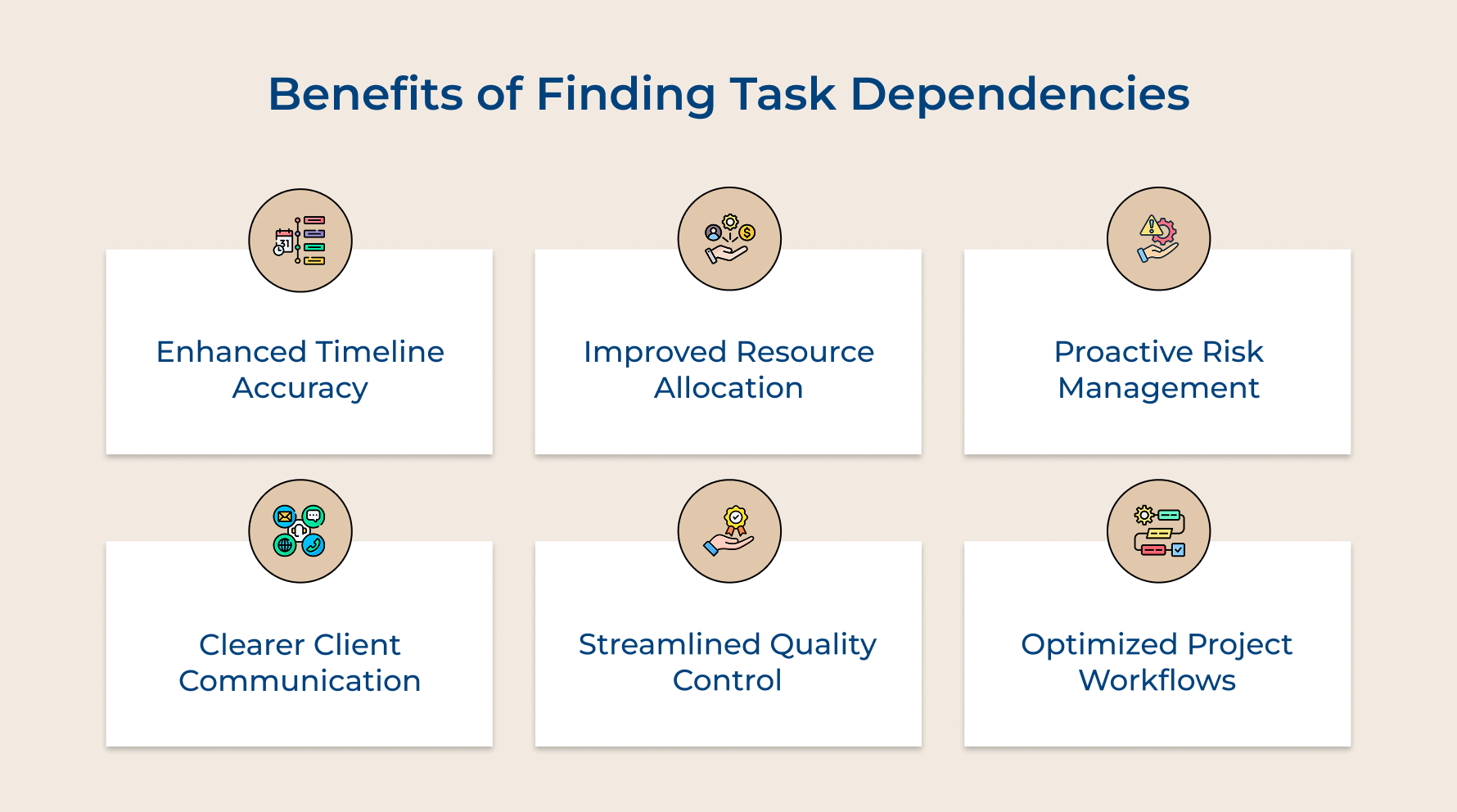
Enhanced Timeline Accuracy
Mapping task dependencies helps you spot what really drives your project timeline. It shows the longest path of work, so you’re not guessing. This way, you avoid overpromising deadlines to clients and create realistic schedules that your team can actually deliver on.
Improved Resource Allocation
When you understand how tasks connect, assigning the right people becomes easier. You can time it right, so writers aren’t waiting for briefs or designers aren’t stuck waiting on content. Everyone stays productive and fewer hours are wasted sitting idle between phases.
Proactive Risk Management
Dependencies highlight potential trouble spots early on. If one delay could affect five tasks, you’ll know in advance. That gives you time to build in buffers or set up plan B, so when issues pop up, your timeline doesn’t fall apart.
Clearer Client Communication
Dependencies help explain why timelines look the way they do. When clients ask to speed things up, you can show them what’s linked and what’s fixed. This level of transparency builds trust and keeps everyone aligned on what’s realistic.
Streamlined Quality Control
When you know which tasks depend on others, you can schedule quality checks at the right time. This helps you avoid catching issues too late. It ensures every stage meets your standards before moving forward, reducing rework and maintaining consistency across all deliverables.
Optimized Project Workflows
Dependency mapping reveals where your process can improve. Some tasks don’t need to be done one after the other, you can overlap them and save time. It helps you build smarter workflows that improve delivery without cutting corners.
Types of Task Dependencies in Project Management
Task dependencies follow predictable patterns that every project manager must recognize to build effective workflows. Understanding these four fundamental relationship types helps you sequence activities logically and avoid common scheduling mistakes.
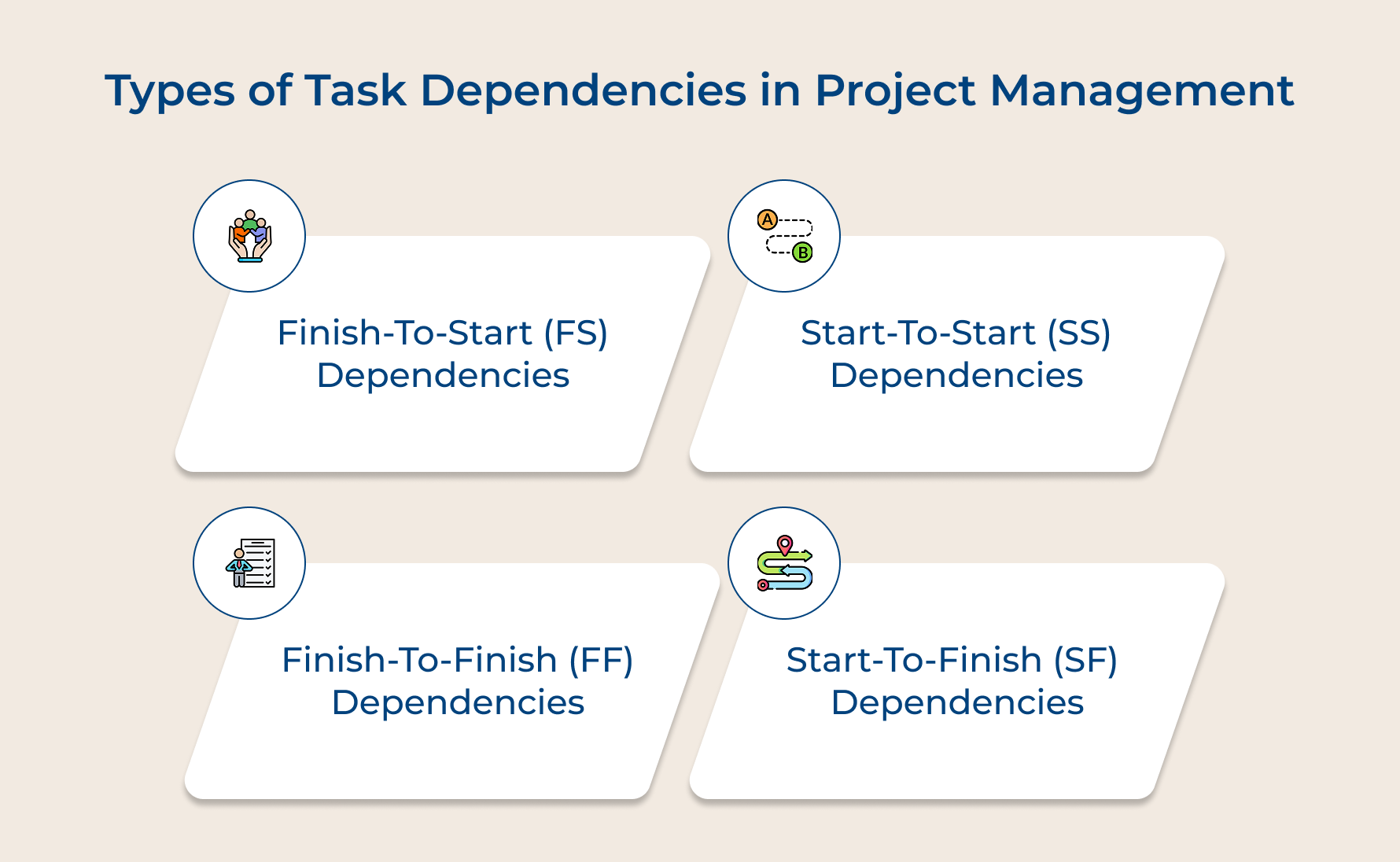
Finish-to-Start (FS) Dependencies
This is the most common type of task relationship, one task must fully finish before the next can begin. It’s straightforward and helps teams avoid confusion or working off incomplete inputs.
In agency settings, think of writing and design. A brochure’s copy must be finalized before the designer can start layout work. Without the approved text, the design can’t move forward, it’s all about clear handoffs and sequencing.
Start-to-Start (SS) Dependencies
SS is the type where two tasks can run in parallel, but one can’t start until the other has at least kicked off. It’s not about finishing together; it’s about sharing the same start trigger.
This setup speeds things up. For instance, once the content outline begins, the SEO team can start optimizing in real-time. It’s a smart way to create overlapping workflows without causing chaos.
Finish-to-Finish (FF) Dependencies
Here, two tasks don’t need to start together, but they must wrap up at the same time—or one can’t finish until the other does.
Take a website launch: QA testing and final documentation often need to end together. You can’t close the docs until testing confirms everything works. This ensures accuracy before anything goes live.
Start-to-Finish (SF) Dependencies
This one’s a bit uncommon. A task can’t finish until another task starts. It’s often used during transitions or handovers between teams or systems.
Picture this: a legacy support team stays on until the new support system is fully up and running. Only then can the old team sign off. It keeps things seamless with no service gaps.
How to Identify Task Dependencies in your Project in 8 Clear Steps
Let’s explore the 8 essential steps to help you master the art of identifying and managing task dependencies with precision.
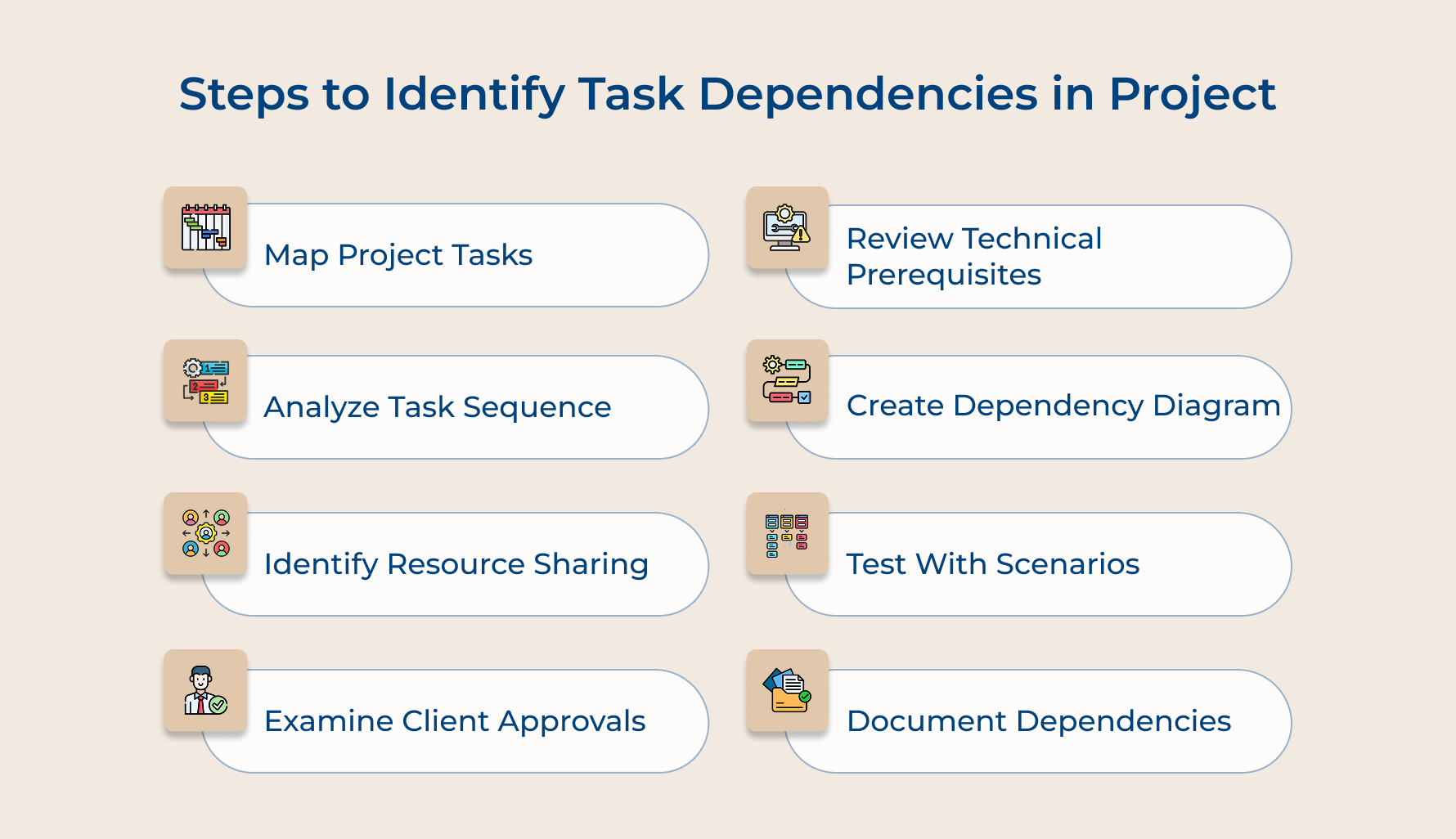
1. Map All Project Tasks Comprehensively
Before spotting dependencies, list out every task in your project. This gives you a complete view of what needs to happen and when.
Here’s how to do it:
- Start with the project scope and break it into deliverables.
- For each deliverable, outline every task needed to get there.
- Group related tasks: research, content creation, design, development, testing, launch.
- Don’t forget review and approval steps, they often cause hidden delays.
You’ll see how things connect and where delays might occur just by mapping tasks this way. Bonus: this also helps with time estimation as well as resource planning.
2. Analyze Task Sequence Requirements Thoroughly
Grouping tasks by category helps you understand their purpose and role in the project flow. This makes dependencies easier to track.
Common categories:
- Creative: Writing, designing, editing
- Technical: Development, testing, deployment
- Strategic: Research, planning, approvals
- Admin: Scheduling, reporting, coordination
Each category often has a natural sequence. For instance, research usually comes before strategy, which guides design. Categorizing tasks clarifies those flows and helps uncover hidden dependencies.
3. Identify Resource Sharing Between Tasks
Once tasks are mapped and grouped, figure out the order they naturally follow. Ask questions like:
- Does this task need something finished before it can begin?
- Can it run in parallel with another?
- Will a delay here block others down the line?
You’re not just finding order, you’re identifying how one task’s timing affects another. Visualize this with arrows or a flowchart to connect dependent steps. This sets the stage for smoother scheduling and avoids nasty surprises later.
4. Examine Client Approval Points Carefully
Understanding the four core dependency types helps you describe task relationships more precisely.
- Finish-to-Start (FS): Most common. Task B starts only when Task A ends. Example: Copywriting must finish before design starts.
- Start-to-Start (SS): Tasks start at the same time but don’t need to end together. Example: Development and testing begin once design starts.
- Finish-to-Finish (FF): Two tasks must finish together. Example: QA and documentation wrap up at the same time before launch.
- Start-to-Finish (SF): Rare. Task B can’t finish until Task A starts. Example: Handovers where one team’s start triggers the end of another’s role.
Knowing these helps you assign accurate timing and avoid clashes.
5. Review Technical and Skill Prerequisites
Don’t rely solely on your task list—your team knows what’s really connected. Involve them by :
- Asking each team member what tasks they depend on to start theirs.
- Having group discussions around potential bottlenecks or parallel work opportunities.
- Digging into past projects—what caused slowdowns?
This input reveals real-world sequencing that might not be obvious in a Gantt chart. It also boosts buy-in because people feel heard during planning.
6. Create Visual Dependency Network Diagram
Once dependencies are identified, track them in your project management software. Don’t just keep them in your head or on paper.
Why does this matter:
- Everyone sees how their tasks impact others.
- Timeline shifts trigger automatic updates.
- You can spot bottlenecks before they happen.
Use tools like Gantt charts, Kanban boards with linked cards, or timeline views with arrows to show connections. Visibility keeps your team aligned and proactive.
7. Test Dependencies Through Scenario Planning
Dependencies aren’t set in stone. Projects shift constantly, and your plans need to adapt along the way. As new priorities come in, clients change their minds or blockers arise, some tasks may be delayed or reshuffled. That’s why it’s crucial to regularly revisit your task dependencies and timelines.
To stay on top of it:
- Review dependencies during sprint planning or weekly check-ins.
- Update your project management tool whenever task relationships shift.
- Communicate any changes to the people impacted—especially if their start or end dates move.
- Watch out for new bottlenecks or parallel opportunities as the project evolves.
This continuous check-in keeps your schedule realistic, prevents last-minute chaos and helps your team stay aligned. Flexibility is key, just because something was linked in the beginning doesn’t mean it still needs to be.
8. Document and Communicate Dependencies Clearly
Seeing dependencies mapped visually helps you catch risks and opportunities you might miss in a list view.
Here’s how to do it:
- Use Gantt charts to show task timing and overlap.
- Build a dependency map or flowchart using arrows and color codes.
- Highlight tasks with multiple dependencies, they’re often bottlenecks.
- Identify tasks that can run in parallel to save time.
These visual tools give you a quick snapshot of how work flows across the project. They make it easier to explain timelines to stakeholders, plan realistic sprints, and prioritize resources where they’re most needed. A clear visual layout simplifies complex projects and keeps everyone on the same page.
Different Examples of Project Dependency
Let’s explore four distinct dependency types through practical examples that demonstrate how these relationships shape project workflows and team coordination.
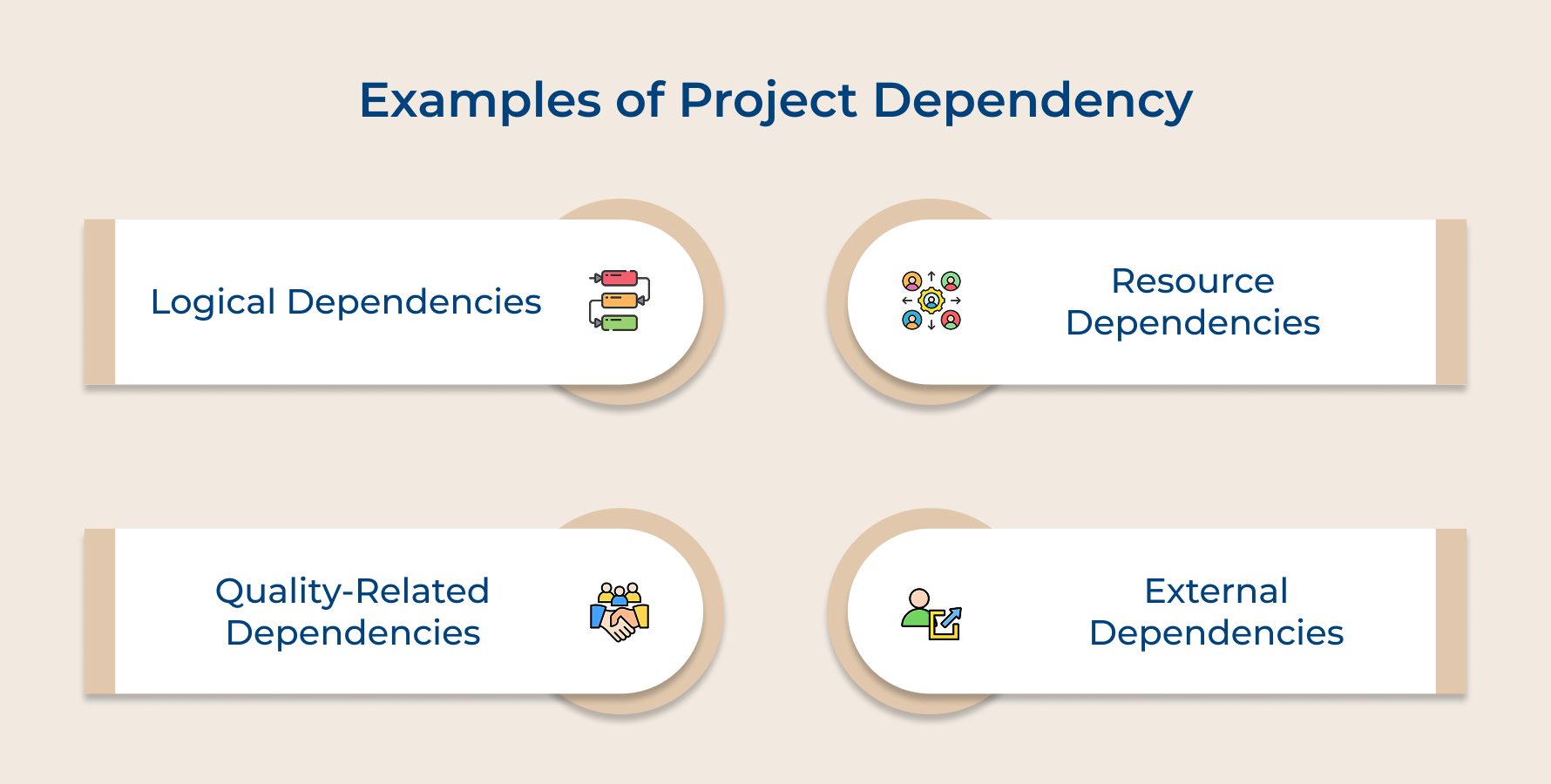
Logical Dependencies
Logical dependencies follow natural work sequences where one task must logically complete before another can begin effectively.
- Marketing agency campaign development: Social media content creation cannot begin until the brand messaging strategy is finalized because designers need approved key messages to create visually consistent posts that align with campaign objectives.
- Consulting firm process improvement: Data analysis must be completed before recommendations can be written because consultants need validated findings to support their suggested improvements and ensure client solutions are evidence-based.
Resource Dependencies
The resource dependencies occur when multiple tasks compete for the same limited resources. Hence, creating scheduling constraints that force sequential work.
- Marketing agency multi-channel campaign: Website redesign and print collateral design both require the senior creative director’s approval but cannot happen simultaneously because this key decision-maker can only review one major creative direction at a time.
- Consulting firm organizational assessment: Client interviews and survey data analysis both need the lead researcher’s attention but must be scheduled sequentially because this specialist cannot conduct interviews while simultaneously processing quantitative data.
Quality-Related Dependencies
These dependencies ensure that quality standards are maintained by requiring review and approval cycles before work can proceed.
- Marketing agency brand launch: Logo design must undergo client approval and revision cycles before any marketing materials can be finalized because inconsistent branding across touchpoints would confuse customers and dilute brand impact.
- Consulting firm strategic planning: Market research findings require thorough validation and fact-checking before strategic recommendations are developed because inaccurate data would lead to flawed business advice and potential client losses.
External Dependencies
External dependencies involve factors outside your organization’s direct control that can significantly impact project timelines and success.
- Marketing agency digital campaign: Social media advertising cannot launch until the client’s legal team approves all promotional claims because regulatory compliance issues could result in campaign shutdown and potential legal complications.
- Consulting firm technology implementation: System integration testing cannot begin until the third-party software vendor delivers the API documentation because developers need technical specifications to build proper connections between different platforms.
Best Practices for Managing Task Dependencies in a Project
Managing task dependencies effectively requires more than just identifying relationships between activities. These proven practices help agencies maintain project momentum while ensuring quality deliverables.
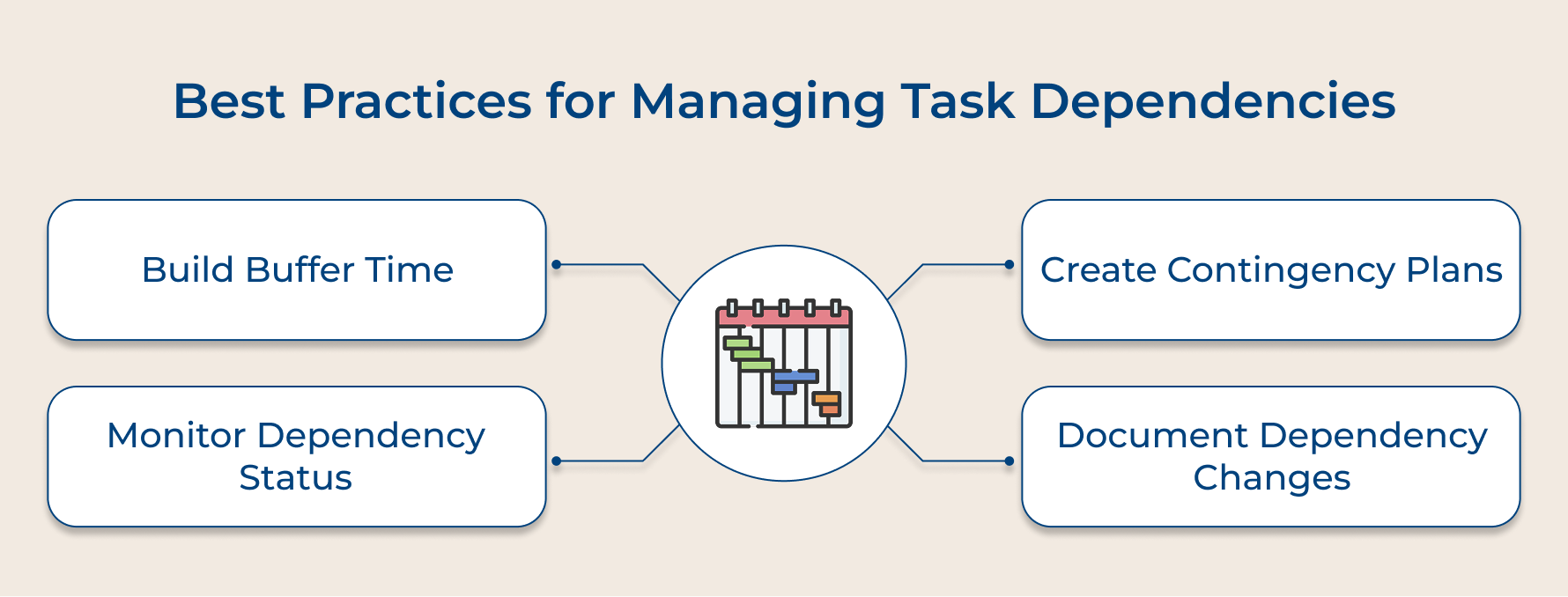
Build Buffer Time Into Critical Dependencies
Add protective time cushions around important task relationships to absorb unexpected delays without derailing entire project timelines. The buffer strategy prevents single task delays from cascading through multiple dependent activities.
Monitor Dependency Status Through Regular Check-ins
Schedule frequent progress reviews specifically focused on upcoming dependencies rather than just overall project status to catch potential bottlenecks early. Monitoring allows teams to adjust resources or timelines when dependencies threaten delays.
Create Contingency Plans for High-Risk Dependencies
Develop alternative approaches for your most vulnerable task relationships where delays could severely impact project success or client satisfaction. Having backup plans ready means you can pivot quickly when dependencies fail.
Document Dependency Changes Throughout the Project
Maintain detailed records of how task relationships evolve as projects progress because scope changes often alter original dependency assumptions. This documentation ensures everyone stays aligned on current workflow requirements.
Popular Terminologies Used in Project Dependencies
These key terminologies appear consistently in project management discussions and mastering them helps you navigate complex dependency relationships with confidence.
- Critical path: This is the longest chain of dependent tasks that sets your project’s minimum completion time. If any task on this path gets delayed, your whole timeline slips. That’s why tracking and protecting these tasks is so important, they leave no room for error.
- Lag time: Lag time is the required gap between finishing one task and starting the next. It’s usually caused by real-world constraints, like needing to let paint dry or waiting for client feedback. No matter how ready you are, these delays can’t be skipped.
- Lead time: Lead time lets you start the next task before the previous one is completely done. It’s great for overlapping work and speeding things up. For example, designers might start layout work once a draft is ready, no need to wait for final content.
- Float or Slack: Float is the time a task can be delayed without messing up the schedule. High float always equals flexibility. Tasks with zero float? They’re critical and must stay on track to avoid pushing the whole project off schedule.
- Predecessor: A predecessor is any task that must be finished (or hit a certain point) before the next one can begin. These tasks create the logical flow of your project and lay the foundation for what happens next.
- Successor: Successors are the tasks waiting in line. They can’t begin until their predecessor tasks are done. These are your next steps in the workflow, and they rely on previous work being completed to move forward.
- Milestone dependency: This happens when several tasks must wrap up before a major milestone can be reached. It’s a big coordination point, think of launching a campaign only after content, design and approval all come together at once.
Master your Projects With Seamless Task Dependencies
Task dependency in project management serves as the invisible foundation that transforms chaotic execution into predictable workflows that consistently deliver results. Without proper dependency understanding, agencies struggle with missed deadlines and frustrated clients who cannot understand why simple projects become complicated disasters.
Agencies and professional services businesses that master dependency management unlock higher profitability through reduced project delays as well as improved resource utilization. These operational improvements directly enhance client satisfaction because projects finish on schedule with transparent communication about realistic timelines and potential challenges.
Limit time — not creativity
Everything you need for customer support, marketing & sales.

Pooja Deshpande is a content contributor at Kooper, focused on creating insightful resources that help agencies and service providers scale efficiently. Passionate about SaaS trends, content strategy, and operational excellence, she delivers practical, easy-to-implement guidance for modern business leaders.