What is Agency Burnout and Best Ways to Avoid it (2026)

Key Highlights:
- Prolonged deadlines and creative detachment are early warning signs of agency burnout impacting morale as well as quality.
- Lack of clear communication channels and undefined project scopes are leading causes of agency burnout in creative teams.
- Strategic workload monitoring and realistic project timelines are essential to reduce agency burnout while maintaining high performance.
Agency burnout is no longer just a buzzword, it’s a full-blown crisis that’s quietly draining talent and profits from marketing agencies around the world. Creative professionals are hitting their limit and it shows.
Nearly 40% of agency employees quit every year. Burnout isn’t just a people problem, it’s a business one. Tight deadlines, unclear expectations, and non-stop hustle culture are pushing teams to the brink.
However, the best part is that agency burnout isn’t inevitable. By addressing the root causes (like poor resource planning and lack of communication) you can flip the script. Build a culture where your team thrives and watch how that energy transforms your work as well as results.
What is Agency Burnout?
Agency burnout happens when marketing and advertising professionals become emotionally exhausted from constant client demands as well as high-pressure deadlines. It’s that overwhelming feeling when creative energy gets drained by endless revisions and impossible timelines.
The cycle begins when agencies take on too many projects to maintain revenue streams. Workers then face conflicting priorities from different clients while managing tight budgets and unrealistic expectations. This creates a spiral where quality suffers and stress compounds until employees reach their breaking point emotionally as well as physically.
Key objectives:
- Set realistic project timelines: Build buffer time into every project schedule to account for unexpected changes and revisions.
- Establish clear client boundaries: Define specific communication hours and revision limits to prevent scope creep from overwhelming your team.
- Rotate high-stress accounts: Move team members between challenging and manageable clients to prevent any one person from bearing too much pressure.
- Implement workload monitoring systems: Track individual capacity and redistribute tasks before anyone becomes overloaded with competing priorities.
- Create recovery periods between projects: Schedule intentional downtime for teams to recharge mentally before jumping into the next demanding campaign.
How Does Agency Burnout Impact Businesses?
Agency burnout creates a devastating ripple effect that damages client relationships and financial performance through decreased quality work with increased turnover rates.
When creative professionals become emotionally exhausted, their ability to generate innovative solutions diminishes significantly while project timelines extend beyond acceptable limits.
Latest statistics showcasing agency burnout’s business impact:
- Employee burnout emerges as the second most common challenge, with 20% of agencies mentioning it as a top struggle in the 2023 Agency Analytics Agency Benchmarks Report.
- Marketing agencies experience approximately 30% annual turnover rates as of 2022, which directly translates to losing 2 out of every 6 team members working on client accounts within 12 months.
- More than 10 million employees take time off because of burnout, with businesses losing more than 80 million hours per year in sick days** while burnout costs UK businesses over £700 million annually.
- The cost of every resignation remains at around 33% of the outgoing employee’s base salary according to the 2023 Retention Report from the Work Institute.
- Total staff turnover in UK agencies was an estimated 24.1% in 2024, down from 31.2% in 2023 showing some improvement but still representing significant business disruption.
5 Important Signs of Agency Burnout
Understanding burnout symptoms helps you recognize when creative professionals hit their breaking point before productivity completely collapses. These warning signs often appear gradually but compound quickly into serious performance issues.
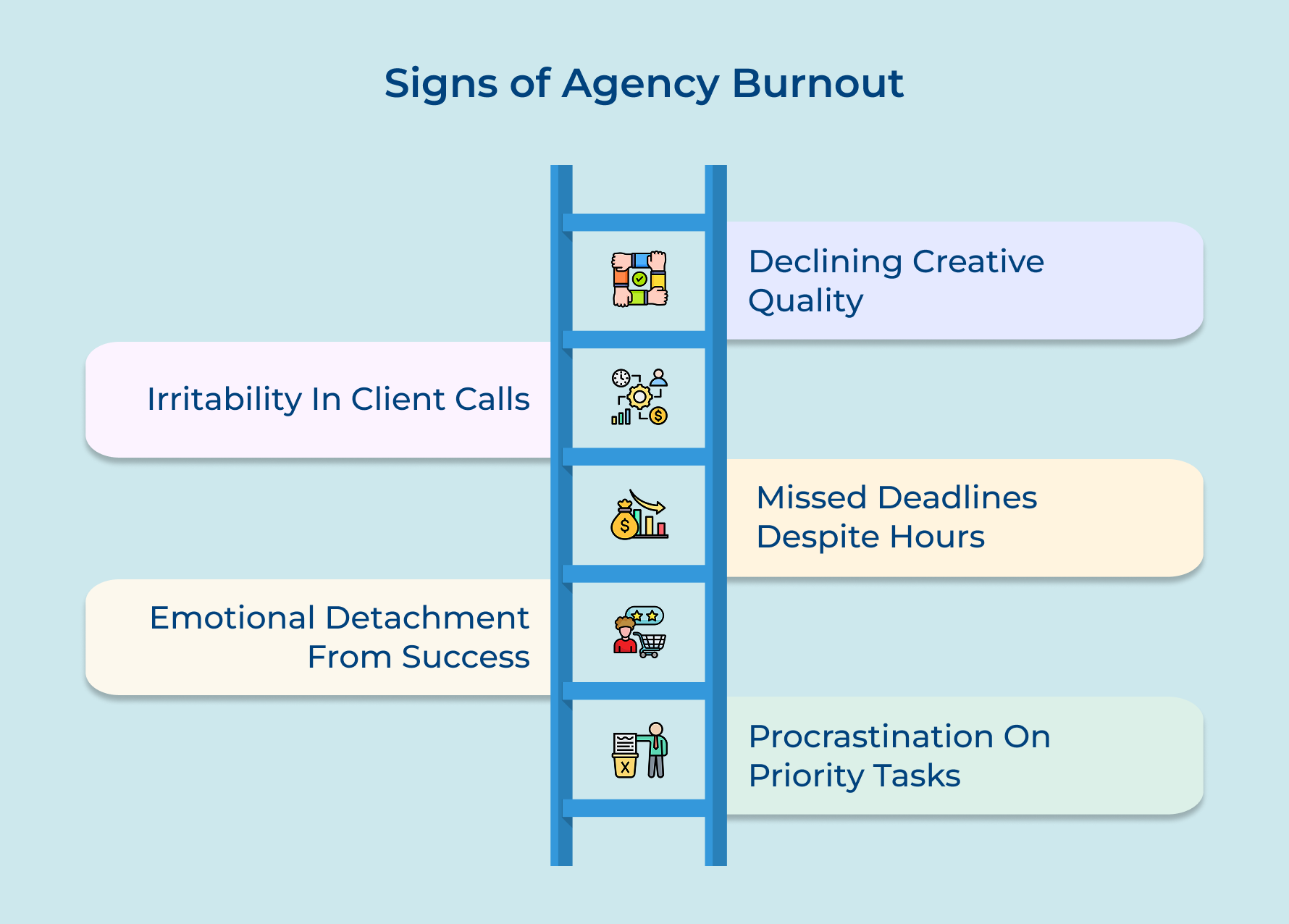
1. Declining Creative Output Quality
When designers start producing predictable work that lacks their usual spark, burnout has begun affecting their creative thinking processes. You’ll notice fewer innovative concepts during brainstorming sessions and increased reliance on templates rather than original solutions for client challenges.
2. Increased Irritability During Client Interactions
Normally patient team members become short-tempered during client calls and express visible frustration with feedback requests. This emotional exhaustion shows up as defensive responses to constructive criticism and reluctance to participate in collaborative problem-solving discussions.
3. Missing Deadlines Despite Extended Work Hours
Projects that previously finished on schedule now consistently run late even though employees work longer hours than before. The paradox occurs because mental fatigue reduces efficiency while decision-making becomes increasingly difficult under sustained pressure.
4. Emotional Detachment From Project Success
Previously enthusiastic employees show little excitement when campaigns succeed or clients express satisfaction with delivered work. The cynical attitude represents a protective mechanism where workers disconnect emotionally to avoid further disappointment or overwhelming responsibility.
5. Procrastination on High-Priority Tasks
Important projects sit untouched while team members focus on easier administrative work or spend excessive time perfecting minor details. This avoidance behavior stems from feeling overwhelmed by complex challenges and losing confidence in their ability to deliver quality results.
6 Crucial Reasons of Agency Burnout
Agency burnout rarely happens overnight but develops through systematic problems in how client projects get managed and executed. Understanding these root causes helps you identify where your processes create unnecessary stress rather than sustainable workflows.
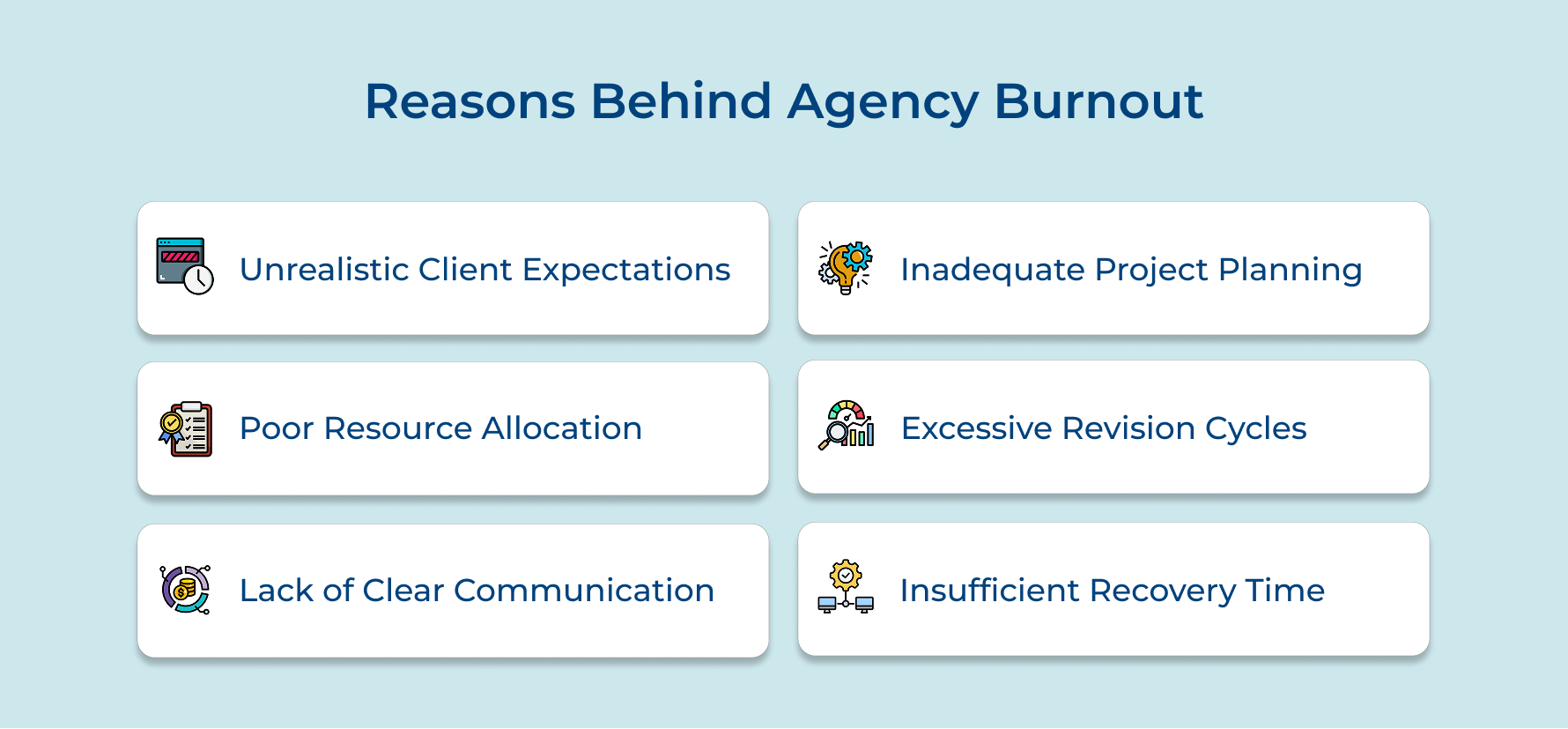
1. Unrealistic Client Expectations and Scope Creep
Clients often arrive with champagne dreams but beer budgets, expecting award-winning campaigns delivered faster than humanly possible. When agencies fail to set firm boundaries during initial discussions, projects expand beyond original agreements without corresponding timeline or budget adjustments.
The constant pressure to accommodate “just one more small change” teaches clients that professional boundaries are negotiable rather than protective measures. This pattern creates a cycle where teams work increasingly longer hours to meet impossible standards while client satisfaction paradoxically decreases due to rushed execution.
2. Poor Resource Allocation Across Multiple Projects
Agency leaders frequently overcommit their teams by accepting too many projects simultaneously without considering realistic capacity limits. It forces employees to juggle competing priorities where every client believes their project deserves immediate attention and maximum creative energy.
These scheduling conflicts manifest in several predictable ways:
- Double-booking creative talent
- Underestimating revision cycles
- Failing to account for sick days
When resource planning becomes wishful thinking rather than strategic mathematics, burnout becomes inevitable as teams attempt to deliver quality work under impossible constraints. The resulting stress affects both individual performance and overall team morale as everyone struggles to meet unrealistic expectations.
3. Lack of Clear Communication Channels
Communication breakdowns don’t just slow things down, they wear your team out. When people are stuck hunting for details or waiting on decisions, frustration builds fast. Without clear processes for feedback and approvals, projects stall, work gets scrapped while creative energy starts to fade.
You’ll spot the chaos in a few familiar ways:
- No project briefs, so teams are left guessing what the client really wants
- Feedback takes days, leaving great work stuck in limbo
- No clear decision-maker, leading to endless revision rounds
This kind of mess forces your team to work reactively. And that back-and-forth? It’s mentally exhausting. It kills momentum, creativity and morale quicker than any tight deadline ever could.
4. Inadequate Project Planning and Timeline Management
Let’s be honest, many agencies make delivery promises based on best-case scenarios instead of reality. And when timelines are too tight, your team ends up paying the price.
- Complex projects get crammed into unrealistic schedules
- Critical steps like research or quality checks are skipped to meet deadlines
- Teams scramble to catch up, working late hours under growing stress
This constant pressure doesn’t just lead to burnout, it affects the quality of your work and client satisfaction, too.
5. Excessive Revision Cycles Without Boundaries
Nothing kills morale faster than watching your work get revised into something unrecognizable. When there are no clear boundaries for revisions, it chips away at your team’s confidence and energy.
Common revision traps include:
- “Unlimited revisions” that make it hard for clients to commit
- Vague feedback that sends the team in different directions
- No clear final approver, leading to version after version with no end in sight
Eventually, your team stops putting their heart into the work, they’re just trying to survive the process.
6. Insufficient Recovery Time Between Projects
Creativity isn’t a machine, it needs breathing room. But many agencies jump from one deadline to the next without giving teams space to reset.
- There’s no time to reflect, recover, or learn from the last project
- Fatigue builds up, and small issues snowball into major stress
- Inspiration fades because everyone’s just trying to stay afloat
If you want sustainable creativity, your team needs time to recharge. That space is where their best ideas are born.
8 Smart Strategies to Prevent Agency Burnout
Let’s explore 8 actionable strategies tailored to prevent and mitigate burnout in agency settings, helping you reclaim productivity as well as preserve your team’s well-being.
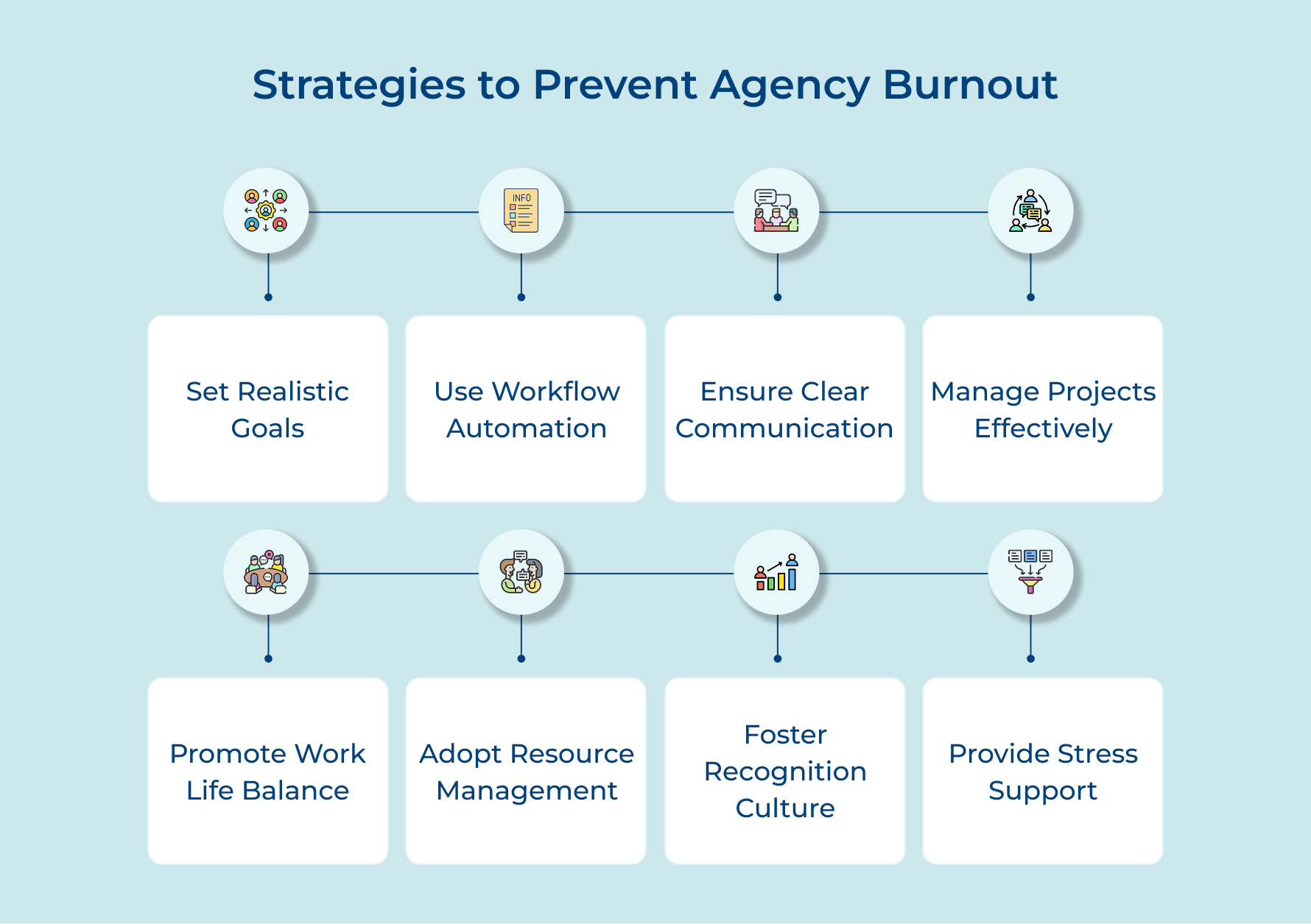
1. Set Realistic Project Goals and Timelines
Setting realistic timelines prevents the crushing pressure that comes from promising impossible deliverables to eager clients. When agencies pad schedules appropriately, teams can focus on quality work rather than constantly fighting against unrealistic deadlines.
Four essential timeline strategies that protect your team from burnout:
- Buffer planning: Add 20-30% extra time to account for unexpected revisions and technical challenges.
- Historical analysis: Review past projects to understand actual completion times versus initial estimates.
- Client approval windows: Build dedicated time blocks for client feedback and decision-making processes.
- Milestone mapping: Break large projects into smaller deliverable chunks with realistic completion dates.
Consider a web design project initially estimated at four weeks. A smart agency adds one week buffer time and schedules client feedback sessions strategically. This approach prevents weekend work sessions and maintains team morale throughout the project lifecycle.
2. Implement Smart Workflow Automation Systems
Automation is a game-changer for agencies aiming to protect their team’s time and sanity. Let’s face it: repetitive, low-value tasks drain creative energy and make even the most passionate pros feel like glorified admins. That’s where smart automation steps in, freeing your team to focus on the work that actually matters.
Before jumping in, ask:
- What tasks eat up time but offer no creative value?
- Which processes require the same manual steps every time?
- Where do we usually drop the ball during handoffs?
Now, automate the pain points:
- Status reporting: Use dashboards instead of weekly emails
- Invoicing: Automate billing for better cash flow
- File organization: Set naming rules and templates
- Client onboarding: Use sequences, not scattered emails
Pairing automation with strong wellness programs reduces burnout and creates space for real, meaningful work.
3. Establish Clear Communication Protocols Always
Clear communication protocols eliminate the guesswork that creates anxiety and prevents teams from making confident decisions.
When everyone understands their role as well as responsibility boundaries, projects flow smoothly without constant back-and-forth clarification requests.
Structured communication systems reduce emotional exhaustion by providing predictable frameworks for feedback and decision-making processes. Teams waste less mental energy decoding unclear messages and spend more time producing meaningful work.
Pro tips:
- Create decision trees that show exactly who approves what at each project stage.
- Set communication blackout hours to protect focused work time from constant interruption.
4. Master Strategic Project and Workload Management
In the marketing and advertising industry, burnout often starts with overloaded teams juggling too many demanding projects at once. Strategic workload management helps your agency avoid this by assigning work with care, not chaos.
Here’s how smart agencies do it:
- Capacity monitoring: Use visual dashboards to track each person’s workload before saying yes to new projects. It helps managers spot who’s overloaded and who’s available.
- Account rotation: Shift team members between intense and lighter accounts to prevent burnout from tough client relationships.
- Fair distribution systems: Assign tasks based on real-time bandwidth, not habit or convenience. Automation tools make this much easier.
When clients request the same team members repeatedly? Set expectations early. Explain the value of rotating fresh talent like new ideas, new energy, and a sustainable pace for everyone.
5. Create Healthy Work-Life Balance Company Culture
Work-life balance culture protects employees from the always-on mentality that turns creative professionals into exhausted zombies. When agencies respect personal boundaries, teams maintain the energy and enthusiasm needed for sustained creative excellence.
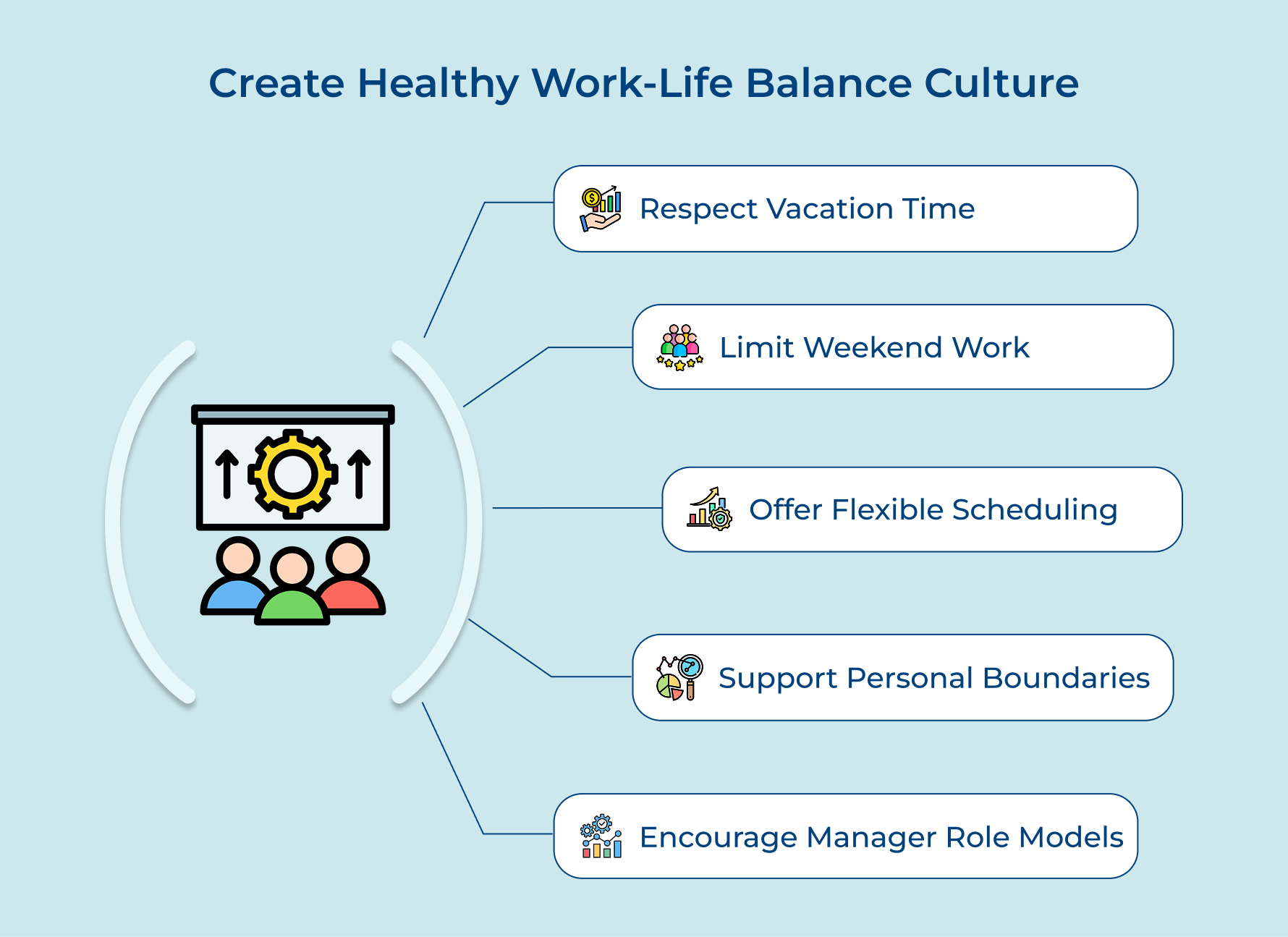
Five essential questions to evaluate your agency’s work-life balance commitment:
- Do employees feel comfortable declining after-hours meetings for personal commitments?
- Are vacation days truly respected without emergency work interruptions?
- Does your team regularly work weekends to meet standard project deadlines?
- Are flexible scheduling options available for different life circumstances?
- Do managers model healthy boundaries by disconnecting from work communications?
These questions reveal whether your stated policies align with actual workplace expectations and help identify gaps between intention as well as reality. Honest answers expose areas where cultural improvements can significantly reduce employee stress and prevent burnout.
6. Invest in Comprehensive Resource Management Software
In the advertising industry, juggling talent across multiple projects can quickly lead to burnout. That’s where resource management software steps in. For ad agencies, it’s like having a GPS for your workflow—guiding every decision with clarity and data.
Here’s what to look for:
- Real-time capacity tracking to see who’s nearing overload
- Project forecasting tools to plan ahead, not just react
- Easy integration with your project management stack
- Custom dashboards to spot trouble before it hits
And how does it prevent burnout?
- Workload visualization shows when someone’s stretched too thin
- Predictive planning catches future conflicts early
- Alerts flag unrealistic deadlines
- Historical data helps set smarter estimates
- Skill-based assignments ensure the right people are on the right jobs
7. Create Recognition and Appreciation Culture Systems
In busy agencies, burnout often comes from feeling overlooked, even when the work is stellar. That’s why building a recognition culture is so important. When people feel seen and appreciated, motivation sticks around.
Here’s how to make it count:
- Celebrate both individual wins and team efforts. Shout out great design work and flawless team coordination. It all matters.
- Give regular feedback and growth opportunities. People thrive when they know where they stand and where they’re headed.
- Recognize extra effort during crunch time. Long nights and tight turnarounds deserve more than a passing “thanks.” Make your appreciation visible.
When agencies show they value their people, employees don’t just survive tough projects, they feel proud of their contributions and stay invested in the work.
8. Develop Proactive Stress Management Support Programs
Proactive stress management programs address burnout before it reaches crisis levels by providing tools and resources for ongoing mental health maintenance.
These initiatives demonstrate genuine care for employee well-being while building resilience against the inevitable pressures of agency work.
Early intervention programs help employees recognize signs of stress and access support before it escalates. This prevents burnout from affecting both performance and personal relationships.
Mental health resources normalize seeking help while providing practical coping strategies for high-pressure creative environments.
Best practices:
- Schedule monthly one-on-one conversations specifically focused on well-being rather than project status.
- Partner with licensed counselors who understand creative industry pressures and challenges.
Support Healthier Workflows and Reduce Agency Burnout With Kooper
All-in-one PSA software eliminates the administrative chaos that drains creative energy by centralizing project management, time tracking, and client communication into unified workflows. This integration prevents the context-switching fatigue that occurs when teams juggle multiple disconnected tools throughout their workday.
Kooper specifically addresses agency burnout through automated resource allocation, real-time capacity monitoring, and streamlined project workflows. The platform’s intelligent scheduling prevents overcommitment while providing visibility into team workloads before stress levels reach dangerous breaking points.
Limit time — not creativity
Everything you need for customer support, marketing & sales.

Pooja Deshpande is a content contributor at Kooper, focused on creating insightful resources that help agencies and service providers scale efficiently. Passionate about SaaS trends, content strategy, and operational excellence, she delivers practical, easy-to-implement guidance for modern business leaders.