Everything You Need to Know About Resource Capacity Planning
- What is Resource Capacity Planning?
- Benefits of Resource Capacity Planning
- Resource Capacity Planning vs. Resource Planning
- The Complete 7-Step Resource Capacity Planning Framework
- 5 Proven Strategies of Resource Capacity Planning
- 4 Comprehensive Resource Capacity Planning Tools
- Maximize Efficiency with Smart Resource Capacity Planning.
- FAQs about Resource Capacity Planning

Key Highlights:
- Learn resource capacity planning strategies that match team growth with demand through lead, lag, match, top-down and bottom-up approaches.
- Explore actionable steps including forecasting, gap analysis and alignment of skill sets with project needs.
- Discover how tools enhance planning through forecasting, utilization tracking and centralized dashboards for improved project visibility.
Are your projects constantly delayed because key team members are overbooked while others sit idle? Does your agency struggle with unpredictable resource crunches that force you to turn away profitable opportunities?
You’re experiencing feast-or-famine workloads, burned-out employees, inconsistent project quality and missed revenue targets that threaten your competitive market position.
Resource capacity planning transforms this chaos into strategic advantage by providing frameworks to optimize your team’s capabilities. This comprehensive guide reveals proven methodologies and actionable strategies for maximizing efficiency as well as profitability.
What is Resource Capacity Planning?
Resource capacity planning in project management is the strategic process of identifying and allocating the right people with the right skills at the right time to complete project tasks successfully. This planning ensures you have sufficient team members available when critical work phases begin while avoiding costly overstaffing during lighter periods.
The process works by first breaking down your project into specific tasks and estimating the time as well as skill requirements for each one. You then match these requirements against your available team members’ schedules and capabilities to identify gaps or conflicts.
When mismatches occur you can adjust timelines or bring in additional resources before problems arise. This forward-thinking approach prevents the common scenario where projects stall because key people are unavailable or overcommitted.
Primary focus areas:
- Start with accurate demand forecasting: Base your resource needs on realistic task estimates rather than wishful thinking.
- Balance workload distribution: Spread tasks evenly across team members to prevent burnout and bottlenecks.
- Plan for flexibility and contingencies: Build buffer time and backup resources into your planning for unexpected changes.
- Align skills with task requirements: Match people’s expertise to the work that needs their specific capabilities.
- Monitor and adjust continuously: Track actual resource usage against your plan and make real-time adjustments as the project evolves.
Benefits of Resource Capacity Planning
Let’s explore six key advantages that make this strategic approach essential for sustainable growth.

Enhanced Project Delivery Predictability
Capacity planning works like a GPS for your project pipeline – it shows who’s available, when and how their skill sets match the work ahead. With that clarity, you can commit to realistic deadlines and earn long-term client trust.
Optimized Resource Utilization and Profitability
Aligning skill sets with project needs ensures every team member contributes at the right time, eliminating idle hours and avoiding overload. It leads to smoother operations and increased profitability.
Reduced Employee Burnout and Improved Retention
Capacity planning is your early warning system. By monitoring workloads and distributing projects fairly, you keep stress in check and build a workplace where people want to stay while giving their best.
Improved Client Satisfaction
When your team isn’t stretched thin, they have time to truly focus. That leads to better work, happier clients and a reputation for consistent quality across your project pipeline.
Enhanced Risk Management and Contingency Planning
Strong capacity planning includes smart buffers and backup options. If someone’s out or a client changes scope, you’ve already planned for it.
Resource Capacity Planning vs. Resource Planning
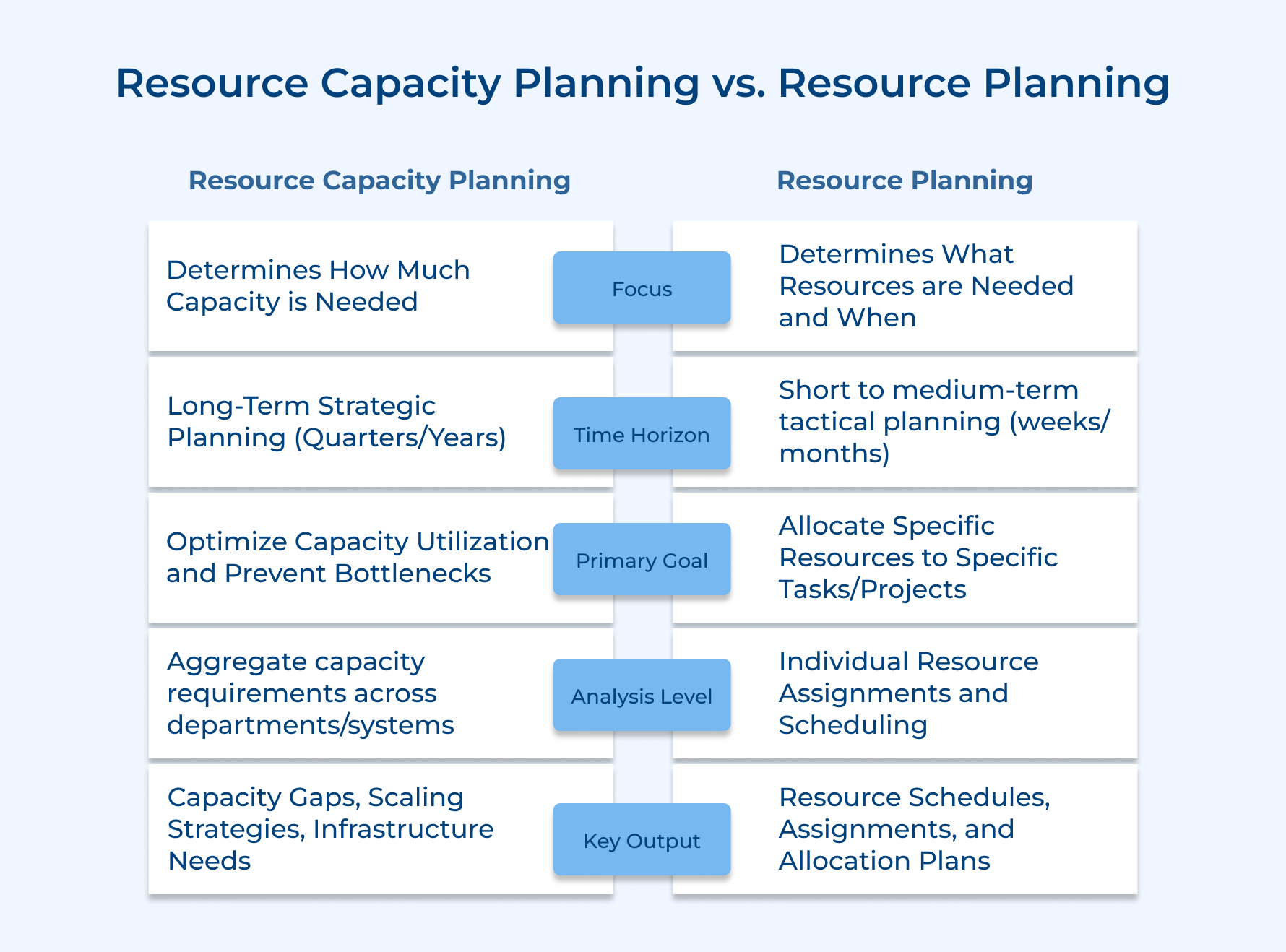
Let’s understand the distinction between resource capacity planning and resource planning in your organization’s project ecosystem. It is crucial to understand what each represents.
Resource Capacity Planning
- Strategic oversight: Resource capacity planning focuses on organizational-level resource supply and demand across all projects as well as business units.
- Future forecasting: It predicts resource needs months or quarters ahead to enable proactive hiring and capacity building decisions.
- Portfolio perspective: This planning considers all projects simultaneously to identify resource conflicts and opportunities across the entire business
- Investment planning: It drives decisions about hiring new talent, training existing staff, or partnering with external contractors
Resource Planning
- Project-specific focus: Resource planning concentrates on assigning the right people to specific tasks within individual projects
- Tactical execution: It handles day-to-day resource allocation decisions based on current project requirements and team availability
- Timeline management: This kind of planning creates detailed schedules showing when each team member will work on specific project deliverables
- Skill matching: It ensures that individual tasks are assigned to team members with appropriate expertise and experience levels
The fundamental difference lies in perspective and purpose. Resource capacity planning asks “Do we have enough capacity as an organization?” while resource planning asks “Who specifically will do this work?” Both are crucial for project success, but they address different challenges in your project management ecosystem.
The Complete 7-Step Resource Capacity Planning Framework
Here, we outline seven essential steps that will guide you in creating an efficient resource capacity plan, helping to align your team’s capabilities with your project objectives.
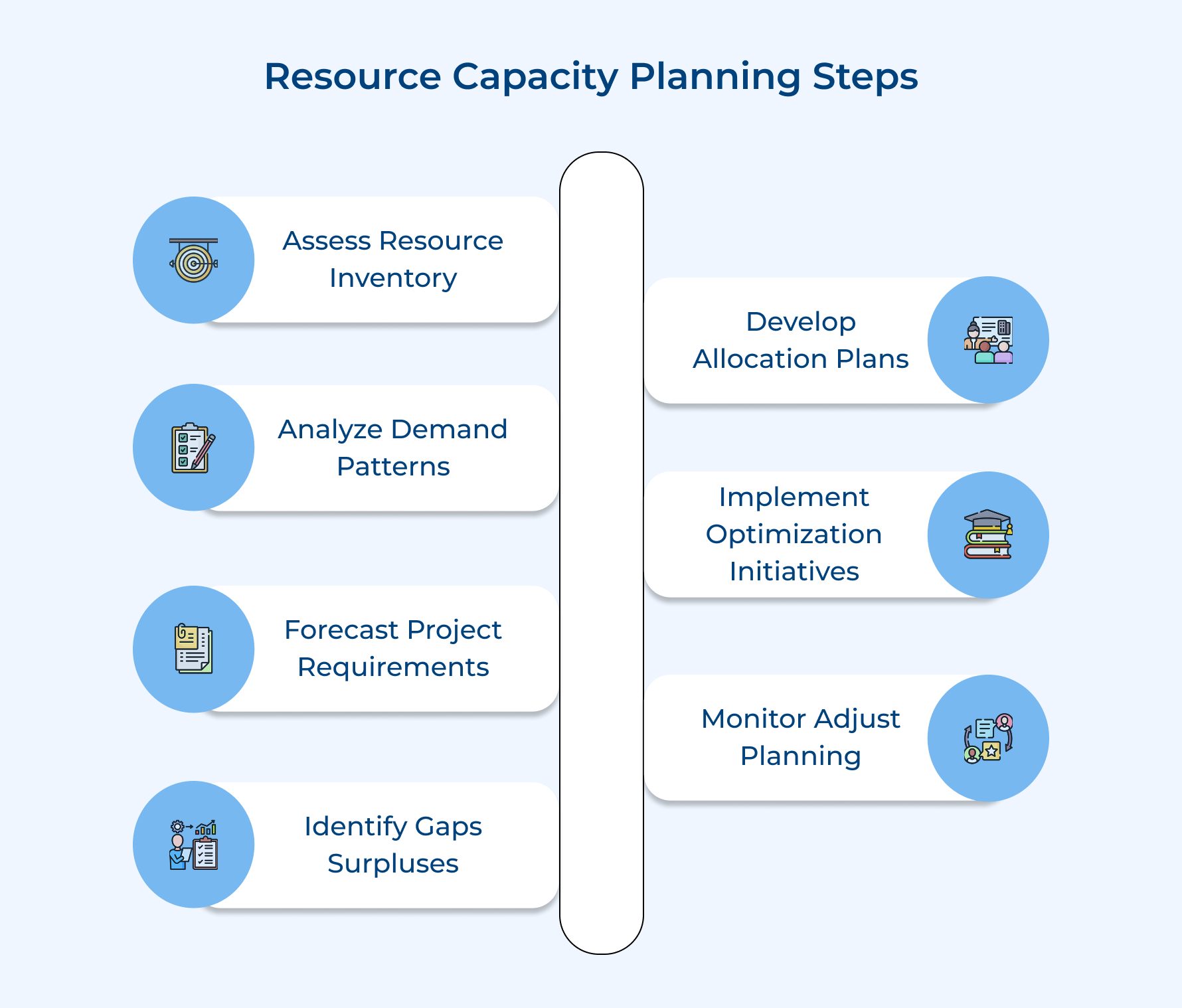
Step 1: Assess Current Resource Inventory
Assessing current resource inventory means creating a comprehensive snapshot of your organization’s existing capabilities and availability. This foundational step prevents overcommitment and ensures you understand your actual capacity before making future planning decisions.
Here are the essential components for conducting a thorough resource inventory assessment:
- Skills cataloging: Document each team member’s technical competencies, certifications and experience levels across different service areas.
- Utilization tracking: Monitor how much time each resource spends on billable versus non-billable activities throughout typical work periods.
- Capacity mapping: Identify current workload distribution and determine how much additional work each team member can realistically handle.
It is also recommended to understand resource capacity calculations as it helps you make data-driven decisions rather than relying on assumptions about team availability.
The calculation involves four key steps:
- Determine total available hours by multiplying team size by standard working hours per period.
- Subtract planned absences including vacation time, training and administrative duties from total hours.
- Calculate current utilization by dividing billable hours by available hours for each resource.
- Identify remaining capacity by subtracting current commitments from total available working time.
Step 2: Analyze Historical Demand Patterns
Before planning for the future, take a good look at your past. Analyzing historical demand patterns helps agencies spot trends and cycles that influence smarter resource decisions.
Here’s how to extract real insights from past data:
- Trend analysis: Review project volumes quarterly or monthly for the last 2-3 years. Look for consistent increases or decreases in certain services.
- Cyclical patterns: Spot peak seasons by linking project spikes to industry events, budget cycles, or specific months.
- Client behavior mapping: Track how often clients scale up, their repeat business cycles and common project scopes over time.
For example, a digital agency might notice that website redesign projects surge by 40% every Q4. Knowing this helps them staff up or prepare contractors in advance.
Step 3: Forecast Future Project Requirements
Forecasting isn’t guesswork, it’s informed anticipation. The more you understand your pipeline and trends, the better you can plan ahead.
Ask these questions:
- What projects are in the sales pipeline and how likely are they to close?
- Are any existing clients showing signs of expansion?
- How are market trends affecting demand for your services?
- Are there seasonal trends that affect your workload?
Then follow these forecasting steps:
- Review proposals and leads: Assign closing probabilities while matching each opportunity with resource estimates.
- Map client patterns: Use past growth trends to anticipate who may increase scope.
- Factor in seasonality: Apply multipliers to adjust forecasts based on known peaks and lulls.
Step 4: Identify Resource Gaps and Surpluses
Compare your forecasts against current team capacity. You’re trying to find where you’re stretched too thin or where talent is underused.
Ask yourself:
- Where is demand outpacing capacity in the next 6 months?
- Who on the team is consistently underutilized?
- What skill sets are missing that block high-value projects?
Two ways to dig deeper:
- Skills gap analysis: Match current team capabilities against what’s needed for forecasted work.
- Workload review: Spot teams or individuals who are underused or overstretched.
This gives you a clear view of what roles need hiring, where to upskill and how to shift work for better balance.
Step 5: Develop Strategic Resource Allocation Plans
Once you know the gaps, it’s time to make a plan. Strategic resource allocation helps you fill holes and get the most from your team.
Start with:
- Hiring roadmaps: Prioritize by urgency and revenue impact. Clearly define what roles you need, their qualifications and when they’re needed.
- Training programs: Upskill your current team in high-demand areas. This builds internal flexibility and makes you less reliant on hiring for every skill.
Pro tip: Cross-training can help reduce bottlenecks and ensure business continuity when someone is on leave.
Step 6: Implement Capacity Optimization Initiatives
With a plan in place, it’s time to act. Optimizing capacity means bringing your plan to life through hiring, training and onboarding new resources.
Execution tips:
- Stagger new hires: Spread start dates so your team isn’t overwhelmed with onboarding.
- Standardize onboarding: Use checklists to make sure every new team member is fully equipped, regardless of which manager is onboarding them.
- Mentorship: Pair new hires with experienced teammates to accelerate integration and productivity.
All these efforts keep your quality high while your team scales up smoothly.
Step 7: Monitor and Adjust Planning Continuously
Don’t let your plan gather dust. Capacity planning is a living process that requires continuous tweaks.
Keep an eye on these KPIs:
- Resource utilization rates
- Timeline slippage or project delays
- Client satisfaction scores
- Revenue per employee
Also:
- Conduct weekly reviews with project managers to catch problems early
- Hold monthly check-ins with clients for feedback and future planning cues
Use these insights to adjust hiring, shift work, or realign skill development. The goal? Stay agile, accurate and ahead of demand.
5 Proven Strategies of Resource Capacity Planning
Let’s explore common resource capacity planning strategies to help you determine which best suits your project needs and risk tolerance.
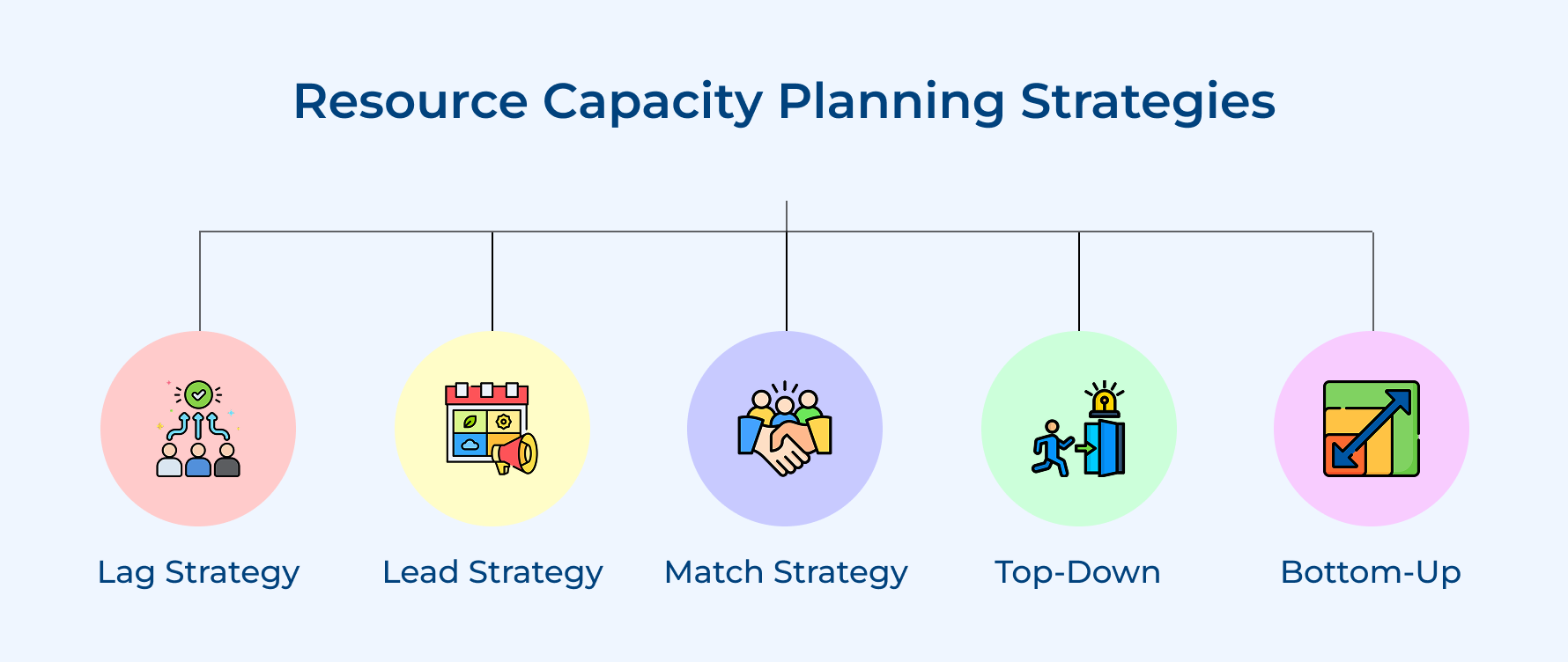
1. Lag Strategy
The lag strategy is a cautious, wait-and-see approach to scaling your team. You only bring in more resources once your current team hits full capacity and demand proves consistent. It’s great for cost control, but it comes with trade-offs.
How it works:
- Monitor team utilization closely (aim for 85–90%)
- Add resources after demand is confirmed and sustained
Pros:
- Keeps overhead costs low
- Ensures hires are backed by revenue
Cons:
- Can lead to project delays
- Might lose out to faster-moving competitors
This strategy suits agencies that value financial stability over rapid growth. Just be ready to manage client expectations during peak workloads.
2. Lead Strategy (Be Prepared)
The lead strategy is all about staying ahead of demand. Instead of waiting until you’re stretched thin, you prepare in advance by adding resources before the rush hits.
Ideal for:
- Seasonal demand spikes
- Fast-growth agencies
How it works:
- Use forecasting and trends to predict busy periods
- Hire or onboard in advance to meet upcoming demand
Pros:
- No scrambling to fill urgent roles
- Maintains delivery quality during peak times
Cons:
- Higher upfront costs
- Risk of underutilized resources if demand doesn’t pan out
For example, a digital agency expecting a January boom might hire in December. It’s proactive, but requires strong planning.
3. Match Strategy
The match strategy is a balanced, flexible approach. You adjust your resources gradually (adding or scaling back) to stay in step with changing demand.
Use it when:
- Your market has predictable ups and downs
- You want flexibility without overcommitting
Key questions to guide the approach:
- What’s the ideal utilization rate for your team?
- What’s your baseline team size for slower periods?
- What are your early warning signals for scaling?
This strategy works best with real-time monitoring tools and agile decision-making. It’s about tuning your resource mix like a volume knob.
4. Top-Down Strategy
Top-down strategy is where leadership sets the capacity plan and passes it down the chain. It ensures your resources align with your agency’s big-picture goals.
How it works:
- Executives define capacity targets and allocate budgets
- Department heads manage resources within these limits
Pros:
- Clear strategic alignment
- No confusion about priorities
Cons:
- May ignore day-to-day execution challenges
- Can feel disconnected from on-the-ground realities
Use this when your agency runs on long-term strategy and clear top-level direction. But make space for feedback from project teams who deal with the real workload daily.
5. Bottom-Up Strategy
The bottom-up strategy flips the traditional model. Instead of execs setting the plan, project managers and team leads report what’s really needed as well as leadership builds resource plans from the ground up.
How it works:
- Project leads assess their needs and submit requests
- Departments analyze team capacity and skill gaps
- HR compiles it all into a hiring and resource plan
Why it works:
- Grounded in real workload data
- Captures frontline insights about skill gaps and demand
Best for:
- Agencies with diverse, complex projects
- Teams that value autonomy and transparency
This method keeps planning closer to reality. It’s slower but more accurate, especially for agencies juggling multiple project types.
4 Comprehensive Resource Capacity Planning Tools
The right tools can transform resource capacity planning from manual guesswork into data-driven strategic advantage. Modern technology solutions provide the visibility and analytical power needed to make informed capacity decisions with confidence.
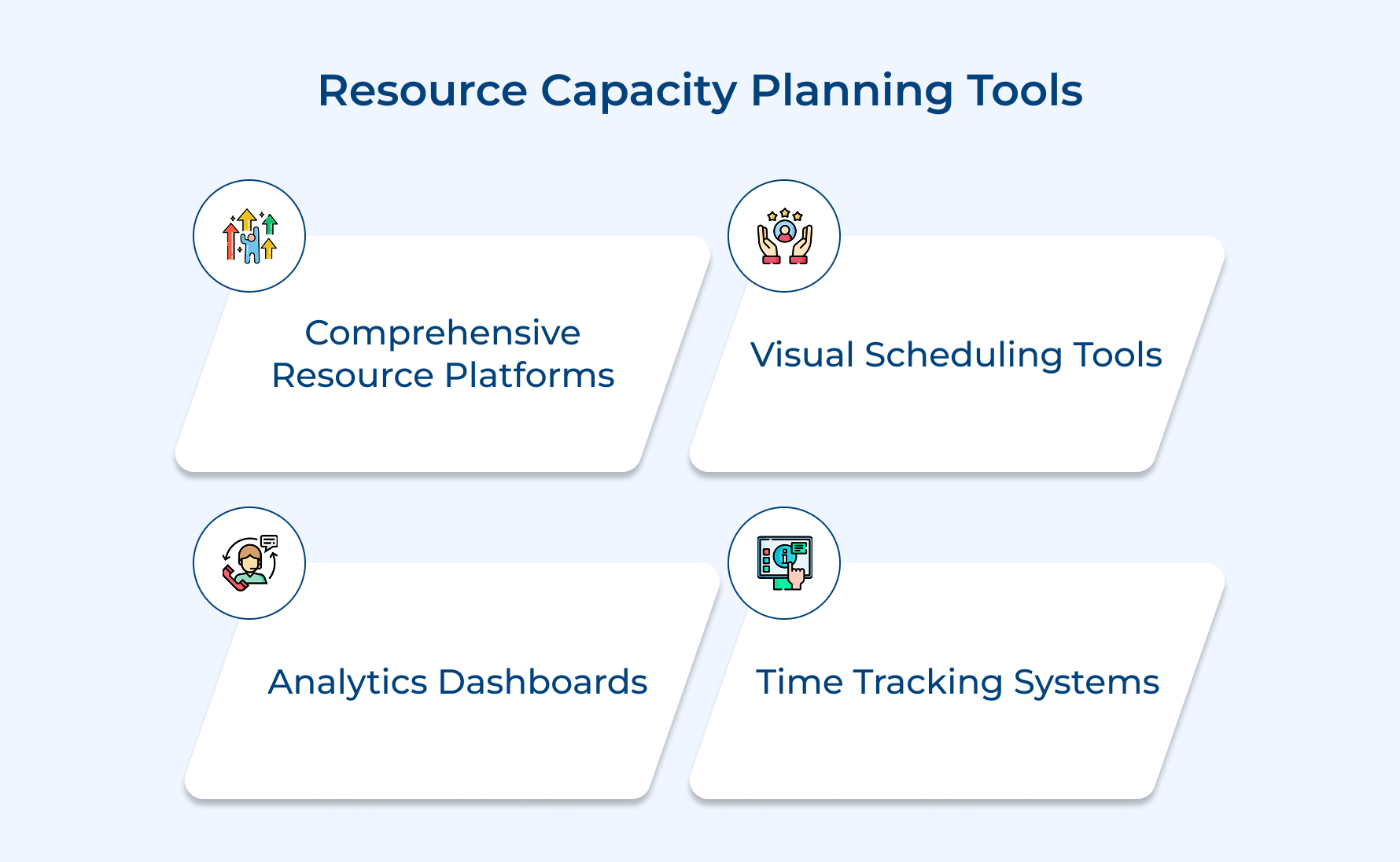
Comprehensive Resource Management Platforms
These all-in-one solutions combine project scheduling, team availability tracking and capacity forecasting into a single integrated system. They provide real-time visibility into resource utilization while offering predictive analytics to help anticipate future capacity needs.
Visual Resource Scheduling and Planning Tools
Interactive calendar-based interfaces allow you to drag and drop team members across projects while instantly seeing capacity conflicts along with availability gaps. These visual tools help project managers understand resource allocation at a glance and identify optimal scheduling solutions.
Business Intelligence and Analytics Dashboards
Advanced reporting platforms aggregate data from multiple sources to create comprehensive capacity insights through customizable charts and performance metrics. The tools help leadership teams identify trends, measure planning accuracy and make strategic decisions based on historical patterns.
Time Tracking and Utilization Monitoring Systems
Automated time capture solutions provide accurate data on how team members spend their working hours across different projects and administrative tasks. This insight enables precise utilization calculations and helps identify discrepancies between planned as well as actual work patterns.
Maximize Efficiency with Smart Resource Capacity Planning.
Resource capacity planning serves as the strategic foundation that prevents agencies from drowning in project chaos while missing profitable opportunities. Without systematic capacity management, organizations face the costly cycle of overcommitting resources, disappointing clients and burning out valuable team members who drive business success.
Smart capacity planning transforms professional services operations by optimizing resource utilization, reducing project delivery risks and creating predictable revenue streams that support sustainable growth. When agencies master this discipline, they gain competitive advantages through improved client satisfaction, enhanced team productivity and strategic flexibility that enables confident business expansion.
Limit time — not creativity
Everything you need for customer support, marketing & sales.

Pooja Deshpande is a content contributor at Kooper, focused on creating insightful resources that help agencies and service providers scale efficiently. Passionate about SaaS trends, content strategy, and operational excellence, she delivers practical, easy-to-implement guidance for modern business leaders.