Complete Guide to Professional Services Pricing Models
- What is a Professional Services Pricing Model?
- Benefits of Professional Services Pricing Model
- 6 Types of Pricing Models for Professional Services
- 7 Actionable Steps to Create Professional Service Pricing Models
- Emerging Trends in Professional Services Pricing
- Professional Services Pricing Model: The Key to Flexible Pricing
- FAQs about Professional Services Pricing Model

Key Highlights:
- Discover seven professional services pricing models and how to align them with your business goals for optimal profitability.
- Learn actionable steps to develop as well as communicate your professional services pricing strategy for long-term growth.
- Explore current trends in professional services pricing, including outcome-based, dynamic, and technology-driven models for industry advantage.
Most professionals don’t get into project management to become pricing strategists. However, without a clear professional services pricing model, even the best-run projects can turn into profitless efforts. Guesswork in pricing leads to unpredictable income, missed opportunities, and burnout from over-delivery.
The truth is: pricing isn’t just about numbers, it’s a reflection of your value, your positioning, and your long-term sustainability. A solid pricing model helps you set fair rates, justify them confidently, and attract the right kind of clients.
This guide explores practical strategies successful project managers use to structure their pricing—from value-based models to tiered offerings—so you can finally align your pricing with your expertise and run a business that works for you, not against you.
What is a Professional Services Pricing Model?
A professional services pricing model is the structured approach businesses use to determine how much they charge clients for their expertise and specialized services. It goes beyond simple hourly rates and encompasses the entire framework of how you package your services as well as communicate their worth to potential customers.
Professional services pricing operates by evaluating the value you deliver rather than just the time you spend on a project. You assess factors like client outcomes, project complexity, your expertise level, and market demand to establish fair compensation.
Value-based objectives:
- Align pricing with the actual value delivered to clients rather than just time invested.
- Create predictable revenue streams that support sustainable business growth and operations.
- Position your services competitively while maintaining healthy profit margins.
- Build transparent pricing structures that clients can easily understand and budget for.
- Establish pricing flexibility that adapts to different client needs and project scopes.
Benefits of Professional Services Pricing Model
A well-structured professional services pricing model transforms how you run your business and serve clients. Let’s explore six key advantages that make this approach essential for sustainable growth.
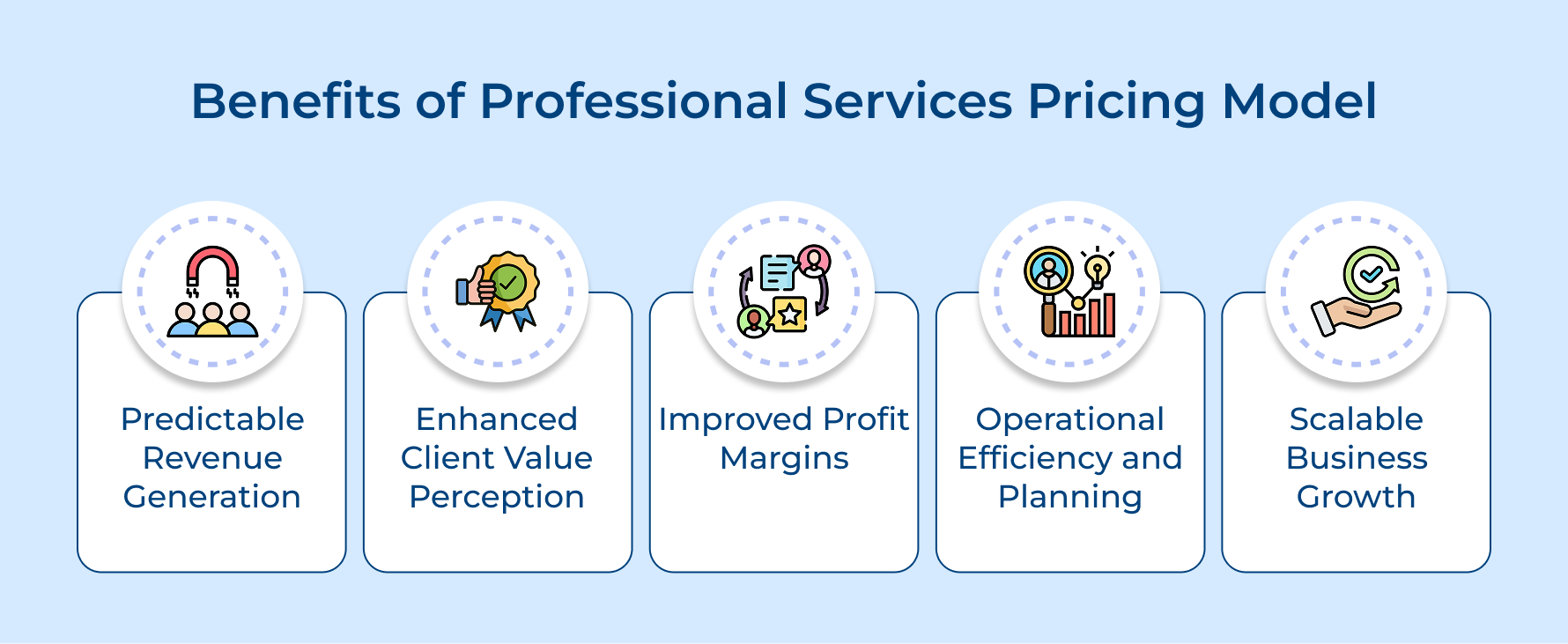
1. Predictable Revenue Generation
A solid professional services pricing model helps business owners move away from feast-or-famine cycles. Leveraging predictable income through retainers or fixed project fees helps you to confidently plan team hires, invest in tools, and ride out slower months without stress.
2. Enhanced Client Value Perception
When you price for outcomes instead of hours, clients stop treating you like a vendor and start seeing you as an essential part of their success. It shifts the conversation from “what does this cost?” to “what is this worth?”
3. Improved Profit Margins
Hourly rates often shortchange your expertise. Value-based pricing lets you get paid for results, not just time. That means higher profit margins without piling on more hours or exhausting your team.
4. Operational Efficiency and Planning
Say goodbye to endless time-tracking and invoice nitpicking. With fixed-fee or retainer setups, you reduce administration tasks and give your team space to focus on delivering real impact instead of counting every billable minute.
5. Scalable Business Growth
Standardized pricing frees you from having to custom-quote every new project. As a business owner, that means you can delegate confidently and keep profitability consistent, even as your team or client list grows.
6 Types of Pricing Models for Professional Services
Professional services firms have evolved beyond simple hourly billing to create sophisticated pricing strategies that better capture value and serve client needs. Each model offers unique advantages depending on your service type and client relationships.
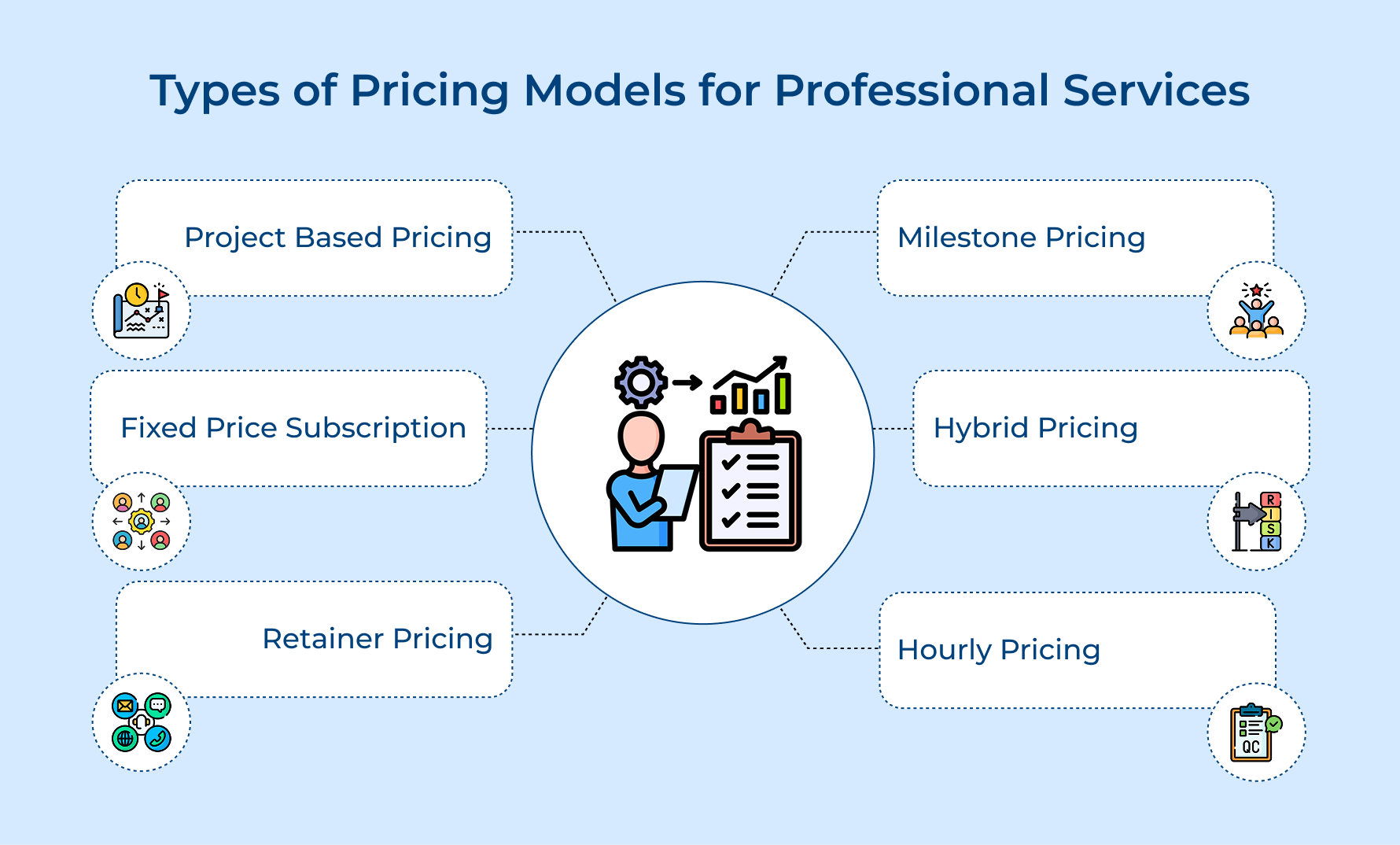
1. Project-Based Pricing Model
Project-based pricing involves setting a fixed fee for delivering specific outcomes within defined scope and timeline parameters. This model works best when you can clearly define deliverables and estimate the effort required to complete the work successfully.
Pros:
- Clients appreciate budget certainty and you avoid scope creep discussions during project execution
- Higher profit potential when you complete projects efficiently using your expertise and proven processes
Cons:
- Risk of underestimating project complexity can lead to reduced margins or client relationship strain
- Requires detailed upfront planning and scope definition which can be time-consuming during sales process
How do you implement this effectively? Start by breaking down your service into clear deliverables that clients can easily understand and value. Then estimate effort based on similar past projects while building in contingency buffers.
2. Fixed Price Recurring/Subscription Model
Fixed price recurring models provide ongoing services for a predictable monthly or quarterly fee that creates sustainable revenue streams. It transforms your professional services into a subscription-like experience that clients budget for as an operational expense rather than project investment.
Consider a marketing agency that provides monthly content creation, social media management, and performance reporting for $3,000 per month. The client receives consistent value while the agency enjoys predictable revenue that supports team planning and resource allocation.
Pro tips:
- Structure your recurring services around measurable outcomes that clients can track month-over-month.
- Build service tiers that allow clients to upgrade as their needs grow and budget expands.
3. Retainer Pricing Model
Retainer pricing secures ongoing availability of your expertise through monthly payments that guarantee priority access to your services.
It particularly works well when clients need strategic guidance or specialized knowledge on an ongoing basis rather than specific project deliverables.
Unlike project-based work, retainers focus on relationship maintenance and advisory services where the value lies in having expert guidance available when needed.
4. Milestone Pricing
Milestone pricing breaks large projects into smaller phases with payment points tied to specific deliverable completions throughout the engagement timeline. Financial risk decreases for both parties while maintaining momentum and accountability during complex long-term projects.
Key Components:
- Phase Definition: Clear boundaries between project stages with specific deliverables and acceptance criteria.
- Payment Schedule: Predetermined amounts due upon completion of each milestone with defined approval processes.
- Progress Tracking: Regular check-ins and reporting mechanisms to ensure alignment as well as address issues early.
Want to implement this successfully? Map out your typical project journey and identify natural breaking points where clients can see tangible progress along with value.
5. Hybrid Pricing Model
Hybrid pricing mixes different models (like retainers, fixed fees, or hourly rates) within a single engagement. It’s a smart move when your services vary in scope, complexity, or duration. The flexible structure helps business owners align pricing with the true value of each part of the work.
Pros:
- You get the best of all worlds, maximizing revenue by applying the most suitable pricing model to each service.
- It’s adaptable, which means you can tweak pricing as the project evolves or client needs shift.
Cons:
- It can get complicated to explain and manage, especially when you’re juggling multiple pricing elements.
- You’ll need systems in place to track everything smoothly. Think contracts, tools, and communication flows.
Professional services pricing examples? Start simple. Try a monthly retainer for ongoing strategy plus a fixed project fee for specific deliverables.
6. Hourly Pricing
Hourly pricing charges clients for the actual time spent working on their projects and remains useful for undefined scope work or specialized expertise. This traditional model provides transparency and flexibility when project requirements cannot be clearly defined upfront.
Answer this questions:
- What specific expertise justifies your hourly rate compared to competitors in your market?
- How will you track and communicate time spent to maintain client trust and transparency?
- What boundaries will you establish to prevent scope creep from eroding your effective hourly rate?
While hourly pricing faces criticism for focusing on time rather than value, it still serves important functions in professional services when used strategically.
7 Actionable Steps to Create Professional Service Pricing Models
We’ve outlined seven essential steps to help you craft a pricing strategy that aligns with your business goals and resonates with your clientele.
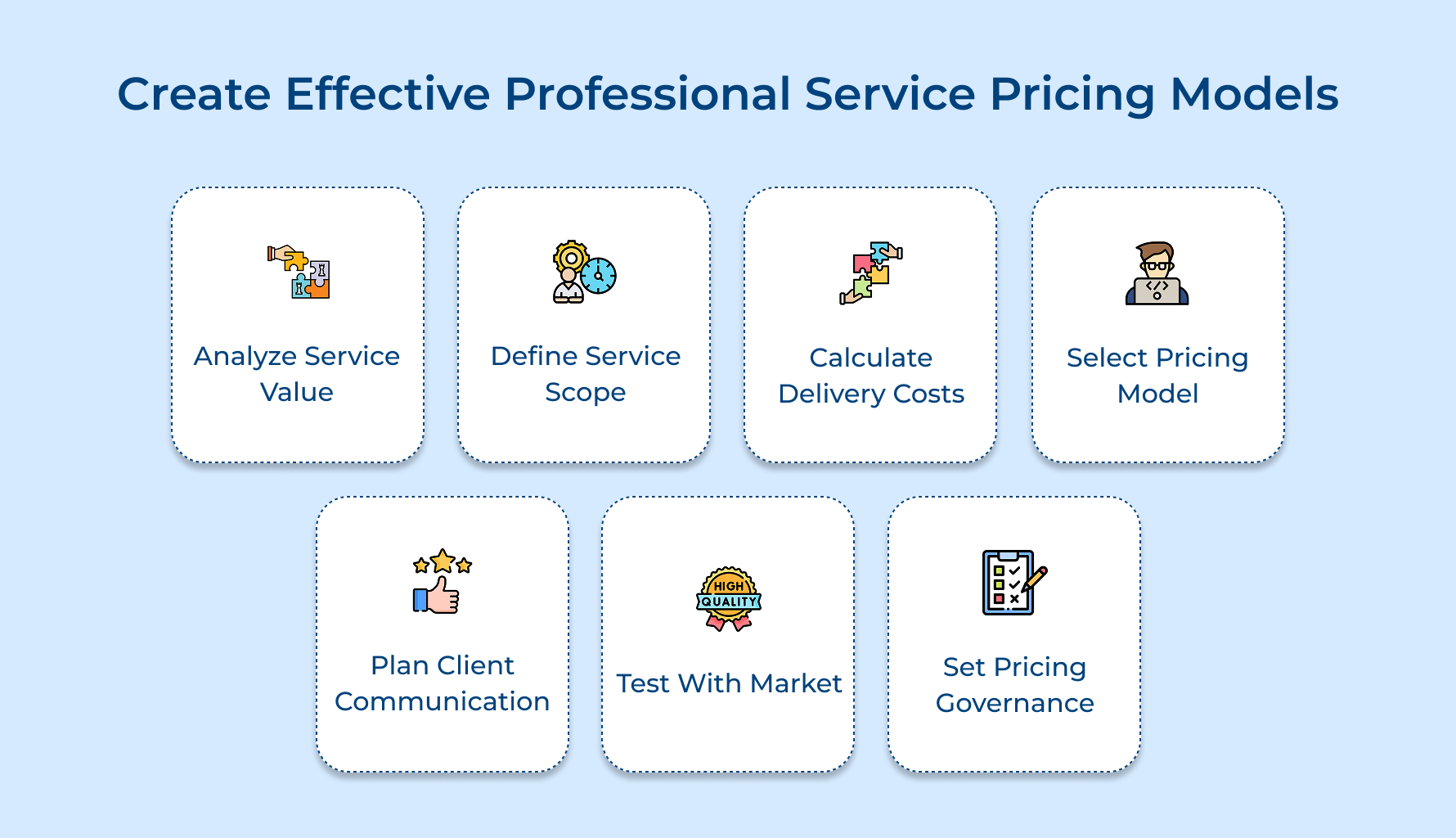
1. Analyze Your Service Value Proposition
Knowing what sets your services apart is key to charging what you’re worth. Without a clear value proposition, business owners often end up in price wars that hurt profits and attract the wrong clients. Instead, define exactly why your services are valuable and to whom.
Here’s how to do that:
- Client interview analysis: Talk to your top five clients. Ask what they value most about your work and which results stood out.
- Competitive benchmarking: Compare yourself to three direct competitors. Look at pricing, expertise, methods, and client success stories.
- Internal capability audit: List your certifications, tools, experience, and team strengths that drive better outcomes.
Once defined, your value proposition becomes your strongest pricing tool. It helps clients focus on results, not rates.
2. Define Clear Service Scope Parameters
Ever had a project spiral out of control with endless tweaks? That’s scope creep and it eats into profit while damaging trust. Setting clear scope boundaries upfront protects both you and your client.
Start by answering:
- What exactly will success look like at the end of this project?
- What tasks fall outside your expertise or offer?
- How will you respond to out-of-scope requests?
Then define these key scope elements:
- Clear deliverables with acceptance criteria
- Timeline with milestones and buffer for changes
- Communication plan (meeting frequency, reports)
- Change process with fees for extra work
Tip: Ask your client what their dream outcome looks like, then map backward to define everything needed to get there.
3. Calculate True Service Delivery Costs
Underpricing often happens because business owners overlook hidden costs. Understanding your true delivery costs including time, tools, admin work, and revisions helps you set prices that protect your margins.
Two ways to make your pricing more accurate:
- Add a 15–20% contingency buffer to account for unexpected issues or extra work.
- Track estimated vs. actual costs on each project. Use the data to improve accuracy and profitability moving forward.
A solid grasp of delivery costs ensures your pricing supports growth, not just survival.
4. Choose Appropriate Pricing Model Structure
Choosing the right pricing structure is about more than preference, it’s a strategic move that affects cash flow, client fit and project success.
Consider these factors:
- Client budget style: Do they want predictable costs or flexibility?
- Project complexity: Are you delivering a clear outcome or ongoing support?
- Risk sharing: Who carries more risk – you or the client?
- Revenue timing: Do you need upfront cash, milestone payments, or can you wait?
For example, a digital agency might charge a flat fee for website builds but use a monthly retainer for ongoing SEO. Align your structure to match both your delivery and your client’s expectations.
5. Develop Client Communication Strategy Framework
Talking about pricing shouldn’t feel awkward. A good communication strategy helps you confidently explain your pricing while showing clients the value they’re getting.
Include these in your proposals:
- Scope breakdown: Clear list of deliverables
- Pricing logic: Explain why your pricing makes sense for the value
- Payment terms: Outline due dates and milestone triggers
- Why this matters: If you’ve ever felt confused reading a vague quote, your clients have too. Transparent pricing materials build trust and speed up approvals.
6. Test Pricing Through Market Validation
Before launching new prices across the board, test them in the real world. Market validation helps you avoid missteps and learn what clients are truly willing to pay.
Try this approach:
- Run pilot pricing with trusted clients. The ones who already value your work and give honest feedback.
- Ask for feedback on clarity, fairness, and value perception. Use questions like:
- Was this within your expected budget?
- What felt confusing or unclear?
- Would you recommend us at this rate?
Use the feedback to adjust. If several clients raise the same concern, it’s a signal worth acting on.
7. Establish Pricing Governance and Review Process
Consistent pricing doesn’t mean rigid pricing. Governance creates structure while allowing room for flexibility when needed.
Here’s how to put it in place:
- Create a pricing committee: Bring in sales, delivery, and finance to review pricing monthly as well as approve exceptions.
- Set up a decision matrix: Define who can approve what, from discount thresholds to custom quotes.
- Schedule quarterly reviews: Analyze metrics like profit margins, win rates and client feedback. Adjust your pricing strategy based on real data.
The challenge? Balancing structure with flexibility. The solution is to define clear rules and clear exceptions so you stay consistent without being stuck.
Emerging Trends in Professional Services Pricing
Here are the emerging trends that forward-thinking organizations are embracing to stay competitive as client expectations and market dynamics continue to evolve.
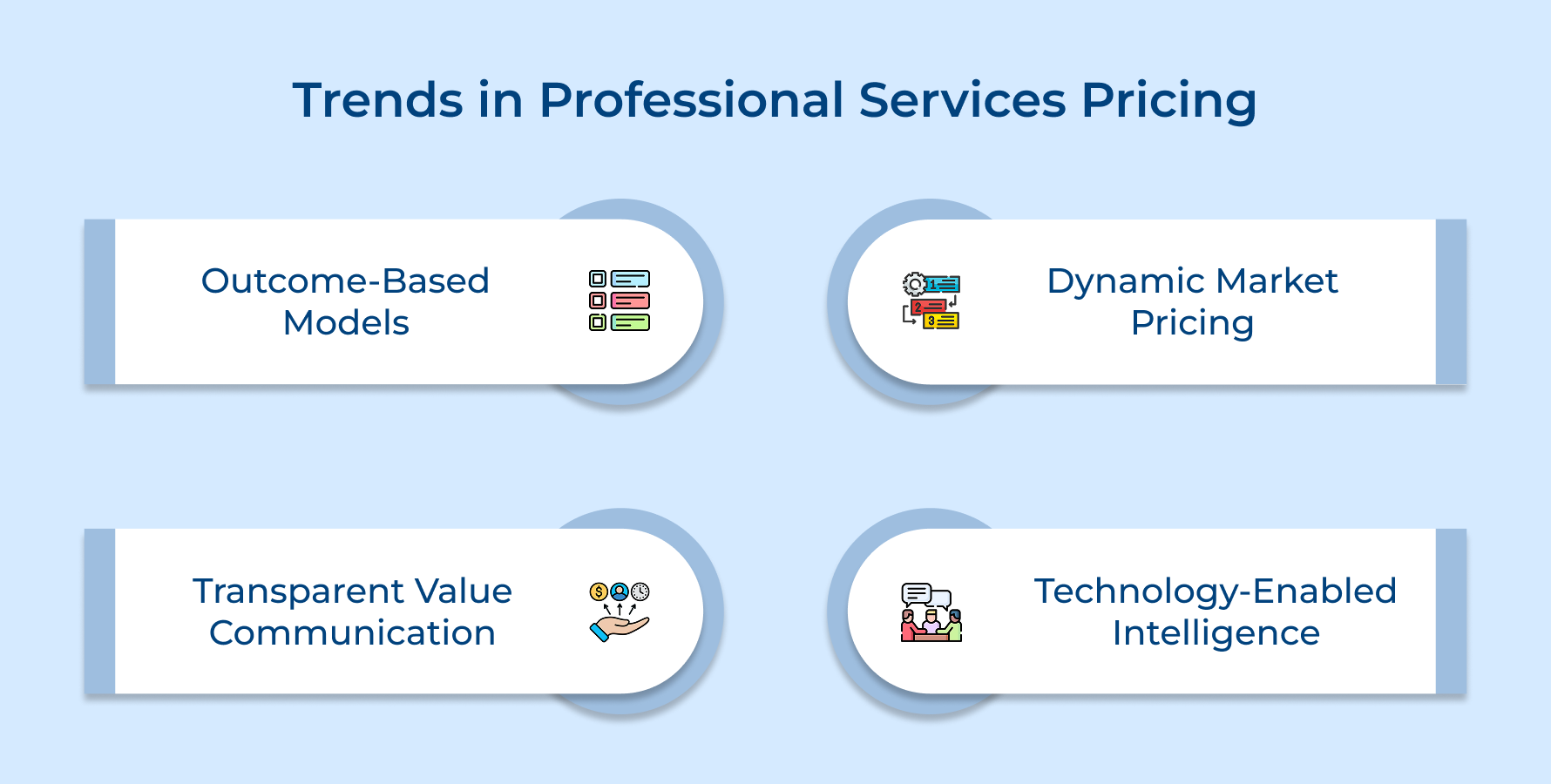
1. Outcome-Based Pricing Models
The old hourly billing model? It’s slowly fading out. More firms are now pricing their services based on results. Clients want to see a clear return on investment, and this model aligns your fees with the business impact you deliver. It’s about getting paid for the value you create, not the clock you watch.
2. Dynamic Pricing Based on Market Conditions
Instead of sticking to rigid rate cards, savvy businesses are adjusting their pricing based on what’s happening in the market. Think surge pricing when demand is high or premium rates for urgent projects. This flexibility helps you stay profitable while adapting to your client’s changing needs and timelines.
3. Transparent Value Communication
Clients don’t want vague line items, they want to know exactly what they’re paying for. That’s why firms are focusing on clear, upfront pricing communication. Breaking down your deliverables and tying them to real outcomes builds trust as well as helps avoid awkward pricing pushbacks.
4. Technology-Enabled Pricing Intelligence
Gone are the days of pricing by gut feeling. With AI and analytics tools, firms can now dive into past project data as well as market insights to make sharper pricing decisions. These tools help you predict true costs, benchmark against competitors, and tailor your pricing for better profits along with happier clients.
Professional Services Pricing Model: The Key to Flexible Pricing
Professional services pricing models have become fundamental business tools rather than optional strategies because they directly address the core challenge of transforming expertise into sustainable revenue. Without structured pricing frameworks, firms struggle to communicate value effectively and often find themselves competing solely on cost rather than outcomes.
When professional services businesses implement thoughtful pricing models, they unlock multiple benefits. First, they improve profitability by capturing the true value of their services. Second, they enhance operational efficiency through more predictable revenue streams. Third, they strengthen client relationships by setting transparent expectations from the start. This well-rounded approach doesn’t just solve short-term challenges, it builds lasting competitive advantages that grow over time.
Limit time — not creativity
Everything you need for customer support, marketing & sales.

Pooja Deshpande is a content contributor at Kooper, focused on creating insightful resources that help agencies and service providers scale efficiently. Passionate about SaaS trends, content strategy, and operational excellence, she delivers practical, easy-to-implement guidance for modern business leaders.