How to Apply Resource-Constrained Scheduling & Avoid Burnout
- What is Resource-Constrained Scheduling (RCS)?
- Key Benefits of Resource-Constrained Scheduling
- Impacts of Resource-Constrained Scheduling
- Resource-Constrained Scheduling vs. Resource Smoothing
- How to Apply Resource-Constrained Scheduling in 7 Simple Steps
- When to Use Resource-Constrained Scheduling?
- Common Challenges in Resource-Constrained Scheduling
- Turn Constraints into Opportunities with Resource-Constrained Scheduling
- FAQs about Resource-Constrained Scheduling

Key Highlights:
- Resource-constrained scheduling builds realistic project plans based on actual capacity, not fantasy availability assumptions.
- Balance workloads, avoid bottlenecks and improve utilization with practical resource-constrained scheduling techniques.
- Discover how limited resources shape timelines, priorities and smarter project decision-making.
You’re building project schedules that look perfect on paper but collapse the moment work begins because everyone is overbooked. Your team is burning out from impossible workloads while deadlines keep slipping no matter how hard everyone pushes to catch up.
The real problem isn’t your team’s effort or commitment but schedules built on fantasy assumptions about unlimited resources. You’re planning as if you can assign five people to ten tasks simultaneously when reality offers far less capacity than needed.
Resource-constrained scheduling solves this by forcing your plans to respect actual availability from the start instead of later. This guide shows you how to build realistic schedules that your team can actually deliver without burning out or missing critical milestones.
What is Resource-Constrained Scheduling (RCS)?
Resource-Constrained Scheduling is a project management technique where you plan tasks based on limited resources available. You can’t do everything at once because you don’t have unlimited people or equipment or budget. So you prioritize and sequence work to make the best use of what you actually have.
Think of it like cooking a big meal with only two burners on your stove. You can’t cook everything simultaneously. Instead you figure out which dishes need the stove first and plan the sequence so everything comes together at the right time without burning anything.
Primary objectives:
- Balance workload across available resources: Spread the work evenly so no one person or machine gets overwhelmed while others sit idle.
- Meet project deadlines despite limitations: Find creative ways to finish on time even when you can’t throw unlimited resources at the problem.
- Avoid resource conflicts and bottlenecks: Prevent situations where multiple tasks compete for the same limited resource at the same time.
- Optimize resource utilization rates: Keep your people and equipment productively busy without overloading them or leaving them underused.
- Maintain realistic and achievable schedules: Create plans that actually work in the real world rather than fantasy timelines that assume infinite resources.
Key Benefits of Resource-Constrained Scheduling
Resource-constrained scheduling might sound limiting but it actually brings serious advantages to your projects. Here’s why working within real constraints makes you a better project manager.
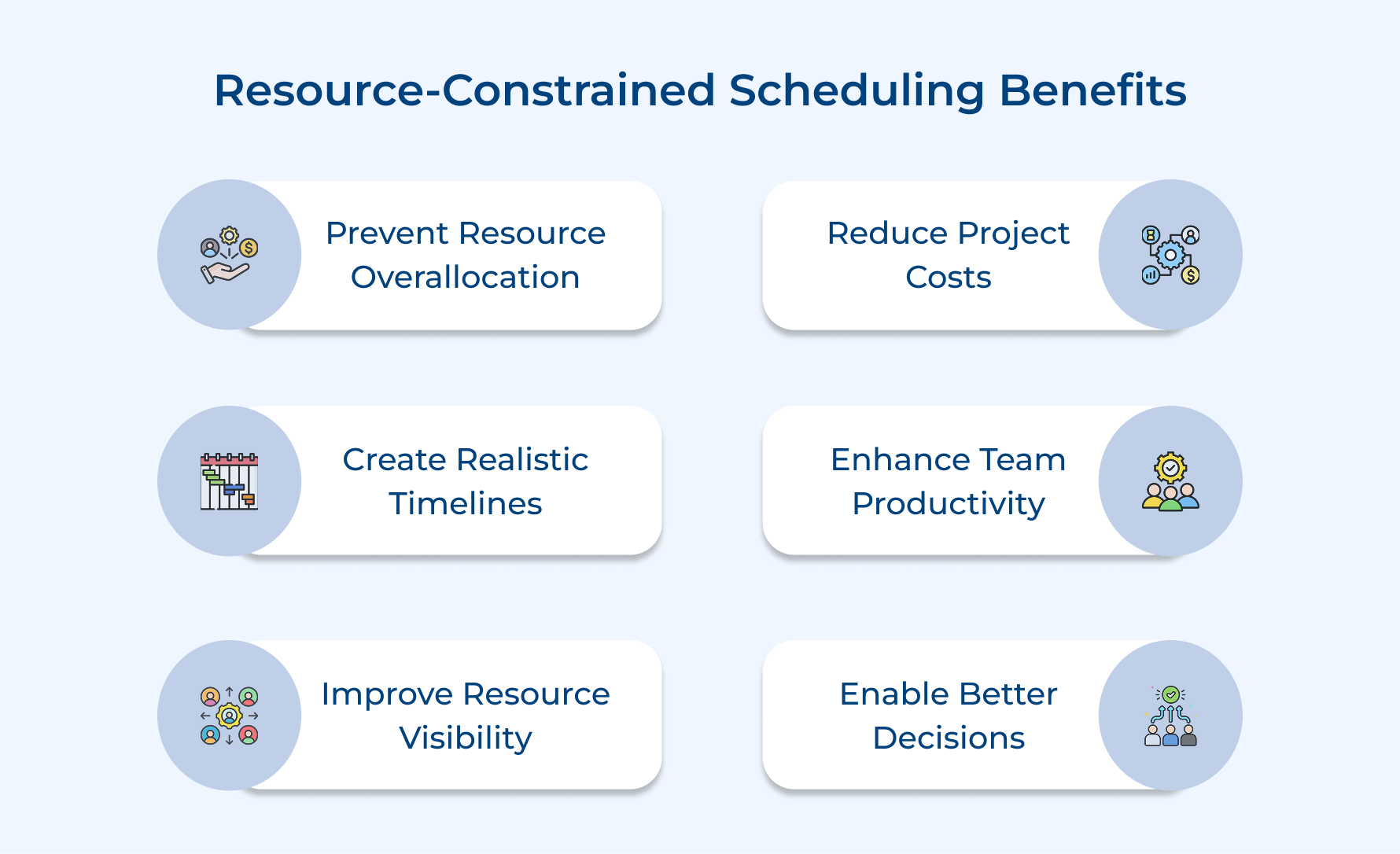
Prevents Resource Overallocation
You avoid the classic mistake of assigning your star developer to five projects simultaneously. The schedule reflects actual capacity so team members can focus properly instead of juggling impossible workloads that lead to burnout and mistakes.
Creates More Realistic Timelines
Your project dates become believable because they’re based on what you can actually do. Stakeholders get honest estimates instead of optimistic fantasies that ignore resource limitations and inevitably fail.
Improves Resource Visibility
You gain clear insight into who’s doing what and when across all projects. This transparency helps you spot problems early and make informed decisions about priorities rather than discovering conflicts too late.
Reduces Project Costs
You eliminate waste from rushed work and expensive last-minute resource additions. Planning around constraints means fewer emergency hires or overtime expenses because you’ve thought through the resource puzzle upfront.
Enhances Team Productivity
People work better when they’re not spread impossibly thin across competing demands. Realistic schedules mean focused effort on fewer tasks which produces higher quality work and keeps morale strong throughout the project.
Facilitates Better Decision Making
You can evaluate tradeoffs clearly when choosing between projects or features. Seeing resource constraints forces honest conversations about what matters most rather than pretending you can do everything at once.
Impacts of Resource-Constrained Scheduling
Resource-constrained scheduling changes how your project unfolds in ways that aren’t always straightforward. Understanding these impacts helps you navigate the tradeoffs that come with working within real limitations.
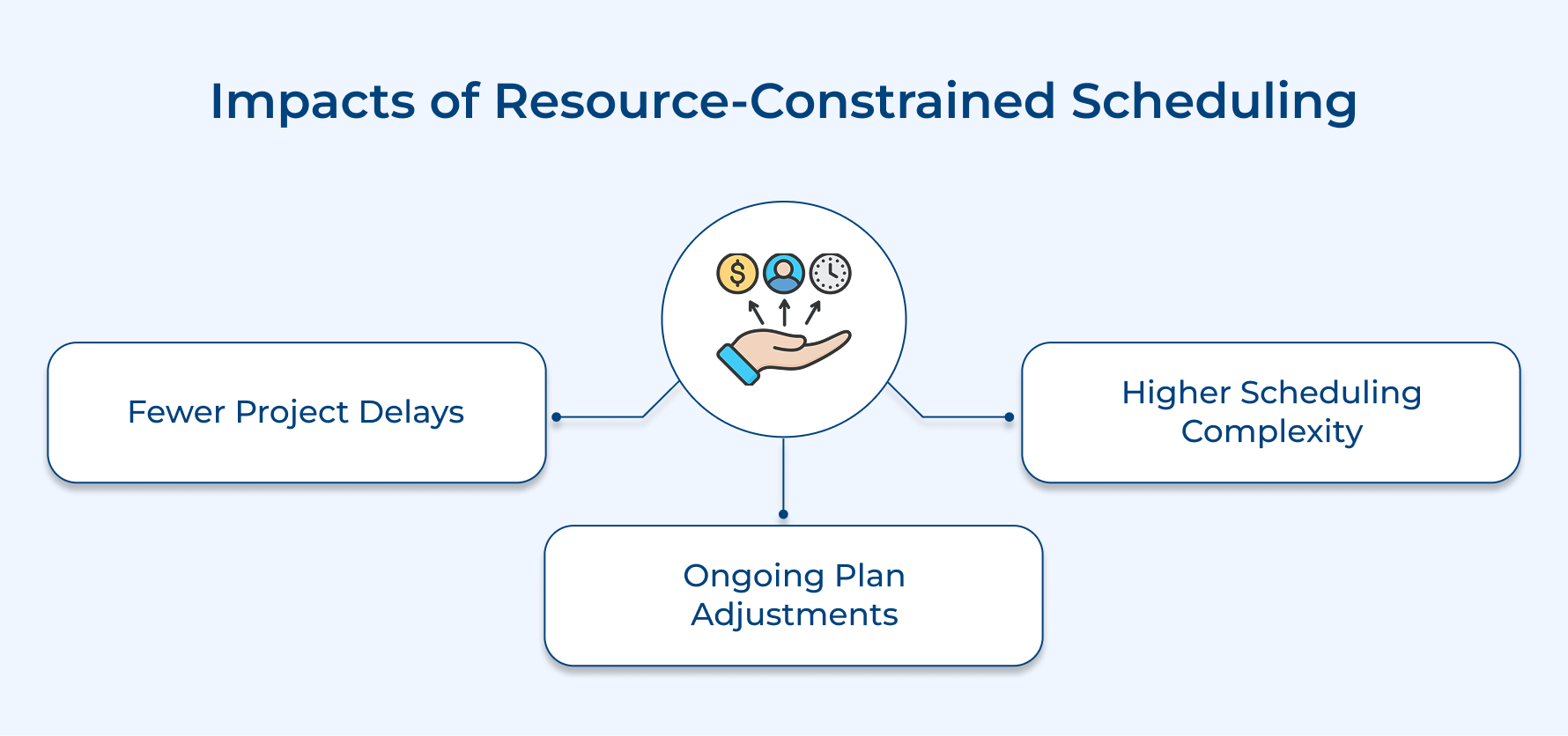
Reduces Project Delays But Lowers Flexibility
Planning around actual resources prevents the chaos of overcommitment that derails schedules. You avoid situations where tasks stall because everyone is overbooked across too many competing priorities.
You lose the ability to shift quickly when priorities change or opportunities emerge unexpectedly. Moving resources around becomes harder because everyone is already allocated to specific tasks with dependencies.
Increases Scheduling Complexity
Creating schedules becomes much harder when you must juggle multiple resource limitations simultaneously. Simple task dependencies now require complex calculations about who’s available and when equipment becomes free.
You need sophisticated tools and techniques to map out feasible schedules that respect constraints. Manual scheduling becomes nearly impossible once you’re managing more than a handful of resources..
Requires Continuous Monitoring and Adjustment
Resource-constrained schedules demand constant attention because real-world changes affect your carefully balanced plan. Team members get sick or equipment breaks down and suddenly your entire schedule needs reworking.
You must actively track resource usage and availability throughout the project lifecycle religiously. What looked perfect on paper three weeks ago might be completely unrealistic given today’s circumstances.
Resource-Constrained Scheduling vs. Resource Smoothing
These two techniques might sound similar but they tackle resource management from opposite angles. Understanding when to use each one can make or break your project timeline.
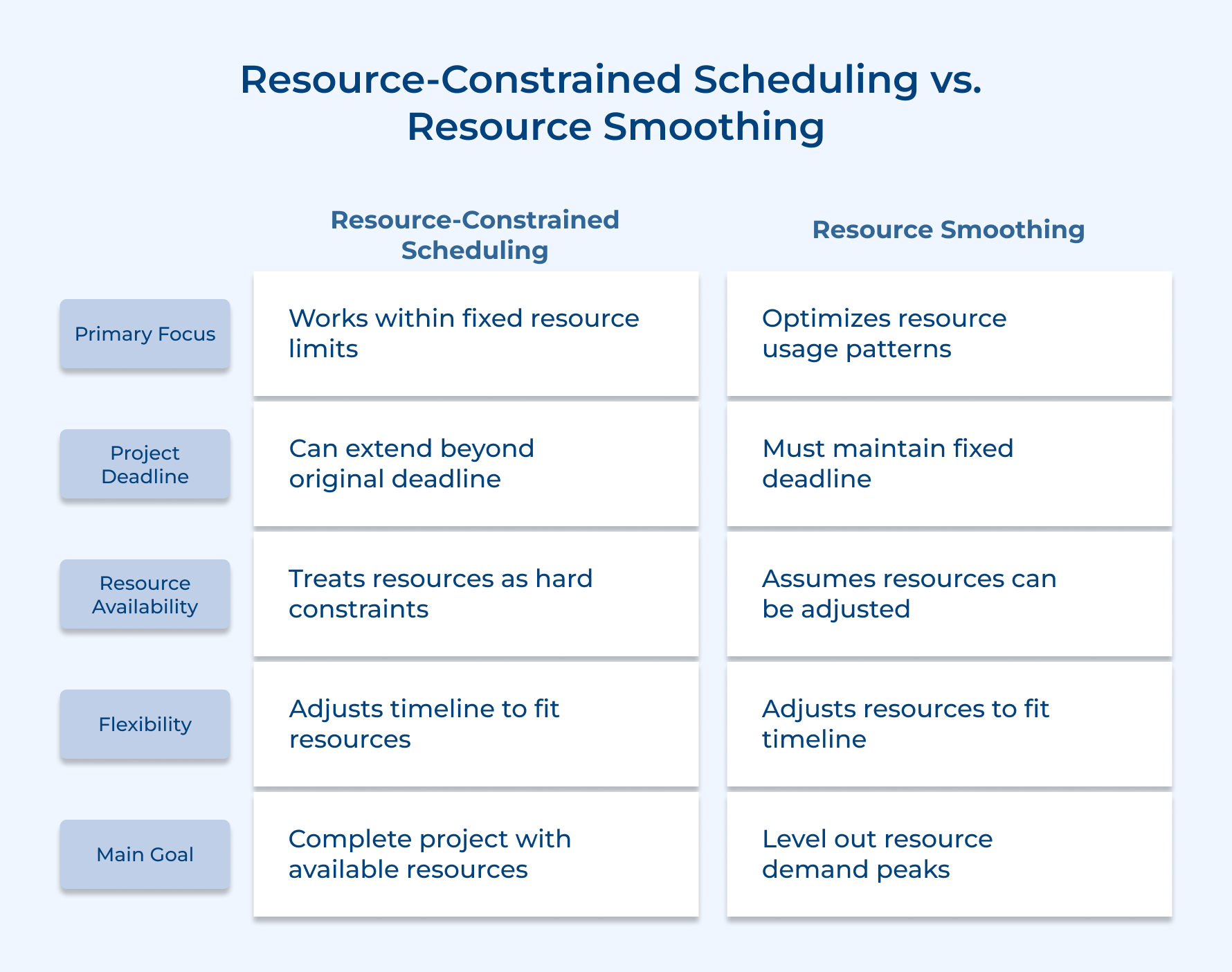
Primary Focus
Resource-constrained scheduling treats your resource limits as non-negotiable boundaries that shape everything else. The entire schedule gets built around what you actually have available right now.
Resource smoothing focuses on evening out the workload so resources aren’t sitting idle one day then overwhelmed the next. It tries to create steady predictable demand without those dramatic peaks and valleys.
Project Deadline
Resource-constrained scheduling might push your deadline further out if that’s what the resource math demands. Meeting the deadline becomes secondary to working within your actual capacity and avoiding overcommitment.
Resource smoothing protects the deadline as sacred and adjusts everything else to hit that date. The end date stays locked while you redistribute work to flatten resource demand.
Resource Availability
Resource-constrained scheduling assumes you can’t get more people or equipment no matter how much you want them. These hard limits force you to sequence work and potentially extend timelines.
Resource smoothing assumes you have some flexibility to bring in additional resources during peak periods if needed. The constraint is softer and more about preference than absolute limitation.
Flexibility
Resource-constrained scheduling gives you a rigid framework where the schedule bends to accommodate fixed resource availability. You rearrange task sequences and accept longer durations to respect those boundaries.
Resource smoothing gives you room to maneuver by adjusting resource levels up or down as needed. You can add people during busy periods or redistribute work to maintain the timeline.
Main Goal
Resource-constrained scheduling aims to deliver the project using only what you have without exceeding capacity limits. Success means finishing the work without overloading anyone even if it takes longer.
Resource smoothing aims to eliminate inefficiency and create predictable steady workloads across the project duration. Success means balanced utilization without wild swings in demand while meeting the deadline.
How to Apply Resource-Constrained Scheduling in 7 Simple Steps
Here’s a simple, step-by-step guide to effectively applying resource-constrained scheduling techniques to keep your projects on track.
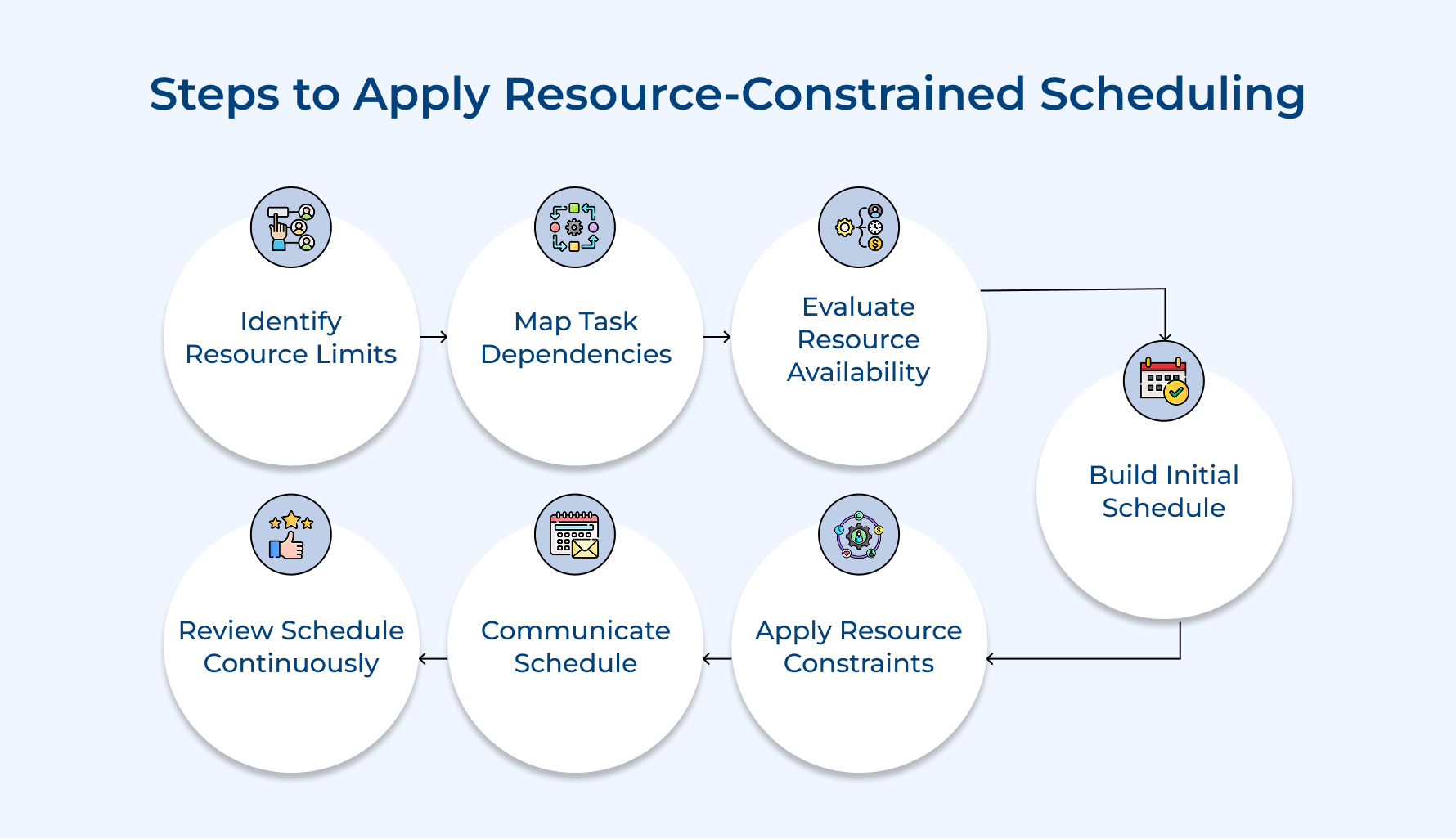
1. Identify All Available Resource Limits
This step involves cataloging every resource you have and understanding exactly how much capacity each one offers. You can’t schedule realistically until you know what you’re actually working with instead of making optimistic assumptions.
Three effective ways to identify resource limits:
- List people, equipment and budget: Start by creating a comprehensive inventory of every team member and their hours plus all physical assets. This gives you a clear picture of your complete resource pool before you begin scheduling tasks.
- Determine maximum capacity per resource: Calculate how much work each resource can actually handle per day or week without burning out. This prevents you from accidentally scheduling someone for twelve hours when they only work eight.
- Note any time-based availability restrictions: Document vacation schedules and equipment maintenance windows or any other periods when resources aren’t available. These time blocks need to be marked off limits in your scheduling process.
For example a software team identifies they have five developers available but one is part-time and another has a two-week vacation planned. Their server environment can only handle three concurrent test deployments which limits parallel work.
Why does this matter so much? Because skipping this step means you’ll build a schedule based on fantasy resources that don’t exist. You’ll commit to deadlines you can’t possibly meet which destroys credibility with stakeholders.
2. Map Task Dependencies and Priorities
This step means figuring out which tasks must happen in a specific order and which ones matter most. Getting dependencies wrong creates chaos because you’ll schedule tasks before their prerequisites are ready.
Five questions to guide your task mapping process:
- Which tasks cannot start until other tasks are completely finished?
- What work can happen simultaneously without creating conflicts or bottlenecks?
- Which deliverables are most critical to project success or client satisfaction?
- Are there any tasks with external dependencies outside your control?
- What happens to downstream work if a particular task gets delayed?
This mapping creates the foundation for your entire schedule by showing you the natural flow of work. You can’t allocate resources effectively until you understand how tasks connect and which ones deserve priority.
Based on these questions you create a dependency network that shows the logical sequence of work. You mark high-priority items that need your best resources and identify parallel paths where multiple teams can work simultaneously.
3. Evaluate Current Resource Availability Levels
This step involves assessing not just how many resources you have but also their actual capability and readiness. Understanding availability means knowing who can do what and when they’re free to do it.
Four key considerations when evaluating resource availability:
- Check team member skill sets: Match people’s actual expertise to the tasks requiring those specific capabilities.
- Review equipment maintenance and usage schedules: Ensure machines or tools are operational and not already committed elsewhere.
- Assess budget allocation across project phases: Verify you have funding available when you need it throughout the timeline.
- Identify resource conflicts with other projects: Determine if your resources are shared with competing initiatives that might claim them.
What if team members are split across multiple projects? Then you need to calculate their actual available hours for your project after accounting for other commitments. A full-time employee might only give you twenty hours per week which changes your entire capacity calculation.
After evaluating availability you’ll know your true resource capacity instead of theoretical maximums that ignore reality. This realistic assessment feeds directly into creating a schedule that actually works because it reflects what you can genuinely deliver.
4. Build Initial Schedule Without Constraint
This step creates an ideal timeline based purely on task dependencies and optimal sequencing without worrying about resources. You’re essentially mapping out the fastest possible path to completion as if you had unlimited capacity.
Ignoring this step means you skip understanding what’s theoretically possible before reality forces compromises on you. Without this baseline you can’t measure the impact of resource constraints or explain to stakeholders why the project takes longer than they hoped.
Three effective ways to build an unconstrained schedule:
- Create an ideal timeline ignoring resource limits: Map out when each task would start and finish if you had perfect resource availability for everything. This shows the absolute minimum duration possible based on dependencies alone without any resource considerations.
- Sequence tasks based only on dependencies: Arrange work in the order it must happen logically where one task feeds into the next. You’re following the natural workflow without thinking about who will do the work or when they’re available.
- Calculate shortest possible project duration: Add up the critical path to determine the theoretical minimum time from start to finish. This number becomes your benchmark for comparing against the resource-constrained version you’ll create next.
So why bother with this fantasy schedule? Because it gives you a negotiating tool when stakeholders push back on your realistic timeline. You can show them the gap between ideal and achievable which helps them understand the cost of resource limitations.
5. Apply Resource Constraints to Schedule
This step transforms your ideal schedule into a realistic one by forcing it to respect actual resource availability. You’re essentially taking the perfect timeline and bending it to fit the real world limitations you identified earlier.
Adjust Tasks Based on Resource Availability
You shift task start dates forward when the required resources aren’t free at the optimal time. This means some work gets delayed until people or equipment become available even though dependencies would technically allow earlier starts.
Resolve Conflicts Where Resources Are Overallocated
You identify moments where your schedule assigns the same person or equipment to multiple tasks simultaneously. Then you reschedule one of those tasks to a different time slot to eliminate the impossible double-booking situation.
Extend Timeline to Match Realistic Capacity
You accept that the project will take longer than the unconstrained schedule showed because resources limit parallelization. Tasks that could theoretically happen together must now happen sequentially because you don’t have enough capacity to do both at once.
6. Communicate Schedule to All Stakeholders
This step involves sharing your resource-constrained schedule with everyone affected and getting their buy-in before execution begins. Ignoring this creates chaos because team members won’t know their assignments and sponsors might reject timelines they never agreed to.
You use the schedule as a communication tool to align expectations across the entire project ecosystem. Everyone sees what work happens when and understands why resource limitations require the specific timeline you’ve created.
Pro tips:
- Present the unconstrained schedule alongside the constrained version to show stakeholders the impact of resource limits.
- Document all resource assumptions in your communication so people understand what could change the schedule later.
7. Review and Monitor Schedule Continuously
This step means actively tracking how your schedule performs against reality and making adjustments as conditions change. Continuous monitoring is essential because resource availability shifts and tasks take different amounts of time than estimated which can derail your carefully balanced plan.
You track specific metrics that reveal whether resources are being used as planned and if the schedule remains feasible. These measurements give you early warning signs when problems emerge so you can respond before small issues become project-killing disasters.
Key metrics for monitoring resource-constrained schedules:
- Resource utilization rates
- Schedule variance
- Critical path changes
- Resource availability changes
Based on these insights you adjust the schedule when circumstances change because rigid adherence to an outdated plan guarantees failure. You’re responding to reality instead of pretending your original schedule remains valid despite changed conditions.
- Reassign tasks to different resources: Move work to available team members when the originally assigned person becomes unavailable unexpectedly.
- Reschedule non-critical tasks: Push lower priority work later to free up resources for critical path items that are falling behind.
- Request additional resources if possible: Escalate to management for temporary capacity increases when delays threaten essential project deliverables.
When to Use Resource-Constrained Scheduling?
Resource-constrained scheduling isn’t always necessary but certain project situations demand this approach. Recognizing these scenarios helps you choose the right scheduling method from the start.

Limited Availability of Resources
You should use resource-constrained scheduling when your team size or equipment is fixed and cannot be expanded regardless of deadlines. This situation forces you to sequence work carefully because throwing more resources at the problem simply isn’t an option available to you.
Multiple Projects Sharing Resources
Resource-constrained scheduling becomes essential when the same people or equipment must serve several projects simultaneously without dedicated allocation. You need to coordinate across initiatives to prevent conflicts and ensure each project gets its fair share of limited capacity.
Flexible Project Timelines
This approach works best when deadlines can move based on resource availability rather than being locked in stone. You have the freedom to extend schedules to match capacity which allows you to optimize resource usage without the pressure of unmovable dates.
High-Demand Specialized Skills
Use resource-constrained scheduling when your project requires experts with rare skills who are constantly in demand across the organization. These bottleneck resources need careful allocation because they determine your entire project pace and can’t be easily substituted or supplemented.
Budget Limitations
Resource-constrained scheduling is necessary when you can’t afford to hire additional staff or rent more equipment to meet aggressive timelines. Your financial constraints become resource constraints which means the schedule must adapt to what you can actually fund throughout the project.
Predictable Resource Patterns
This method suits situations where you know resource availability patterns well in advance like seasonal businesses or academic environments with fixed terms. You can plan around these predictable limitations to create realistic schedules that align with known capacity fluctuations throughout the year.
Common Challenges in Resource-Constrained Scheduling
Resource-constrained scheduling delivers real benefits but also comes with significant hurdles. Understanding these challenges helps you prepare for them rather than getting blindsided mid-project.
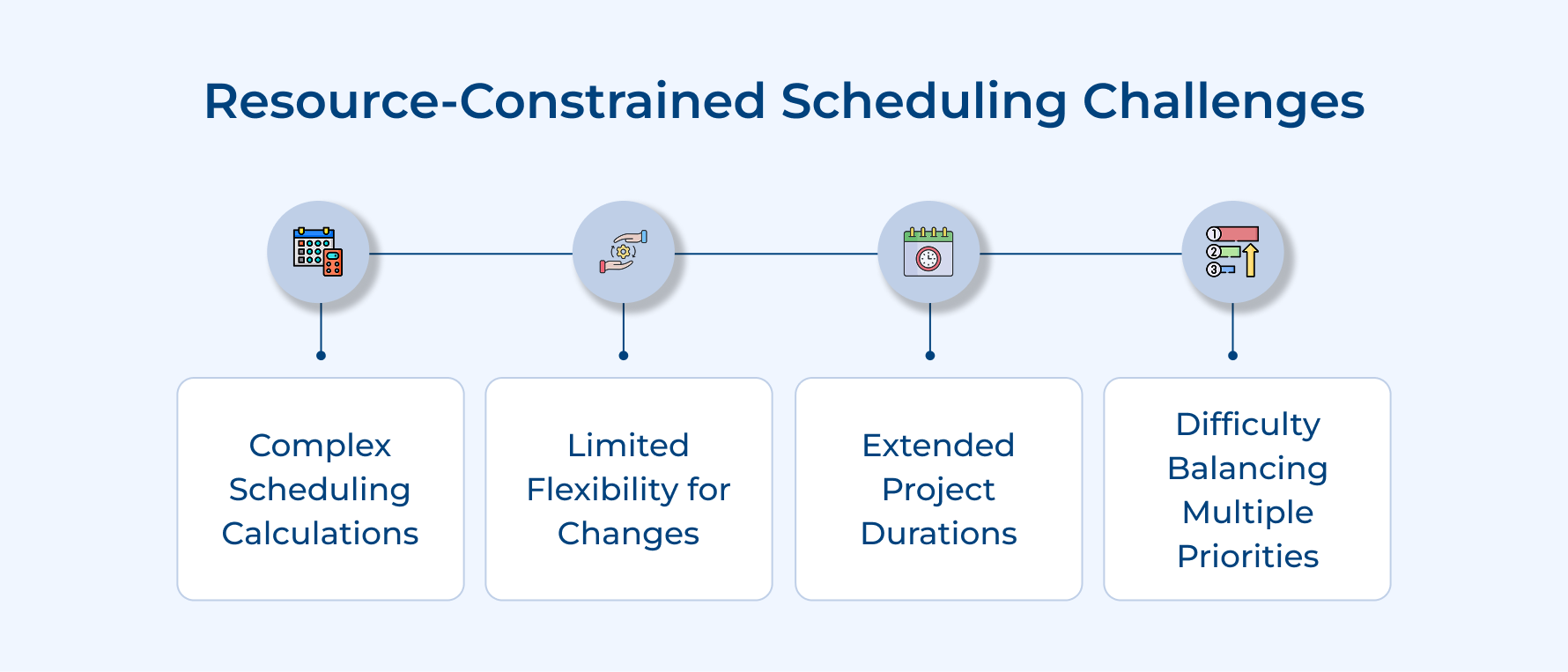
Complex Scheduling Calculations
Creating a resource-constrained schedule requires juggling multiple variables simultaneously including dependencies and priorities as well as availability. The mathematical complexity grows exponentially with project size which makes manual scheduling nearly impossible.
Limited Flexibility for Changes
Your carefully balanced schedule becomes fragile when resources are fully allocated with no slack built in. A single unexpected absence can trigger a cascade of rescheduling because you have no spare capacity.
Extended Project Durations
Resource constraints often push completion dates much further out than stakeholders expect based on the work itself. This timeline extension frustrates clients who struggle to understand why projects take so long.
Difficulty Balancing Multiple Priorities
You constantly face impossible choices about which tasks get limited resources when multiple high-priority items compete. These trade-off decisions create tension with stakeholders who all believe their needs should come first.
Here are practical strategies that help you navigate these obstacles and keep your projects on track:
- Invest in project management software that automates complex resource calculations and conflict detection.
- Build buffer time into schedules for critical resources to absorb unexpected disruptions.
- Set stakeholder expectations early about realistic timelines given actual resource availability.
- Establish clear prioritization criteria with leadership so resource allocation follows agreed-upon business rules.
- Cross-train team members on multiple skills to create flexibility when resources become unavailable.
Turn Constraints into Opportunities with Resource-Constrained Scheduling
Resource-constrained scheduling forces you to face reality instead of building fantasy timelines that inevitably fail. This honest approach creates schedules you can actually deliver which builds trust with stakeholders and teams.
Start applying these techniques to your next project and watch how constraints sharpen your planning skills. You’ll make better decisions about priorities and discover creative solutions you’d never consider if resources felt unlimited as well as readily available.
Limit time — not creativity
Everything you need for customer support, marketing & sales.

Neeti Singh is a passionate content writer at Kooper, where he transforms complex concepts into clear, engaging and actionable content. With a keen eye for detail and a love for technology, Tushar Joshi crafts blog posts, guides and articles that help readers navigate the fast-evolving world of software solutions.